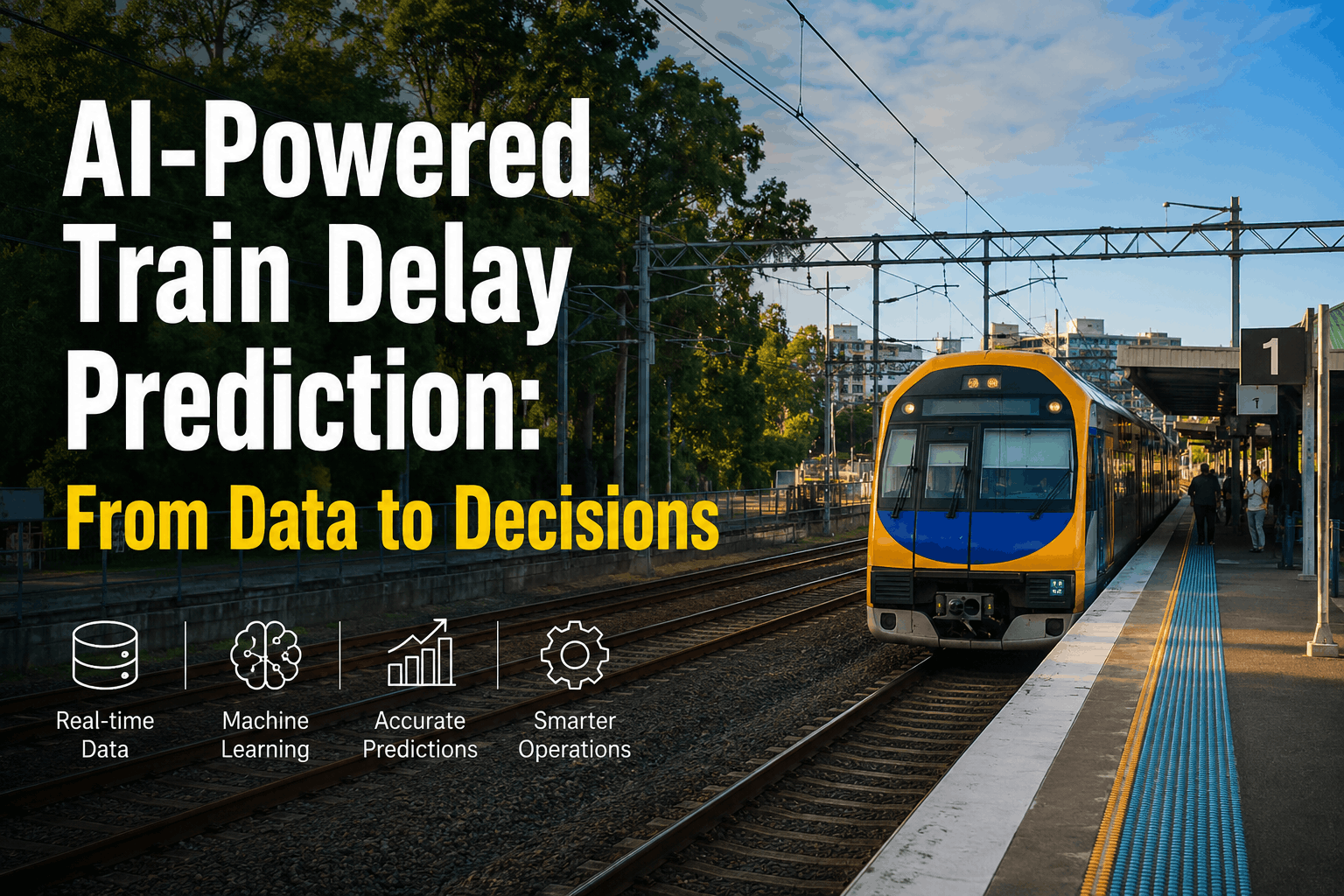
For rail networks, a single 2-minute delay at a critical junction isn't an isolated event—it's a "Network Contagion" that can propagate across hundreds of kilometers, resulting in thousands of hours of lost productivity. This is known as the "Secondary Delay Spiral," where the cumulative impact of a minor fault exceeds the original incident's duration by 5x. AI train delay prediction changes the paradigm by shifting from reactive logging to proactive network simulation. By integrating real-time infrastructure health data with historical delay patterns, iFactory’s AI platform predicts potential bottlenecks up to 4 hours in advance. This allows dispatchers to perform "Micro-Rescheduling" before the network reaches a state of cascading failure. Book a Comprehensive Network Audit to eliminate the friction from your timetable.
Digitize Your Network Flow & Eliminate Delay Propagation
Deploy AI-powered delay forecasting to predict timetable friction, optimize junction slots, and ensure 99.5% arrival accuracy across your entire rail corridor.
The Technical Architecture of Predictive Rail Timetabling
Railway networks are inherently complex Graph Systems where every node (station/junction) is linked by time-sensitive edges (tracks). AI train delay prediction infrastructure utilizes Graph Neural Networks (GNN) to model these interdependencies. This railway delay guide reveals how digital oversight allows for "Conflict Resolution" before trains even reach a junction, ensuring that proactive rail management preserves the network's slot yield. Schedule a Demo to see real-time delay modeling in action.
Effective rail delay monitoring requires the ingestion of "Multi-Modal Data Streams." iFactory combines Train Describer (TD) data, weather telemetry, and infrastructure health metrics (such as active speed restrictions) to create a "Probability Surface" for every train on the map. By digitizing rail operational assessment, dispatchers can move beyond static rules-of-thumb to data-driven decision making, reducing "Primary Delays" by 25% through early-intervention maintenance and slot re-allocation.
Four Critical Data Layers for Delay Prediction
Predicting a delay is about more than just tracking a train's position. iFactory predictive rail analytics monitors the four primary drivers of network friction. Book a Lifecycle Review.
Infrastructure Health & TSR (Temporary Speed Restrictions)
Track faults lead to unplanned speed restrictions. iFactory's EAM platform feeds these "Slow Zones" directly into the prediction engine to adjust arrival times with meter-level precision.
Real-time Train Describer (TD) & GPS Position
Continuous sub-second tracking of every asset. We use Kalman Filters to predict a train's trajectory and identify "Slow-Running" precursors caused by rolling stock fatigue.
External Environmental & Weather Telemetry
High winds and extreme heat impact rail expansion and braking distances. Our AI overlays weather maps to predict "Weather-Induced Latency" across the network.
Historical Pattern Recognition (Big Data)
Analyzing 10 years of historical delay data. iFactory identifies "Hidden Bottlenecks" where certain junctions underperform during peak loads, allowing for structural timetable redesign.
The Economic Impact of Predictive Rescheduling
The financial impact of train delay is exponential. For every minute of primary delay, the associated cost (in fines, lost productivity, and fuel) can grow by $5,000 across a busy corridor.
| Operational Strategy | Delay Horizon | Primary Delay Save | Secondary Delay Save | Decision Speed | Est. Annual Savings |
|---|---|---|---|---|---|
| Reactive Log & Patch | Post-Incident | 0% | 0% | Minutes | $0.0M (Baseline) |
| Rule-Based Automation | 5–10 Mins | 10% | 15% | Seconds | $4.2M (Static) |
| AI Predictive Forecasting | 2–4 Hours | 35% | 50% | Milliseconds | $18.5M (Dynamic) |
| Network Synchronized AI | Full Timetable | 50% | 75% | Autonomous | $28.2M (Maximum) |
Utilizing a predictive rail schedule allows for "Elastic Timetabling," where the network can stretch and contract in response to real-time events without breaking the core service obligation.
Key Metrics for Network Flow Optimization
To achieve true network flow mastery, our platform tracks five interconnected performance indicators. Book a Demo to see live network metrics.
1. Delay Propagation Index (DPI)
The ratio of secondary delays to primary delays. iFactory aims to keep this below 1.5, ensuring that incidents are localized and resolved quickly.
2. Junction Occupancy Yield (JOY)
Calculates the percentage of available capacity utilized at critical nodes. AI optimization identifies "Dead Time" between trains that can be harvested for extra paths.
3. Mean Absolute Percentage Error (MAPE)
The core accuracy metric for our prediction engine. We maintain a sub-5% MAPE for arrival predictions within a 60-minute window.
4. Recovery Time Objective (RTO)
The time taken to return the network to the "Planned Timetable" after a major incident. AI-rescheduling reduces RTO by up to 40%.
5. Energy-Efficient Rescheduling (EER)
Optimizes train speeds during delays to minimize regenerative braking loss and traction energy spikes, reducing operational fuel costs.
A Perspective from the Control Room
Implementing iFactory’s prediction engine has transformed the daily operations of one of the world's busiest rail hubs.
"Before iFactory, our dispatchers were fighting fires. They’d react to a delay once the train had already stopped. Now, we’re seeing the fire before the first puff of smoke. The AI warns us that a freight train's speed is dropping 20 miles away, allowing us to move a following express train to a parallel track before the bottleneck forms. We've seen a 30% reduction in passenger compensation claims and our staff stress levels have dropped significantly. It’s like having a crystal ball for the entire network."
Head of Network Operations, Regional Rail Authority
Frequently Asked Questions
Below are the most common questions regarding AI train delay prediction.
How can AI predict a delay caused by an unplanned mechanical failure?
While we can't predict a random mechanical snap, we can predict its 'Network Impact' the millisecond it happens. Furthermore, iFactory’s predictive maintenance module often identifies 'Precursor Vibrations' in rolling stock that allow us to pull a failing train into a siding before it causes a mainline blockage.
Does the system require new GPS hardware on all trains?
No. iFactory is designed to leverage your existing Train Describer (TD) and signaling data feeds. We overlay this with any available GPS or V2X data to increase precision, but the core engine can operate on legacy infrastructure data alone.
How does the system handle 'Knock-on' delays at junctions?
This is our core strength. Our Graph Neural Network (GNN) simulates the entire junction's topology. It identifies 'Conflict Points' where a delayed train will overlap with another train's path and automatically suggests the optimal sequence to minimize the total network delay.
What is the direct impact on passenger satisfaction scores?
By providing 95% accurate arrival data to passenger apps 2 hours in advance, we eliminate the frustration of 'Ghost Delays.' Passengers can adjust their plans before reaching the station, significantly improving Net Promoter Scores (NPS).
How long does it take for the AI to learn our network's specific characteristics?
We typically ingest 12–24 months of historical delay logs to train the baseline model. After a 30-day 'Shadow Mode' period where the AI runs alongside your human dispatchers, the system is ready for full operational support.
Ready to Eliminate Timetable Friction?
Predict delay propagation, optimize junction slots, and ensure 100% network flow with iFactory Predictive Analytics.