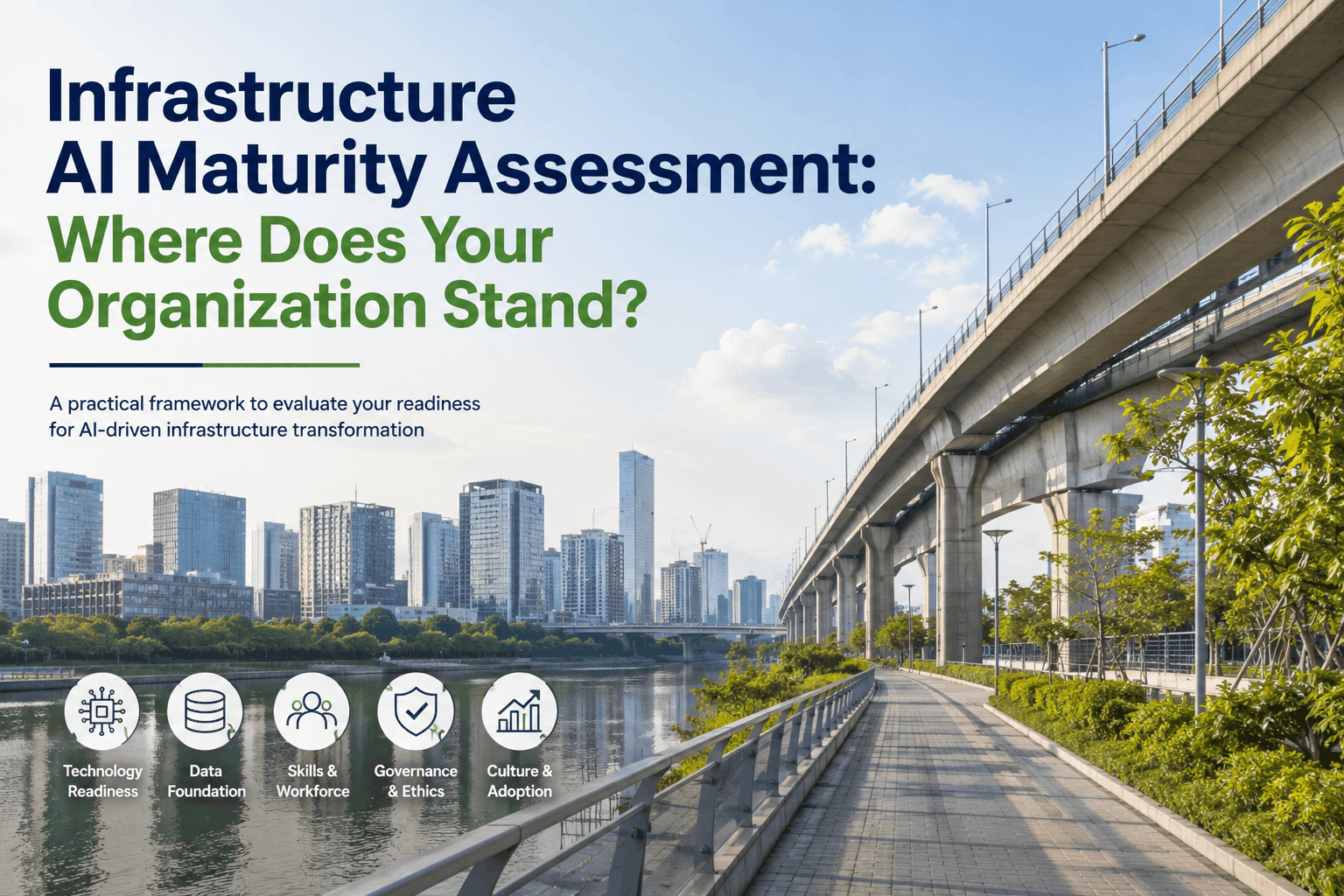
As infrastructure authorities globally race to adopt artificial intelligence, a critical divide has emerged between those achieving transformative ROI and those trapped in permanent pilot cycles. This divide is defined by the "Intelligence Latency" of the organization—the speed at which raw asset data is converted into actionable reliability decisions. An infrastructure AI maturity assessment is no longer a theoretical exercise; it is a diagnostic necessity for any municipal or national authority planning a 5-year capital strategy. In 2025, maturity is not measured by the number of sensors you have deployed, but by the degree to which your AI platform can perform causal inference and autonomous precursor detection without human intervention. If your current "AI" platform still requires manual data cleansing and results in a 4-hour reporting delay, your organization is likely at Level 1 maturity, carrying significant "Hidden Risk" and uncaptured OPEX savings. To see where your network sits on the iFactory AI maturity curve, Schedule Your Free Demo for a structured readiness audit today.
The 4 Levels of Infrastructure AI Maturity
Mapping the Journey from "Fix-it-When-it-Breaks" to "Autonomous Health"
To build a successful infrastructure AI maturity assessment, organizations must evaluate their position across four distinct stages of evolution. Most authorities discover that while they have invested in IoT sensors (Level 2), their actual decision-making logic remains trapped in Level 1 "Reactive" patterns. This "Capability Gap" is where multi-million dollar budget inefficiencies reside. iFactory’s platform is designed to bridge this gap, moving your teams from observing data to understanding causality. Schedule Your Free Demo for a custom gap analysis.
The Infrastructure AI Readiness Scorecard
Evaluating Your Organization Across 5 Critical Dimensions
A true ai asset management strategy requires alignment across data, technology, and culture. Use the scorecard below to evaluate your current readiness. Organizations that score high on "Data Latency" but low on "Causal Intelligence" often struggle with ROI, as they have the data but no mechanism to act on it with precision.
| Maturity Dimension | Level 1 (Reactive) | Level 3 (iFactory) | Organizational Impact |
|---|---|---|---|
| Data Latency | Hours / Days | Sub-Second (< 200ms) | Instant Response Velocity |
| Health Visibility | Periodic Inspection | Continuous Modeling | Elimination of 'Blind Zones' |
| Failure Logic | Correlation-Based | Causal Physics-Informed | Zero False Positives |
| CMMS Integration | Manual Entry | Automated AI Triggers | 40% Labor Efficiency Gain |
| Audit Readiness | Weeks of Prep | Continuous Digital Log | 90% Reduction in Audit Hours |
The Cultural Shift: Moving from Firefighting to Reliability Engineering
Why Technology is Only 50% of the Maturity Assessment
The highest-maturity organizations (Level 3 and 4) are defined by a shift in personnel mindset. In a Level 1 organization, the "Hero" is the technician who fixes a major burst at 3 AM. In a Level 4 organization, the "Hero" is the reliability engineer whose AI models identified the precursor 14 days ago, allowing for a planned repair during standard hours without any service disruption. This shift requires a robust ai maintenance platform like iFactory that provides teams with the confidence to trust predictive signals. When your crews move from "Searching for Faults" to "Verifying AI Insights," your tool-time and morale both skyrocket. Authorities who want to benchmark their team's cultural readiness can Book a Demo for a structured stakeholder audit.
"Our maturity assessment was a wake-up call. We thought having dashboards meant we were 'AI-Ready,' but iFactory showed us that our 4-hour data latency was costing us $2.2M annually in missed precursor signals. By moving to Level 3 maturity, we've transformed our maintenance team from a cost center into a strategic reliability engine. We've seen a 28% reduction in lifecycle costs across our bridge portfolio in just 12 months."
Director of Innovation, National Transport Authority
Frequently Asked Questions
What is an infrastructure AI maturity assessment?
It is a structured evaluation of your organization's readiness to adopt AI across five dimensions: Data Infrastructure, Asset Visibility, Causal Intelligence, Operational Integration, and Cultural Readiness. It helps you identify the "Capability Gaps" that are preventing you from achieving ROI.
Why is data latency critical for AI maturity?
In infrastructure, "Latency is Cost." If your AI is analyzing data that is 4 hours old, you have already missed the window for low-cost intervention. Maturity is defined by sub-second ingestion and sub-90-second predictive signaling.
How does iFactory help organizations move from Level 1 to Level 3?
We provide the unified data ingestion layer and the physics-informed causal models that convert raw sensor streams into actionable intelligence. We eliminate the "Data Silos" that keep organizations trapped in reactive patterns, providing a clear path to predictive reliability.
What is "Causal AI" and why is it required for Level 4 maturity?
Standard AI looks for patterns (correlation). Causal AI looks for *reasons* (physics). To autonomously optimize a city's energy grid or water network, the AI must understand the causal physics of the asset to prevent catastrophic failure while maximizing through-put.
How long does it take to advance one level on the maturity curve?
With iFactory, organizations can move from Level 1 (Reactive) to Level 3 (Predictive) within 12-24 weeks. The technology can be deployed in under 12 weeks; the remaining time is focused on integrating the AI signals into existing CMMS workflows and training the reliability teams.
Does maturity require a complete overhaul of our current systems?
No. Maturity is about "Layering Intelligence." iFactory is designed to ingest data from your legacy GIS, SCADA, and IoT systems. We add the "Intelligence Layer" on top of what you already have, converting your current data debt into a strategic health asset.
What is the ROI of moving from Level 1 to Level 4?
Organizations at Level 4 maturity consistently report a 30%+ reduction in lifecycle costs, a 45% reduction in emergency repairs, and a 22-34% CapEx deferral through health-driven lifecycle extension. The financial impact is measured in millions of dollars of recovered budget annually.
How can I get a formal maturity assessment for my organization?
iFactory offers a structured 10-day maturity audit for municipal and national authorities. Our industrial intelligence team will audit your current data silos, response latencies, and technical readiness, delivering a comprehensive 5-year ROI roadmap. Schedule Your Free Demo to begin.