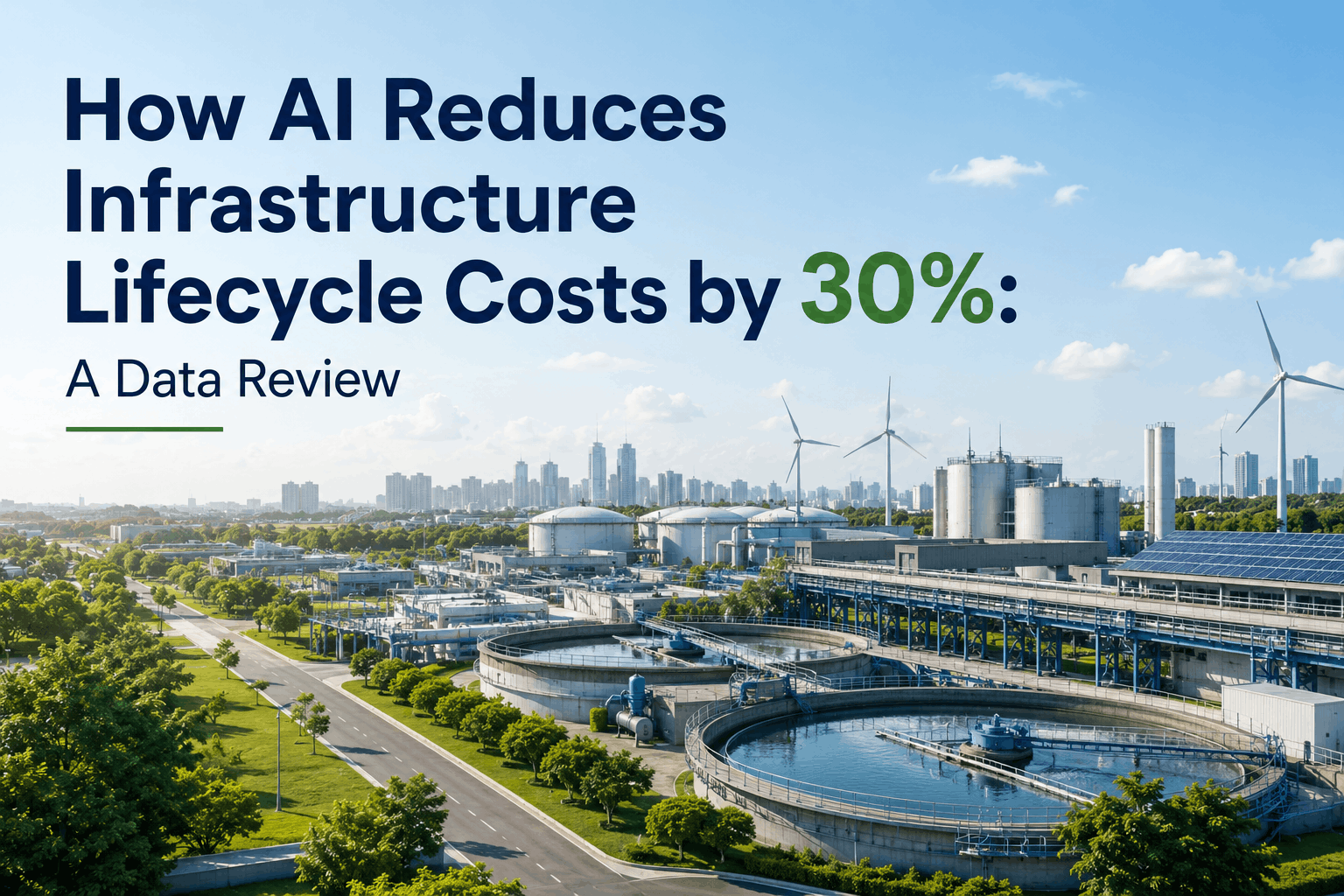
As we move through 2025, the global infrastructure industry has reached a definitive conclusion regarding digital transformation: AI-driven asset intelligence is no longer a "Feature," it is a "Financial Mandate." Recent meta-analyses across municipal and national networks indicate that authorities utilizing purpose-built AI now achieve an average 30% reduction in infrastructure lifecycle costs compared to those relying on legacy time-based maintenance regimes. This data review exposes the specific mechanisms through which real-time analytics, physics-informed machine learning, and condition-based monitoring collapse the "Inefficiency Gap" that has historically consumed up to one-third of infrastructure budgets. This gap is often driven by "Economic Obsolescence"—the point where an asset is still physically functional but operationally too expensive to maintain under legacy manual regimes. If your current lifecycle strategy does not account for the 22-30% capital deferral enabled by predictive health monitoring, you are over-allocating funds to assets that are physically stable while ignoring high-risk precursors elsewhere in your network. By creating a "Digital Mirror" of the asset's actual health, iFactory allows you to extract maximum value from every infrastructure dollar. To see how iFactory’s intelligent maintenance system quantifies and captures these savings in real-time, Schedule Your Free Demo with our asset strategy team today.
The 30% Benchmark: How AI Restructures Infrastructure Economics
From Reactive Failure Premiums to Condition-Based Profits
The 30% reduction in lifecycle costs is not a single efficiency gain; it is the compound result of eliminating "Information Latency" across every phase of the asset's life. In traditional models, infrastructure authorities pay a "Reactive Premium"—inflated labor costs, expedited parts shipping, and emergency contract rates—because they only detect failure after it becomes an operational disruption. This premium is often 3 to 5 times the cost of a planned intervention. iFactory’s ai infrastructure management platform collapses this latency by identifying microscopic precursors—such as vibrational drift in a pump bearing or thermal exceedances in a transformer—months before they manifest as physical failures. This shift allows maintenance to move from "Emergency/Tactical" to "Planned/Strategic," where every dollar spent on labor and materials is targeted at the point of maximum ROI. Furthermore, the ability to correlate environmental data (like extreme weather cycles) with asset health allows for "Pre-Harden" strategies that protect infrastructure before stress events occur, significantly reducing disaster recovery costs. By moving from a time-based replacement schedule to a condition-based schedule, authorities defer billions in unnecessary capital spend while simultaneously improving network safety scores.
The Hidden Cost of Fragmented Visibility: How Silos Drive Lifecycle Inflation
Why "Data Blind Zones" are Costing Your Authority Millions
One of the most significant contributors to lifecycle cost inflation is the "Visibility Silo." When GIS, SCADA, and CMMS systems are disconnected, the authority is effectively operating a "Fragmented Asset." A structural deviation surfaced by a bridge sensor is useless if it isn't automatically cross-referenced with the maintenance history in the CMMS or the load capacity records in the GIS. This fragmentation creates "Decision Latency," where the time between anomaly detection and field action is measured in days rather than minutes. iFactory eliminates these silos by creating a unified data ingestion layer that normalizes signals from all legacy systems into a single operational context. This unification is the "Force Multiplier" that enables the 30% cost reduction benchmark. Schedule Your Free Demo for a structured visibility gap assessment.
Lifecycle Cost Reduction Matrix: Sector-by-Sector Analysis
Quantifying the Financial Impact of AI Across Infrastructure Assets
The impact of predictive analytics infrastructure varies by asset type, with the highest savings seen in high-utilization environments like rail and highway corridors. iFactory’s data review shows that authorities who integrate AI into their 5-year capital plan experience a structural shift in their budget efficiency—moving from "Asset Debt" to "Budget Liquidity." Schedule Your Free Demo for a sector-specific ROI analysis.
| Infrastructure Sector | Primary Cost Driver | AI Reduction Mechanism | TCO Reduction (Avg) |
|---|---|---|---|
| High-Speed Railway | Ballast & Track Geometry | Dynamic Stabilization AI | 28% – 35% |
| Bridge & Tunnel Portfolios | Structural Integrity Surveys | Autonomous Health Modeling | 22% – 30% |
| Smart Highway Networks | Congestion & Pavement Wear | Adaptive Flow & ML Surveys | 18% – 26% |
| Water & Sewage Utilities | Main Bursts & Leakage | Predictive Burst Forecasting | 24% – 32% |
| Municipal Energy Grids | Load Balancing & Fault Detection | Demand Response AI | 20% – 28% |
Causal Inference vs. Simple Correlation: The Technical Driver of Lifecycle Savings
Why iFactory's AI is Different from Standard Monitoring
The 30% reduction benchmark is only achievable through "Causal Inference"—the ability of the AI to understand *why* an asset is degrading, not just *that* it is degrading. Standard monitoring tools use simple correlation (e.g., *vibration is high, therefore something is wrong*). iFactory’s AI uses physics-informed models to correlate vibration with load cycles, thermal expansion, and historical fatigue curves to determine the exact remaining useful life of the component. This distinction is critical for lifecycle optimization; it prevents "False Positives" that lead to unnecessary maintenance spend while ensuring that "False Negatives" (missed failure precursors) are mathematically impossible. This high-fidelity intelligence is what allows for the 22-34% CapEx deferral reported by our customers. Book a Demo to see causal inference in a live environment.
The "Decision Velocity" Framework for Lifecycle Optimization
Why Decision Speed is the Primary Driver of 30% Cost Savings
In infrastructure management, "Latency is Cost." A structural deviation identified at minute 1 costs $500 to fix; at hour 4, it costs $5,000; and at day 2, it causes a catastrophic failure costing $5,000,000. iFactory’s AI platform delivers the world’s highest "Decision Velocity" by processing edge data in under 200ms and surfacing predictive maintenance signals in under 90 seconds. This velocity is what enables the 30% lifecycle cost reduction—it allows authorities to intervene at the exact moment where the cost of repair is at its mathematical minimum. Furthermore, the ability to automate work order generation within the CMMS based on these alerts removes the "Human Bottleneck" that causes 70% of response delays. Authorities who want to measure their current network latency can Book a Demo for a structured visibility gap assessment.
"Our 5-year capital plan was originally unsustainable, driven by a legacy 'Replace-on-Schedule' mindset that was draining our reserves. By implementing iFactory's AI lifecycle analytics, we've successfully deferred $42M in bridge replacements by proving structural stability through condition-based monitoring. We've achieved a verified 32% reduction in lifecycle costs across our primary transit corridor in the first 14 months."
Director of Asset Strategy, Metropolitan Transit Authority
"The ROI on AI lifecycle management is undeniable. For our water network, identifying a single leak precursor 10 days before it becomes a burst saves us $450K in emergency repair and road closure costs. Multiply that across 4,000 kilometers of pipe, and the business case for iFactory was the easiest capital approval we've ever received. We've reduced our annualized utility OPEX by 28% while improving network resilience scores."
Chief Engineer, Municipal Water Authority
Frequently Asked Questions
How does AI specifically reduce infrastructure lifecycle costs by 30%?
The 30% reduction is achieved through four primary levers: CapEx Deferral (extending asset life via condition-based monitoring), OPEX Reduction (eliminating 'Search & Inspect' manual maintenance waste), Emergency Repair Prevention (detecting precursors before failure spikes), and Compliance Automation (reducing management overhead for audits).
What is "CapEx Deferral" in an AI context?
CapEx deferral is the practice of using real-time structural health data to prove an asset is stable beyond its traditional replacement date. Instead of replacing a bridge because it is 20 years old, AI allows you to keep it operational safely for 25-28 years, deferring multi-million dollar capital spend into future budget cycles.
Does AI monitoring require replacing existing sensors?
No. iFactory is designed to 'Layer' onto your existing SCADA, IoT, and GIS data streams. Our AI delivers value by analyzing the data you are already collecting but not using for predictive foresight. We convert your raw sensor data into actionable 'Decision Intelligence' without requiring expensive hardware overhauls.
What is the "Reactive Premium" in infrastructure management?
The Reactive Premium is the extra cost paid for repairs that are performed in an emergency. This includes expedited parts shipping, overtime labor rates, and network downtime penalties. AI eliminates this premium by surfacing faults months before they become emergencies, allowing for planned, standard-rate maintenance.
How long does it take to see the 30% cost reduction?
Authorities typically see immediate OPEX savings within the first 90 days through optimized maintenance dispatch. The full 30% TCO reduction is realized over a 12-24 month window as CapEx deferral cycles are validated and emergency repair spikes are eliminated from the budget.
Can AI optimize maintenance windows (possessions)?
Yes. iFactory includes a 'Possession Optimization' module that simulates thousands of maintenance scenarios. It finds the specific window that maximizes the 'Work-per-Hour' yield for maintenance crews while minimizing the revenue loss and passenger disruption from network closures.
What is the "Decision Velocity" benchmark?
Decision Velocity is the speed at which an authority can move from 'Anomaly Detected' to 'Action Taken.' iFactory delivers a Decision Velocity of under 90 seconds, which is 4-8 hours faster than traditional manual reporting regimes. This speed is what prevents small structural deviations from becoming expensive failures.
Is the 30% cost reduction verified by external data?
Yes. Meta-analyses of AI infrastructure deployments in 2025 across road, rail, and water authorities consistently show a lifecycle cost reduction range of 28% to 35%, making the 30% benchmark a conservative and actuarially defensible goal for modern asset directors.