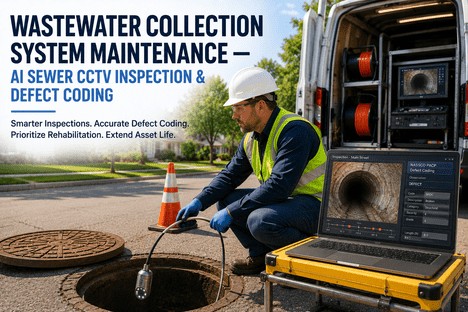
Every developed country sits on a vast hidden network of sewers, water mains, stormwater interceptors, and tunnels — millions of kilometres of buried pipe that no inspector can walk through or visually examine from above ground. For decades the only way to look inside has been a CCTV crawler with a tethered camera, operated by a technician scoring defects manually against a coding standard like NASSCO PACP in North America or WRc MSCC5 in the UK. The work is slow, expensive, subjective, and inconsistent between inspectors. AI inspection robots are transforming the economics. Modern sewer crawlers, water-main free-swimming robots, and tunnel-scanning platforms now combine CCTV, sonar, laser profiling, and electro-scan leak detection — with deep-learning models that automatically identify cracks, root intrusions, collapsed sections, and joint defects from the captured footage, classifying them straight into PACP or MSCC5 codes. The result is what utilities have wanted for years: faster inspection, consistent defect grading, and dramatically lower cost per kilometre — typically 30–60% lower once automated coding replaces frame-by-frame human review. Utility teams that schedule a demo are finding they can clear inspection backlogs that grew through the pandemic in a fraction of the budgeted time. This article walks through what AI inspection robots actually do for sewers, water mains, and tunnels — the robot types, the AI capabilities, the realistic cost ranges, and the deployment realities every water utility hits on day one.
Stop Coding Defects Frame-by-Frame. Let AI Do It.
iFactory layers automated PACP and MSCC5 defect coding on top of any CCTV crawler footage — purpose-built for water utilities, drainage authorities, and trenchless inspection contractors managing million-metre networks.
1. Why Water Utilities Need AI Robotic Inspection Now
Buried water and wastewater networks are the single biggest under-monitored asset class in the developed world. A mid-sized city water utility typically runs 2,000–5,000 km of sewer, plus an equivalent length of water mains and stormwater pipe. Even with a fleet of CCTV crawlers running every weekday, the network is on a 10–15 year inspection cycle — meaning the data informing capital-replacement decisions for a given pipe could be over a decade old.
The bottleneck is not the camera; it is the human in the loop. A certified PACP coder spends roughly one hour reviewing one hour of footage, scoring every crack, joint defect, root intrusion, debris deposit, and structural anomaly against the standard. Coder fatigue degrades accuracy after the fourth hour of a shift. Different coders score the same footage with measurable variance. AI changes this by automating the defect detection and classification step entirely — a deep-learning model reviews the footage in minutes, surfaces only frames containing actionable defects, and pre-codes them for the human reviewer to validate. Utility teams that book a demonstration see live PACP-coded output from their own archive footage.
2. Four Robot Families for Four Different Water Assets
Production AI inspection programmes do not run one robot — they run a fleet tuned to the asset. Each family addresses a different combination of pipe size, fluid condition, and access geometry.
| Robot Family | Asset Type | Pipe Diameter | Sensor Payload |
|---|---|---|---|
| Tethered CCTV Crawler | Sewers, drains, stormwater | 150–2,400 mm | HD CCTV + pan/tilt/zoom + LED |
| Multi-Sensor Pipe Profiler | Large sewers & interceptors | 600 mm+ | CCTV + laser profiler + sonar |
| Free-Swimming Water-Main Bot | Pressurised potable water mains | 100–600 mm | Acoustic leak + magnetic flux |
| Push-Camera & Lateral Launcher | Service laterals & small pipes | 50–200 mm | Flexible HD push camera |
| Tunnel & Culvert Crawler | Large-bore tunnels, culverts | 1,500 mm+ | CCTV + LiDAR + IMU |
| Electro-Scan Probe | Non-conductive sewers (leak detection) | 100–1,200 mm | Low-voltage HF electrical probe |
3. What the AI Layer Actually Does on Top of the Robot
The robot captures the data; AI turns it into a defect log a utility can act on. Modern systems run a stack of deep-learning models in parallel on the captured footage. Object detection models (YOLOv8, Mask R-CNN) locate every defect frame-by-frame and label it with its NASSCO PACP code — crack, fracture, broken, deformed, hole, joint displacement, infiltration, deposit, surface damage, root intrusion. Semantic segmentation models (U-Net, DeepLabv3+) measure defect extent in pixels, then convert to real-world dimensions using the calibrated camera geometry.
On top of those, severity classifiers grade each detected defect on the PACP 1–5 severity scale, and tracking models follow each defect across multiple frames so that one root intrusion seen for ten seconds is logged as one defect, not two hundred. The final output is a defect log in PACP, MSCC5, or operator-specific format — ready for direct ingestion into the asset register without a human re-keying anything. Utilities that schedule a strategy session see this full coding stack running on their own pipe footage in under an hour.
4. From Crawler Launch to Coded Defect Log — Six Stages
Modern AI-assisted inspection runs as a six-stage chain. The operator launches the robot and certifies the final defect log — every stage in between runs autonomously.
5. The Defects AI Inspection Reliably Catches
A modern AI inspection model trained on PACP-coded data reliably catches the full defect spectrum that drives sewer rehabilitation decisions. Structural defects — cracks, fractures, broken pipe, deformed pipe, holes — are detected with the highest accuracy because their visual signatures are sharp. Operational defects — deposits, attached debris, encrustation, intruding roots — are detected with slightly lower but still strong accuracy. Service defects — line connections, intruding service connections, lining failures — round out the typical coding catalogue.
6. What It Costs — Honest Ranges by Inspection Mode
Costs vary by geography, pipe size, depth, and inspection volume. The figures below reflect typical mid-2020s commercial ranges from utility tender documents and published inspection-contractor pricing.
| Inspection Mode | Typical Use Case | Cost per Metre (USD) | AI Saving vs Manual |
|---|---|---|---|
| Standard CCTV crawler + manual coding | Routine sewer condition assessment | $3–8 / metre | Baseline |
| CCTV crawler + AI auto-coding | Large-volume backlog clearance | $1.50–4 / metre | 40–60% lower |
| Multi-sensor (laser + sonar) crawler | Large interceptor & trunk surveys | $8–20 / metre | 30–45% lower |
| Free-swimming water-main robot | Pressurised potable mains, in-service | $15–40 / metre | 30–40% lower |
| Electro-scan leak quantification | Pre/post-rehab compliance testing | $10–25 / metre | Complement, not replacement |
| Tunnel / culvert robotic survey | Large-bore inspection | $25–80 / metre | 35–50% lower |
7. Five Deployment Realities Water Utilities Hit on Day One
AI Inspection Robots for Water Infrastructure — Frequently Asked Questions
Tap any question to reveal the answer.
Do we have to buy new robots, or will AI work with our existing CCTV crawlers?+
How accurate is AI defect coding compared to a certified human coder?+
What does AI inspection actually cost per metre or per kilometre?+
Will the AI output meet our PACP or WRc MSCC5 compliance requirements?+
Can AI find leaks that CCTV alone cannot detect?+
How does iFactory's AI inspection platform integrate with our existing CMMS?+
Clear the Inspection Backlog. Halve the Cost. Keep Your Coders.
iFactory orchestrates AI defect coding on every major crawler footage format — feeding PACP and MSCC5 codes directly to Maximo, Cityworks, Innovyze, and SAP PM. Built for utilities that need scale without sacrificing standards compliance.