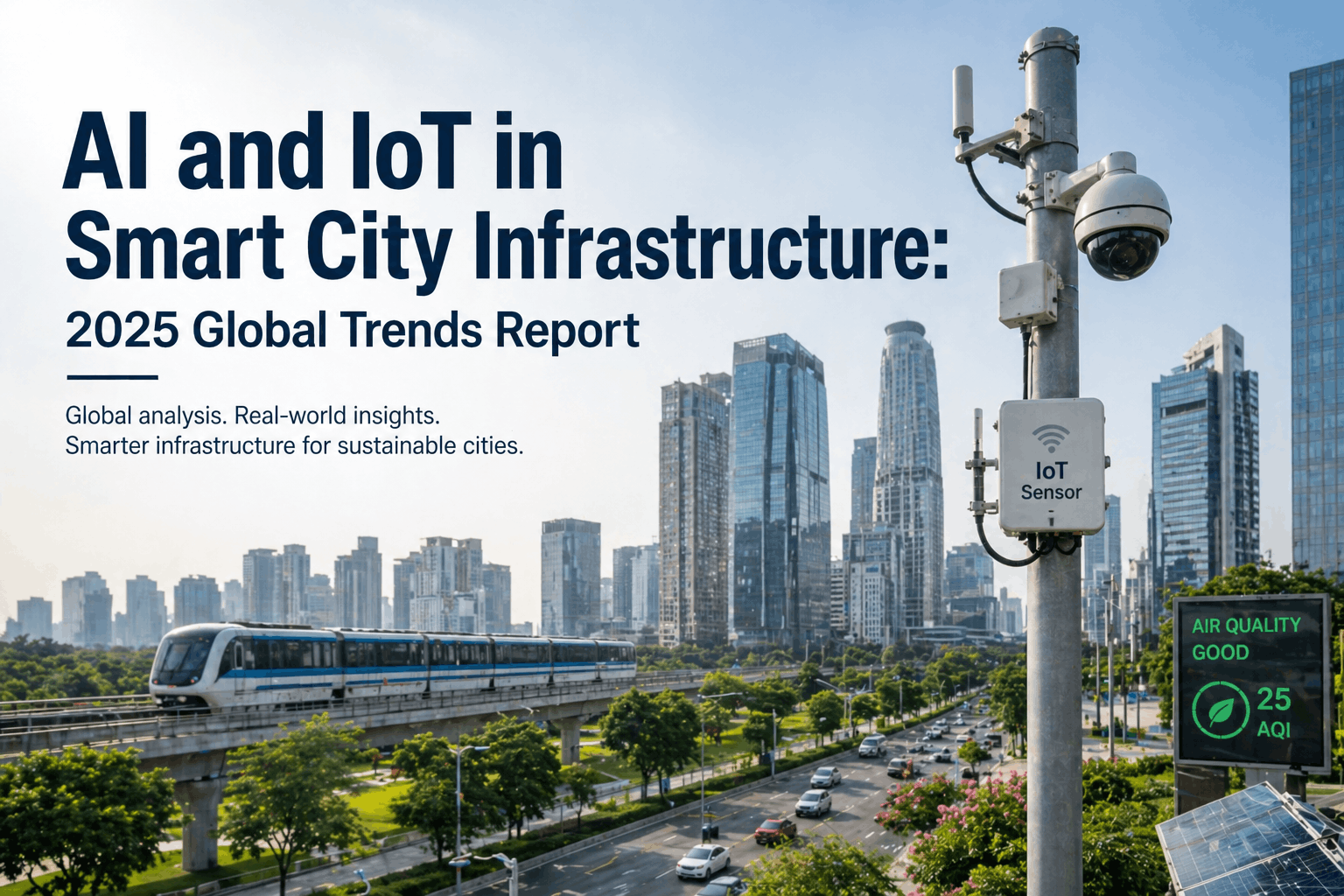
The global smart city market reached $952 billion in 2025 — and by 2034, analysts project it will surpass $6.3 trillion, growing at a CAGR of 23.2%. That trajectory is driven by one structural reality: AI and IoT have become the only viable path to managing infrastructure at urban scale. More than 1,000 cities globally now have active smart city programs, with over 58% deploying digital platforms for traffic management, energy monitoring, and public safety. IoT-enabled devices exceed 2.5 billion units across smart city environments worldwide. For city planners, infrastructure operators, and the enterprises supplying them, the intelligence threshold has already been crossed — the gap now is execution speed. If you are benchmarking your infrastructure technology roadmap for 2025–26, schedule a strategy session with iFactory's urban infrastructure team to map your deployment against this year's global benchmarks.
AI & IoT in Smart City Infrastructure
Market data, technology benchmarks, and regional case studies for infrastructure leaders and city planners navigating the intelligence era of urban management.
Executive Summary: The Intelligence Threshold Has Been Crossed
In 2025, the question city planners and infrastructure directors are grappling with is no longer whether to deploy AI and IoT in urban systems — it is how fast they can close the gap between their current instrumentation and what top-quartile cities are already operating. IoT-enabled devices exceed 2.5 billion units across smart city environments globally. The intelligence threshold — the point at which connected infrastructure generates more operational value than traditional approaches — has been crossed in transport, utilities, and public safety in cities across three continents.
This report synthesizes market data, technology deployment patterns, and regional investment trends to give infrastructure leaders a precise picture of where the sector stands in 2025 and where the highest-ROI deployment opportunities exist across AI asset management, IoT predictive maintenance, and connected infrastructure monitoring through 2030. City infrastructure directors looking to benchmark their programs against global leaders can schedule a consultation to review iFactory's infrastructure intelligence framework.
2025 Market Snapshot: Scale, Growth, and Investment Flows
The smart city market's growth rate — 23.2% CAGR through 2034 — is significantly above the broader digital infrastructure sector average. The IoT-in-smart-cities segment is projected to grow from $269 billion in 2025 to $742 billion by 2030 at a 22.5% CAGR. Smart infrastructure solutions account for 34% of total smart city deployments — the largest single segment — followed by smart energy at 22%, smart mobility at 18%, smart governance at 14%, and smart healthcare at 12%.
Deploy Infrastructure Intelligence at Urban Scale
iFactory's AI-powered platform connects IoT sensor networks, predictive maintenance systems, and asset performance analytics into a unified operations layer — built for smart city infrastructure at enterprise scale.
Regional Adoption Map: Where Deployment Is Leading, Following, and Accelerating
Regional smart city adoption patterns in 2025 reveal three distinct dynamics: North America leads in AI-analytics adoption and private-sector deployment velocity; Asia-Pacific leads in raw infrastructure scale and government-mandated programs; and Europe leads in regulatory integration and sustainability-linked infrastructure investment. Understanding regional deployment patterns is essential for technology vendors, system integrators, and city authorities benchmarking against global peers.
AI analytics adoption leader. US market valued at $192.5B in 2025, growing at 27% CAGR through 2030. Federal IIJA $550B infrastructure allocation accelerating IoT sensor deployment.
Fastest growing region. $140B+ invested in 2024–25. Sensor density exceeds 2,800 units per sq km in major urban zones. Led by China, Japan, South Korea, Singapore, and India.
Sustainability-led procurement. Market at $202.9B in 2025. Germany's 70+ Smart Communities program and Berlin's 40% energy reduction from AI lighting are regional benchmarks.
Greenfield acceleration driven by Saudi Vision 2030. KAFD signed MoU with Huawei at LEAP 2025 to deploy WiFi-7, 5G-A, AI/IoT across 1.6 million m² smart district.
Asia-Pacific now holds the largest share of global IoT device installations in smart city environments — approximately 46% — with deployment density exceeding 2,800 sensors per square kilometre in major urban zones. In April 2025, Singapore's Smart Nation initiative integrated IoT-enabled infrastructure alerts and AI-powered traffic optimization into its MyTransport.SG app, exemplifying the region's integration-first approach. Infrastructure procurement teams looking to align with regional deployment benchmarks can book a platform overview with iFactory's team.
The Five AI Applications Delivering Measurable ROI in Smart Infrastructure
AI deployment in smart city infrastructure has moved well beyond pilot programs. The applications generating documented, scalable ROI in 2025 cluster around five domains where real-time data abundance, high asset criticality, and operational complexity combine to create a clear value case for machine intelligence over human-managed monitoring.
AI-Powered Predictive Maintenance for Critical Infrastructure
AI predictive maintenance platforms reduce maintenance costs by 25–30% while cutting unplanned downtime by 35–50%, according to cross-industry studies covering water networks, transport systems, and energy infrastructure. In Singapore, predictive maintenance deployed across public transportation networks produced fewer service outages and measurably lower maintenance costs. Barcelona and Chicago have leveraged predictive analytics for water and power grids, achieving substantial reductions in breakdowns. Condition-based maintenance demonstrates up to 45% improvement in cost rates compared to time-based approaches in multi-component infrastructure systems.
IoT Sensor Networks for Real-Time Asset Monitoring
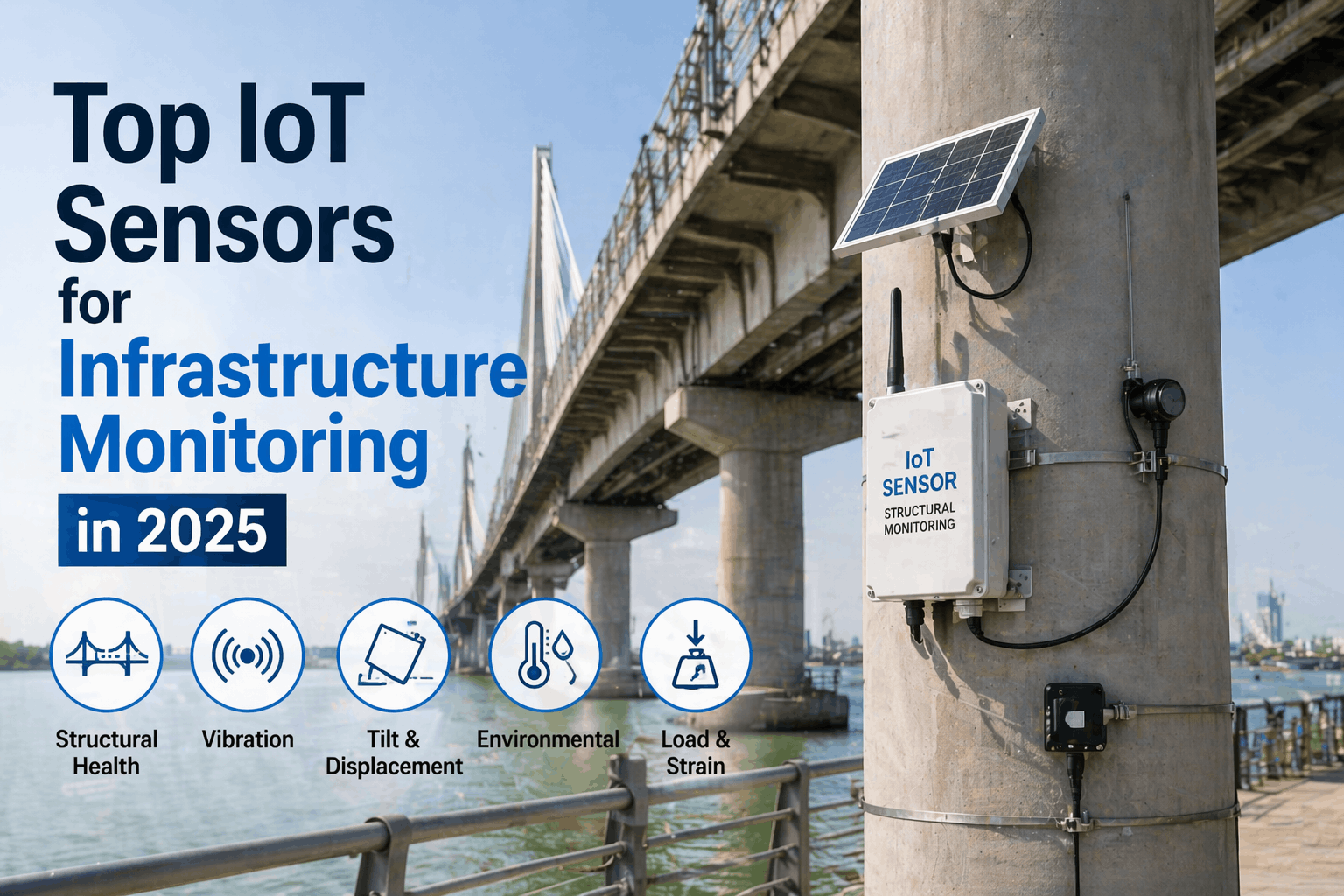
IoT sensor infrastructure has become the foundational data layer for every other smart city application. Sensors embedded in roads, bridges, tunnels, water mains, and energy distribution nodes collect continuous structural integrity and environmental data — enabling real-time monitoring and failure prediction before disruption occurs. Asia-Pacific cities are deploying at scale: sensor density in major urban zones exceeds 2,800 units per square kilometre, feeding AI analytics platforms that process asset health data continuously. The US Infrastructure Investment and Jobs Act's $550 billion infrastructure allocation is directly accelerating IoT sensor deployment across the North American network.
Digital Twin Platforms for Infrastructure Simulation
Digital twins — dynamic virtual models of physical urban infrastructure — allow city administrators to simulate failure scenarios, forecast asset degradation, and test maintenance interventions before committing capital. Hamburg's smart port operations use digital twins combined with real-time IoT sensor data to optimise logistics and infrastructure management at scale. Research across 30 peer-reviewed studies confirms that AI-driven smart infrastructure can deliver 15% energy savings, 25–30% cost reductions, and 25% congestion reduction. Digital twin adoption is growing fastest in transport and water infrastructure.
AI-Driven Energy Management and Smart Grid Optimisation
Smart energy management holds 22% of total smart city deployment share — the second-largest segment — driven by AI platforms that continuously optimise grid load, identify consumption anomalies, and automate demand response. Berlin's AI-powered street lighting reduced electricity consumption by 40% in test districts in 2024. Energy management AI systems identify the correlation between infrastructure degradation and excess power consumption, converting equipment health monitoring into both a maintenance and a utility cost optimisation tool simultaneously.
Intelligent Transportation and Traffic Analytics
AI-driven traffic management systems deliver 25% congestion reduction and 18% decrease in travel times in documented deployments, according to a systematic review of 30 peer-reviewed implementation studies. Passenger information management systems represent the fastest-growing smart transportation subsegment, integrating real-time IoT, AI, and digital signage to optimise route decisions and reduce transit downtime. Siemens secured a major smart city IoT contract for Indian metropolitan transport infrastructure in Q2 2025, covering connected traffic systems, energy management, and public safety networks.
IoT Predictive Maintenance: The ROI Engine of Smart Infrastructure
Among all smart city infrastructure technologies, AI-powered predictive maintenance consistently delivers the fastest and most measurable financial return. Industrial operators lose $50 billion annually to unplanned downtime, with median costs exceeding $125,000 per hour across industries. In urban infrastructure contexts — where a water main failure, transport network outage, or grid interruption affects hundreds of thousands of residents — the cost multiplier is significantly higher. Predictive maintenance software transforms this exposure into a manageable, scheduled operational event.
| Metric | Traditional / Time-Based | AI Predictive Maintenance |
|---|---|---|
| Unplanned Downtime | Reactive — post-failure response | 35–50% reduction achieved |
| Maintenance Cost Rate | Baseline (100%) | 25–45% lower cost rate |
| Failure Prediction Lead Time | None — calendar-based only | Days to weeks in advance |
| Adopter ROI Rate | Uncertain / multi-year | 95% report positive ROI |
| Full Amortisation | Multi-year if ever | 27% achieve payback in Year 1 |
| Energy Waste Detection | Utility bill review only | Real-time correlation with asset health |
The adoption statistics are clear: 95% of predictive maintenance adopters report positive ROI, with 27% achieving full platform amortisation within the first year of deployment. For smart city infrastructure directors managing aging physical assets — water networks, transport systems, utility grids — this makes AI predictive maintenance the first budget item to defend and the last to cut when capital is constrained. Infrastructure operators looking to build the business case for predictive maintenance deployment can request an ROI modelling session with iFactory's infrastructure analytics team.
Smart City Technology Stack: What Leading Cities Are Actually Deploying
Successful smart city infrastructure deployments in 2025 are built on a layered technology architecture that combines edge computing, 5G connectivity, IoT sensor networks, AI analytics, and integrated asset management platforms. The failure mode of the previous decade — deploying point solutions that could not communicate across departments or asset classes — has been replaced by a platform-first procurement logic that prioritises data interoperability and cross-asset intelligence from day one.
5G is the connectivity backbone that makes real-time smart city intelligence viable at scale. By 2025, 5G networks reach one-third of the world's population, and 5G technology commands 37.5% of cellular IoT market share. Edge computing is equally critical: approximately 50% of enterprise-generated data is now processed at the edge — enabling instantaneous response times that safety-critical infrastructure applications demand, while reducing bandwidth costs and improving data sovereignty compliance.
Sector Deployment Breakdown: Infrastructure, Energy, Transport, and Safety
The distribution of smart city investment across sectors in 2025 reveals where both the largest existing deployments and the fastest growth opportunities exist for infrastructure intelligence platforms and IoT predictive maintenance solutions.
Global Case Studies: Cities Setting the Benchmark in 2025
The most instructive smart city deployments of 2024–25 share a common architectural pattern: they start with a unified data layer across multiple infrastructure domains, add AI analytics on top of that layer, and build decision workflows that connect operational alerts to executive action. The cities generating the highest documented ROI are not those with the most sensors — they are those with the most integrated data architectures.
Smart Nation IoT Infrastructure Alerts + Transport AI
Singapore's Smart Nation initiative integrated IoT-enabled infrastructure alerts and AI-powered traffic updates into its MyTransport.SG app in April 2025 — delivering real-time infrastructure status and predictive transit management to the entire urban network simultaneously. Predictive maintenance deployed across public transportation networks has produced measurable reductions in service outages and maintenance costs, making Singapore one of the most closely studied benchmark deployments globally for smart public transport infrastructure management.
AI Street Lighting + Digital Twin Port Operations
Berlin's 2024 AI street lighting deployment achieved a 40% electricity reduction in test districts through real-time sensor-driven control and AI load optimisation. Hamburg enhanced smart port operations by combining real-time IoT sensors with digital twin simulation, optimising logistics infrastructure management across one of Europe's largest shipping hubs. Germany's federal Smart Communities programme now funds 70+ municipalities in scalable urban digitisation programs that replicate these benchmarks.
Water & Power Grid Predictive Analytics
Both cities deployed AI predictive analytics across water and power grid infrastructure, achieving substantial reductions in network breakdowns and maintenance response times. These deployments demonstrate the cross-sector applicability of AI infrastructure maintenance platforms — the same predictive models that identify bearing failures in pumping stations can flag pressure anomalies in water mains and thermal signatures in substations, using a unified analytics engine across physically distinct asset classes.
Integrated IoT Smart City Infrastructure at Metropolitan Scale
In Q2 2025, Siemens won a contract to deploy IoT-based smart city infrastructure across an Indian metropolitan area, integrating connected traffic systems, energy management, and public safety networks into a single operational platform. This deployment represents the template for India's Smart Cities Mission — 100 cities, $14 billion in sanctioned investment — and demonstrates the enterprise-scale opportunity for integrated infrastructure intelligence platforms in the fastest-growing smart city region globally.
Before deploying iFactory's infrastructure analytics platform, our maintenance team was responding to failures after citizens reported them. Now we predict 80% of critical asset faults two to three weeks before they surface — infrastructure downtime has dropped by 41% in 18 months, and our maintenance budget planning is accurate for the first time in the department's history. Full ROI was achieved within the first year.
Implementation Challenges and How Leading Cities Overcome Them
Despite accelerating deployment, smart city infrastructure programs face four recurring implementation barriers that separate successful programs from stalled ones. Understanding these barriers — and the architectural choices that resolve them — is essential for procurement teams designing RFPs and city authorities evaluating vendor proposals.
Legacy System Integration
Many critical urban assets lack digital interfaces or modern sensor outputs, requiring non-invasive retrofit sensor architectures and API-based data translation layers. Successful programs add intelligence on top of existing infrastructure without requiring costly replacement — using edge AI devices for local processing combined with cloud integration for enterprise analytics.
High Upfront Investment Perception
Budget gatekeepers frequently cite uncertain ROI as a procurement barrier. The most effective counter is deploying in phases: start with highest-criticality assets, demonstrate measurable ROI within the first 6–12 months, then expand coverage using documented returns to justify the next phase budget. 95% of adopters report positive ROI with 27% achieving full amortisation in Year 1.
Data Governance and Interoperability
Fragmented data standards across city departments — different sensor protocols, proprietary SCADA formats, siloed operational databases — prevent the cross-asset intelligence that makes smart city platforms valuable at enterprise scale. Platform-first procurement enforcing API interoperability and unified data schemas from deployment day one eliminates this barrier for future expansion phases.
Organisational and Cultural Adaptation
Maintenance teams accustomed to fixed-schedule work orders require structured change management alongside AI platform deployment. Clear ROI visibility for frontline staff — showing how predictive alerts reduce emergency callouts and after-hours interventions — is the most effective adoption accelerator. Cross-functional alignment between IT, operations, and finance is required before platform go-live.
See How iFactory Solves the Integration Challenge
iFactory's platform connects with legacy SCADA systems, modern IoT sensor networks, and enterprise asset management systems through a unified API layer — without requiring infrastructure replacement or production downtime.
2025–2030 Outlook: Five Technology Shifts Redefining Smart City Infrastructure
The structural forces shaping smart city infrastructure investment through 2030 are well-established — urbanisation, decarbonisation mandates, aging physical assets, and the productivity imperative in public services. Five specific technology transitions will define which vendors and which city programs lead the next cycle of smart infrastructure development. Infrastructure operators looking to align their 2026 procurement strategy with these trends can request a technology roadmap session with iFactory's urban infrastructure team.
Edge AI Becomes Standard in Critical Infrastructure Monitoring
With 50% of enterprise data already processed at the edge, AI inference moving to local processing nodes — in pump stations, substations, and transport hubs — eliminates latency constraints for safety-critical applications and reduces bandwidth costs for city-wide IoT deployments.
Digital Twins Scale From Buildings to City-Wide Asset Networks
Digital twin adoption moves from individual structures to networked city asset portfolios — enabling simulation-based capital planning across entire utility districts, transport corridors, and building portfolios simultaneously. Cities using digital twins for capital planning will achieve 30–40% more efficient infrastructure investment decisions.
5G-SA Networks Enable Real-Time City-Wide Operational Command
5G Standalone networks, eliminating dependence on 4G legacy infrastructure, will enable uninterrupted machine-to-machine communication at the latency levels required for autonomous infrastructure response — making real-time operational command centres technically and economically viable for mid-size cities.
AI Compliance Documentation Becomes a Regulatory Requirement
As EU Digital Infrastructure Directives and equivalent frameworks in the US and Asia-Pacific codify data sovereignty, cyber resilience, and automated audit trail requirements, cities that invested early in automated compliance documentation will hold significant procurement and regulatory advantages.
Predictive Capital Allocation Replaces Calendar-Based Infrastructure Budgeting
AI asset management platforms will shift municipal infrastructure budgeting from fixed annual CapEx cycles to dynamic, condition-driven capital allocation — prioritising investment in assets showing accelerated degradation signals. Cities operating on this model will extract 20–35% more infrastructure longevity per capital dollar invested.
Frequently Asked Questions: AI, IoT, and Smart City Infrastructure
What is the current size of the global smart city market in 2025?
The global smart cities market was valued at approximately $952 billion in 2025 and is projected to reach $6.3 trillion by 2034, growing at a CAGR of 23.2%. The IoT-in-smart-cities segment specifically stands at $269 billion in 2025 and is expected to reach $742 billion by 2030 at a CAGR of 22.5%. More than 1,000 cities globally have active smart city programmes as of 2025, with over 58% deploying digital platforms for traffic management, energy monitoring, and public safety.
How does AI predictive maintenance reduce costs in smart city infrastructure?
AI predictive maintenance reduces infrastructure maintenance costs by 25–30% while cutting unplanned downtime by 35–50% compared to traditional time-based approaches. Condition-based maintenance demonstrates up to 45% improvement in cost rates in multi-component infrastructure systems. 95% of adopters report positive ROI, with 27% achieving full platform amortisation within the first year. The technology works by continuously monitoring equipment health via IoT sensors and using machine learning to predict failures days to weeks before they occur — converting reactive emergency repairs into scheduled, lower-cost maintenance events.
Which regions are leading smart city IoT adoption in 2025?
North America holds 39.6% of global smart city market share and leads in AI analytics adoption, with the US market at $192.5 billion. Asia-Pacific holds roughly 46% of global IoT device installations in smart city environments and is growing at a 17.2% CAGR, led by China, Japan, South Korea, Singapore, and India. Europe represents 26% of global market share at $202.9 billion, growing at 15% CAGR with a distinctive sustainability and regulatory-compliance focus. The Middle East is an emerging high-growth region at 16.3% CAGR, driven by Saudi Vision 2030 and UAE smart infrastructure programmes.
What are the main applications of IoT sensors in smart city infrastructure?
IoT sensors in smart city infrastructure are deployed across five primary applications: structural health monitoring of roads, bridges, and tunnels; real-time water network pressure and quality monitoring; energy grid load and fault detection; traffic and transport system optimisation; and environmental monitoring including air quality and noise levels. Sensors embedded in physical infrastructure feed continuous data to AI analytics platforms that detect anomalies, predict failures, and trigger maintenance workflows — converting passive infrastructure into active, self-reporting asset networks.
How long does it take to deploy an AI infrastructure monitoring system in a city?
Priority infrastructure deployments — covering highest-criticality assets such as primary water pumping stations, main traffic corridors, and energy substations — typically go live within 4–8 weeks using non-invasive sensor installation that does not interrupt operations. City-wide coverage across multiple asset classes is typically achieved within 6–12 months using a phased rollout that delivers measurable ROI from each phase before the next begins. Platforms designed with API-first architecture integrate with existing SCADA, ERP, and asset management systems without requiring infrastructure replacement.
What role does 5G play in smart city infrastructure management?
5G is the connectivity backbone that makes real-time smart city intelligence viable at scale. It supports significantly higher data speeds, ultra-low latency, and massive device connectivity compared to 4G, making it essential for safety-critical IoT applications requiring instantaneous response. 5G already holds 37.5% of cellular IoT market share in 2025, and 5G networks now reach one-third of the world's population. The cellular IoT connectivity market is projected to grow from $6.7 billion in 2024 to $126.7 billion by 2035 at a 30.7% CAGR — among the highest growth rates across all digital infrastructure markets.
How does a digital twin platform benefit smart city infrastructure planning?
Digital twins create dynamic virtual models of physical urban infrastructure that enable simulation-based capital planning and proactive problem resolution. City administrators can simulate infrastructure failure scenarios, forecast asset degradation curves, and test maintenance interventions before committing capital — dramatically improving CapEx efficiency. Hamburg's smart port operations and multiple European cities have used digital twins to optimise logistics and reduce over-engineering in redundancy systems. Research confirms that AI-driven digital twin frameworks deliver 15% energy savings and 25–30% cost reductions in documented urban deployments.
What is the biggest barrier to smart city IoT deployment and how is it overcome?
The most consistently cited barrier is high upfront investment combined with uncertain ROI timelines — a perception gap rather than a financial reality, given that 95% of adopters report positive returns. The most effective solution is a phased deployment approach: start with 3–5 highest-criticality assets, document measurable ROI within 6–12 months, then use those documented returns to justify budget for subsequent phases. Legacy system integration is the second major barrier, addressed by API-first platforms that add intelligence on top of existing infrastructure. US IIJA allocations, EU digital infrastructure funds, and public-private partnership structures can significantly offset upfront capital requirements.
Build Your Smart City Intelligence Platform with iFactory
iFactory connects IoT sensor networks, AI predictive maintenance, asset performance analytics, and compliance documentation into a unified infrastructure intelligence platform — purpose-built for cities, utilities, and critical infrastructure operators managing assets at scale.