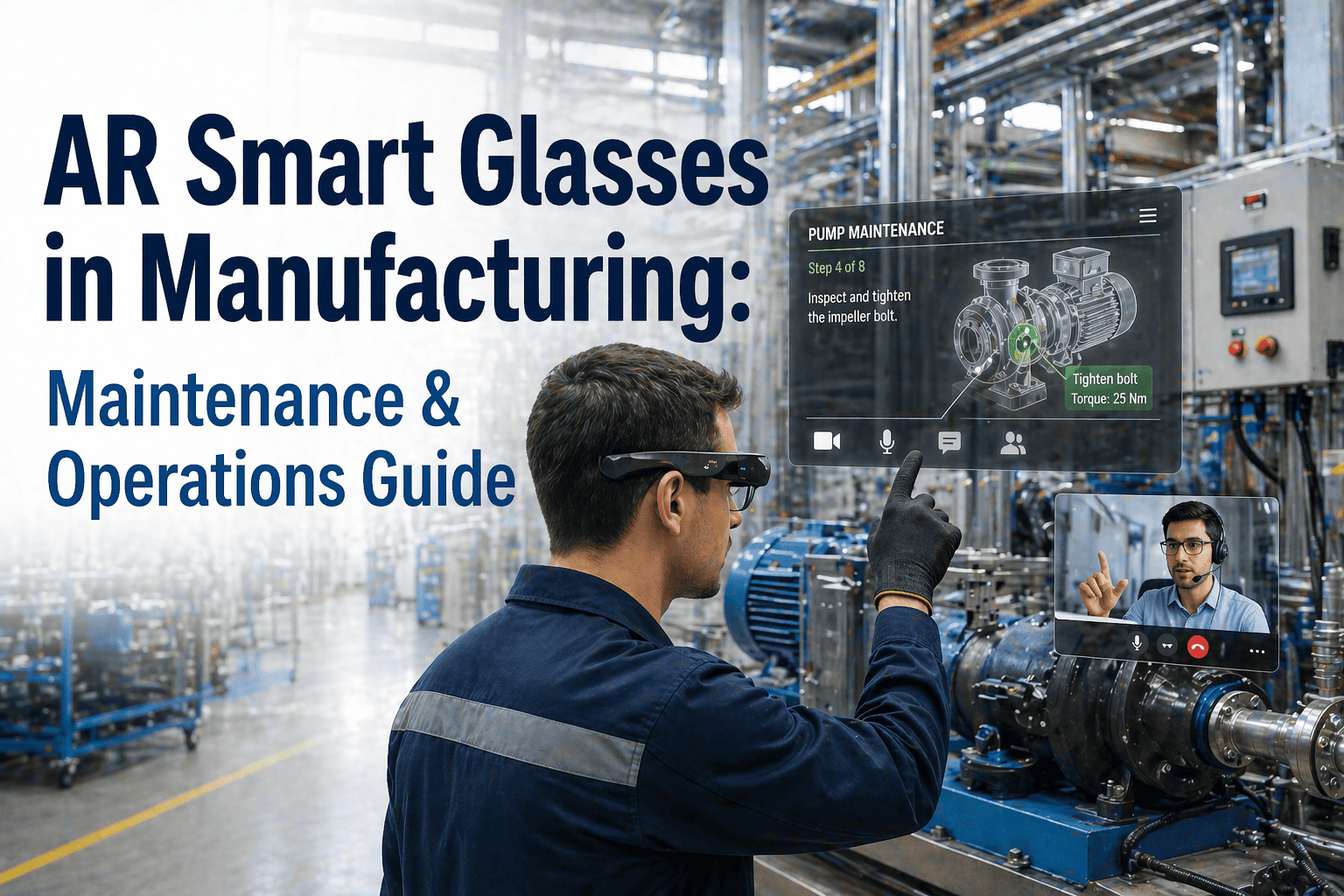
Augmented reality headsets and wearable devices are no longer proof-of-concept projects sitting in innovation labs. In 2026, they are operational tools on the floor of U.S. manufacturing facilities — routing technicians through complex repair procedures, streaming live sensor data onto a technician's field of view, and connecting a floor-level worker in Houston to a remote OEM expert in Germany in under 90 seconds. The question is no longer whether AR and wearables belong in manufacturing analytics. The question is how quickly your facility can close the gap between the plants that have deployed them and the plants that are still debating the ROI.
AR & Wearable Technology — 2026 Field Guide
Your Technicians Can See More Than the Machine Can Tell Them
Real-time AR overlays, hands-free work orders, and remote expert support are compressing repair times by 30–50% across U.S. manufacturing facilities. Here is the complete operational picture.
32%
Average reduction in mean time to repair (MTTR) with AR-guided field service
$4.7B
U.S. industrial AR market size projected by end of 2026
48%
Of Tier 1 U.S. manufacturers have active wearable analytics pilots in 2026
$210K
Average annual savings per 10-technician team from AR-assisted maintenance programs
What AR and Wearables Actually Do in a Manufacturing Analytics Context
The term "augmented reality" carries a lot of marketing weight in the industrial technology space, so it is worth being precise about what these systems do operationally. In a manufacturing analytics context, AR and wearable devices serve four distinct functions — each generating and consuming data in ways that a CMMS platform like iFactory can leverage directly.
Heads-Up Data Display
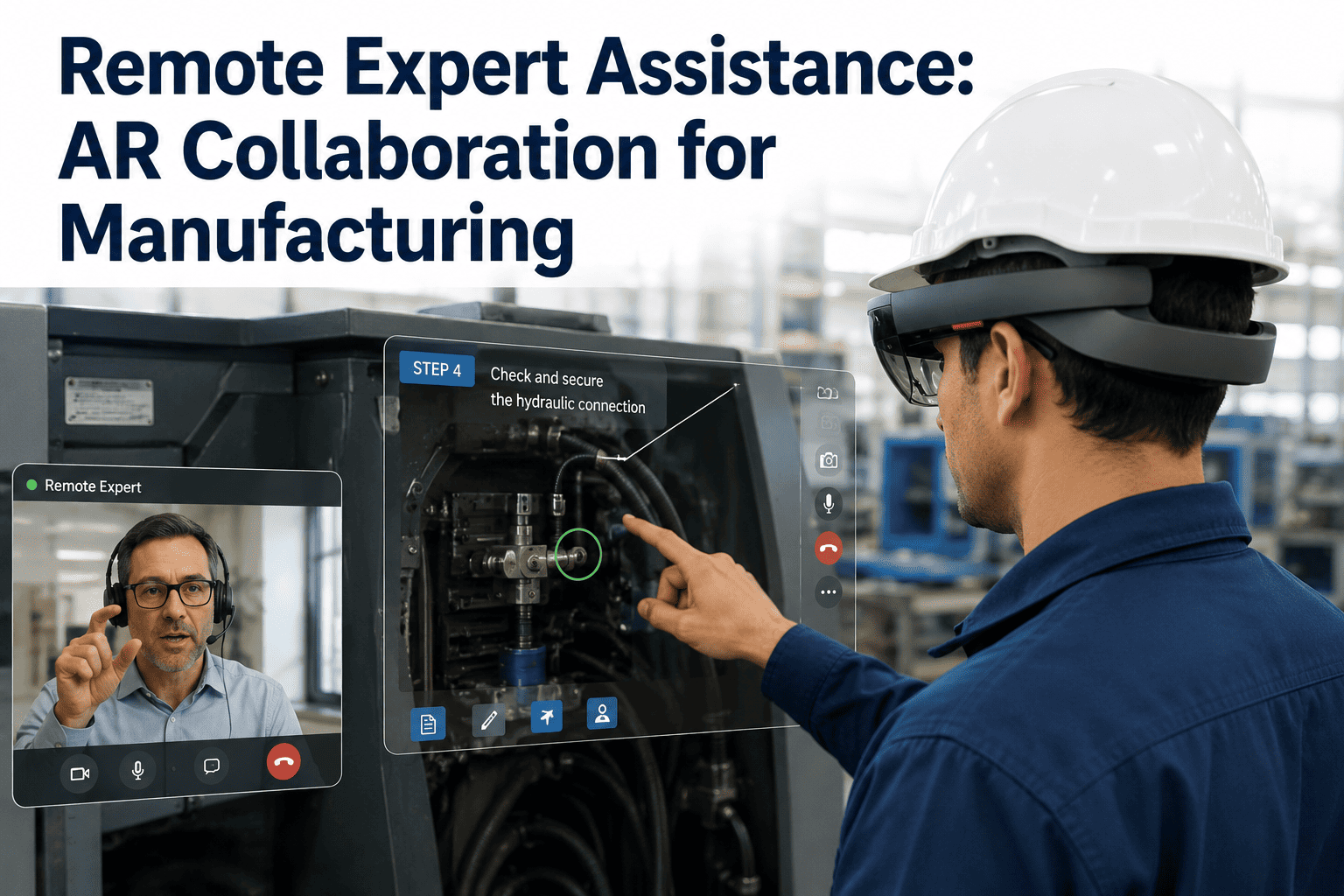
Smart glasses and AR headsets overlay live sensor readings, asset health scores, and step-by-step work order instructions directly onto the technician's field of view — without requiring them to look away from the equipment they are servicing.
Smart GlassesLive Sensor DataHands-Free
Remote Expert Assistance
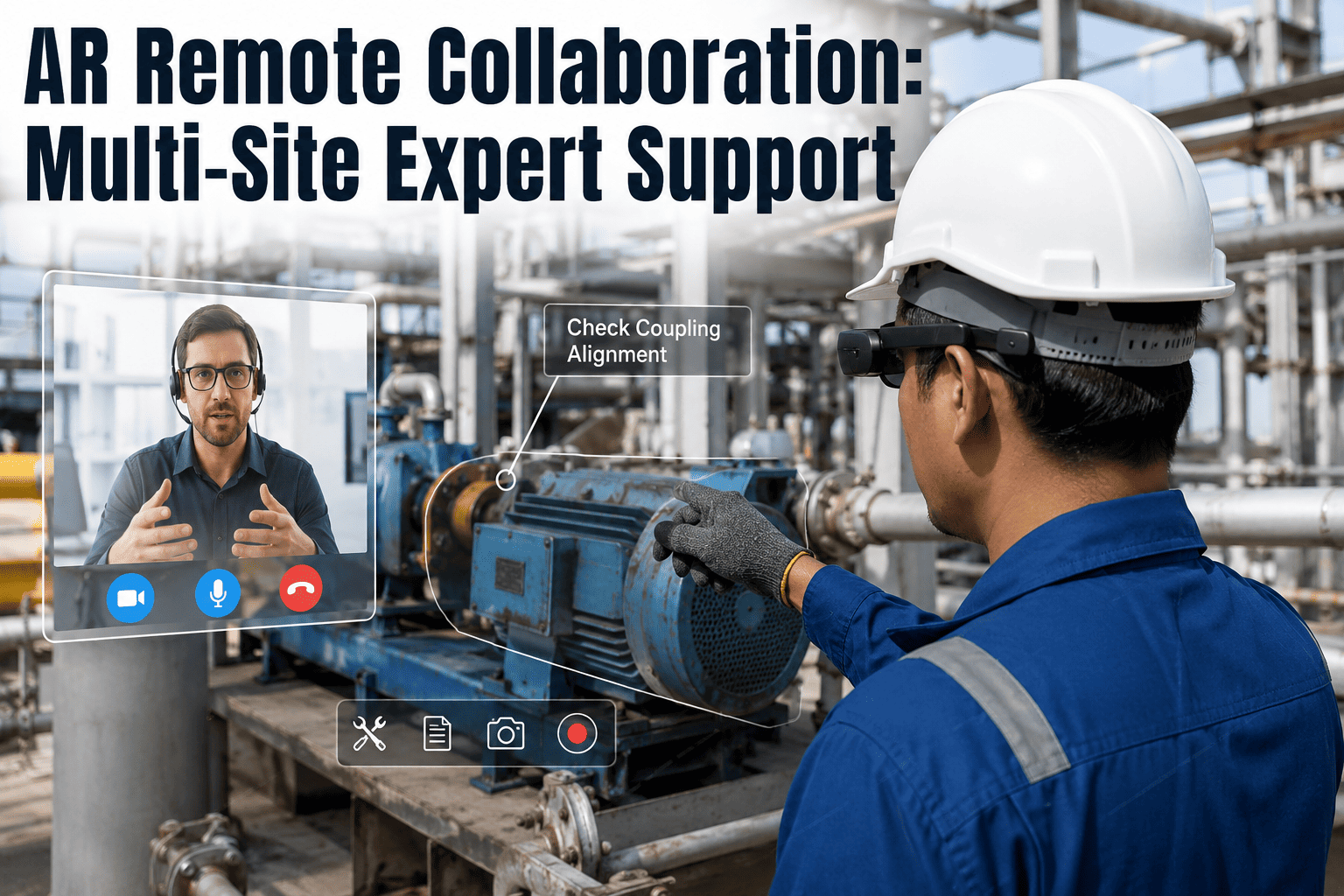
A field technician's headset streams live video to a remote OEM engineer or senior specialist who can annotate the technician's view in real time — placing directional arrows, warning zones, and callout markers directly onto what the technician sees.
Live Video StreamAnnotation ToolsRemote OEM Access
Hands-Free Work Order Execution
Wearable devices allow technicians to complete, annotate, and close work orders using voice commands and gesture controls — eliminating the clipboard, the shared tablet, and the end-of-shift data entry backlog that degrades maintenance record quality across most facilities.
Voice CommandsGesture ControlAuto-Logging
Biometric and Environmental Monitoring
Wristband and vest-mounted wearables track technician heart rate, ambient temperature, vibration exposure, and proximity to hazardous zones — feeding occupational health data into the EHS management layer and generating real-time safety alerts when thresholds are breached.
Biometric DataEHS IntegrationSafety Alerts
The AR Analytics Workflow: From Equipment Fault to Closed Work Order
Understanding the operational value of AR requires tracing the complete workflow from fault detection to resolution — and identifying exactly where AR compresses cycle time and improves data quality at each step. The following workflow reflects how iFactory's platform integrates with AR-enabled devices across a typical mid-size U.S. manufacturing facility.
01
Fault Detection and Work Order Generation
iFactory's predictive maintenance engine detects an anomaly in vibration or temperature data from a PLC-connected sensor. A work order is automatically generated, classified by priority, and assigned to the next available technician — without dispatcher involvement.
Cycle time without AR: 18–45 min | With AR integration: 2–4 min (auto-dispatch)
02
Technician Navigation and Asset Identification
The technician's AR headset receives the work order and displays a floor navigation overlay guiding them to the flagged asset. On arrival, the headset scans the asset's QR code or recognizes it via visual AI — pulling the complete asset history, last maintenance event, and relevant OEM documentation onto the display.
Cycle time without AR: 12–20 min | With AR integration: 3–5 min
03
Step-by-Step Guided Repair Procedure
The headset overlays the approved repair procedure directly onto the physical equipment — highlighting the specific bolt to loosen, the component to inspect, the torque value to apply. Each completed step is voice-confirmed and auto-logged against the work order record in real time.
Error rate without AR: 14–22% | With AR guidance: 3–5%
04
Remote Expert Escalation (When Required)
If the technician encounters an unexpected fault condition, they activate the remote assist function. An OEM engineer or senior specialist joins the session, views the live headset feed, and annotates the technician's visual field with directional guidance — resolving issues that would otherwise require an on-site specialist visit.
Specialist travel cost avoided: $1,800–$6,500 per event | Resolution time: 22 min avg
05
Work Order Closure and Analytics Capture
On repair completion, the technician voice-confirms closure. iFactory auto-populates the work order record with time spent, parts used, procedure steps completed, and any deviations noted — creating a complete, timestamped maintenance record that feeds the asset's health index and lifecycle model.
Data completeness without AR: 58–72% | With AR: 96–99%
Want to see this workflow running live on a plant floor? Book a 30-minute platform walkthrough to see AR-integrated work order execution in real time.
Device Comparison: Choosing the Right Wearable for Your Manufacturing Environment
Not every wearable device is appropriate for every manufacturing environment. The right hardware decision depends on your facility's ambient conditions, the complexity of the maintenance tasks involved, and the degree of hands-free operation required. The following comparison covers the four device categories most commonly deployed in U.S. manufacturing analytics programs in 2026.
AR Smart Glasses (Monocular)
Step-by-step guided repair in high-dexterity environments; parts identification
Limited field of view; battery life 4–6 hrs under active use
Full work order display, asset scan, voice command closure
$1,200–$2,800 per unit
AR Headset (Full Binocular)
Complex assembly validation; remote expert assist; 3D overlay for spatial work
Weight (400–650g); not suited to confined-space or high-heat environments
Full AR overlay, remote video stream, real-time annotation, auto-logging
$3,500–$7,200 per unit
Smart Wristband / Watch
Biometric monitoring; vibration alerts; quick work order acknowledgment
No visual overlay capability; data display limited to simple alerts
Alert receipt, work order acknowledge, biometric feed to EHS module
$180–$420 per unit
Body-Worn Vest / Sensor Array
Hazardous zone proximity; environmental exposure logging; fall detection
Bulky in high-mobility tasks; requires dedicated IT/OT integration layer
EHS zone mapping, incident trigger, safety compliance documentation
$650–$1,400 per unit
Quantifying the ROI: What U.S. Plants Are Actually Measuring
Industrial AR ROI is often discussed in abstract efficiency terms. The following breakdown reflects the specific, measurable outcomes that U.S. manufacturing facilities are tracking 12–18 months post-deployment — and the cost categories where the return is most consistently realized.
MTTR Reduction
32%
Average reduction in mean time to repair across AR-guided maintenance programs. At a mid-size plant averaging 240 maintenance events per month, this represents approximately 480 technician-hours recovered annually.
$67,200/yr saved at $140/hr fully-loaded technician cost
Specialist Travel Elimination
74%
Percentage of OEM specialist on-site visits eliminated through remote AR-assisted sessions at facilities with mature AR programs. Each avoided visit saves $1,800–$6,500 in travel, lodging, and downtime costs.
$48,000–$156,000/yr for plants averaging 30 specialist calls annually
First-Time Fix Rate
+28%
Improvement in first-time fix rate when technicians execute repairs using AR-guided step procedures with access to live asset history. Repeat-visit events cost an average of $3,200 each in labor and secondary downtime.
$89,600/yr saved for a plant with 28 FTF improvement across 100 complex repairs
Training Cost Reduction
41%
Reduction in formal classroom and shadowing training hours required to certify new technicians on complex equipment. AR-guided procedures function as on-the-job training — reducing new hire ramp time from 14 weeks to 8 weeks on average.
$22,400/new hire savings at facilities with 6+ technician hires per year
Maintenance Record Quality
97%
Asset record completeness achieved when AR devices auto-log maintenance events versus the 58–72% completeness typical of manual data entry programs. Higher record quality directly improves AI failure prediction accuracy and lifecycle modeling.
Compliance audit risk reduced; AI model accuracy improves 15–22% with complete records
Average Payback Period
9 months
Median ROI payback timeline for AR and wearable analytics deployments at U.S. manufacturing facilities when integrated with a CMMS platform. Hardware-only deployments without CMMS integration typically show 24–36 month payback periods.
Full program ROI driven by CMMS integration, not hardware alone
Your Technicians Are Already in the Field. Give Them the Data Layer They Need.
iFactory's platform integrates with AR headsets, smart glasses, and wearable devices to deliver live asset data, guided work orders, and remote expert access — all logged automatically to your CMMS record without a single manual entry.
Implementation Checklist: Deploying AR Analytics Without the Common Pitfalls
The majority of failed industrial AR deployments share the same root cause: the hardware was purchased before the data infrastructure was ready to support it. AR headsets that cannot connect to live asset records, push work orders, or auto-log completion events are expensive clipboards. The following checklist reflects the deployment sequence that iFactory recommends based on successful AR integrations across U.S. manufacturing clients.
Phase 1: Data Infrastructure (Weeks 1–4)
Asset register complete and digitized in CMMS — all assets tagged with QR codes or RFID
Work order templates standardized with step-level instructions (not just task summaries)
Wireless network coverage verified across all production floor zones at AR device operating frequencies
OEM documentation library uploaded and linked to asset records in CMMS
Phase 2: Pilot Deployment (Weeks 5–10)
Select 2–3 high-frequency, moderate-complexity maintenance tasks for initial AR procedure build
Deploy 3–5 devices to a single maintenance team; measure MTTR and first-time fix rate before and after
Configure remote expert session capability with at least one OEM or senior specialist contact
Validate auto-logging accuracy — confirm that AR-captured work order data matches manual audit sample
Phase 3: Full Deployment and Analytics Activation (Weeks 11–20)
Expand procedure library to cover top 20 maintenance tasks by frequency across all production lines
Connect biometric wearable data feed to iFactory EHS management module for occupational health tracking
Activate predictive maintenance alert push to AR devices — faults surface on technician headset before dispatcher involvement
Generate first 90-day ROI report: MTTR delta, FTF improvement, remote assist events, specialist travel avoided
Running a pilot evaluation and need a CMMS platform that integrates with your AR devices on day one? Schedule a technical walkthrough with iFactory's integration team to map your device stack to our platform.
Expert Review: What U.S. Maintenance Leaders Say About AR in Production
"The first thing that surprised us was not the repair time improvement — it was the training effect. New technicians with six months of floor time were executing procedures that used to require two years of shadowing, because the AR overlay was effectively putting a senior engineer's knowledge directly in their field of view. Our knowledge transfer problem did not go away, but it became manageable."
VP of Maintenance Operations
Tier 1 Automotive Components Manufacturer, Michigan
"We had a specific problem with a legacy CNC line — three OEM engineers on three continents, one of whom understood the control system better than anyone else on earth. Before AR remote assist, getting him involved meant a $4,200 trip and four days of scheduling. Now he joins a session from his desk, draws on our technician's view, and we resolve the issue in under an hour. That capability alone justified the hardware spend in the first quarter."
Director of Engineering Services
Precision Machining Facility, Ohio
Conclusion
AR and wearable technology for manufacturing analytics is not a futurism story in 2026 — it is an operational gap story. The plants that have deployed these systems are recovering technician hours, eliminating specialist travel costs, compressing training timelines, and building maintenance records that are accurate enough to support real predictive analytics. The plants that have not are still managing with clipboards, shared tablets, and the institutional knowledge that leaves with every retirement. The hardware is no longer the barrier; headsets, smart glasses, and wearable sensors have dropped to price points that are recoverable in a single avoided outage event. The barrier now is the data infrastructure — and specifically, the CMMS platform that connects field wearables to asset records, work orders, and AI analytics in a unified system. That is the integration gap iFactory is designed to close. Deployment to first measurable ROI takes under 90 days for most mid-size U.S. manufacturing facilities.
Ready to see how AR-guided maintenance integrates with iFactory's CMMS? Book a 30-minute demo and get a live walkthrough of AR-connected work order execution and asset analytics.
Frequently Asked Questions
Does AR analytics require a completely new network infrastructure investment?
In most cases, no. The majority of U.S. manufacturing facilities that have deployed Wi-Fi 6 or LTE/private 5G for existing IoT sensor networks have sufficient bandwidth for AR headset video streaming (typically 8–15 Mbps per active device). The infrastructure audit conducted during Phase 1 of iFactory's deployment process identifies specific coverage gaps — most of which are resolved with access point repositioning rather than full network upgrades. Facilities with older Wi-Fi 5 infrastructure may need targeted AP additions in high-activity maintenance zones, with typical costs in the $3,000–$12,000 range depending on floor size.
How does iFactory handle AR data privacy, particularly for video streams from production floors?
iFactory's remote assist sessions operate on end-to-end encrypted video streams with session-level access controls. Remote participants are credentialed within the platform — OEM engineers, for example, can only access sessions for assets they are registered against. Session recordings, where enabled, are stored in the client's iFactory instance under the same role-based access controls as all other maintenance records. IP-sensitive production floor areas can be designated as no-record zones where streaming is permitted but session storage is disabled. All data handling is compliant with SOC 2 Type II controls.
What happens when an AR headset loses connectivity mid-procedure in a dead zone or Faraday-shielded area?
iFactory supports offline procedure caching on AR devices — the technician's assigned work order and the associated step-by-step procedure are downloaded to the device before they enter the work zone. Steps completed during an offline session are queued locally and synchronized to the CMMS record automatically when connectivity is restored. This offline-first architecture is the same approach used in iFactory's mobile app for remote plant sites, and it ensures that work order data quality is not degraded by intermittent connectivity conditions.
Can AR procedures be built without OEM involvement for assets that have no digital documentation?
Yes. iFactory's procedure builder allows maintenance engineers to create AR-guided procedures from scratch using their own institutional knowledge — capturing the step sequences that experienced technicians already follow and converting them into a visual guided format. This is particularly valuable for legacy assets and custom-built equipment where OEM documentation is incomplete or unavailable. The process typically involves a structured recording session with your most experienced technician, which iFactory's onboarding team facilitates as part of the deployment program. These internally-built procedures often become the most used and highest-rated in a facility's library within the first 90 days.
Is AR analytics practical for small and mid-size manufacturers, or is this technology still primarily for large enterprises?
The economics have shifted significantly. In 2022, a full AR analytics deployment required upfront hardware investment of $50,000–$200,000 and a 12–18 month integration project. In 2026, a practical pilot deployment for a mid-size manufacturer — 5 AR smart glasses devices, iFactory CMMS integration, and a 50-procedure library — can be operational for under $20,000 in hardware with a 60-day deployment timeline. The payback case for a 150-person manufacturing facility is typically built on 3–4 avoided specialist visits and a 20% MTTR improvement — both of which are consistently achievable within the first six months. iFactory's pricing scales to facility size, making the platform accessible to facilities operating below 500 employees.
Your Competitors Are Already Running AR-Guided Maintenance. Are You?
iFactory's platform connects AR headsets, smart wearables, and field devices to a unified CMMS analytics layer — giving your maintenance team real-time asset data, guided procedures, and complete work order records without a single manual entry. Deployment in 60 days. ROI in under 12 months.