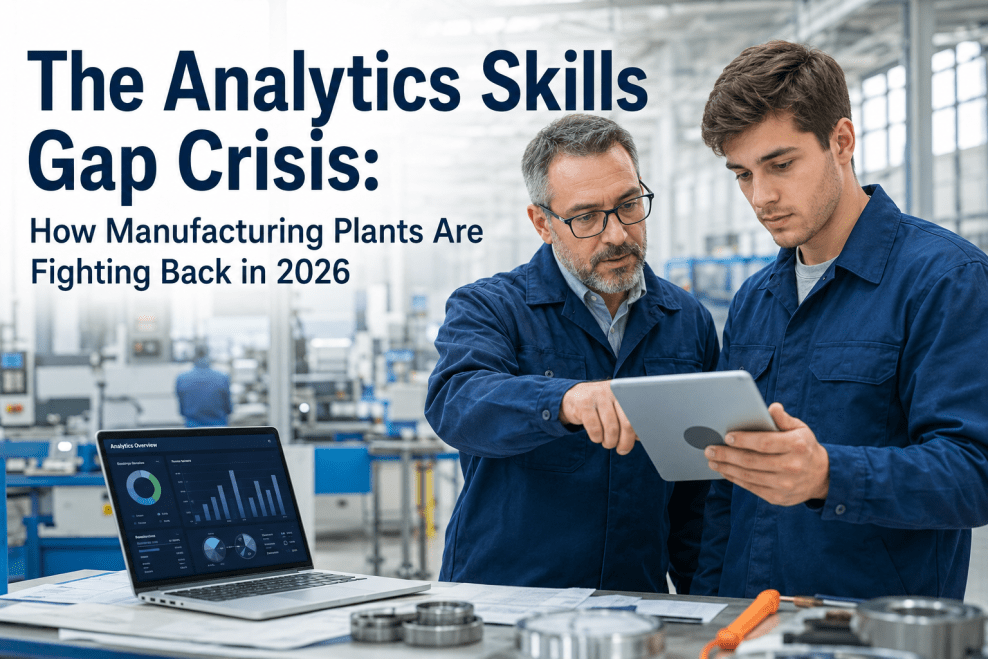
The U.S. manufacturing sector is staring down a workforce paradox in 2026 — plants are deploying more analytics, AI, and predictive systems than ever before, yet the people who can actually interpret and act on that data are in shorter supply each quarter. Industry estimates suggest more than 1.9 million manufacturing positions could go unfilled by the end of this decade, and a disproportionate share of those vacancies are in roles that require analytics fluency: data-literate technicians, predictive maintenance specialists, MES analysts, and shop-floor supervisors who can translate dashboards into decisions. The result is a strategic risk that no capital investment alone can fix. This guide walks U.S. plant leaders through what the analytics skills gap actually looks like in 2026, why traditional hiring is failing to close it, and the five fastest-moving counter-strategies — AI knowledge capture, digital SOPs, structured workforce training, AR-based learning and retention-first talent design — that leading plants are using to fight back.
Why the Analytics Skills Gap Is the Defining Workforce Issue of 2026
The analytics skills gap is not the same problem as the general manufacturing labor shortage — and treating them as one issue is why most plants are losing ground. The labor shortage is about headcount: not enough people willing to work on the floor. The analytics skills gap is about capability: even when plants do hire, the new workforce often cannot interpret the data their machines, MES platforms, and predictive maintenance systems are generating. A plant can be fully staffed and still be functionally understaffed for the kind of work modern manufacturing requires.
Three structural forces are tightening this gap simultaneously. First, the baby-boomer technician cohort — the operators who built tribal knowledge over 30-year careers — is retiring at the fastest rate in U.S. manufacturing history. Second, the analytics layer on the plant floor has expanded faster than training programs can keep up: a 2019 maintenance technician is now expected to read vibration spectra, interpret AI anomaly alerts, and act on OEE dashboards in real time. Third, the talent that does have these skills is being aggressively recruited by tech-adjacent industries — logistics, energy, and SaaS — that often pay 20–35% more for the same analytical capability.
Want to see how iFactory's workforce analytics module identifies skill gaps at the individual role level? Book a demo with iFactory's workforce team and get a site-specific skills gap assessment.
Strategy 1: AI Knowledge Capture — Preserving What Retiring Experts Know
The single most expensive thing happening in U.S. manufacturing right now is the silent departure of senior technicians whose knowledge was never written down. A maintenance lead with 28 years of experience knows which bearing makes a specific sound 90 days before failure, which torque sequence prevents gasket leaks on a particular pump model, and which combination of vibration and temperature signals predicts a specific motor failure mode. None of that knowledge is in the equipment manual. When that person retires, the plant loses it.
AI knowledge capture systems — increasingly built into modern CMMS and MES platforms — are designed to extract this tribal knowledge while the experts are still on the floor. The approach is straightforward: every work order, troubleshooting note, root-cause finding, and corrective action gets logged with structured tags. AI models then mine that data to surface patterns no individual could remember and present them to newer technicians as contextual guidance during their work. The result is institutional memory that survives turnover.
Strategy 2: Digital SOPs — Turning Paper Procedures into Living Guidance
Paper-based SOPs are functionally dead in a workforce that has grown up with smartphones and on-demand information. The newer cohort of technicians does not read 47-page binders before performing a task — they look up procedures the way they look up everything else: on a screen, contextually, when they need them. Plants that still rely on paper SOPs are not just losing efficiency; they are losing compliance and consistency because the procedures are not actually being followed.
Digital SOPs — delivered through tablets, AR overlays, or work order interfaces — solve this in three ways. They make procedures discoverable at the point of work, not in a file cabinet two buildings away. They embed checkpoints that confirm each step was completed before the next can begin. And they automatically version themselves, so when a procedure updates, the updated version is the only one available — eliminating the chronic problem of operators following outdated SOPs because that is what they printed last year.
Digital SOPs are the foundation layer of a workforce-resilient plant. Book a demo to see iFactory's smart document management and SOP delivery in action.
Strategy 3: Structured Workforce Training Backed by Analytics
Traditional manufacturing training is largely measured by attendance and completion — neither of which has any meaningful correlation with on-the-job capability. A technician can sit through a 40-hour PLC programming course, pass the multiple-choice exam, and still be unable to troubleshoot a real PLC fault on the floor six weeks later. The skills gap is widened by training programs that confuse activity with outcomes.
The plants making the most progress in 2026 are moving to analytics-backed training: every training intervention is tied to a measurable on-the-job KPI, and learners are not certified complete until their post-training performance metrics confirm capability transfer. This requires the training system and the operations system to be connected — which is precisely what platforms like iFactory enable by linking workforce records, work order performance, and certification status in one data layer.
Strategy 4: AR-Based Learning for High-Complexity Tasks
Augmented reality training has moved from novelty to operational tool in 2026, particularly for high-complexity, low-frequency tasks where the cost of error is high and the opportunity to practice is rare. Replacing a turbine seal happens once every 18 months on a specific machine — there is no way to build muscle memory through repetition. AR-based training lets a technician walk through the procedure overlaid on the actual equipment, with visual cues at every step, before performing the live work.
The plants seeing the strongest results are using AR for three task categories: complex assembly and disassembly procedures, safety-critical lockout-tagout sequences, and quality inspection where visual reference standards must be matched. Across these use cases, training time reductions of 40-65% are commonly reported, alongside error rate reductions of 50% or more on the first independent execution.
Curious how AR-based learning integrates with your existing CMMS and training records? Book a demo with iFactory and explore connected workforce training workflows.
Strategy 5: Retention-First Talent Design
The fastest way to close an analytics skills gap is to stop losing the people who already have the skills. U.S. manufacturing turnover averaged 31% in 2024 and 2025 — every departure means re-running the entire training investment, plus the productivity loss during the new hire's ramp-up. Plants that treat retention as a workforce strategy rather than an HR metric are pulling ahead of competitors who hire harder but lose faster.
The retention levers that move the needle in 2026 are not what most plant leaders expect. Compensation matters, but is rarely the primary driver of voluntary exits among skilled technicians. The factors that consistently rank higher in exit interviews are: clarity of career progression, day-to-day autonomy on the floor, access to modern tools and systems, and recognition for the analytical work technicians increasingly do. Plants that invest in these areas are seeing turnover rates drop into the high teens — a 12-15 point improvement that effectively doubles the productivity of every dollar spent on training.
Frequently Asked Questions
Conclusion: The Plants That Win in 2026 Will Treat Workforce as Infrastructure
The analytics skills gap is not a problem that can be solved by hiring harder or paying more — too many competing industries are doing the same thing for the same talent. The plants that pull ahead in 2026 and beyond will be the ones that treat their workforce as infrastructure: systematically capturing knowledge before it walks out the door, delivering procedures through tools that match how people actually work, training based on measurable outcomes rather than hours logged, and designing roles that skilled technicians want to stay in.
The five strategies covered here are not theoretical. They are deployed in U.S. plants today, returning measurable results on turnover, ramp-up time, first-time-right execution, and OEE. The plants that combine them are building a structural advantage that competitors who keep treating workforce as a recruitment problem will not be able to close quickly.
iFactory's workforce, knowledge capture, and digital SOP modules give operations teams the platform to execute these strategies without building a custom infrastructure from scratch — and the analytics layer to prove the outcomes back to leadership.
If your plant is losing skilled technicians faster than you can train new ones, the cost is quantifiable today. Book a demo with iFactory's workforce team and get a site-specific gap and retention assessment within one week.