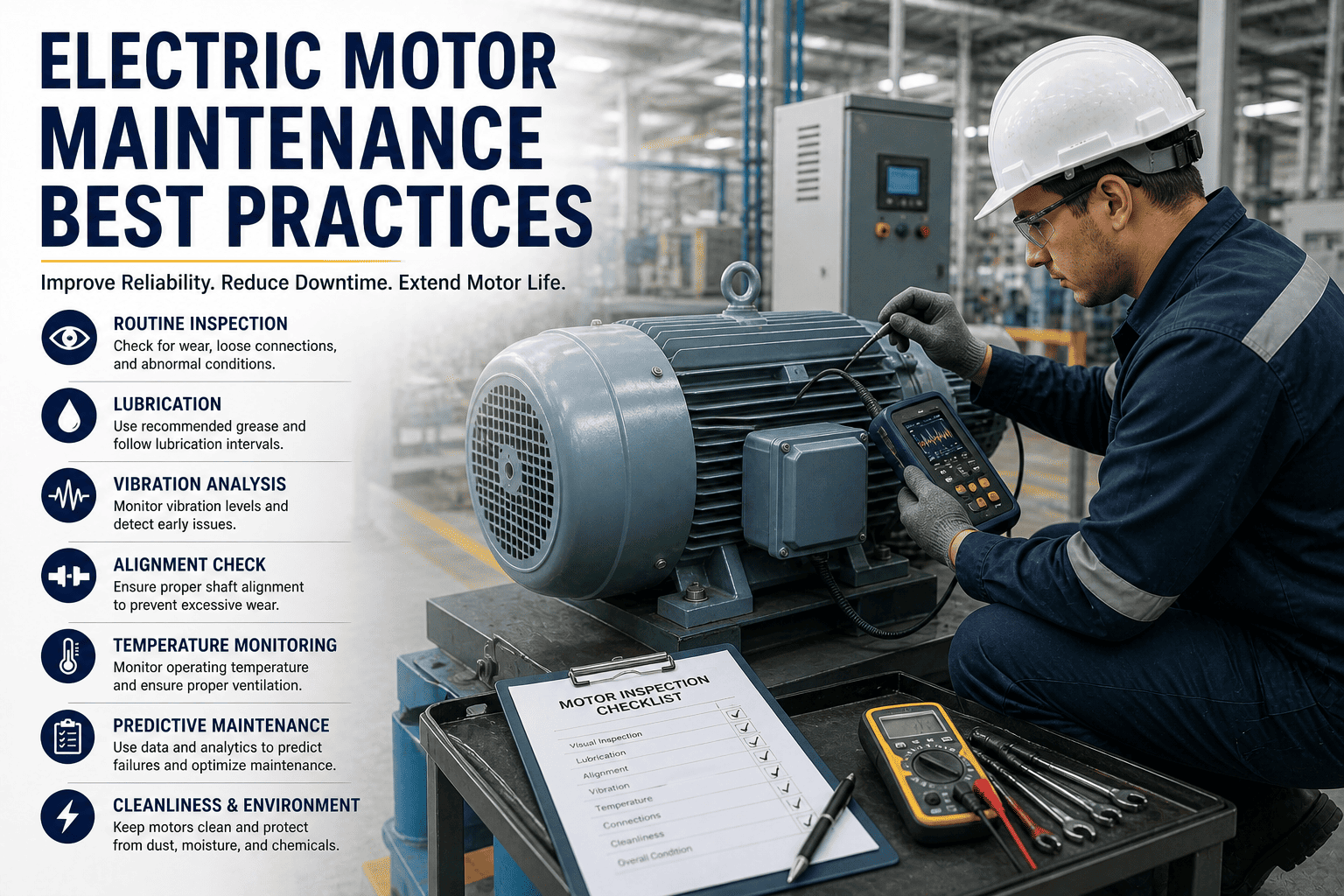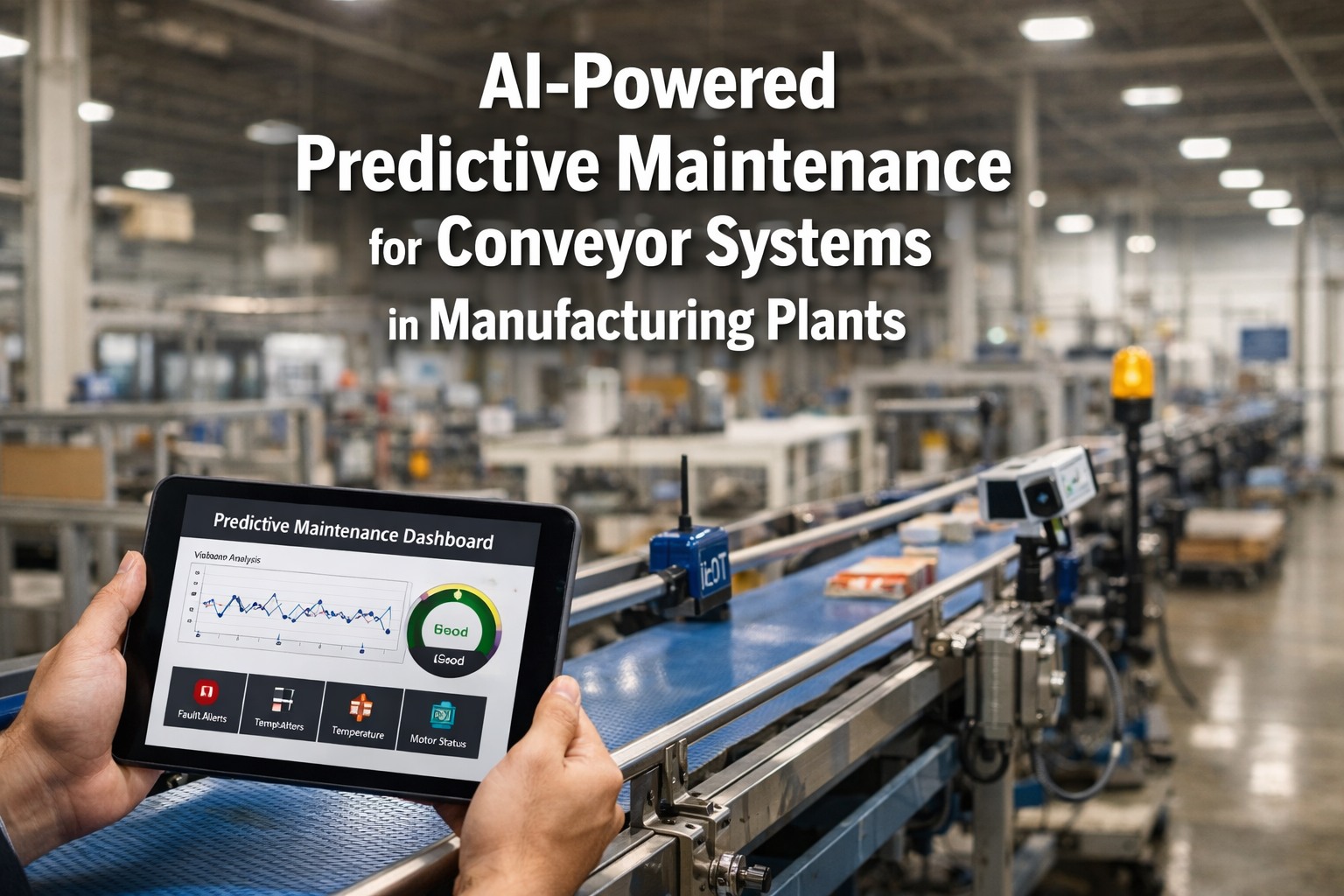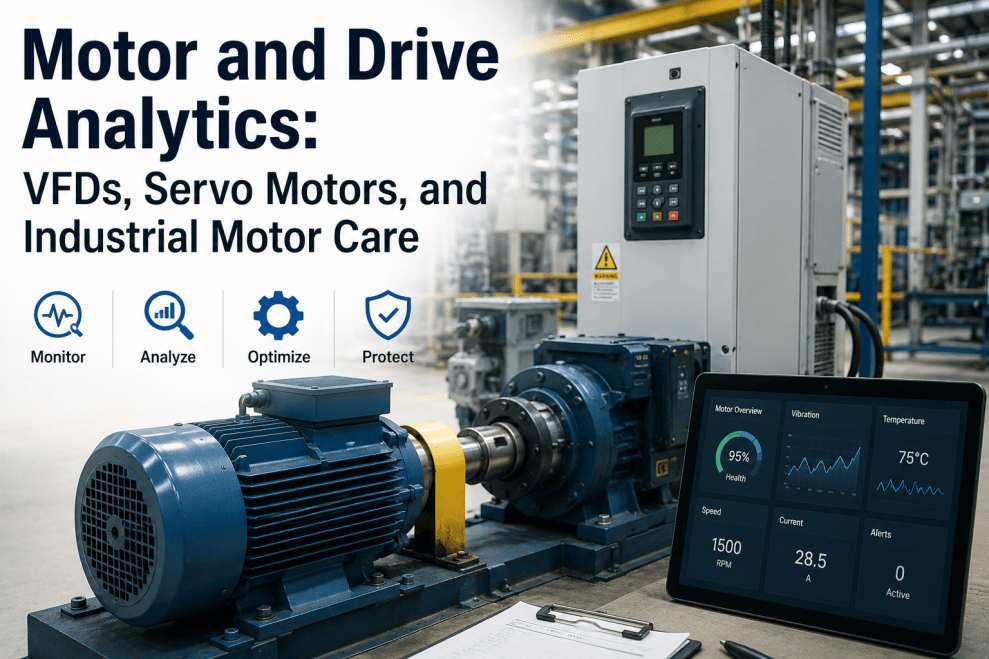
Industrial motors and their drives are the workhorses of every manufacturing plant — and the silent budget killers when they fail unexpectedly. A single unplanned VFD trip on a critical production line can cost a U.S. manufacturer between $8,000 and $50,000 per hour in lost output, expedited freight, and overtime recovery. The shift from reactive to analytics-driven motor and drive maintenance is no longer a future investment. It is the difference between plants that win uptime contracts and those losing them on reliability scores. Implementing a structured motor analytics program turns thousands of motors into a managed, predictable asset class instead of a reactive emergency queue.
Is Your Motor Fleet Costing You Hidden Downtime?
Deploy iFactory's motor and drive analytics platform to monitor VFDs, servo systems, bearings, and thermal load across every motor on your floor — with automated work order generation built in.
Why Motor and Drive Analytics Matters in Modern Manufacturing
The average U.S. manufacturing plant operates between 200 and 2,000 electric motors, ranging from small fractional-horsepower units on conveyors to multi-megawatt synchronous drives on primary process equipment. Add to that the ecosystem of VFDs, servo drives, soft starters, and motor control centers, and the asset count quickly outpaces what any manual PM program can track effectively. The hidden cost is not just the catastrophic failures — it is the slow efficiency degradation, the unnoticed bearing wear, and the thermal events that quietly shorten asset life.
Motor analytics changes the equation by converting electrical and mechanical signals into actionable maintenance decisions. Current signature analysis, vibration trending, thermal mapping, and drive parameter logging together create a digital twin of motor health that catches degradation patterns weeks before failure. The technology is no longer reserved for billion-dollar refineries — it scales economically down to single-line manufacturers running 50 motors, and a phased motor monitoring rollout typically delivers ROI inside the first year.
Variable Frequency Drive Monitoring: What the Data Reveals
VFDs are among the most data-rich assets on a plant floor — yet most maintenance teams use less than 10% of the diagnostic information modern drives expose. A VFD continuously reports motor current, voltage, frequency, torque estimation, DC bus voltage, IGBT temperature, and fault histories. Pulling these parameters into an analytics platform reveals patterns no calendar-based PM program can detect, and a well-structured drive monitoring deployment typically pays back within 90 days through prevented trips alone.
| VFD Parameter | What It Indicates | Alert Threshold | Action Triggered |
|---|---|---|---|
| DC Bus Voltage Ripple | Capacitor aging or input phase imbalance | >5% deviation from baseline | Inspect input filtering |
| IGBT Heatsink Temperature | Fan degradation or cooling blockage | >15°C above baseline at equivalent load | Clean filter / replace fan |
| Output Current Imbalance | Motor winding degradation or cable fault | >3% phase-to-phase variance | Megger motor windings |
| Fault Code Frequency | Recurring overcurrent or undervoltage events | >3 events in 30 days | Root cause investigation |
| Torque vs. Speed Profile | Load coupling or driven equipment issues | >10% deviation from process baseline | Inspect coupling/load |
| Runtime Hours at Full Load | Capacitor and fan replacement scheduling | 40,000 hrs cumulative | Schedule major service |
DC bus capacitors are the most overlooked aging component in any VFD — they degrade silently over 7–10 years and cause the majority of mid-life drive failures. An analytics platform that tracks DC bus ripple gives you 6–12 months of advance warning, allowing capacitor replacement to be scheduled during planned shutdowns instead of becoming an emergency.
Servo Motor Maintenance: Precision Asset Care for Automation Cells
Servo motors and drives operate at the precision end of the motor spectrum — and their failure modes differ significantly from standard induction motors. A servo motor failure in a robotic cell or high-speed packaging line can halt an entire production zone within minutes. Servo-specific analytics focus on encoder feedback integrity, torque ripple, position error accumulation, and brake wear, none of which appear in a traditional motor PM checklist.
Encoder Feedback Integrity
Position error accumulation between commanded and actual encoder feedback is the earliest indicator of a degrading servo system. Drift exceeding 0.05° per motor revolution typically signals encoder contamination, coupling slippage, or controller tuning loss. Analytics platforms log this metric continuously and trigger inspection work orders before positioning accuracy affects part quality.
Torque Ripple Signature
Healthy servo motors exhibit a characteristic torque ripple signature at known mechanical and electrical frequencies. Deviation from this baseline indicates bearing wear, magnet degradation, or commutation issues. Trending torque ripple across thousands of operational cycles reveals degradation patterns weeks before they trigger drive faults.
Holding Brake Cycle Counting
Servo holding brakes have a finite engagement cycle life — typically 1 to 5 million cycles depending on construction. Analytics platforms count actual brake engagements and trigger replacement scheduling at 80% of rated life. Manual tracking of this metric is virtually impossible across a multi-axis robotic cell.
Regenerative Energy Profiling
High regenerative energy events during deceleration stress servo drive braking resistors and DC bus capacitors. Analytics platforms profile regen events and flag motors operating outside design envelopes — often revealing programming inefficiencies that can be tuned for both energy savings and component longevity.
In high-speed packaging and CNC environments, a single failed servo can idle an entire line worth $5,000–$15,000 per hour in lost throughput. Bringing servo health into the same dashboard as your other rotating assets through a unified preventive analytics platform eliminates the silos between automation engineers and maintenance teams.
Bearing Monitoring and Thermal Analytics: The Two Highest-Impact Programs
If you have budget for only two motor analytics programs, vibration-based bearing monitoring and thermal load analytics deliver the highest return on investment across virtually every plant environment. Together they address roughly 70% of all motor failure modes and can be deployed with retrofit sensor packages that do not require motor downtime to install.
Accelerometers on motor bearing housings capture vibration in three axes and analyze frequency content for characteristic bearing fault signatures: inner race, outer race, ball pass, and cage frequencies. A failing bearing exhibits clear amplitude growth at these frequencies 4–8 weeks before catastrophic failure.
Motor winding insulation life follows Arrhenius degradation — every 10°C above design temperature halves expected insulation life. Embedded RTD or thermistor data logged in the analytics platform reveals motors running hot due to overload, voltage imbalance, or cooling degradation, allowing intervention before winding failure.
MCSA analyzes the frequency spectrum of motor input current to detect rotor bar breaks, eccentricity, and bearing faults without requiring direct vibration sensors. Particularly valuable for motors in inaccessible locations such as overhead conveyors or submerged pumps where sensor mounting is impractical.
Most motor bearings are over-greased by 30–50%, which damages seals and accelerates the very wear maintenance teams are trying to prevent. Analytics platforms correlate bearing temperature, vibration, and runtime hours to optimize regrease intervals on a per-motor basis rather than calendar schedules.
Deploying Motor and Drive Analytics: A Phased Approach
Plant-wide motor analytics deployment does not require boiling the ocean. A disciplined phased rollout — focused first on critical-rank assets — delivers measurable returns within the first quarter and builds the data foundation for fleet-wide expansion. A practical implementation sequence looks like this:
Criticality-Ranked Motor Inventory
Rank every motor by criticality score: production impact, replacement cost, lead time, and current failure history. Top 15–20% of motors by criticality earn full sensor coverage. The bottom 50% can rely on lighter-touch run-to-failure with spare inventory management. This ranking alone often surfaces 20–40 motors that have been silently driving plant downtime for years.
Sensor and Data Source Mapping
For critical motors, install vibration sensors and verify temperature sensor connectivity. For VFD-driven motors, establish Modbus, EtherNet/IP, or OPC-UA data pipelines from existing drive controllers — no new hardware required. Servo systems typically expose data through fieldbus protocols that the analytics platform can subscribe to natively.
Baseline Capture and Threshold Tuning
Capture 30–60 days of operational data under normal conditions to establish per-motor baselines. Alert thresholds are then set as percentage deviations from individual baselines rather than absolute values — recognizing that two identical motors in different applications will have different healthy operating signatures.
Work Order Automation and Continuous Refinement
Configure threshold breaches to auto-generate work orders with the right technician role, parts requirements, and response SLA. Monthly review of false-positive rates and missed-event analysis tunes the system over the first 6 months. After the initial calibration period, most operations see false-positive rates drop below 5%.
Build a Motor & Drive PM Program That Actually Prevents Failures
iFactory's Preventive Analytics Scheduling platform gives manufacturing operations a single system to monitor VFDs, servo drives, bearing health, and thermal load across every motor — with usage-based triggers and automated work order generation.
What Reliability Engineers Say About Motor Analytics
The transition from time-based motor PM to analytics-driven maintenance is well documented in reliability engineering literature and case studies across food processing, automotive, chemical, and discrete manufacturing operations. Two perspectives from the field illustrate the operational and financial impact.
We had a 250 HP motor on our primary product line that had failed twice in five years — each event cost us roughly $180,000 in production losses. After implementing vibration and current signature analytics, we caught the third developing fault six weeks out. We swapped the motor during a scheduled weekend shutdown for under $12,000 total cost. That single catch paid for the entire analytics deployment across our four-plant network.
Our VFD population was the silent risk no one was watching — we had 340 drives across the plant ranging from 5 to 800 HP. Pulling DC bus and IGBT temperature data into our PM platform revealed 14 drives operating with degraded cooling systems and 7 with capacitor aging beyond service life. None of those would have surfaced through visual inspections. Scheduling that work during planned outages saved an estimated $400,000 in avoided emergency response and lost production.
These results are typical, not exceptional. Plants that commit to analytics-driven motor maintenance consistently see the program pay for itself within the first 6–12 months on critical asset coverage alone.
The Bottom Line on Motor and Drive Analytics
Motors and drives are the most numerous, most overlooked, and most consequential assets in any manufacturing plant. The traditional model — calendar-based PM, reactive repairs, and emergency motor purchases at premium prices — is steadily losing ground to data-driven approaches that catch degradation weeks before failure and schedule corrective work during planned downtime instead of disrupting production.
A structured motor analytics program does not require a multi-year digital transformation. It requires a criticality-ranked rollout, baseline measurement discipline, and a platform that ties electrical signatures, vibration data, thermal trends, and drive parameters into a single work order pipeline. The plants winning on uptime, OEE, and customer reliability scorecards in 2026 are not the ones with the newest motors — they are the ones whose motor health data drives every maintenance decision.
If your VFDs, servo motors, and induction motors are still on calendar-based PM, the path forward starts with bringing their data into one place. Motors already generate the signals; what is missing is the analytics layer that turns those signals into scheduled, prioritized action. A purpose-built motor analytics platform closes that gap and turns reactive maintenance teams into proactive reliability organizations.
Motor and Drive Analytics — Frequently Asked Questions
Vibration-based bearing analytics typically provides 4–8 weeks of advance warning before catastrophic failure, depending on operating speed and load profile. Early indicators include amplitude growth at characteristic bearing fault frequencies — inner race, outer race, ball pass, and cage frequencies — that appear in the vibration spectrum long before audible or thermal symptoms develop. High-speed motors above 3,000 RPM tend to provide shorter warning windows than slower-speed assets, but even 2–3 weeks is enough lead time to procure parts and schedule the swap during planned downtime.
For VFD-driven motors, drive parameter data alone delivers substantial analytics value with zero motor-mounted hardware. Motor current signature analysis, torque profiles, thermal trends, and fault histories are all extractable from modern VFDs via Modbus, EtherNet/IP, or OPC-UA. For across-the-line motors or for the highest-criticality assets, supplementary vibration and temperature sensors deliver the most complete picture. A practical rollout combines both: drive data for the broad fleet, plus sensor packages on the top 15–20% of motors ranked by criticality.
Most plants with 100+ motors see measurable ROI within 90–180 days of deployment on critical asset coverage. Typical first-year returns include one to three prevented catastrophic motor failures worth $50,000–$200,000 each in avoided downtime and emergency replacement, 15–25% reduction in unplanned maintenance labor, 20–30% reduction in motor and bearing inventory carrying costs through better demand forecasting, and 10–22% energy savings from VFD parameter optimization. The documentation value for reliability reporting and customer audits is a meaningful secondary benefit.
Servo motor analytics focuses on parameters unique to precision motion: encoder feedback integrity, torque ripple at specific mechanical frequencies, position error accumulation, holding brake cycle counts, and regenerative energy events. Standard induction motor monitoring centers on bearing vibration, winding temperature, current imbalance, and load profile. Both share thermal and bearing monitoring fundamentals, but servo analytics requires deeper integration with the motion controller and tighter sampling rates — typically 1–10 kHz for torque and position signals versus 1–10 Hz for general induction motor parameters.
Yes. Modern motor analytics platforms are drive-agnostic and integrate via standardized industrial protocols including Modbus TCP/RTU, EtherNet/IP, PROFINET, OPC-UA, and MQTT. ABB, Allen-Bradley/Rockwell, Siemens, Yaskawa, Schneider, Danfoss, and other major VFD brands all expose comparable parameter sets even when the proprietary register maps differ. A well-designed platform normalizes these into a unified data model so a maintenance technician sees the same dashboard regardless of which drive vendor sits behind the motor. This is essential for multi-plant operations or facilities that have accumulated mixed-brand drive populations over decades of capital projects.
Bring Every Motor and Drive Into One Analytics Platform
Join manufacturers who have replaced calendar-based motor PM with usage-driven, analytics-backed preventive schedules that protect VFDs, servo systems, and induction motors across multi-plant operations.