Generative AI for Manufacturing analytics: Practical Use Cases Beyond the Hype
By Daniel Brooks on May 23, 2026
Generative AI has moved past the demo-video phase in U.S. manufacturing. The technology that was, two years ago, a curiosity for the corporate innovation team is now embedded in the daily workflows of maintenance technicians, quality engineers, plant managers, and production schedulers. The shift happened because the use cases finally became practical: not "AI will replace your workforce" but "AI will draft the failure analysis report your reliability engineer used to spend four hours writing." This guide walks through the generative AI applications that are producing measurable returns in U.S. manufacturing facilities today — the ones where the ROI math actually works, the integration complexity is manageable and the productivity gains are documented. Hype gets a lot of attention. This guide focuses on what works.
Generative AI — Manufacturing Analytics Guide
Generative AI in Manufacturing Has Crossed From Pilot to Production. Here Is What Is Actually Working.
From automated failure diagnosis to AI-generated SOPs and predictive maintenance copilots — U.S. manufacturers are measuring 30–60% productivity gains on knowledge work that used to consume engineering hours. The use cases that matter are not the ones in the press releases.
Reduction in time-to-diagnosis when generative AI assists root-cause analysis workflows
$420K
Average annual productivity recovery per facility from AI-assisted technical documentation
11 wk
Median time from generative AI deployment to first measurable productivity ROI
73%
Of U.S. manufacturers running at least one generative AI use case in production by Q1 2026
Why Generative AI Has Reached Maturity in Manufacturing — and What Changed
The first wave of generative AI in manufacturing — roughly 2023 through mid-2024 — was characterized by ambitious pilots that struggled to leave the lab. Off-the-shelf large language models could write impressive prose but had no awareness of plant-specific equipment, maintenance history, safety constraints, or operational context. A model that confidently recommended the wrong torque spec for a critical fastener was worse than no model at all. What changed in the past 18 months is the architecture: retrieval-augmented generation (RAG), domain-tuned models, and direct integration with CMMS, MES, and historian systems mean that generative AI in 2026 produces grounded, traceable, plant-specific output — not hallucinated text. The difference is measurable, and it has shifted the technology from interesting demos to operating tools.
The 5 Generative AI Use Cases Producing Documented ROI in U.S. Manufacturing
The use cases below are the ones that iFactory's deployment data — across automotive, food and beverage, metals, and discrete manufacturing clients — shows producing measurable productivity recovery within the first two quarters of operation. Each is in production at multiple U.S. facilities today.
01
AI-Assisted Failure Diagnosis and Root-Cause Analysis
When a critical asset fails, the reliability engineer's first hour is spent gathering context: pulling the maintenance history, reading the last three work orders, checking the vibration trend data, and reviewing the OEM service bulletin. Generative AI assistants integrated with the CMMS and historian compress that hour into 90 seconds — surfacing a structured failure summary with the most probable causes ranked by evidence weight. The technician still makes the call, but starts from a fully-briefed position rather than a blank page.
Productivity gain:45–65% reduction in mean time to diagnosis
02
Automated SOP and Work Instruction Generation
Standard operating procedures are the connective tissue of plant operations — and most U.S. manufacturers have an SOP backlog measured in hundreds of documents that are out of date, missing for new equipment, or written so poorly that operators ignore them. Generative AI drafts SOPs directly from OEM manuals, engineering specifications, and historical work order data — producing a structured first draft that the engineering team edits in minutes rather than authors from scratch over days. A library that took 18 months to build by hand is now refreshed in 6–8 weeks.
Productivity gain:70–80% reduction in SOP authoring time
03
Predictive Maintenance Copilots for Frontline Technicians
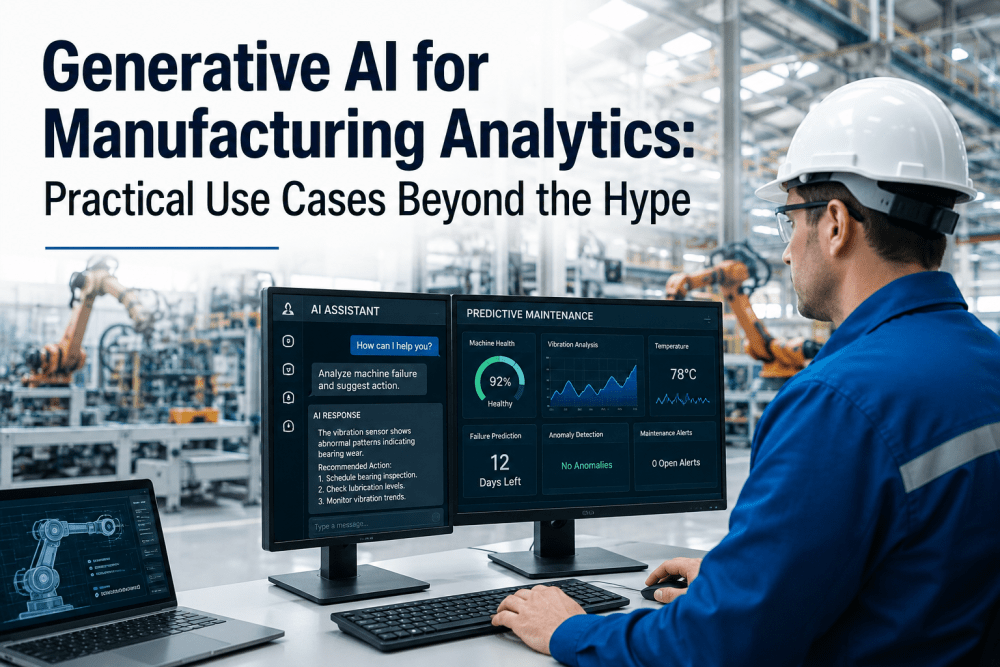
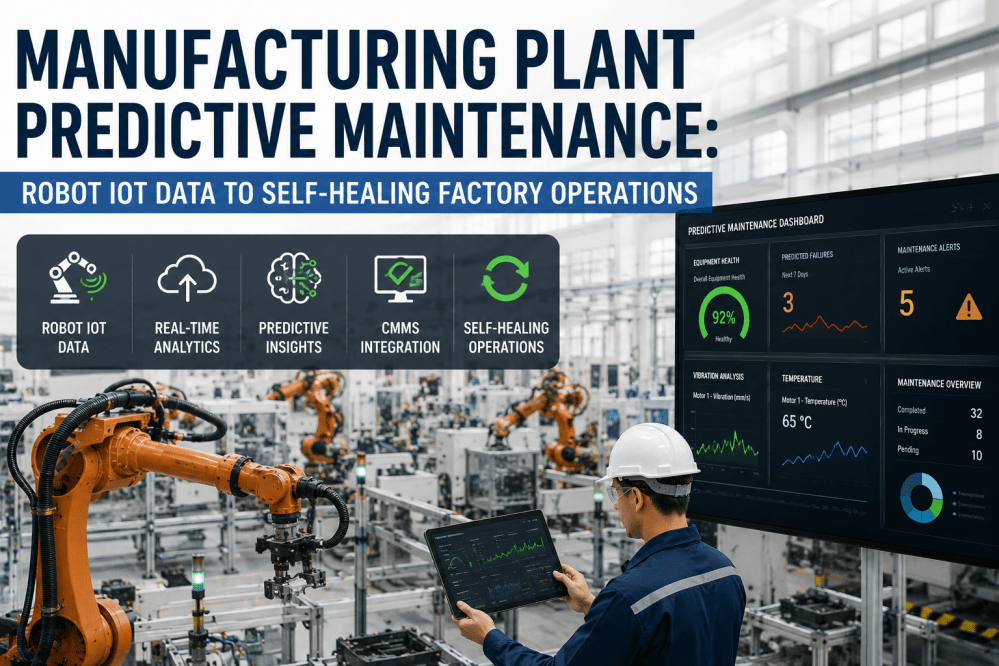
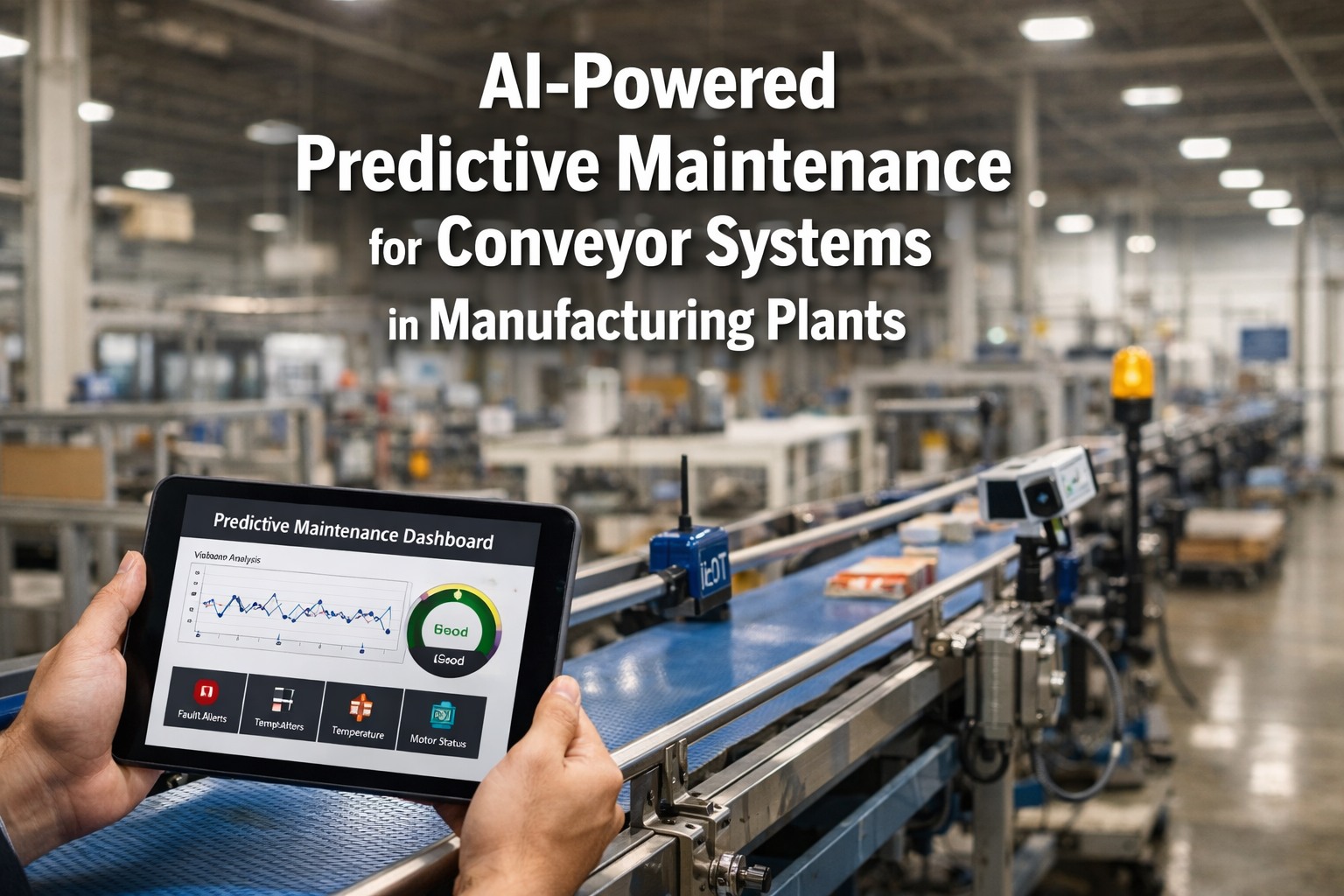
Predictive maintenance models are good at flagging anomalies. They are less good at telling the technician what to do about them. A generative AI copilot bridges the gap: when the vibration model flags an emerging bearing fault, the copilot retrieves the bearing's service history, surfaces similar past failures and their successful repair sequences, and drafts the work order with parts list, tools required, and estimated labor. The technician spends time on the repair instead of on the paperwork around it.
Productivity gain:35–50% reduction in work order preparation time
04
Quality Defect Pattern Recognition and Reporting
When defect rates spike on a production line, the quality team's job is to find the pattern: which shift, which lot of raw material, which operator, which machine, which environmental condition. Generative AI integrated with the MES and quality system runs correlation analysis across thousands of variables and produces a written defect investigation summary — naming the suspected cause and the supporting evidence. What used to be a three-day investigation becomes a one-hour review of the AI-drafted analysis.
Productivity gain:55–75% reduction in defect investigation cycle time
05
Shift Handover and Operational Summary Automation
The 15 minutes at shift change where the outgoing supervisor briefs the incoming one are some of the highest-information-density minutes in any plant — and the most prone to gaps when one party is rushed or distracted. Generative AI produces a structured shift handover document automatically from MES events, alarm logs, work order activity, and quality data: production achieved against target, abnormal events, open issues, and pending actions. The supervisors discuss exceptions instead of reciting facts.
Productivity gain:40–60% improvement in handover completeness and accuracy
Generative AI Architecture: Why RAG and Domain Grounding Changed Everything
The single biggest reason generative AI failed in early manufacturing pilots was hallucination — the tendency of off-the-shelf language models to produce fluent, confident, and completely wrong technical content. The fix that made generative AI deployable in production environments is retrieval-augmented generation: the model does not answer from its training data; it answers from your CMMS records, your equipment manuals, your historical work orders, and your engineering specifications. The model writes the response; the source of truth is your plant data.
Off-the-Shelf LLM Approach
2023–early 2024 pilot model
Answers based on general training data — no plant-specific knowledge
High hallucination risk on technical specifications, torque values, and tolerances
No traceability — engineers cannot verify the source of AI claims
Cannot reference current maintenance history, work orders, or sensor data
Knowledge frozen at model training cutoff — outdated within months
Compliance and audit teams reject output as unverifiable
Typical outcome: Promising demos that never moved to production deployment
RAG-Based Domain-Grounded Approach
iFactory's 2026 deployment architecture
Answers retrieved from your CMMS, MES, document repository, and historian data
Every claim traceable to a source document, work order, or sensor reading
Current data — answers reflect today's maintenance status and equipment state
Audit-ready output with source citations for compliance and quality review
Plant-specific terminology, equipment naming conventions, and procedures
Continuously updated as new work orders, SOPs, and sensor data accumulate
Typical outcome: Production deployment in 8–12 weeks with documented ROI in first quarter
Implementation Sequence: How U.S. Manufacturers Are Phasing Generative AI Deployment
The U.S. manufacturers seeing the strongest returns from generative AI are not the ones with the most ambitious AI strategies — they are the ones who sequenced their deployments correctly. The pattern that works starts with low-risk, high-volume knowledge work and progressively adds use cases as the data infrastructure and team familiarity mature.
Phase 1 — Weeks 1–8
Knowledge retrieval and document automation
Document search assistant
Conversational query interface to SOPs, equipment manuals, and engineering specs — replaces 30+ minutes of document hunting per technician per shift
Shift handover automation
Auto-generated handover summaries from MES, alarm, and work order data — eliminates 15-minute morning briefing inefficiency across all shifts
Phase 2 — Weeks 9–20
Workflow and analysis integration
Failure diagnosis copilot
AI-assisted root cause analysis with evidence ranking — reliability engineers brief from a structured starting point instead of from scratch
Work order drafting
Auto-generated work orders triggered by predictive maintenance alerts — parts, tools, labor estimates pre-populated
Phase 3 — Weeks 21–36
Strategic and cross-functional applications
Quality investigation automation
AI-drafted defect investigation reports with correlation analysis across thousands of process variables and material lots
SOP and training content generation
Auto-drafted standard operating procedures and operator training materials — engineering team edits rather than authors
What Generative AI Will Not Do — and Where Manufacturers Should Set Expectations
The cases where generative AI fails in manufacturing are predictable, and getting them clear in advance saves deployment teams from the disappointment cycle that derailed early pilots. Generative AI is a productivity multiplier on knowledge work — drafting, summarizing, correlating, retrieving. It is not a replacement for engineering judgment, not a substitute for real-time control systems, and not appropriate for safety-critical decisions without human review. The U.S. manufacturers getting the strongest returns are the ones who deploy generative AI where it makes engineers and technicians more productive — not where it makes operational decisions on its own.
Where Generative AI Fits — and Where It Does Not
Strong Fit Use Cases
Drafting documents that humans review and approve
Summarizing historical maintenance and quality records
Retrieving information from technical document libraries
Pattern recognition and correlation across operational data
Generating structured output from unstructured inputs
Poor Fit Use Cases
Real-time machine control or PLC decision-making
Safety-critical decisions without engineering review
Final regulatory submissions without compliance sign-off
Calculations requiring high numerical precision
Decisions without traceable source documentation
Move Beyond the Hype. Deploy Generative AI Where It Actually Produces ROI.
iFactory's generative AI module integrates with your CMMS, MES, and document repositories to deliver grounded, traceable, plant-specific AI assistance — from failure diagnosis to SOP generation to shift handover automation, deployed in 8–12 weeks with measurable productivity ROI in the first quarter.
Expert Review: What U.S. Reliability and Operations Leaders Say After 12 Months
"What changed my mind on generative AI was the failure diagnosis assistant. I was skeptical because I'd seen the early demos and they produced confident-sounding nonsense. But once it was pulling from our actual CMMS history and equipment manuals, it stopped hallucinating and started genuinely shortening our investigations. We documented a 58% reduction in mean time to diagnosis on our top 20 critical assets in the first six months. That is real productivity, not a slideshow."
"Our SOP library was three years out of date — we had 1,400 documents and maybe 300 of them reflected the equipment as it actually exists on the floor. We tried the traditional approach of hiring contractors to refresh them, and the cost estimate came back at $680,000 over 14 months. With AI-assisted drafting, our internal engineering team refreshed the entire library in 11 weeks. Total spend was under $90,000, and the documents are actually accurate because the AI pulled directly from current equipment data."
Director of OperationsFood and Beverage Processing Company, Ohio
Generative AI in U.S. manufacturing is no longer a question of whether the technology works — the answer to that question was settled in the past 18 months by the manufacturers who quietly moved past pilot programs into production deployments. The remaining questions are which use cases to deploy first, how to sequence the rollout to build organizational confidence and measurable returns, and how to architect the data foundation so the AI answers from grounded plant knowledge rather than hallucinated text. The U.S. manufacturers winning with generative AI are the ones who treat it as a productivity multiplier on the knowledge work their engineering and operations teams already do — not as a replacement for human judgment, and not as a silver bullet that solves every operational problem at once. iFactory's generative AI module is built on that principle: grounded, traceable, integrated with your existing systems, and deployed against the use cases that produce documented ROI within the first quarter of operation.
How does generative AI in manufacturing differ from general-purpose AI tools like ChatGPT?
The fundamental difference is grounding. General-purpose AI tools answer from their training data, which has no awareness of your specific equipment, maintenance history, safety procedures, or operational context. Manufacturing-grade generative AI uses retrieval-augmented generation (RAG) to answer from your CMMS records, equipment manuals, work order history, and historian data — every claim traceable to a source document or sensor reading in your environment. The practical result is that manufacturing AI produces verifiable, auditable output that engineering and compliance teams will accept; general-purpose AI produces fluent prose that frequently cannot be trusted in a production context.
What is the typical deployment timeline for generative AI in a manufacturing facility?
For a mid-size U.S. manufacturer with existing CMMS and MES systems, iFactory typically deploys the first generative AI use cases — document search and shift handover automation — within 6–8 weeks. The full Phase 1 capability set is operational by week 8. Phase 2 use cases such as failure diagnosis assistance and AI-drafted work orders typically reach production by weeks 14–20. The phased approach lets the deployment team verify each use case against measurable productivity metrics before adding scope, which is the pattern that produces the strongest sustained ROI.
How does iFactory's generative AI handle data security and proprietary information?
iFactory's generative AI architecture is designed for manufacturing environments where intellectual property protection is non-negotiable. The deployment options include on-premises hosting, private cloud deployment within the customer's tenant, and hybrid configurations where sensitive data never leaves the facility. Model interactions are logged for audit purposes; no customer data is used to train shared models; and access controls integrate with the customer's existing identity management. For aerospace, defense, and regulated industries, iFactory offers deployment configurations that meet ITAR, CMMC, and FDA 21 CFR Part 11 requirements.
What does generative AI cost relative to the productivity returns it delivers?
For a typical mid-size U.S. manufacturing facility, generative AI deployment runs $85,000 to $240,000 in the first year, including platform licensing, integration with existing CMMS and MES systems, and deployment services. Documented productivity returns at iFactory client facilities average $380,000 to $620,000 in the first 12 months from time savings on technical documentation, failure diagnosis, shift reporting, and work order preparation — producing a typical first-year net return of 2.5x to 4x and ongoing annual productivity gains of $400,000 to $700,000 per facility once Phase 2 and Phase 3 use cases are in production.
Will generative AI replace maintenance technicians, reliability engineers, or operations staff?
No, and the U.S. manufacturers seeing the strongest returns from generative AI are explicit that this is not the goal. The technology multiplies the productivity of skilled engineers and technicians — letting them spend more time on judgment-intensive work and less on paperwork, documentation hunting, and routine analysis that AI can draft for human review. In practice, generative AI is making existing manufacturing roles more attractive: technicians spend their shifts on equipment instead of on data entry, and engineers focus on the 20% of problems that genuinely require their expertise rather than on the 80% of repetitive documentation that previously consumed their week.
Stop Watching Generative AI From the Sidelines. Deploy It Where It Works.
iFactory's generative AI module is in production at U.S. manufacturing facilities across automotive, food and beverage, metals, and discrete manufacturing — deployed in 8–12 weeks, grounded in your plant data, and producing documented productivity returns of 2.5x to 4x in the first 12 months of operation.