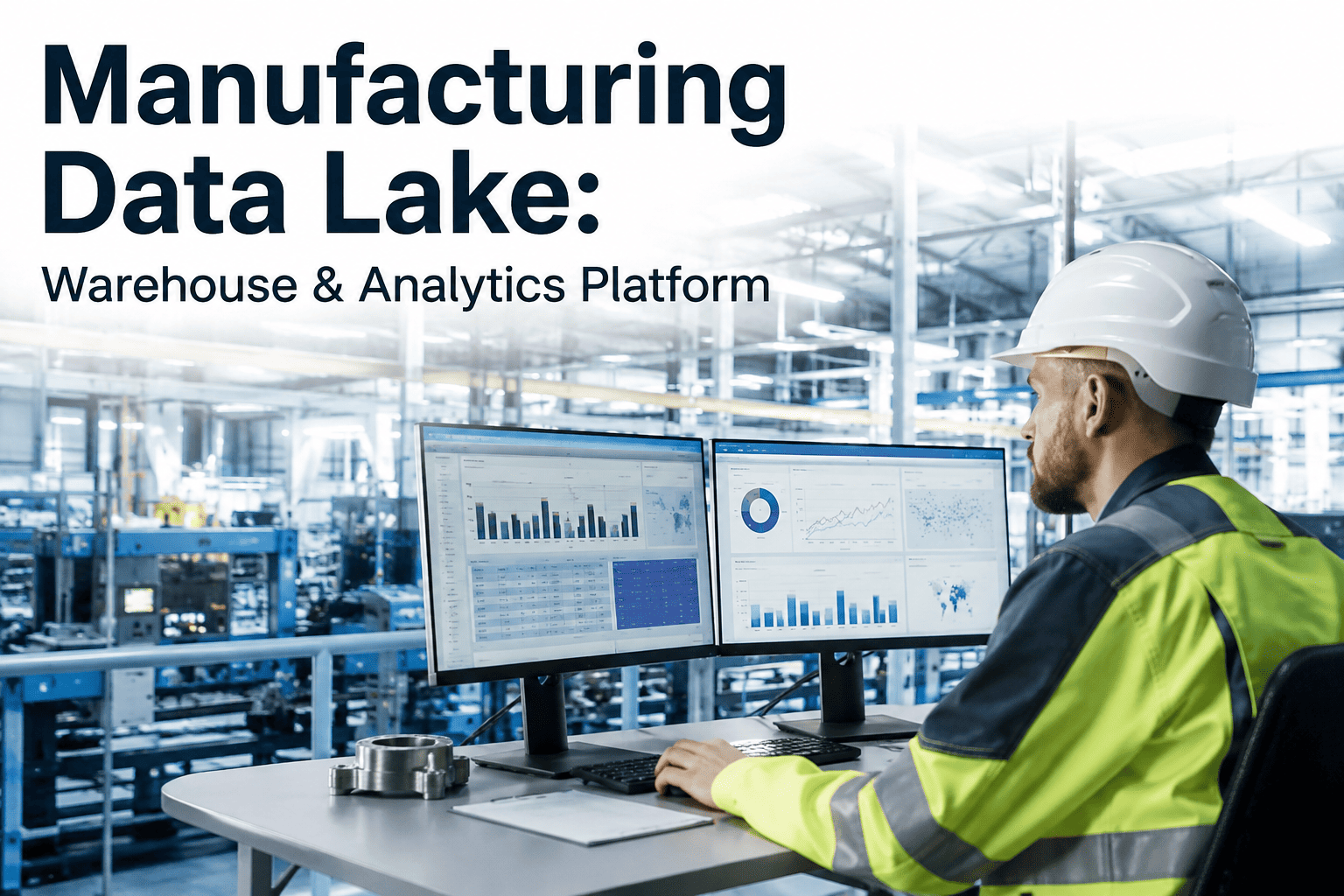
Spare parts inventory sits at the intersection of two competing pressures that every U.S. manufacturing operation knows intimately: the operational risk of not having a critical component when equipment fails, and the financial cost of carrying thousands of SKUs that may never move. For most facilities, MRO inventory management has historically been treated as a back-office function — managed with spreadsheets, institutional memory, and annual audit cycles that are structurally incapable of keeping pace with the complexity of modern manufacturing. The result is a paradox that plays out on plant floors every day: stockouts on the parts that matter most and warehouses full of components that haven't been touched in years. Data-driven spare parts optimization breaks this paradox by connecting equipment condition signals, consumption history, supplier lead times, and criticality classification into a continuously updated inventory model — one that tells planners not just what is on the shelf, but what needs to be there before the next failure occurs. For manufacturing operations that have made this transition, the financial impact is not incremental. It is structural: less emergency procurement, less tied-up capital, fewer unplanned stoppages, and maintenance teams that spend their time fixing equipment rather than hunting for parts.
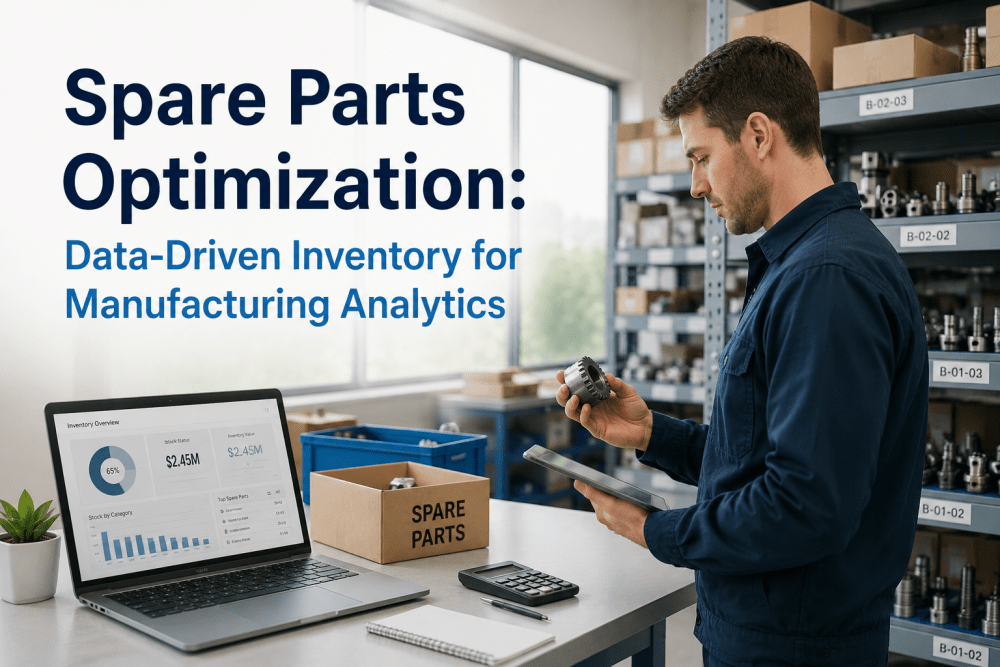
Spare Parts Optimization: Data-Driven Inventory for Manufacturing
iFactory's AI inventory platform helps manufacturing operations eliminate costly stockouts, reduce excess MRO carrying costs, and ensure critical spare parts are always available — without overstocking.
Why Traditional MRO Inventory Management Leaves Money on the Table
Most manufacturers still manage spare parts inventory the same way they did two decades ago: static reorder points, annual audits, and tribal knowledge about which parts to keep on the shelf. This approach has four structural weaknesses that compound over time.
Four Structural Failures of Legacy Spare Parts Management
The Data-Driven Spare Parts Optimization Framework
Effective spare parts optimization is a layered analytical framework that connects equipment condition data, consumption history, supplier lead times, and criticality classification into a continuously updated inventory model. Here is how leading manufacturers structure this process.
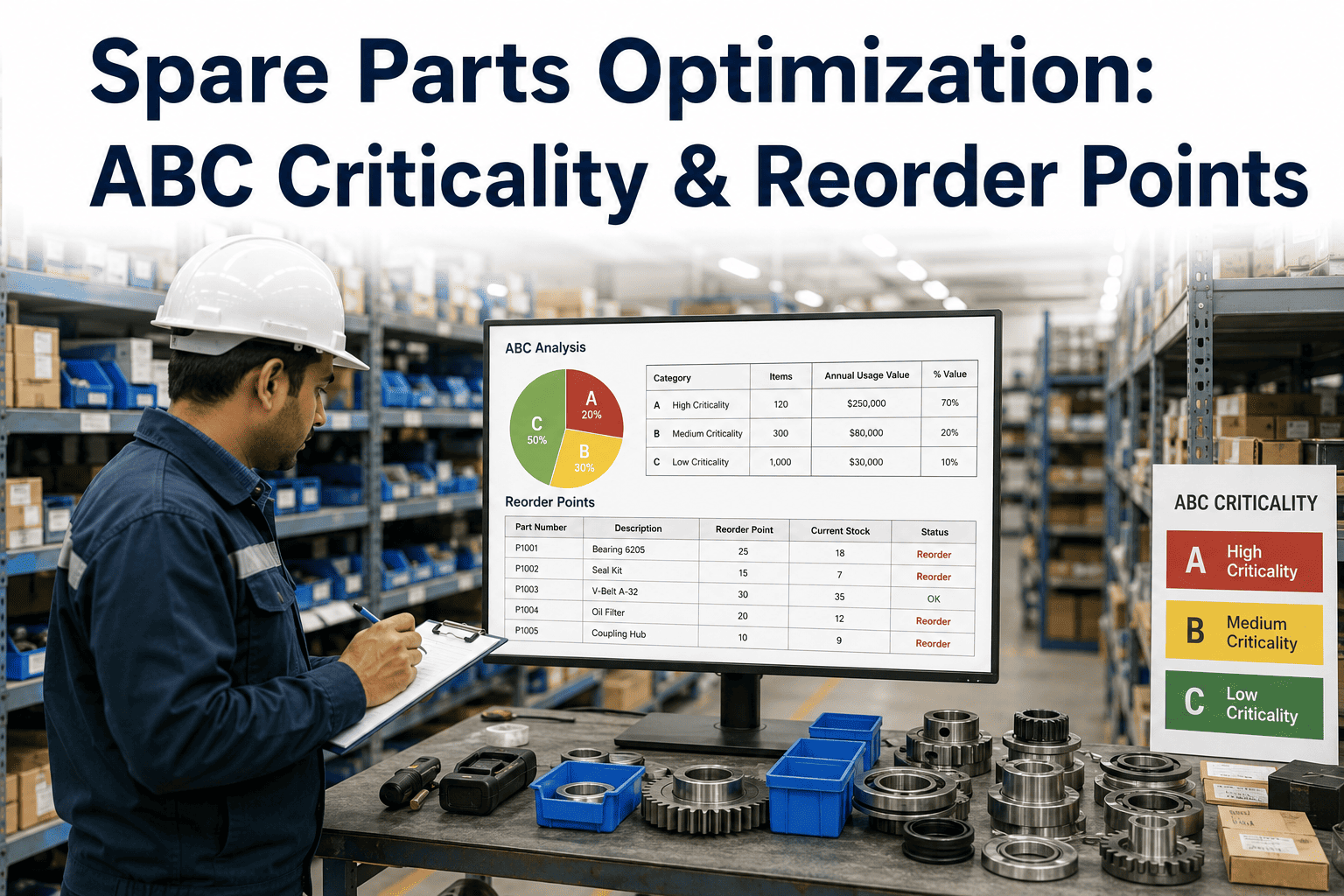
Parts Criticality Classification
Every spare part is scored on two axes: the criticality of the equipment it supports (impact of downtime on production throughput) and the availability risk of the part itself (lead time, single-source exposure, obsolescence risk). This produces a criticality matrix that drives differentiated stocking strategies — not a single policy applied uniformly across all SKUs.
Consumption Pattern Analysis
Historical work order data, maintenance records, and CMMS consumption logs are analyzed to identify actual usage rates by part, by equipment class, and by production schedule phase. AI models distinguish planned preventive maintenance consumption from unplanned corrective demand — which have fundamentally different stocking implications.
Predictive Demand Integration
When predictive maintenance models flag elevated failure probability on specific assets, the inventory system automatically adjusts forward stocking recommendations for parts associated with those failure modes. This integration — between condition monitoring and inventory planning — is the single largest driver of stockout reduction in modern manufacturing operations. See how iFactory connects predictive maintenance to inventory — book a demo.
Dynamic Reorder Point Calculation
Reorder points and safety stock levels are recalculated continuously based on current lead time data from suppliers, updated consumption forecasts, and equipment condition signals — not reset once a year during planning cycles. Dynamic recalculation is what separates optimized from merely organized inventory management.
Obsolescence & Rationalization Management
The system continuously monitors parts with zero consumption over rolling 12-month and 24-month windows, flags them for rationalization review, and identifies interchangeable substitutes that allow inventory consolidation. Proactive obsolescence management typically recovers 15–22% of tied-up MRO capital in the first year alone.
Spare Parts Optimization Across Manufacturing Environments
Effective MRO inventory optimization delivers distinct value across different manufacturing environments. The use cases and measurable outcomes differ by facility type — here is what each segment achieves.
Discrete Manufacturing: Assembly & Machining
Discrete manufacturers managing high-mix, low-volume production rely on parts availability to avoid line stoppages on critical tooling and mechanical components. AI optimization reduces emergency purchase orders by 68% and right-sizes safety stock to actual consumption patterns — typically recovering $180K–$420K in annual emergency procurement costs.
Process Manufacturing: Chemical & Food
Process manufacturers operating continuous production lines face catastrophic downtime costs when critical seals, pumps, or valves are unavailable. AI criticality classification ensures insurance spares for single-point-of-failure equipment are always held while eliminating excess stock on non-critical components — reducing overall MRO inventory value by 20–28%.
Multi-Site Operations: Centralized Warehousing
Multi-plant operations with centralized MRO warehousing gain the largest returns from AI optimization through interplant transfer intelligence — routing parts from overstocked facilities to understocked ones before triggering new purchase orders. This network-level optimization reduces total network inventory by 18–24% without compromising fill rates at any individual site.
Heavy Industry: Mining & Metals
Heavy industry operations managing large rotating equipment fleets — conveyors, crushers, mills, and compressors — face high per-unit parts costs and long supplier lead times. AI optimization integrates vibration monitoring and wear data directly into inventory planning, ensuring replacement components are on-site before failures occur rather than ordered reactively after them.
Traditional vs. Data-Driven Spare Parts Management
The operational and financial difference between static and AI-driven MRO inventory management is measurable across every dimension that matters to a plant manager or maintenance director. The following benchmarks reflect current deployments across U.S. manufacturing operations.
| Performance Metric | Traditional / Static | AI-Driven (iFactory) | Performance Delta |
|---|---|---|---|
| Critical Parts Fill Rate | 78–84% typical | 98%+ with predictive stocking | Near-zero critical stockouts |
| Inventory Carrying Cost | 15–22% excess above optimal | Confidence-band optimized | -25% carrying cost |
| Obsolete Inventory Share | 30–40% of total stock | Continuous rationalization | 15–22% capital recovered |
| Emergency Purchase Orders | High frequency, premium cost | -68% emergency PO reduction | $180K–$420K/yr savings |
| Reorder Point Accuracy | Annually updated, static | Continuously recalculated | Real-time lead time response |
| Unplanned Downtime from Stockouts | 4–8 hrs/month average | Under 1 hr/month | -87% downtime exposure |
| Planner Labor (MRO Reconciliation) | 2–3 FTE manual load | Automated AI-directed planning | $240K–$380K FTE reallocation |
| Black Swan Supply Disruptions | No proactive scenario coverage | AI scenario pre-positioning | Disruption buffer deployment |
The business case is not incremental — manufacturers transitioning to AI-driven MRO optimization consistently report ROI realization within 6–10 months, driven primarily by emergency purchase elimination and obsolescence capital recovery. Book a demo to build a custom ROI model for your plant's inventory profile.
Ready to Replace Static Reorder Rules with AI-Driven Inventory Intelligence?
iFactory's spare parts optimization platform is already deployed across discrete manufacturing, process industries, and MRO-intensive facilities. Get a live walkthrough configured for your plant's equipment profile and inventory complexity.
Deploying AI Spare Parts Optimization: The 90-Day Implementation Timeline
Transitioning from static MRO management to a data-driven optimization platform does not require a multi-year ERP overhaul. iFactory's deployment methodology is structured for manufacturing environments with existing CMMS, ERP, and SCADA systems — delivering measurable inventory improvement by Day 45 while the full AI model matures.
Inventory Audit & Data Integration
Complete current-state inventory audit with criticality classification of all active SKUs. Integration connectors deployed to existing CMMS, ERP, and procurement systems. Historical consumption data ingested and normalized for model training. No downtime required on operational systems.
Demand Modeling & Reorder Point Recalibration
AI consumption models trained on 18–24 months of historical work order and procurement data. Initial dynamic reorder points generated for all A and B criticality parts. Baseline excess inventory and obsolescence exposure quantified. Book a demo to walk through the demand modeling methodology with iFactory engineers.
Predictive Maintenance Integration & Stockout Elimination
Inventory recommendations connected to predictive maintenance failure probability signals. Automated alerts activated for parts associated with flagged equipment. Emergency purchase order frequency tracked as primary leading indicator of optimization impact.
Full Optimization, Obsolescence Recovery & KPI Dashboards
Obsolescence rationalization recommendations activated. Capital recovery plan generated for excess and dead stock. Executive and operations dashboards live with real-time inventory efficiency KPIs. Continuous retraining pipeline operational with every new consumption event.
What Manufacturing Operations Leaders Say About Data-Driven MRO Management
iFactory's supply chain and maintenance engineering team has worked with manufacturing operations ranging from single-site discrete manufacturers to multi-plant process operations. The following reflects distilled insight from MRO optimization deployments across U.S. manufacturing environments.
"The breakthrough insight in spare parts optimization is not that you need more data — most plants are already drowning in data from their CMMS and ERP systems. The breakthrough is connecting that data to the right decision model. When a vibration sensor flags bearing degradation on a critical compressor, the inventory system should already be checking whether the replacement bearing is in stock and automatically triggering a reorder if it isn't. That closed loop between condition monitoring and inventory action is what eliminates the 3 a.m. emergency calls. The plants that build this connection consistently operate with 30–40% less MRO capital tied up than those that don't."
Three Non-Obvious Insights from MRO Optimization Deployments
The Financial Impact: Building the Business Case for AI Spare Parts Optimization
For manufacturing operations evaluating AI inventory investment, the business case is built across five primary value streams. The following framework reflects realistic value realization estimates based on current deployments across U.S. discrete and process manufacturing operations.
| Value Stream | Current State Cost | With AI Optimization | Annual Value |
|---|---|---|---|
| Excess Safety Stock Capital | 15–22% above optimal | Confidence-band optimized | $280K–$640K per facility |
| Emergency Purchase Orders | $180K–$420K/yr (mid-size plant) | -68% with AI demand signals | $122K–$285K savings |
| Obsolescence Capital Recovery | 30–40% dead or excess stock | Continuous rationalization | 15–22% of total MRO value |
| Unplanned Downtime from Stockouts | 4–8 hrs/month at $8K–$40K/hr | Under 1 hr/month average | $1.2M–$3.8M/yr prevented |
| Planning Labor & Reconciliation | 2–3 FTE manual planning load | Automated AI-directed planning | $240K–$380K FTE reallocation |
For a mid-size manufacturing operation with 2–4 facilities and 3,000+ active MRO SKUs, total annual value realization from AI spare parts optimization consistently exceeds $2 million, with full deployment cost typically recovered within the first 6–10 months. Book a demo to build a custom ROI model for your specific asset portfolio.
Spare Parts Optimization Is Now a Competitive Requirement, Not a Cost-Cutting Exercise
The manufacturers winning on operational efficiency in 2026 are not the ones with the largest spare parts warehouses — they are the ones with the smartest inventory models. Data-driven spare parts optimization converts MRO inventory from a cost center managed by intuition into a strategic asset managed by continuous analytics.
The tools to do this are no longer experimental. AI-driven inventory platforms integrated with CMMS work order data, predictive maintenance signals, and supplier lead time feeds are deployed and delivering measurable results at manufacturing facilities across the U.S. right now. The operational gap between manufacturers that have made this transition and those still running on static min/max rules is already significant — and it compounds every quarter.
iFactory's spare parts and inventory management platform has been purpose-built for the data complexity and maintenance workflow requirements of manufacturing operations. Book a demo with our MRO optimization specialists to see a live walkthrough configured for your facility type.
Frequently Asked Questions: Spare Parts Optimization for Manufacturing
How does iFactory's spare parts platform integrate with our existing CMMS and ERP systems?
iFactory uses pre-built integration connectors for the CMMS platforms most commonly deployed in U.S. manufacturing — including IBM Maximo, SAP PM, Oracle eAM, Infor EAM, and UpKeep — as well as ERP systems including SAP, Oracle, and Microsoft Dynamics. Integration is completed through secure API connections and does not require modification to existing operational systems. Most integrations are live within the first 15–20 days of deployment, with no operational system downtime required.
What is the typical reduction in MRO inventory carrying costs after implementing AI-driven optimization?
Manufacturers implementing iFactory's AI-driven inventory optimization typically achieve 20–28% reduction in MRO carrying costs within the first 12 months, driven by a combination of safety stock right-sizing, obsolescence recovery, and elimination of duplicate SKUs identified through the parts rationalization engine. Plants starting from a less disciplined baseline typically see larger initial gains.
How does the platform handle critical insurance spares for major equipment with long lead times?
Insurance spare management is handled through a separate criticality tier in iFactory's classification engine. Parts in this tier — typically capital-intensive components for single-point-of-failure equipment — are managed under availability-first stocking policies rather than demand-driven reorder models. The platform tracks supplier lead time changes, equipment age, and parts interchangeability to continuously validate whether each insurance spare remains appropriately configured for the current environment.
How long does it take to see measurable inventory improvement after deployment?
Most manufacturing operations see their first measurable improvement — typically in the form of emergency purchase order frequency reduction — within 45–60 days of deployment, as initial AI reorder point recommendations take effect. Obsolescence capital recovery begins during the first 30–45 days as rationalization recommendations are generated. Full optimization performance is typically achieved between months 3 and 5.
Is this solution appropriate for smaller manufacturing operations, or only for large multi-plant enterprises?
iFactory's inventory optimization platform scales from single-facility manufacturers managing 500–1,000 active spare parts SKUs up to multi-plant enterprises with centralized warehousing and complex interplant transfer requirements. Smaller operations often achieve faster time-to-value because their inventory topology is simpler to model. The core AI framework operates the same way at all scale levels, with configuration adjusted for each facility's equipment profile and supply chain complexity.
Stop Managing Spare Parts by Intuition. Start Managing by Data.
iFactory's AI-driven spare parts platform eliminates critical stockouts, recovers tied-up MRO capital, and connects inventory planning directly to equipment condition — all without replacing your existing CMMS or ERP.