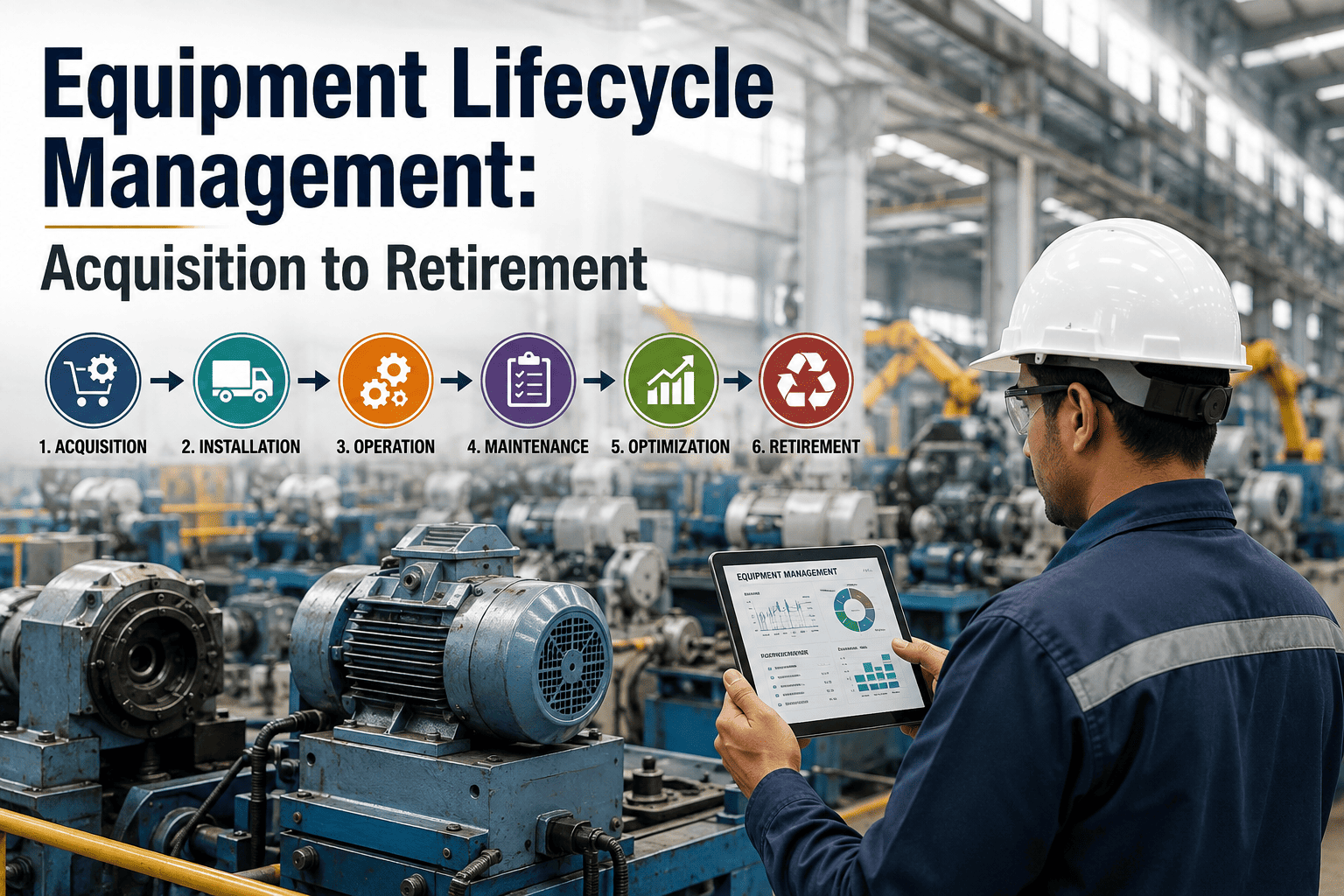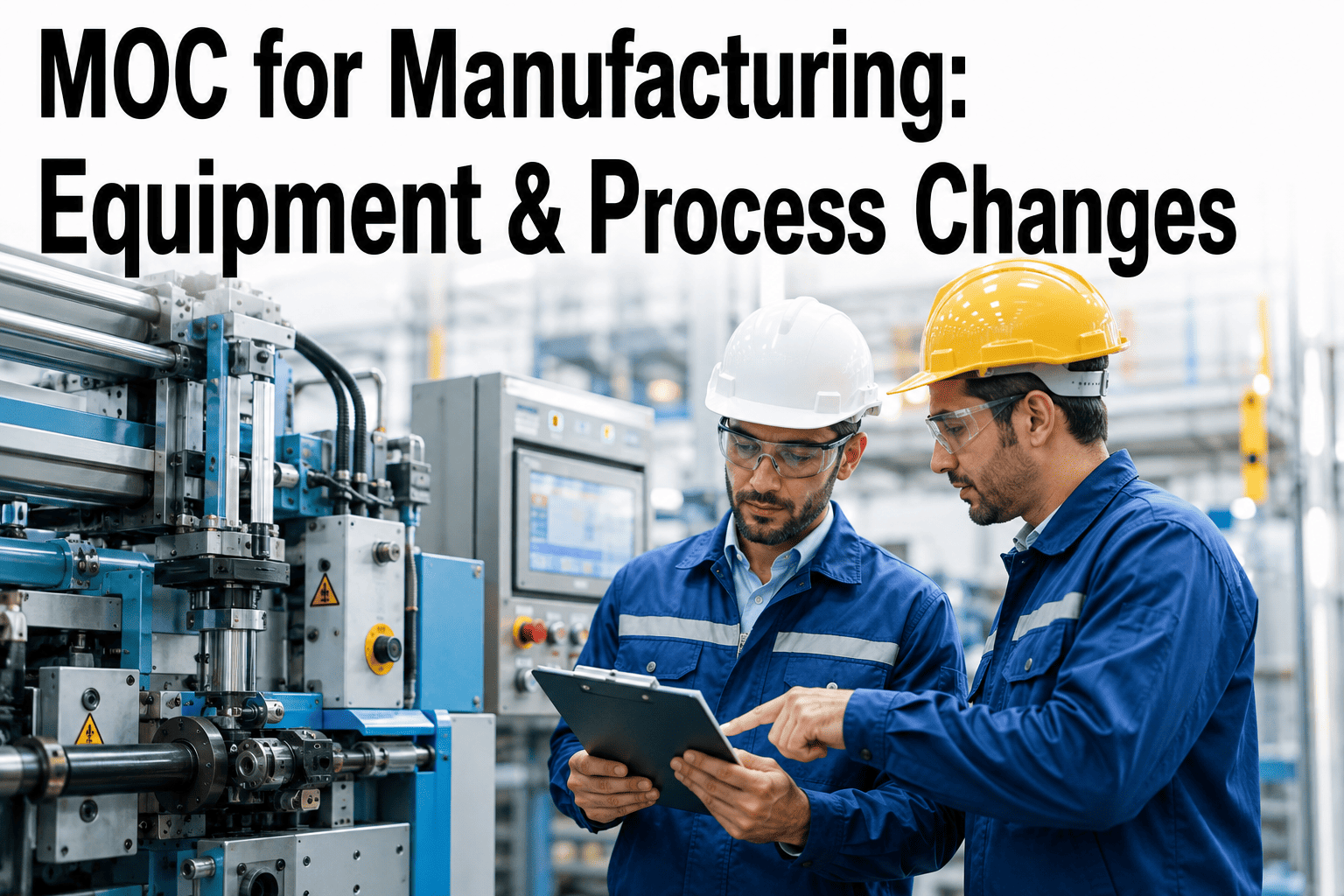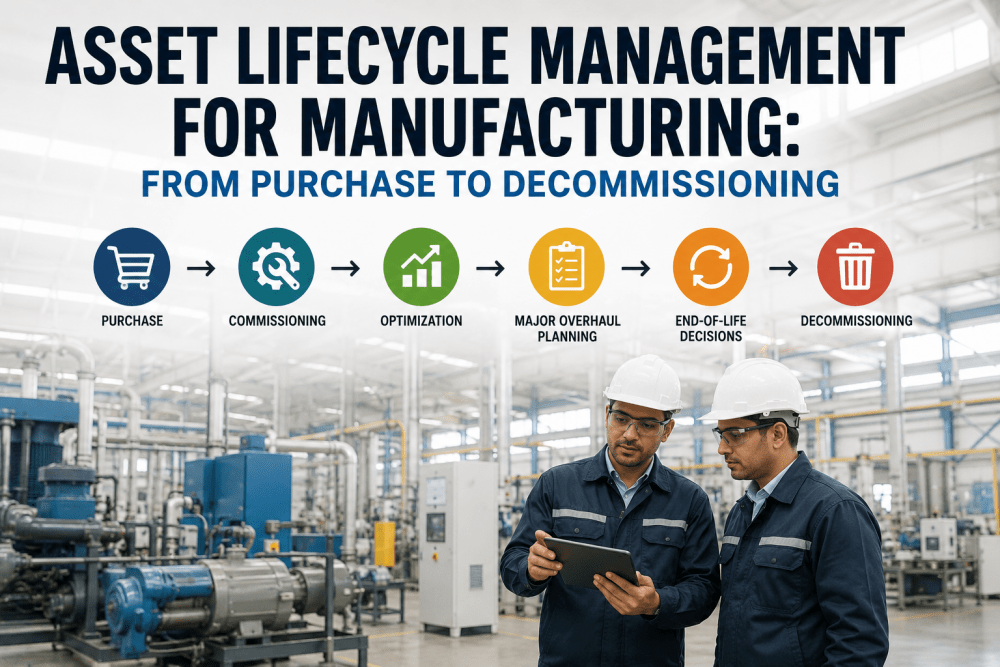
Asset Lifecycle Management has evolved from a financial accounting exercise into a strategic operational discipline that determines whether U.S. manufacturers extract full value from their capital investments or quietly bleed millions in unrealized ROI. Every piece of production equipment — from CNC machining centers and injection molding presses to packaging lines and overhead cranes — passes through five distinct lifecycle stages: planning and procurement, commissioning, operational use, maintenance and optimization, and finally decommissioning or disposal. Most manufacturers manage these stages in disconnected silos: procurement owns the purchase, operations runs the asset, finance tracks depreciation and decommissioning becomes a last-minute scramble when equipment finally fails. This fragmentation costs the average U.S. manufacturing facility between 12% and 18% of total asset value over the equipment lifecycle through premature replacements, missed warranty claims, untracked downtime costs and write-offs of assets that still carried residual value. A unified Asset Lifecycle Management approach — backed by intelligent software, structured workflows, and connected operational data — eliminates these losses and turns every asset into a measurable, optimized profit contributor. If your operation is still managing capital equipment across disconnected spreadsheets, ERP modules, and tribal knowledge, Book a Demo to see how iFactory's Asset Lifecycle Management platform unifies purchase-to-decommissioning visibility across your entire equipment portfolio.
Manage Every Manufacturing Asset From Purchase Through Decommissioning — In One Connected Platform.
iFactory's Asset Lifecycle Management platform unifies procurement records, commissioning data, operational performance, maintenance history, and end-of-life planning into a single source of truth — so every CapEx decision is informed, every asset delivers full ROI, and no equipment leaves your floor with hidden value.
Understanding the Full Asset Lifecycle: Where Manufacturers Win or Lose Equipment ROI
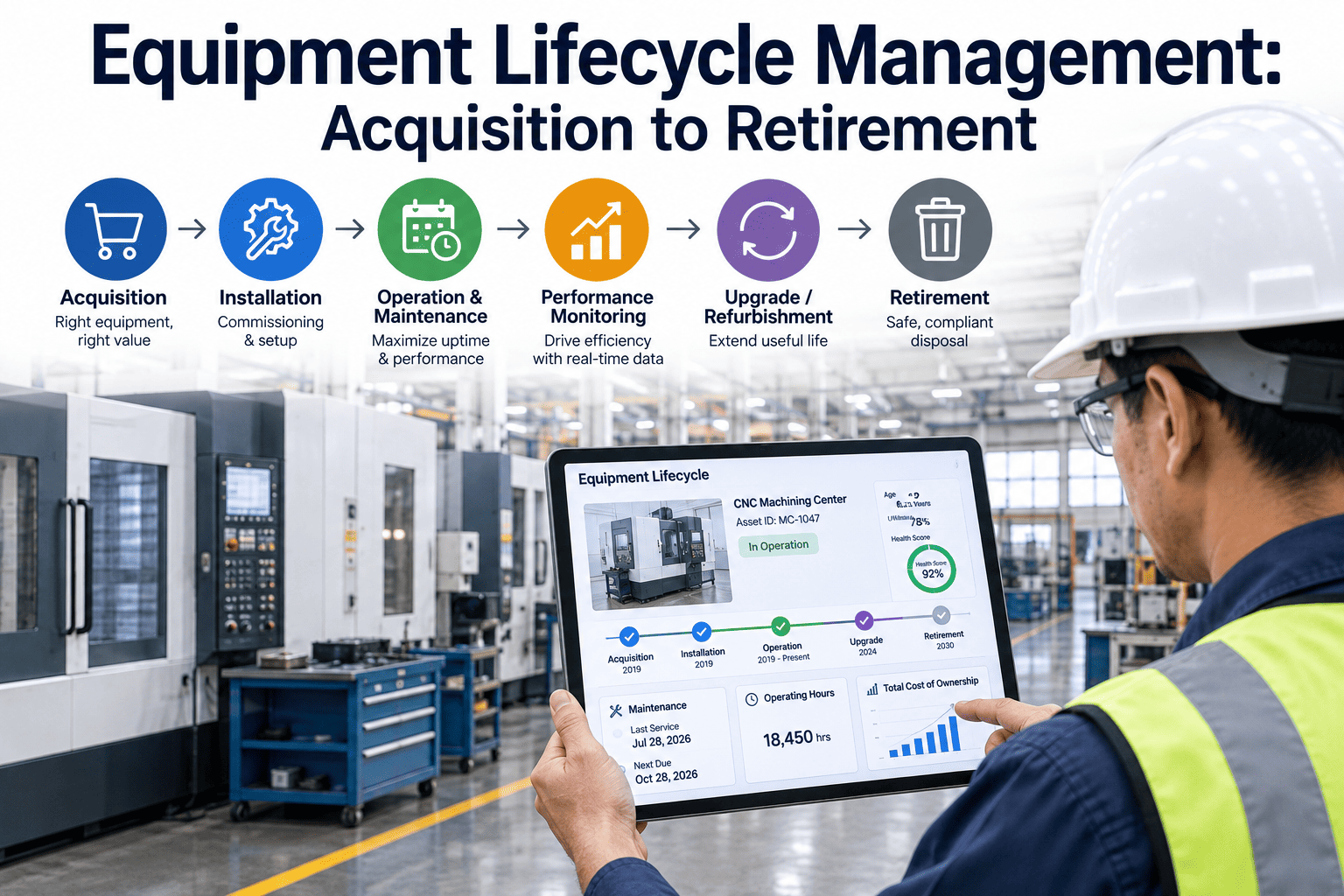
A manufacturing asset is not a static line item on a balance sheet — it is a dynamic entity that moves through five well-defined stages, each with its own decision points, cost drivers, and value-creation opportunities. Manufacturers who treat these stages as separate administrative events leave value on the table at every transition. Manufacturers who treat them as a continuous, instrumented lifecycle capture compounding gains in availability, total cost of ownership, and capital efficiency. The five stages below define the structure that iFactory's Asset Lifecycle Management platform automates and optimizes for U.S. manufacturing operations.
Planning & Procurement
Total cost of ownership modeling, vendor evaluation, technical specification alignment, and CapEx justification — the stage where 70% of an asset's lifetime cost is locked in before it ever arrives on the floor.
Commissioning & Onboarding
Installation verification, factory acceptance testing, warranty registration, asset tagging, baseline performance capture, and integration into the digital asset register — establishing the data foundation for every downstream decision.
Operational Use
Production utilization tracking, OEE monitoring, downtime cost attribution, and continuous performance benchmarking against design specifications — the longest stage and the one that generates the data needed for every other decision.
Maintenance & Optimization
Preventive maintenance execution, predictive condition monitoring, spare parts management, retrofit and upgrade planning, and reliability engineering interventions that extend useful life and defer capital replacement.
Decommissioning & Disposal
End-of-life valuation, residual value recovery, environmental compliance, decommissioning workflow execution, and lessons-learned capture that informs the next procurement cycle — closing the loop on the asset's full economic life.
Unified Asset Register
A centralized digital twin of every asset that connects all five stages — with hierarchical asset structures, complete service history, financial data, and operational context accessible to every stakeholder in real time.
The Asset Lifecycle Workflow: How iFactory Connects Every Stage
The diagram below illustrates the continuous workflow that iFactory's Asset Lifecycle Management platform orchestrates across every manufacturing asset — from initial business case through final disposition. Each stage feeds structured data forward into the next, creating a closed-loop system where insights from operational performance inform future procurement, and decommissioning lessons reshape the planning stage for the next generation of equipment. Book a Demo to see this workflow applied to your specific asset portfolio.
Why TCO — Not Purchase Price — Is the Real Measure of Manufacturing Asset Value
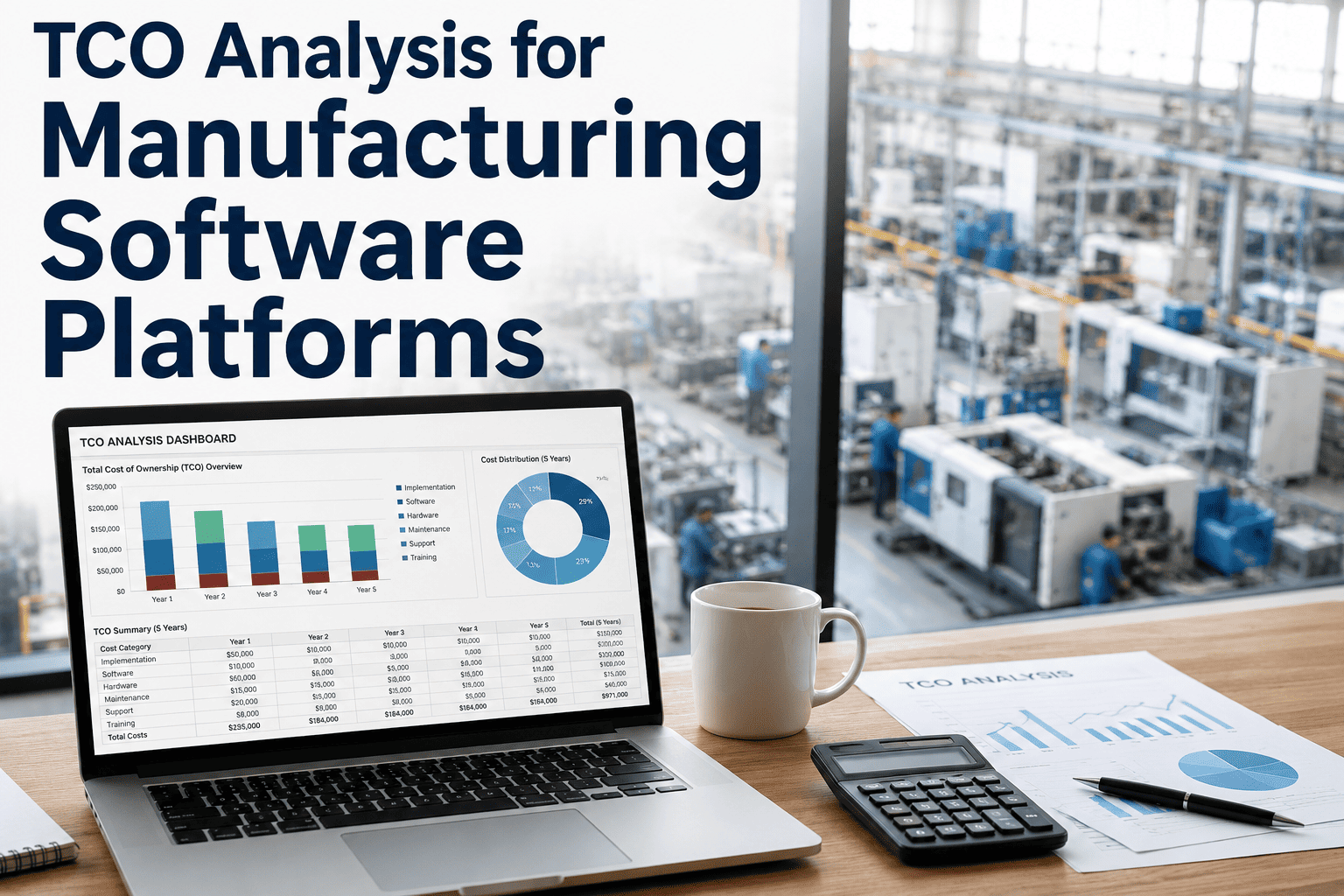
The single most expensive mistake U.S. manufacturers make in capital equipment decisions is selecting assets on purchase price rather than total cost of ownership. Acquisition cost typically represents only 15% to 30% of an asset's lifetime financial footprint. The remaining 70% to 85% is locked in across maintenance labor, spare parts consumption, energy usage, downtime impact, training requirements, and end-of-life disposition. A lower-priced machine that consumes 20% more energy, requires proprietary spare parts, and lacks remote diagnostic capability will routinely cost two to three times more across a ten-year operating window than a higher-priced alternative with superior lifecycle economics. iFactory's Asset Lifecycle Management platform makes TCO visible and actionable — not as a one-time procurement exercise, but as a continuously updated metric that informs every decision from initial purchase to mid-life upgrade to final decommissioning. Book a Demo to see how iFactory builds a real TCO model for your asset categories.
Purchase price, freight, installation, initial commissioning — the visible cost that dominates procurement decisions but represents a minority of lifetime spend.
Preventive maintenance labor, spare parts, breakdown repairs, contractor services, and reliability engineering investments across the operational life.
Electrical consumption, compressed air, water, consumables, and operator labor — recurring costs that compound dramatically over a 10–15 year asset life.
Unplanned downtime cost, throughput loss, quality scrap, and missed shipments — often the largest hidden cost in poorly managed asset portfolios.
Removal labor, environmental compliance, disposal fees, and any residual value recovery from resale, parts harvesting, or scrap metal recovery.
The complete financial picture that iFactory's platform tracks across every asset — making CapEx decisions, replacement timing, and upgrade investments quantifiable and defensible.
For most U.S. manufacturers I work with, the asset lifecycle conversation starts and ends with depreciation schedules — which is exactly why so much equipment value evaporates without anyone noticing. When we deployed iFactory's Asset Lifecycle Management module across our four plants, the immediate revelation was that we had been replacing assets three to five years before their economically optimal retirement point, simply because we had no visibility into actual condition and remaining useful life. The TCO modeling alone shifted nearly $4.2 million in planned CapEx into the following two fiscal years — capital that we instead deployed into capacity expansion. The platform pays for itself in the first replacement decision it informs.
When to Repair, Retrofit, or Replace: The Manufacturing Asset Decision Framework
One of the most consequential decisions in Asset Lifecycle Management is determining when an asset has reached its economically optimal retirement point. Replace too early and capital is wasted on equipment that still had productive life remaining. Replace too late and accumulating maintenance costs, declining reliability, and energy inefficiency erode margin month after month. iFactory's platform uses condition data, maintenance history, and TCO trajectory modeling to recommend the right action at the right time across three structured options.
Option 1 — Repair & Maintain
For assets within 60% of design life, with stable maintenance cost trends and acceptable reliability metrics, continued operation with reliability-centered maintenance investment delivers the strongest ROI. iFactory's reliability dashboards continuously validate that this assumption remains true and flag drift before it becomes a structural problem.
Option 2 — Retrofit & Upgrade
For mid-life assets with strong mechanical fundamentals but obsolete control systems, energy inefficiency, or capability gaps, targeted retrofits — modern PLCs, variable frequency drives, IIoT instrumentation, or capacity upgrades — extend useful life by 5 to 10 years at a fraction of replacement cost. iFactory's retrofit ROI calculator quantifies the case for every candidate asset.
Option 3 — Replace & Decommission
For assets where annual maintenance cost exceeds 15% of replacement value, where reliability has degraded to unacceptable thresholds, or where production requirements have outgrown design capacity, structured replacement combined with disciplined decommissioning is the economically optimal path. iFactory orchestrates both halves of this transition.
Traditional Asset Management vs. iFactory Lifecycle Management: A Direct Comparison
The operational difference between fragmented asset tracking and unified lifecycle management is not a matter of incremental improvement — it is a different operating model. The comparison below highlights how iFactory transforms each stage of the asset journey for U.S. manufacturers.
| Lifecycle Stage | Traditional Approach | iFactory Lifecycle Management | Operational Outcome |
|---|---|---|---|
| Procurement Planning | Purchase-price-driven RFQ process, limited TCO modeling, fragmented vendor data | TCO-modeled vendor scoring, integrated specification library, automated business case generation | Procurement decisions aligned with lifetime economic outcomes |
| Commissioning | Paper-based FAT documents, manual asset tagging, warranty data lost in email threads | Digital commissioning workflows, automated asset register entry, structured warranty capture | Zero post-commissioning data loss, full warranty visibility |
| Operational Monitoring | Disconnected OEE dashboards, manual downtime logging, no cost-per-hour visibility | Connected OEE, automated downtime attribution, real-time cost-of-downtime calculations | Every operational decision quantified in dollar impact |
| Maintenance Strategy | Calendar-based PM, reactive breakdown repair, no predictive analytics | Condition-based PM, predictive failure analytics, integrated spare parts forecasting | Maintenance cost reduction of 20–35% with reliability improvement |
| Mid-Life Decisions | Ad-hoc retrofit requests, anecdotal replacement timing, gut-feel capital decisions | Structured repair/retrofit/replace analytics, data-driven CapEx prioritization | CapEx allocation aligned with maximum portfolio ROI |
| Decommissioning | Last-minute disposal scramble, no residual value recovery, lost institutional knowledge | Planned end-of-life workflows, residual value capture, structured knowledge transfer | Up to 8% residual value recovery, lessons fed into next cycle |
The ROI of Connected Asset Lifecycle Management for U.S. Manufacturers
The performance gains from unified Asset Lifecycle Management are measurable, repeatable, and directly attributable to specific platform capabilities. The benchmarks below reflect average results achieved by iFactory-deployed U.S. manufacturers within 18 months of platform activation.
Defer 18–28% of planned equipment replacements by extending economic life through retrofit and reliability-centered maintenance.
Reduce annual maintenance spend by 20–35% through predictive intervention, spare parts optimization, and PM rationalization.
Improve overall equipment availability by 8–15 percentage points through reliability engineering and predictive failure detection.
Recover up to 8% of original asset value at decommissioning through structured disposition, parts harvesting, and resale.
Stop Managing Manufacturing Assets as Disconnected Line Items.
iFactory's Asset Lifecycle Management platform unifies procurement, commissioning, operations, maintenance, and decommissioning into one connected system — giving U.S. manufacturers the visibility, control, and economic insight to extract full value from every capital investment.
Asset Lifecycle Management Is the CapEx Strategy U.S. Manufacturers Cannot Afford to Postpone
Asset Lifecycle Management is no longer a back-office discipline or a maintenance department concern — it is a board-level capital strategy that determines whether U.S. manufacturers extract full economic value from the multimillion-dollar equipment portfolios they have already paid for. The manufacturers winning the productivity race in 2026 and beyond are not necessarily those with the largest CapEx budgets — they are the ones who have built the digital infrastructure to manage every asset from purchase through decommissioning as a single, optimized economic decision. iFactory's Asset Lifecycle Management platform is purpose-built for the operational complexity, financial precision, and regulatory accountability that U.S. manufacturing operations require. Every stage of the asset journey — from initial business case to final disposal — is connected, instrumented, and measurable. Book a Demo to see exactly how iFactory's platform maps to your asset portfolio and what your specific ROI projection looks like at your current scale.
Frequently Asked Questions: Asset Lifecycle Management for Manufacturing
What is the difference between Asset Lifecycle Management and traditional CMMS or EAM software?
A traditional CMMS focuses on the maintenance stage of an asset, while EAM systems typically broaden to include some financial tracking. True Asset Lifecycle Management unifies all five stages — planning, procurement, commissioning, operation, maintenance, and decommissioning — into a single connected workflow with TCO economics, predictive analytics, and decommissioning planning integrated end-to-end.
How long does iFactory's Asset Lifecycle Management deployment typically take for a U.S. manufacturing facility?
Most single-facility deployments achieve operational go-live within 60 to 90 days, with full lifecycle data capture across the active asset register typically completing within 6 months. Multi-site rollouts follow a phased model that activates value at each facility independently while building toward enterprise-wide standardization.
Can iFactory integrate with our existing ERP, CMMS, and accounting systems?
Yes — iFactory integrates with major ERP platforms including SAP, Oracle, Microsoft Dynamics, and NetSuite, along with most CMMS, MES, and accounting systems through native API connectors and configurable data bridges, without requiring replacement of existing financial or operational platforms.
How does the platform calculate Total Cost of Ownership for our specific asset categories?
iFactory builds asset-class-specific TCO models using a combination of your historical financial data, operational performance from connected systems, industry benchmarks, and vendor-supplied lifecycle data — producing a calibrated TCO curve for every asset that updates continuously as new operational and maintenance data flows in.
What kinds of manufacturing assets can be managed through iFactory's lifecycle platform?
The platform manages the full spectrum of manufacturing capital assets — production machinery, material handling equipment, utilities infrastructure, HVAC systems, tooling and molds, instrumentation, and facility infrastructure — with hierarchical asset structures that scale from individual components to enterprise-wide portfolios across multiple sites.
See iFactory's Asset Lifecycle Management Platform Applied to Your Manufacturing Operation.
Connect with our asset management engineers to map your current equipment portfolio, identify the highest-ROI optimization opportunities, and build a deployment roadmap that delivers measurable financial impact within the first fiscal quarter.