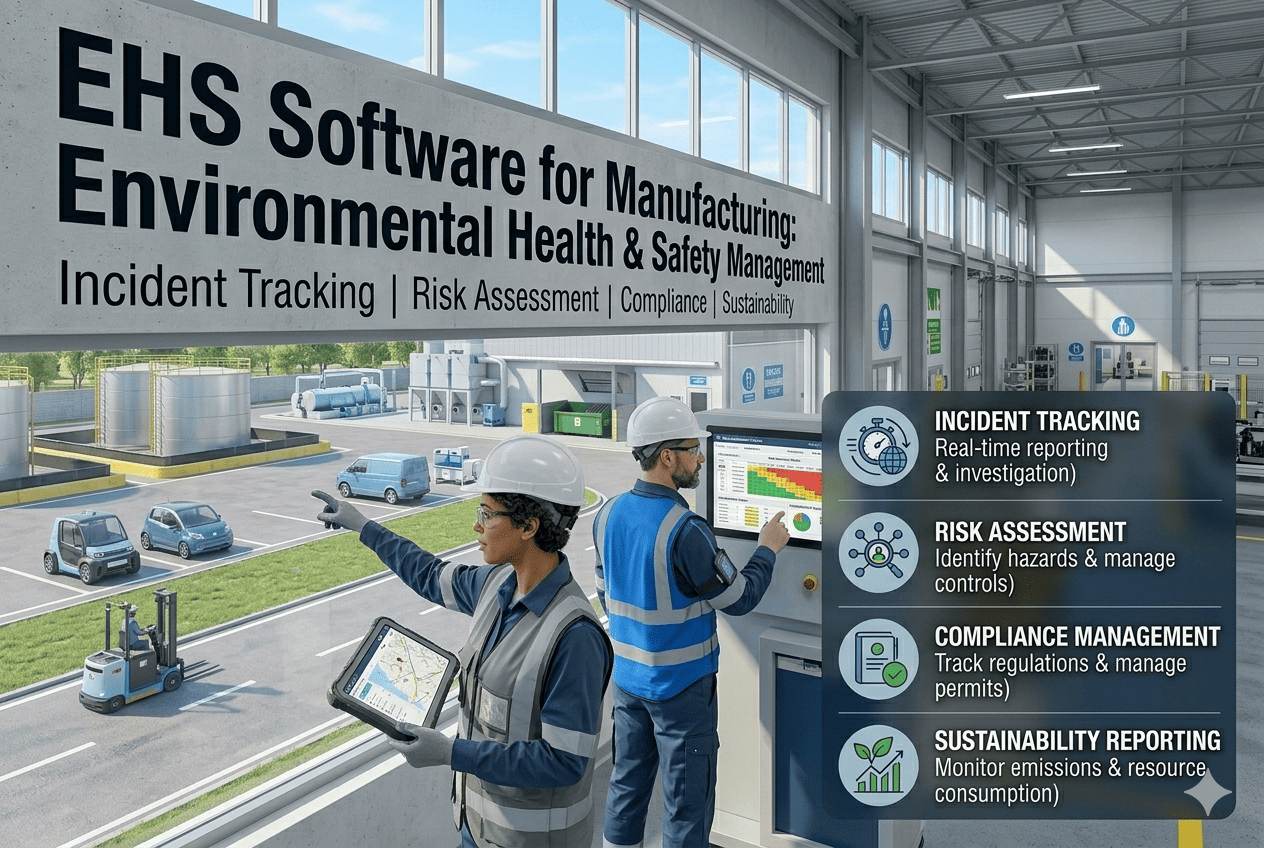
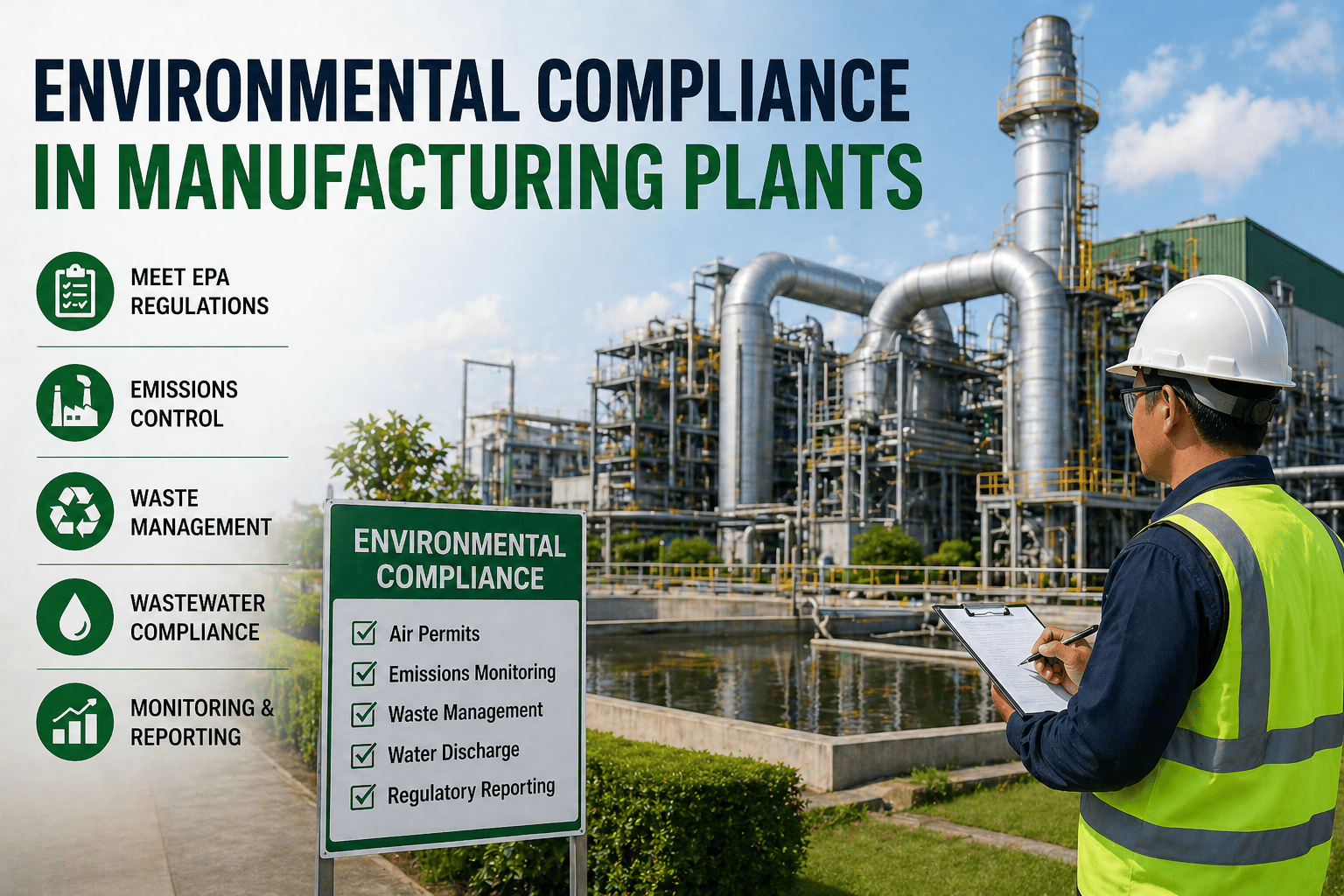
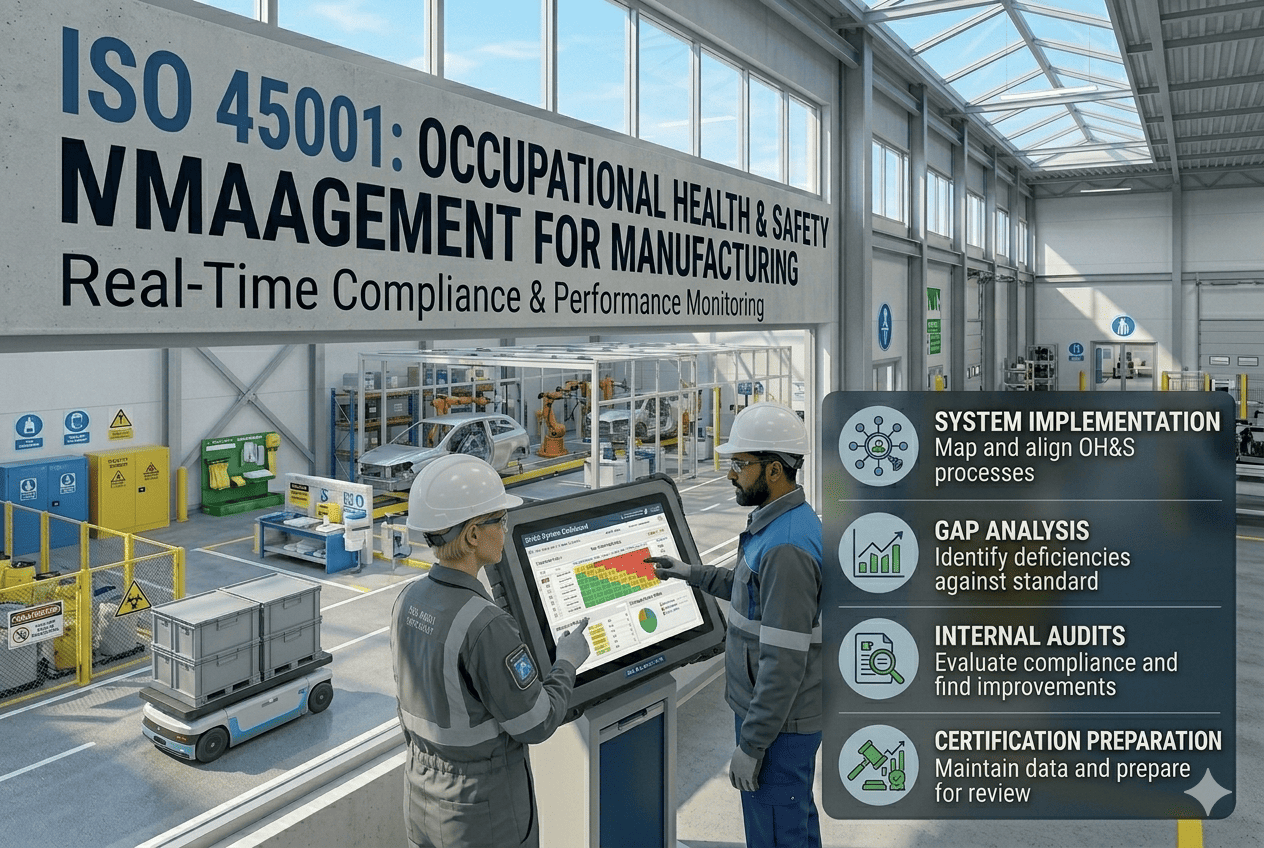
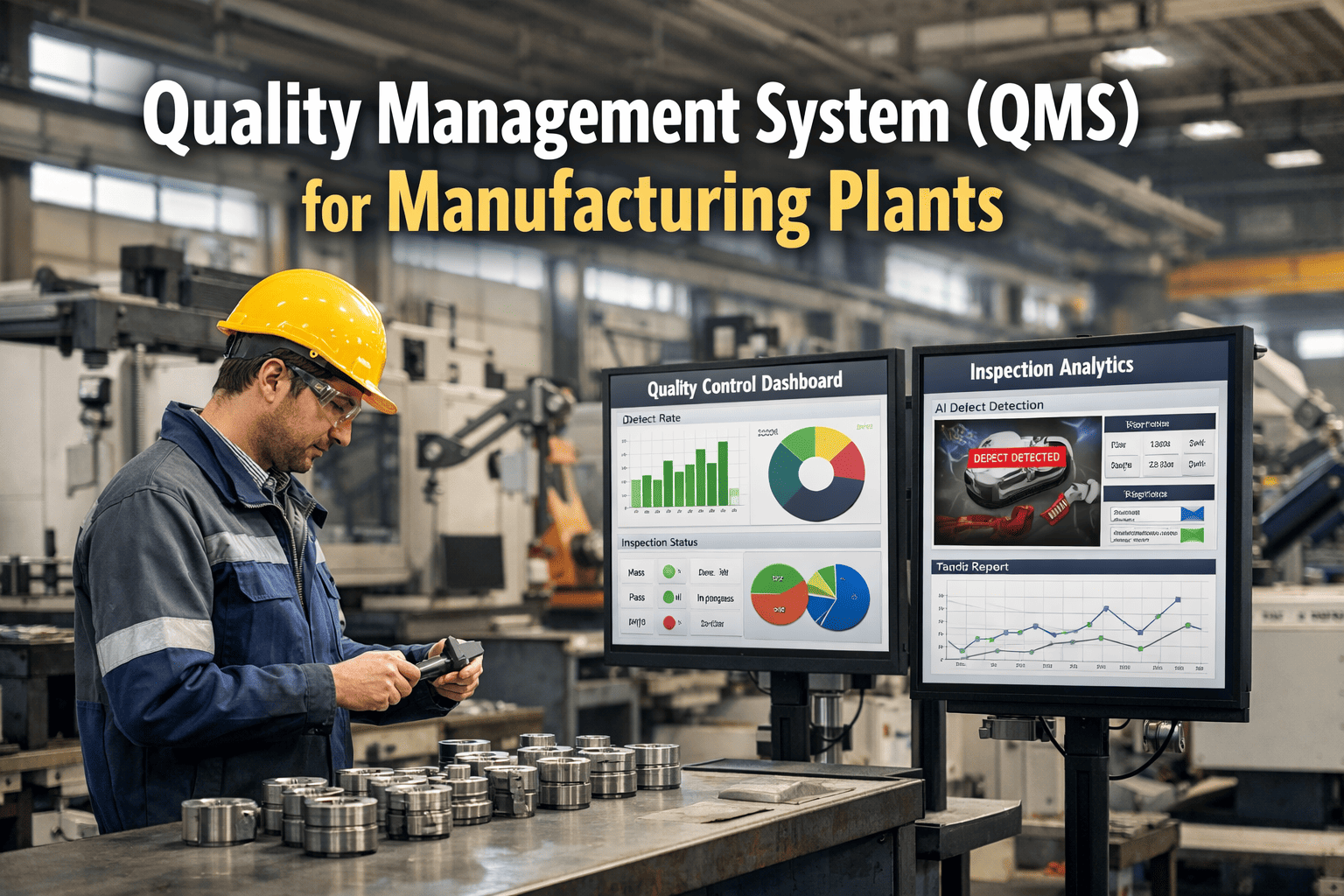
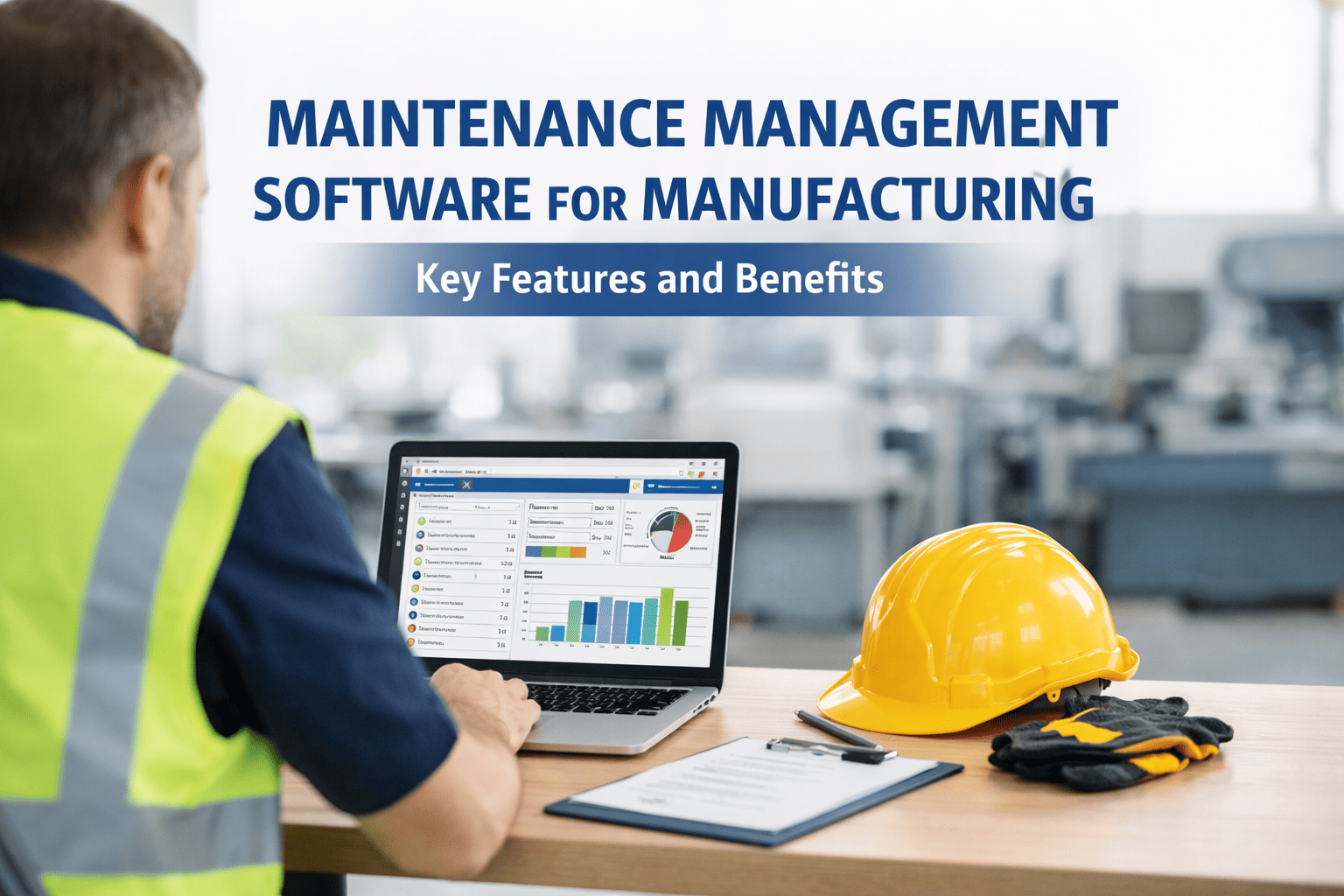
Manufacturing plants managing environmental health and safety compliance across production facilities face a fragmented data challenge: incident reporting, near-miss tracking, hazard assessments, and regulatory audit documentation are distributed across email inboxes, paper forms, spreadsheets, and disconnected safety management tools — creating blind spots where safety risks persist undetected until worker injury, environmental violation notices, or regulatory penalties force reactive response. By the time conventional EHS programs surface a systemic safety gap, the cost compounds across multiple dimensions: worker injuries cost $2.8M–$6.4M per serious incident including medical, lost productivity, regulatory fines, and litigation; environmental non-compliance citations carry $15K–$280K per violation; and safety culture deterioration drives turnover of skilled operators at 22–34% annually. iFactory's AI-powered EHS management platform changes this entirely — detecting environmental health and safety pattern risks 60–90 days before regulatory violations surface, automating incident documentation for compliance audits, and integrating directly into your existing SCADA, PLC, MES, and ERP systems without requiring safety platform replacement. Book a Demo to see how iFactory identifies EHS risks, automates compliance documentation, and reduces safety incident costs across your manufacturing operations within 8 weeks.
87%
Reduction in missed safety compliance deadlines through automated audit preparation
$3.2M
Average annual EHS incident cost avoided per manufacturing facility
73%
Improvement in near-miss detection rate vs. manual reporting systems
8 wks
Full deployment timeline from system integration to live EHS monitoring go-live
Every Undetected EHS Risk Is Multiplying Compliance Cost. AI Identifies It Before Regulators Do.
iFactory's AI engine monitors environmental emissions, workplace hazard exposures, incident pattern trends, and regulatory compliance deadlines — 24/7, automatically flagging emerging risks and generating audit-ready documentation without manual safety team intervention.
The Complete AI Platform for Manufacturing Operations
Modern manufacturing plants operate across multiple regulatory frameworks simultaneously: OSHA workplace safety standards, EPA environmental emissions compliance, state-specific EHS requirements, and industry-specific certifications (ISO 45001, ISO 14001, NFPA standards). Safety incident investigations, environmental monitoring reports, and compliance audits create documentation burdens that conventional EHS programs cannot manage efficiently — leading to missed deadlines, incomplete incident records, and regulatory violation patterns that persist across multiple inspection cycles. iFactory replaces fragmented EHS tracking with continuous AI-powered environmental health and safety intelligence that ingests incident data, environmental sensor readings, regulatory requirement calendars, and workforce safety behavior patterns — calculating emerging EHS risk profiles 60–90 days before compliance deadlines or regulatory enforcement actions. See a live demo of iFactory auto-identifying emerging near-miss patterns across shift teams and recommending targeted safety training interventions.
The business case for proactive EHS management is unambiguous: OSHA recordable injury rates averaging 3.1 per 100 workers cost the manufacturing sector $62B annually in direct medical and indirect productivity losses. Environmental violations carry regulatory penalties ranging $15K–$280K per citation, with facilities averaging 2–4 violations per inspection cycle when EHS compliance relies on manual documentation and reactive reporting.
One Platform for Smart Manufacturing with AI-Powered Maintenance, OEE, and Operations
iFactory delivers an integrated AI platform purpose-built for manufacturing plant operations across production lines, maintenance workflows, quality control, and environmental health safety. Every module connects to your existing SCADA, PLC, MES, and ERP systems without requiring safety or operational platform replacement.
01
AI Predictive Maintenance
Predict Failures Before They Stop Production. Condition-based monitoring across rotating equipment, hydraulic systems, electrical drives, and instrumentation — identifying failure precursors 14–56 days before breakdown. Prevents unplanned downtime that impacts EHS safety culture and production continuity.
02
Digital Shift Logbooks
Eliminate Manual Logs with AI Digital Shift Logbooks. Automated capture of shift events, equipment status, near-miss observations, and safety observations — replacing paper logs with timestamped, searchable digital records that support EHS investigations and audit preparation without operator burden.
03
Knowledge Capture System
AI That Turns Downtime Into Planned Maintenance. Automated documentation of incident investigations, root cause analyses, and corrective action recommendations — building institutional knowledge that prevents recurrence across shifts, teams, and production cycles without manual knowledge management overhead.
04
Smart Maintenance Planning
Real-Time Visibility Into Every Production Line. Predictive maintenance recommendations automatically sequenced to minimize production impact and eliminate safety-critical maintenance being deferred due to production pressure — protecting both safety and throughput simultaneously.
05
Real-Time OEE Tracking
Connects to Your Existing SCADA/PLC Systems. Production efficiency metrics automatically calculated from live PLC and SCADA data — identifying downtime patterns, quality loss root causes, and speed loss opportunities without manual OEE data collection or spreadsheet reconciliation.
06
Compliance Automation
Built for Manufacturing Plants, Not Generic CMMS. EHS documentation, audit preparation, regulatory deadline tracking, and compliance reporting automatically generated from incident data, environmental monitoring records, and safety observations — eliminating manual audit preparation and ensuring consistent compliance across all facilities.
07
SCADA/PLC Integration
Direct integration with Honeywell, Siemens, Emerson, Yokogawa, and ABB control systems via OPC-UA, Modbus, and native protocols — pulling real-time equipment status, alarm data, and process variables without control system modification or integration middleware.
08
Work Order Automation
Auto-generates maintenance and EHS work orders from predictive alerts, near-miss observations, and incident investigations — routing assignments to maintenance and safety teams with recommended resource allocation and timeline impact estimates based on historical data.
How iFactory Solves Manufacturing EHS Management
Traditional manufacturing EHS programs rely on manual incident reporting, periodic safety audits, and reactive compliance documentation — all of which respond after safety incidents have already created worker exposure or environmental impact. iFactory replaces this with continuous AI-powered EHS intelligence that detects emerging safety pattern risks, near-miss clustering that signals deteriorating safety culture, and environmental compliance deadline drift before regulatory enforcement occurs. See a live demo of iFactory identifying a recurring confined space entry protocol violation across shift teams and automatically routing targeted safety training recommendations.
01
Multi-Source EHS Data Integration
iFactory ingests incident reports, near-miss observations, environmental sensor data, worker shift logs, equipment maintenance records, and regulatory requirement calendars simultaneously — fusing multi-source safety data into real-time risk profiles updated every 4 hours with emerging pattern detection.
02
AI Safety Risk Classification
Proprietary ML models classify safety incidents and near-miss observations by root cause category, incident severity, regulatory impact, and recurrence probability — with escalation recommendations attached. Safety teams receive graded alerts prioritized by potential injury consequence and compliance violation risk. False positive rate drops to under 8%.
03
Predictive Compliance Risk Detection
iFactory's LSTM-based forecasting engine identifies emerging compliance risk areas 60–90 days before regulatory inspection findings would surface — analyzing incident patterns, environmental monitoring trends, and safety audit performance to predict inspection focus areas and flag facilities trending toward violations.
04
Automated Incident Investigation Documentation
iFactory auto-populates incident investigation forms with contextual data from equipment records, shift logs, and near-miss reports — reducing investigation time from 8–12 hours to 45 minutes while improving investigation completeness and consistency across safety teams and facilities.
05
Audit-Ready EHS Reporting
Every safety event — reported, investigated, and resolved — generates structured documentation pre-formatted for regulatory submission: OSHA 301 incident logs, EPA environmental violation defense packages, audit trail evidence, and corrective action tracking — eliminating manual audit preparation.
06
Environmental Compliance Automation
iFactory monitors environmental monitoring deadlines, automatically flags facilities approaching emission reporting windows, and generates environmental compliance status reports from air quality, water discharge, and waste tracking data — ensuring no compliance deadlines are missed and environmental documentation is complete.
How iFactory Is Different from Traditional EHS Platforms
Most EHS software vendors deliver incident tracking dashboards or compliance checklist systems built for corporate safety functions. iFactory is purpose-built for manufacturing plant operations where equipment failures create immediate worker safety hazards, shift-based production creates rapid safety culture change, and environmental monitoring requires real-time sensor integration. Talk to our manufacturing EHS specialists and compare your current compliance approach directly.
| Capability |
Traditional EHS Software |
Generic CMMS Platforms |
iFactory Platform |
| Data Integration Scope |
Manual incident entry only. No equipment or environmental data integration. Paper forms digitized manually. |
Maintenance data only. No EHS or environmental integration. No incident investigation support. |
Live integration with SCADA, PLC, MES, environmental sensors, incident reports, shift logs, and regulatory databases. Multi-source data auto-ingested every 4 hours. Zero manual entry required. |
| Risk Detection |
Reactive reporting only. Incident forms filled after events occur. No predictive pattern detection. |
Equipment failure alerts only. No EHS or environmental context. No safety risk modeling. |
AI models identify emerging safety patterns 60–90 days before incidents occur. Environmental compliance risk forecasted before regulatory inspection focus areas materialize. Near-miss clustering detected automatically. |
| Incident Investigation |
Blank investigation forms. Manual root cause analysis. 8–12 hour investigation timelines typical. Inconsistent investigation quality across facilities. |
No incident investigation capability. Maintenance-focused only. |
Auto-populated investigation forms with equipment context, shift event history, and near-miss trend data. 45-minute investigation completion. Consistent investigation quality enforced across all facilities and teams. |
| Regulatory Compliance |
Manual audit preparation. OSHA 301 logs maintained separately. No compliance deadline tracking. Incomplete documentation typical for regulatory audits. |
No compliance documentation support. Maintenance records only. |
Auto-generated OSHA 301 logs, EPA environmental reports, audit trail documentation, and corrective action tracking pre-formatted for regulatory submission. Compliance deadline calendar automated. Audit-ready documentation generated at incident close. |
| Manufacturing Plant Fit |
Generic EHS platform. No production line integration. No shift team coordination. No real-time visibility. |
Maintenance management only. Safety blind spot. No environmental data. |
Purpose-built for manufacturing plants with equipment integration, shift team coordination, environmental sensor connectivity, and real-time incident routing to safety teams without delay. |
| Deployment Timeline |
8–16 weeks. Significant training required. Change management intensive. Slow value realization. |
6–12 weeks. Limited EHS functionality requires external tools. |
8 weeks fixed. Pilot results on historical incidents in week 4. Live EHS monitoring by week 8. Minimal process change required. |
iFactory AI Implementation Roadmap
iFactory follows a fixed 6-stage deployment methodology designed specifically for manufacturing EHS management — delivering pilot results in week 4 and full production monitoring by week 8. No open-ended implementations. No scope creep.
01
Data Integration
Historical incident records and environmental monitoring data extraction from EHS systems, SCADA, and production records
02
System Connections
Live SCADA, PLC, MES, environmental sensors, and ERP connection via OPC-UA, Modbus, REST APIs
03
AI Model Training
EHS risk detection and compliance forecasting models trained on your facility-specific incident patterns and environmental data
04
Pilot Validation
Live EHS risk detection on historical incidents to validate AI model accuracy before full deployment
05
Workflow Integration
Safety team notification routing, incident investigation automation, and compliance deadline tracking setup
06
Full Production
AI EHS monitoring live across all production lines, facilities, and shift teams 24/7
8-Week Deployment and ROI Plan
Every iFactory engagement follows a structured 8-week program with defined deliverables per week — and measurable ROI indicators beginning from week 4 of deployment. Request the full 8-week deployment scope document tailored to your manufacturing facility EHS complexity.
Weeks 1–2
Infrastructure Setup
Historical incident records, near-miss reports, and environmental monitoring data extraction from existing EHS systems and SCADA archives
SCADA, PLC, MES, and environmental sensor connection via OPC-UA or Modbus — establishing real-time data flows without control system modification
Regulatory requirement mapping and facility-specific EHS compliance calendar configuration
Weeks 3–4
Model Training and Pilot
AI EHS risk detection models trained on your facility-specific incident patterns, equipment failure correlations, and environmental trends
Pilot validation performed on historical incidents — comparing AI risk classifications vs. actual investigation outcomes
First EHS risk detections validated with safety team — ROI evidence begins here
Weeks 5–6
Calibration and Expansion
EHS risk thresholds refined based on pilot accuracy and safety team action response timelines
Incident investigation automation setup and safety team notification routing activated across all production lines
Safety team training completed — incident report and investigation procedures updated for AI-assisted workflow
Weeks 7–8
Full Production Go-Live
Full facility AI EHS monitoring live across all production lines, equipment, and shift teams — 24/7 incident detection and compliance tracking
Automated incident investigation workflows and audit-ready documentation generation activated for all reported incidents
EHS baseline report delivered with incident prevention metrics, compliance deadline achievement, and safety cost avoidance data
ROI IN 6 WEEKS: MEASURABLE RESULTS FROM WEEK 4
Facilities completing the 8-week program report an average of $1.2M in EHS incident costs avoided within the first 6 weeks of full production monitoring — with emerging safety risk detection accuracy of 82–91% achieved by week 4 pilot validation on historical incident data.
$1.2M
Avg. cost avoided in first 6 weeks
82–91%
Safety risk detection accuracy by week 4
60–90 days
Advance compliance risk warning
AI EHS Management. Live in 8 Weeks. ROI Evidence in Week 4.
iFactory's fixed-scope deployment program means no open timelines, no months of EHS system implementation, and no delays before you see your first safety risk detection.
Use Cases and KPI Results from Live Deployments
These outcomes are drawn from iFactory deployments at operating manufacturing plants across three EHS management scenarios. Each use case reflects 12-month post-deployment performance data. Request the full case study report for the manufacturing facility type most relevant to your operation.
A food processing facility with 340 employees across three shifts was experiencing recurring slips, trips, and falls due to undetected housekeeping gaps and inadequate slip-resistant floor maintenance in processing areas. Manual incident investigation identified individual incidents but could not detect the pattern until at least 4 similar incidents had occurred across different shift teams. iFactory deployed AI incident pattern detection trained on 18 months of incident data, identifying that slip hazards were clustering in specific production zones during night shift transitions. Within 30 days of go-live, iFactory detected an emerging pattern of hand laceration incidents across the packaging line — a pattern that would have taken 6–8 incidents to surface through manual trend analysis. The safety team implemented targeted equipment guarding improvements before the injury cluster could materialize.
6–8
Incidents prevented through early pattern detection vs. waiting for injury cluster to manifest
$480K
Incident cost avoided through proactive intervention
38%
Improvement in safety culture scores among night shift teams
A pharmaceutical manufacturer managing complex environmental and occupational health compliance across air quality monitoring, chemical inventory tracking, and worker exposure assessments was missing compliance deadline documentation in 22% of required reporting periods — creating regulatory risk exposure. Manual compliance tracking relied on individual team members maintaining personal calendars and spreadsheets, resulting in missed submission windows and incomplete supporting documentation during regulatory audits. iFactory deployed automated compliance deadline tracking integrated with environmental sensor data and incident records — auto-generating required documentation packages 30 days before deadline with complete supporting evidence. Within 60 days, iFactory identified that the facility had been consistently underdocumenting volatile organic compound (VOC) emissions despite having the raw sensor data to support compliance. Audit-ready documentation was automatically generated retroactively, preventing what would have been a significant EPA violation citation.
22%
Compliance deadline miss rate eliminated
$140K
EPA violation penalty avoided through complete documentation
45 hrs/qtr
Manual compliance documentation time eliminated per quarter
A multi-plant chemical manufacturing operation managing hundreds of equipment failures and operational incidents per year was struggling with incident investigation quality consistency across facilities — some investigations took 3 days while others took 21+ days, and investigation depth varied significantly depending on which safety professional was assigned. Manual root cause analysis required extensive equipment history review, shift log examination, and maintenance record analysis. iFactory deployed automated investigation workflow acceleration where incident reports auto-populated investigation forms with relevant equipment history, maintenance records, shift event context, and similar historical incidents. Investigation timelines collapsed from 12–16 hours of active safety staff time to 2–3 hours, and investigation completeness increased from 68% of required documentation to 96%. The facility captured institutional knowledge from investigations that had previously been scattered across individual investigator files and forgotten — allowing patterns to be identified across the entire 4-plant operation.
73%
Reduction in investigation timelines
28%
Improvement in investigation documentation completeness
$720K
Recurring incident cost eliminated through knowledge capture and pattern prevention
Results Like These Are Standard. Not Exceptional.
Every iFactory deployment is scoped to your specific manufacturing facility configuration, equipment types, and EHS compliance requirements — so you get safety improvements calibrated to your operations, not generic manufacturing benchmarks.
What Manufacturing Safety Leaders Say About iFactory
The following testimonials are from safety directors and operations managers at manufacturing facilities currently running iFactory's AI environmental health and safety platform.
iFactory detected a hand laceration pattern before it became a major incident cluster. Our team had no idea the pattern was emerging because it was spread across three shifts and two weeks. That early warning changed how we think about safety — we went from reactive investigation to predictive intervention.
Safety Director
Food Processing Facility, USA
We eliminated 22% of our compliance deadline misses in the first quarter. The automated deadline tracking and documentation generation saved us what would have been a significant EPA violation penalty. The audit preparation alone justifies the platform cost.
Environmental Compliance Manager
Pharmaceutical Plant, Germany
Incident investigations that took 16 hours now take 2 hours. And they're more complete — the system brings in all the relevant context that our investigators used to miss. We've captured more institutional knowledge in 6 months than we had in the previous 2 years.
Operations Manager
Chemical Manufacturing Complex, UK
Integration with our Honeywell SCADA system was seamless. Within two weeks we had real-time production data flowing into EHS monitoring. The safety team now has context about what equipment was running during incidents — information that was literally inaccessible before.
Head of Safety
Automotive Parts Manufacturing, India
Regional Manufacturing EHS Challenges and How iFactory Solves Them
Manufacturing environmental health and safety compliance faces region-specific challenges driven by local regulatory frameworks, industry composition, and available skilled safety resources. iFactory's AI platform is configured to address these regional variations with localized compliance requirement tracking and facility-specific EHS reporting.
| Region |
Key Challenges |
Compliance Requirements |
How iFactory Solves |
| United States |
Complex multi-state EHS requirements. OSHA enforcement focus varies by region. High litigation risk from workplace incidents. Aging industrial workforce creating safety culture gaps. |
OSHA recordkeeping (300 logs), state-specific EHS regulations, ANSI safety standards, industry-specific NFPA codes. |
iFactory auto-generates OSHA-compliant 300 logs and manages state-specific requirement calendars. Safety culture monitoring across generational cohorts. Litigation defense documentation automatically captured. |
| United Kingdom |
Stringent Health and Safety Executive (HSE) enforcement. Shared responsibility between employer and worker. Complex investigation and reporting timelines for serious incidents. |
UK Health and Safety at Work Act 1974, HSE RIDDOR reporting requirements, ISO 45001 alignment, workplace exposure limit compliance. |
iFactory auto-generates RIDDOR-compliant incident reports within mandatory investigation timelines. UK HSE compliance document tracking built in. Shared responsibility compliance tracked across management and worker behavior. |
| United Arab Emirates |
Extreme heat impact on occupational health. Large migrant workforce with language barriers in safety training. Rapid facility scaling with evolving safety protocols. |
UAE Ministry of Human Resources guidelines, heat stress exposure limits, worker accommodation safety standards, incident notification requirements. |
iFactory includes heat stress monitoring integrated with environmental sensors. Language-independent visual incident pattern detection. Scalable across rapidly expanding facility networks with consistent safety baseline. |
| India |
Complex dual regulatory frameworks (national and state). Limited skilled safety personnel relative to workforce size. Environmental compliance fragmentation across water, air, and hazardous waste management. |
Indian Factory Act, Occupational Safety and Health Code, state-specific pollution control board requirements, hazardous waste management rules. |
iFactory manages dual compliance requirement calendars and auto-generates state-specific documentation. Scales EHS oversight across large workforces despite limited safety staffing. Unified environmental compliance tracking across all regulatory domains. |
| Europe |
Strict EU work-time directives affecting shift safety coordination. Multi-country harmonization complexity. Heavy focus on worker participation in safety decisions. Significant ESG/sustainability integration into EHS. |
EU Framework Directive 89/391/EEC, SEVESO III major accident prevention, ISO 45001, ESG sustainability reporting alignment. |
iFactory tracks work-time compliance impact on safety performance. Multi-country regulatory requirement management. Worker safety input automatically captured and escalated. Environmental sustainability metrics integrated into EHS reporting. |
iFactory vs. Competitor EHS and CMMS Platforms
The manufacturing EHS market includes traditional EHS software providers, generic CMMS platforms, and enterprise safety management suites. iFactory differentiates through manufacturing-specific AI, fixed deployment timelines, and SCADA/PLC integration depth. Request a side-by-side comparison report tailored to your current EHS approach.
| Feature |
SafetySync |
SafeOps |
QAD Redzone |
IBM Maximo |
SAP EAM |
Oracle EAM |
Fiix |
UpKeep |
iFactory |
| AI EHS Risk Detection |
Limited. Rule-based incident scoring. No pattern detection. |
None. Incident tracking only. |
None. Manufacturing focus without safety. |
Limited. Asset-focused, not safety-focused. |
None. ERP incident module, no AI. |
None. ERP incident module, no AI. |
None. CMMS only. |
None. Mobile CMMS. |
Manufacturing-specific AI trained on incident patterns. Detects emerging safety risks 60–90 days before incidents occur. 82–91% prediction accuracy. |
| SCADA/PLC Integration |
None. Manual incident entry only. |
None. Incident tracking only. |
Limited. Manufacturing-focused but limited EHS integration. |
Limited. Asset history only. No real-time control system data. |
Limited EDI. No real-time SCADA connection. |
Limited EDI. No real-time SCADA connection. |
None. Maintenance-only platform. |
None. Mobile app only. |
Native integration with Honeywell, Siemens, Emerson, Yokogawa, ABB via OPC-UA and Modbus. Real-time equipment context for every incident. |
| Incident Investigation Support |
Basic form templates. Manual root cause analysis. No context data population. |
Basic forms. Manual investigation. Limited data support. |
None. Manufacturing focus without safety investigation. |
None. Maintenance work orders only. |
None. ERP incident module only. |
None. ERP incident module only. |
None. PM scheduling only. |
None. Work order app. |
Auto-populated investigation forms with equipment history, shift logs, maintenance context, and historical similar incidents. 45-minute investigation completion vs. 12-16 hour baseline. |
| Compliance Documentation |
Manual audit preparation. OSHA 301 logs separate. Incomplete supporting documentation. |
Manual forms. No compliance reporting structure. |
Limited manufacturing documentation. No EHS compliance output. |
Generic incident module. No industry-specific compliance templates. |
Generic incident module. Manual compliance reporting. |
Generic incident module. Manual compliance reporting. |
None. Maintenance documentation only. |
None. Work order documentation. |
Auto-generated OSHA 301 logs, EPA environmental reports, audit-ready documentation, and corrective action tracking pre-formatted for regulatory submission. Compliance deadline calendar automated. Zero manual audit preparation. |
| Environmental Monitoring |
Limited. Manual entry only. |
No environmental data. |
No environmental data. |
No environmental data. |
No environmental data. |
No environmental data. |
No environmental data. |
No environmental data. |
Integrated environmental sensor monitoring with real-time emissions tracking, compliance deadline forecasting, and auto-generated environmental reports. |
| Deployment Timeline |
10–16 weeks. Heavy training required. |
8–14 weeks. Moderate customization. |
Not applicable (manufacturing only). |
12–24 weeks. Professional services heavy. |
16–32 weeks. High customization typical. |
20–40 weeks. Enterprise implementation. |
4–6 weeks. Limited features without customization. |
2–4 weeks. Mobile app only. |
8 weeks fixed. Pilot in week 4. Full EHS monitoring by week 8. Minimal training required. |
| Manufacturing Plant Fit |
Moderate. Generic EHS platform. |
Poor. Generic incident tracking. |
Moderate. Manufacturing-focused, limited EHS. |
Poor. Asset management focus. |
Poor. ERP focus, not plant operations. |
Poor. ERP focus, not plant operations. |
Poor. Generic CMMS. |
Poor. Mobile CMMS only. |
Excellent. Purpose-built for manufacturing plant operations with SCADA integration, incident investigation acceleration, and compliance automation specialization. |
Frequently Asked Questions
Does iFactory replace our existing EHS system or CMMS platform?
No. iFactory integrates with existing EHS systems, CMMS platforms, and SCADA/PLC networks via standard APIs — adding AI-powered risk detection and compliance automation on top of your current tools. Your maintenance and safety teams continue using familiar interfaces while gaining predictive intelligence.
Book a Demo to verify compatibility with your specific EHS and maintenance platforms.
Which SCADA/PLC systems and EHS platforms does iFactory integrate with?
iFactory integrates natively with Honeywell, Siemens, Emerson, Yokogawa, and ABB control systems via OPC-UA and Modbus. For EHS systems, iFactory connects to most major platforms via API. Environmental sensors from all major manufacturers are supported. Custom integration available for legacy systems.
Talk to Support to confirm compatibility with your specific configuration.
How does iFactory detect emerging safety patterns across shift teams?
iFactory uses AI clustering algorithms that identify incident patterns across time, location, equipment, and personnel — even when individual incidents occur weeks apart and across different shifts. Patterns that would require 6–8 incidents to surface through manual trend analysis are detected after 2–3 events occur.
What compliance frameworks does iFactory's reporting support?
iFactory auto-generates reports for OSHA 300 recordkeeping, EPA environmental compliance, state-specific EHS requirements, ISO 45001 safety management, HSE RIDDOR (UK), and ESG sustainability reporting. Region-specific compliance templates pre-configured. Reports generated automatically at incident close.
How long does the AI model take to produce reliable safety risk predictions?
Baseline model training on 18–36 months of historical incident and SCADA data typically takes 6–9 days. First predictions are validated during the Week 3–4 pilot phase. Full model calibration — with 82–91% detection accuracy — is achieved within 6 weeks of deployment for standard manufacturing facilities.
Can iFactory handle multi-facility EHS management across geographically dispersed plants?
Yes. iFactory supports multi-facility deployments with consolidated EHS reporting, comparative safety performance analytics across locations, and centralized compliance deadline management. Each facility maintains local safety team incident routing while corporate safety can monitor facility-wide patterns and emerging compliance risks.
Stop Reacting to EHS Incidents. Predict Safety Risks 3 Months Early.
iFactory gives manufacturing safety teams real-time AI incident risk detection, automated incident investigation, compliance deadline automation, and multi-facility safety analytics — fully integrated with your SCADA, PLC, MES, and EHS systems in 8 weeks, with ROI evidence starting in week 4.
60–90 days advance compliance risk detection
SCADA and EHS system integration in under 2 weeks
82–91% emerging safety pattern detection by week 4
Auto-generated audit-ready compliance documentation