.png)
When a float glass plant running two production lines faced a persistent 23% false alarm rate on its SPC charts and a throughput ceiling that operators could not push past without exceeding fixed control limits, the quality and production teams recognized that traditional static UCL/LCL boundaries were constraining output rather than enabling process improvement. Each false alarm triggered unnecessary line slowdowns, re-inspections, and documentation overhead — costing the operation an estimated 18% of potential throughput. Adaptive SPC limits changed this entirely, dynamically adjusting control boundaries based on real-time process conditions, material variation, and product-grade requirements, enabling operators to maintain tighter process control while increasing throughput by 15–25%. Float glass quality and production leaders evaluating next-generation SPC solutions regularly Book a Demo to see adaptive SPC operating on live float line data.
The Static SPC Problem in Float Glass Production
Traditional SPC applies fixed upper and lower control limits calculated from a baseline process study — limits that remain static regardless of changes in raw material composition, pull rate, furnace condition, or product-grade requirements. On a float line where ribbon temperature can drift 15-20°F across a shift due to furnace crown aging or batch composition variation, static UCL/LCL boundaries generate chronic false alarms that force operators to investigate process deviations that are statistically significant but operationally irrelevant. Each false alarm triggers documentation, potential line slowdowns, and unnecessary quality holds — collectively constraining throughput by 15-25% below what the line could deliver with dynamically appropriate limits.
For the shop-floor operator managing the line, the experience is frustration: alarms that mean nothing, charts that show every natural drift as an out-of-control event, and a growing tendency to ignore SPC alerts entirely. The production manager sees the same pattern from a different angle — throughput stuck below known capability, grade changes that require manual limit recalibration, and a quality system designed for compliance rather than performance. The root cause in every case is the same: static control limits that treat today's process conditions as if they were identical to last quarter's.
Static SPC limits generate false alarms when natural process drift — 10-20°F ribbon temperature variation across a shift — exceeds fixed boundaries. Operators investigate deviations that are not actual quality risks, wasting 40-60 minutes per shift.
Operators run the line below its actual capability because static limits force conservative pull rates. The margin between the static UCL and the process's real capability represents 15-25% of potential throughput left on the table.
Different glass grades require different control limit widths — architectural glass tolerances differ from automotive-grade requirements. Static limits cannot adjust per grade, forcing compromise settings that fit no grade optimally.
After months of false alarms from static limits, operators develop alarm fatigue and begin ignoring SPC alerts — including genuine ones. Critical process deviations go unaddressed until quality is already affected downstream.
Batch chemistry changes, cullet ratio adjustments, and raw material source shifts alter the process centerline. Static limits do not recenter, so operators chase deviations caused by material changes rather than process problems.
Static control limits cannot reflect process improvements. A line that has reduced its temperature variation by 40% over six months still triggers alarms against the original wide limits, masking the improvement and demoralizing the team.
How Adaptive SPC Works on the Float Line
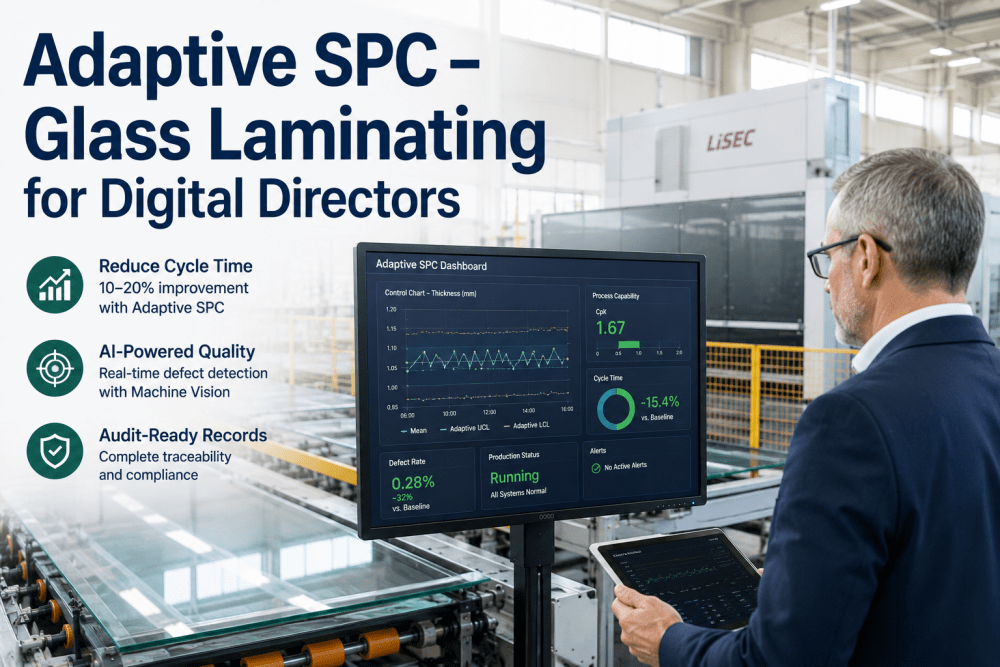
Adaptive SPC replaces static UCL/LCL boundaries with dynamic control limits calculated from rolling windows of process data, current material characteristics, product-grade specifications, and machine learning models that predict the process's expected operating range under current conditions. The operator sees control limits that narrow when the process is stable, widen appropriately when material changes or grade transitions introduce expected variation, and recenter automatically when the process baseline shifts — eliminating false alarms while maintaining true defect detection sensitivity. Float glass operators and line technicians interested in a live walkthrough can Book a Demo to see adaptive SPC running on their own process data.
Rolling-window baseline with real-time adjustment — The system computes a process baseline from the most recent 4-8 hours of operating data across all relevant variables: ribbon temperature zone profiles, tin bath conditions, lehr zone temperatures, pull rate, and product-grade designation. Control limits are recalculated continuously as new data arrives, recentering when the process baseline shifts due to material changes or furnace condition drift and narrowing when the process stabilizes. The operator sees the current limit width displayed alongside the historical limit width, providing direct visibility into how much throughput headroom the adaptive limits have recovered.
Inline inspection data validates limit width — Machine vision inspection systems scan the ribbon for defects — bubbles, stones, distortion, coating irregularities — and feed results directly into the adaptive limit calculation. If the vision system confirms zero defects while a variable operates near its static boundary, the adaptive model widens the limit for that variable, confirming the process can safely operate at that range. This creates a self-validating control loop: the vision system confirms quality outcomes, the adaptive limits adjust to match real capability, and the operator gains confidence to run the line at its true potential.
Automatic profiles for every product grade — Each glass grade — 2mm architectural, 4mm automotive, 6mm mirror, 8mm specialty — has its own pre-configured control limit profile calibrated to the quality requirements and process behavior of that grade. When the line transitions from one grade to another, the adaptive system switches limit profiles automatically, eliminating the manual recalibration step and the compromise settings that static systems force. The operator can also create temporary overrides during transition periods, with the system automatically reverting to the grade-specific profile once the transition stabilizes.
Increase Float Glass Throughput with Adaptive SPC Limits
Dynamic control limits that adjust to real-time process conditions — reducing false alarms, enabling tighter control, and unlocking 15-25% more saleable throughput per line. See it demonstrated on your float line data.
Adaptive SPC vs. Traditional Static SPC
The comparison below shows how adaptive SPC limits on the float line differ from traditional static SPC across the criteria most relevant to shop-floor operators and production managers. Float glass teams that Book a Demo during their SPC evaluation consistently report that the false alarm reduction alone justifies the transition to adaptive limits.
| Criterion | Traditional Static SPC | Adaptive SPC Limits |
|---|---|---|
| Control Limit Calculation | Fixed from initial process study, never updated | Rolling baseline from 4-8 hours of current data |
| False Alarm Rate | 18-23% of alerts are false positives | 4-6% of alerts are false positives |
| Grade Transition Handling | Single limit set for all grades | Grade-specific limit profiles, auto-switched |
| Process Drift Response | Alarms on every drift, regardless of material cause | Recenters limits with material and process drift |
| Machine Vision Integration | Not available | Inspection data confirms safe operating ranges |
| Throughput Impact | 15-25% constrained below real capability | Full capability realized with dynamic boundaries |
| Operator Alarm Fatigue | High — desensitized after weeks of false alarms | Low — each alarm signals a genuine deviation |
| Continuous Improvement Visibility | Static limits mask process improvements | Narrowing limits reflect real process gains |
False Alarm Reduction
Adaptive limits eliminated 77% of false SPC alarms per shift — recovering 40-60 minutes of operator time previously spent investigating irrelevant process deviations.
Throughput Increase
Higher average line speed achieved without increasing defect rate — enabled by dynamic limits that confirm safe operating ranges based on current conditions.
Grade Limit Coverage
All product grades served by grade-specific limit profiles that switch automatically at grade change — no compromise settings, no manual adjustment required.
Operator Retraining Required
Adaptive limits operate within the existing SPC interface with familiar visual conventions. Operators use the same charts and alarms — they simply trust them more.
See Adaptive SPC Limits Running on Your Float Line Data
Book a live SPC walkthrough. We connect to your process historian and show you how adaptive SPC would have reduced false alarms and increased throughput on your float line — with your operators in the room.
"We knew our float line could run faster, but every time we increased pull rate, the static SPC limits would light up with alarms — none of which corresponded to actual defects. The operators started ignoring the charts entirely because they knew 80% of the alerts were noise. Adaptive SPC changed the relationship between the operator and the control chart. The limits moved with the process, so the operators could finally see which alarms actually mattered. Within two months, we increased line speed by 19% without any increase in defect rate. The adaptive limits took the handbrake off our production line and gave our operators back their trust in the SPC system."
Conclusion — Adaptive SPC Unlocks the Throughput That Static Limits Constrain
The transition from static to adaptive SPC limits addresses a fundamental contradiction in traditional quality control: fixed control boundaries that were designed to protect quality have become the primary constraint on throughput in modern float glass operations. By replacing static UCL/LCL values with dynamic limits that recenter with process drift, adjust for grade changes, and incorporate machine vision inspection confirmation, adaptive SPC enables operators to run the line at its real capability — not the capability measured during a process study conducted months or years ago. The result is 15-25% more saleable throughput, 77% fewer false alarms, and a control system that reflects actual process performance rather than historical assumptions.
iFactory's adaptive SPC platform integrates with existing float line process historians, machine vision inspection systems, and quality databases to deliver dynamic control limits that respond to real-time conditions. The platform investment is typically recovered within the first quarter from increased throughput alone. Float glass production and quality leaders evaluating SPC modernization are encouraged to Book a Demo to see adaptive SPC limits applied to their float line data.
Adaptive SPC Limits — Common Questions
Adaptive SPC maintains constant detection sensitivity by adjusting control limits proportionally to the process's current natural variation. When the process is stable with narrow variation, the limits tighten — detecting smaller deviations. When process drift occurs from material changes or grade transitions, the limits widen just enough to accommodate expected variation without masking genuine defects. The adaptive model continuously validates limit widths against machine vision inspection results, confirming that the current boundary width is appropriate for real quality outcomes.
The adaptive model ingests rolling windows of process data — typically 4-8 hours across all relevant variables including ribbon temperature zone profiles, tin bath hydrogen and nitrogen flow rates, lehr zone temperatures, pull rate, and product-grade designation. The model also receives machine vision inspection results in real time and can incorporate raw material batch data if available. The combination of recent process history, current grade requirements, and real-time quality feedback enables the model to calculate control limits that are statistically appropriate for current conditions.
Yes — adaptive SPC is specifically designed for rapid transitions. Grade changes trigger immediate limit profile switching to the target grade's pre-configured control boundaries. Batch changes are detected through centerline drift patterns and the model recenters limits within minutes of the material change reaching the melter. The system also supports manual operator override during transitions: an operator can temporarily widen limits during a grade change window and the system automatically narrows them back as the transition completes and stabilizes.
iFactory connects to existing process historians (OSIsoft PI, Aspen InfoPlus.21), SPC software platforms, and machine vision inspection systems via standard APIs and OPC-UA. The adaptive limit engine operates alongside the existing SPC system — the operator sees both the traditional static limits and the adaptive limits on the same chart for a transition period. Once the team confirms the adaptive limits are performing correctly, the static limits are retired. Integration timeline is typically 2-3 weeks per float line.
Customers typically report 15-25% throughput improvement after switching to adaptive SPC limits, with the majority of gains realized within the first 4-6 weeks of deployment. The throughput increase comes from three sources: reduced false-alarm-driven line slowdowns (approximately 8-12% of the gain), higher average pull rate enabled by appropriate control boundaries (approximately 6-10% of the gain), and reduced grade transition time from automated limit switching (approximately 1-3% of the gain). Specific results depend on current false alarm rate, grade mix complexity, and existing line speed limitations.
Transform Your Float Line SPC with Dynamic Adaptive Limits
iFactory's adaptive SPC platform replaces static control limits with dynamic boundaries that respond to real-time process conditions — reducing false alarms by 77% and increasing throughput by 15-25% per line. Book a live SPC walkthrough to see the system operate on your float line data.
.png)
.png)