The software license on a manufacturing AI proposal is almost never the number that breaks the budget. It is everything the license price doesn't include — sensor retrofits, network upgrades, data engineering, integration with existing MES and ERP systems, ongoing monitoring, and the staff time to keep it all running — that turns a clean line-item estimate into a year-three budget surprise. A CIO evaluating manufacturing AI needs the full three-year picture before signing anything, not just the number on the vendor's price sheet. A transparent total cost of ownership breakdown across hardware, software, services, and the operating costs that show up after go-live gives finance a number they can actually plan around. iFactory's platform is built to model that full breakdown against your specific plant environment. Book a demo to see a three-year TCO model built for your production footprint.
AI-Driven · CIO Finance View · 3-Year TCO
What Manufacturing AI Actually Costs Over Three Years — Not Just the License Price
A transparent breakdown across hardware, software, integration, and the hidden operating costs that surface after go-live — built so the number your team plans around is the number you actually spend.
16%
Share of typical year-one AI spend that the software license actually represents
20–30%
Amount hidden operational costs typically add beyond the original baseline budget
1 in 4
Organizations underestimate total AI project cost by 50% or more before approval
50–70%
Lower marginal cost for each additional AI use case once the core infrastructure exists
Where Budgets Go Wrong
Four Reasons Manufacturing AI Cost Estimates Miss the Mark
Every one of these gaps is predictable, and every one of them is avoidable with a cost model that accounts for the full plant environment instead of the software alone.
License-Only
The Budget Started and Stopped at the Subscription Price
Platform and licensing costs typically represent a small fraction of true first-year spend, so a budget built around the license price alone is missing the majority of the real number before the project begins.
Brownfield
Retrofit Costs Were Never Modeled
Existing facilities with legacy equipment require sensor retrofits, edge gateways, and network upgrades that greenfield cost estimates simply don't account for, shifting payback timelines by six to twelve months when left out.
Year Two Cliff
Ongoing Operations Cost Was Treated as an Afterthought
Monitoring, maintenance, model retraining, and platform support don't stop after go-live, and organizations that budget only for implementation routinely hit an unplanned cost increase in year two.
People Cost
Staffing and Training Were Left Out of the Model
Internal platform engineering, data engineering, and end-user training carry a real ongoing cost that a hardware-and-software-only estimate consistently omits from the total picture.
The Cost Category Breakdown
Six Categories That Make Up a Realistic 3-Year TCO
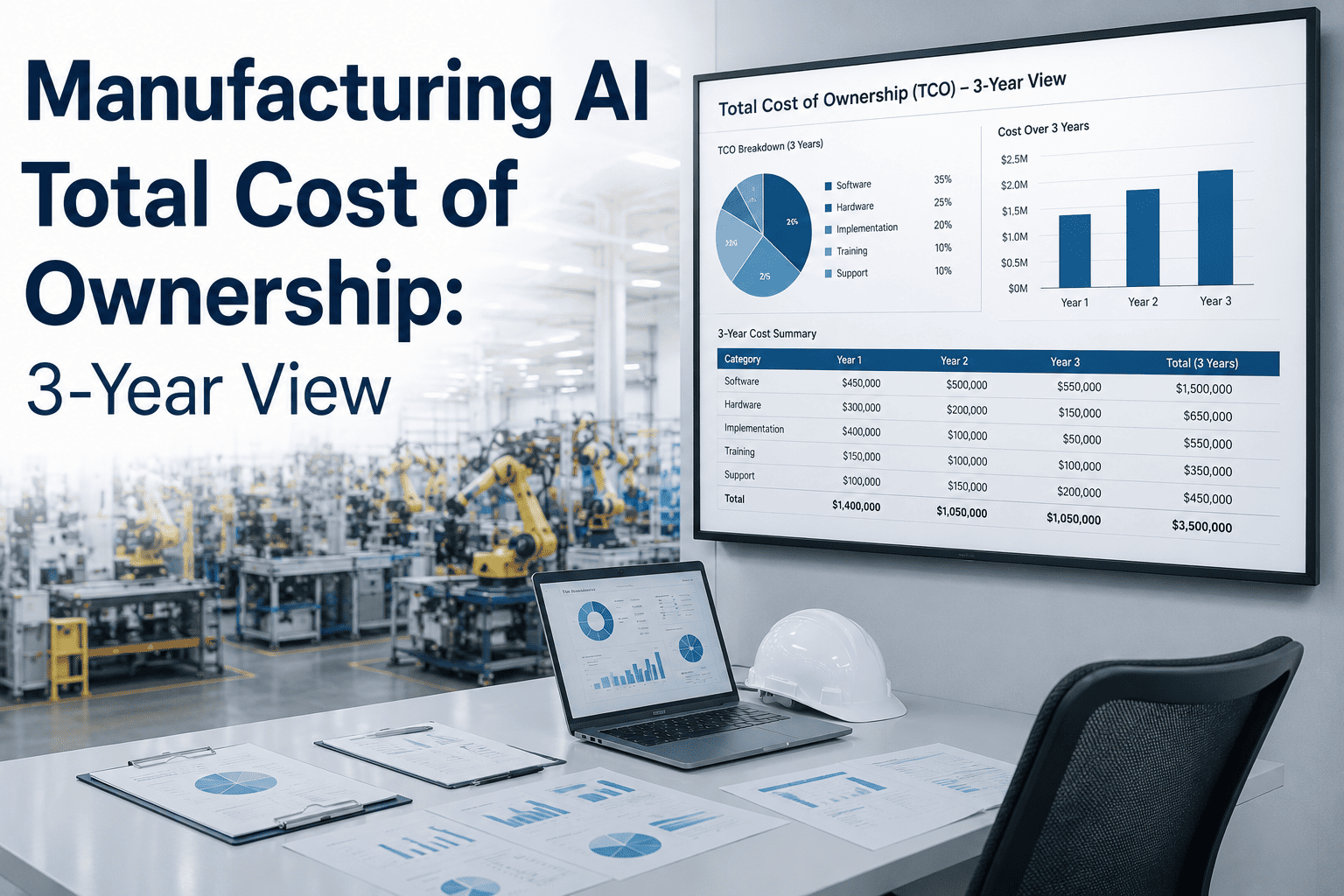
Software licensing is the smallest line, not the largest. Infrastructure and integration together typically account for close to half of total spend across three years.
Infrastructure and Sensors
28%
Sensor retrofits, edge gateways, network upgrades, and compute — the largest single category for brownfield manufacturing sites.
Integration and Data Engineering
22%
Connecting SCADA, MES, CMMS, and ERP systems, plus the data pipeline work required to make plant data model-ready.
Ongoing Operations and Monitoring
18%
Model monitoring, retraining, platform support, and the staff time required to keep the system reliable after go-live.
Software and Platform Licensing
16%
The subscription or license cost most budgets start with — and the smallest of the six major cost categories.
Training and Change Management
8%
Operator and engineer onboarding, documentation, and the adoption work that determines whether the system gets used.
Governance, Security, and Compliance
8%
Access control implementation, audit logging, and the compliance documentation required for regulated production environments.
Year-by-Year View
How the Same Budget Shifts Across Three Years
Cost Driver
Year 1 — Setup
Year 2 — Scale
Infrastructure
Heaviest spend — sensors, edge, network built from scratch
Incremental only, extending to a second line or site
Integration
Full data pipeline and system connections built for the first time
Reused architecture drops marginal integration cost significantly
Training
Full onboarding program for the first user group
Refresher training only, cost drops sharply
Operations
Ramping up monitoring and support as the system stabilizes
Steady-state monitoring cost, now the largest recurring line
Overall Trend
Highest total spend of the three years, capex-heavy
Lower total spend, shifting toward opex and steady operations
iFactory Builds Your Full 3-Year TCO Model Against Your Actual Plant Environment.
Infrastructure, integration, licensing, training, operations, and compliance — sized to your existing sensor coverage and system architecture, not a generic industry average.
The Costs Budgets Miss Most
Three Hidden Costs That Show Up After the Contract Is Signed
Brownfield Retrofit Premium
Legacy equipment without existing sensors or network infrastructure adds six to twelve months of infrastructure work compared to a greenfield estimate, extending payback without reducing eventual ROI.
Model Drift and Retraining
As production conditions, equipment, and product mix change, models require periodic retraining — a recurring cost that flat-rate license quotes rarely disclose upfront.
Compliance and Audit Evidence
Security architecture, access logging, and audit documentation for regulated production environments accumulate as ongoing cost, not a one-time setup fee.
License Estimate vs. Full TCO
The Number on the Price Sheet vs. the Number You'll Actually Spend
Category
License-Only Estimate
Full TCO Model
Scope
Software subscription price only
Infrastructure, integration, operations, training, and governance included
Year 1 Accuracy
Represents roughly 16% of true first-year spend
Reflects the full first-year investment across all cost categories
Year 2 and 3 Visibility
No visibility into ongoing operations or retraining cost
Steady-state operating cost modeled and planned for in advance
Budget Outcome
Cost overrun discovered mid-project, often 20 to 30% above baseline
Budget matches actual spend within the planned range
From the Field
What the First-Year Budget Missed
The vendor quote we brought to the board was the license fee, full stop. Nobody flagged that our plant's sensor coverage was thin enough to need a real retrofit, or that the integration work to connect our MES and our maintenance system would take three months of contractor time. By month five we'd spent forty percent more than the approved budget and still hadn't gone live. The second time around, we built the estimate from six categories instead of one — infrastructure, integration, licensing, operations, training, and compliance — and priced each one against our actual plant, not an industry average. The number was bigger going in, but it was the real number, and we didn't have to go back to the board for an emergency budget increase halfway through.
— CIO, Multi-Site Industrial Equipment Manufacturer, U.S. Midwest
40%Overrun against the license-only first budget
6 categoriesUsed to rebuild the estimate the second time
0Emergency budget requests since switching to a full TCO model
Conclusion
The License Price Was Never the Whole Story. Budget for the Rest of It.
A manufacturing AI budget built around the software license alone is missing the majority of what the project will actually cost. Infrastructure and sensor retrofits, system integration, ongoing operations, training, and governance make up the larger share of a realistic three-year total — and every one of them is predictable enough to model before the project starts, not after the invoices arrive.
iFactory's platform builds the full six-category TCO model against your specific plant environment, so the budget your board approves is the budget you actually spend. Book a Demo to see a three-year TCO breakdown built for your production footprint.
Frequently Asked Questions
Manufacturing AI TCO — What CIOs Ask Before Budgeting
What percentage of manufacturing AI TCO does the software license actually represent?
Across modeled enterprise AI rollouts, the platform, model, and licensing line typically represents around sixteen percent of first-year total cost of ownership. The remainder is the work required to make the system usable in production: infrastructure and sensor retrofits, data integration and engineering, ongoing operations and monitoring, training, and governance. A budget built solely around the license quote is structurally missing the majority of the real number.
Book a demo to see the full breakdown modeled against your plant.
Why do brownfield manufacturing sites cost more to deploy AI on than greenfield facilities?
Brownfield facilities with legacy equipment typically lack the sensor coverage, standardized protocols, and network infrastructure that a purpose-built greenfield site would already have, requiring retrofit work before any AI system can reliably ingest production data. This shifts the payback timeline by six to twelve months compared to a greenfield estimate, but it does not eliminate the eventual return — it extends the initial infrastructure investment period.
Does the cost of adding a second AI use case drop once the first one is deployed?
Yes, significantly. Once the core infrastructure, data pipeline, and integration architecture exist for one use case, the marginal cost of adding a second or third use case typically drops fifty to seventy percent, because the sensor coverage, network connectivity, and system integrations are already in place. This is one of the strongest arguments for building the first deployment on infrastructure designed to extend, not on a narrow, single-purpose integration.
What ongoing costs continue after a manufacturing AI system goes live?
Ongoing costs include model monitoring and periodic retraining as production conditions change, platform support and maintenance, continued data engineering as new sensors or systems are added, and governance activities like access review and audit logging. These operational costs typically become the largest recurring line item by year two or three, even as one-time implementation costs disappear from the budget.
How can a CIO avoid a mid-project budget overrun on a manufacturing AI deployment?
The most effective safeguard is building the original budget across all six cost categories — infrastructure, integration, licensing, operations, training, and governance — rather than starting from the license quote and adding contingency. Organizations that model the full TCO upfront consistently land within their planned budget range, while license-only estimates are the single most common source of the twenty to thirty percent overruns that force a mid-project budget request.
Contact support for help structuring a full TCO model before your next budget cycle.
Get the Real Three-Year Number Before You Present to the Board
Infrastructure, integration, licensing, operations, training, and governance — modeled against your actual plant environment, not an industry average, so the budget you approve is the budget you spend.