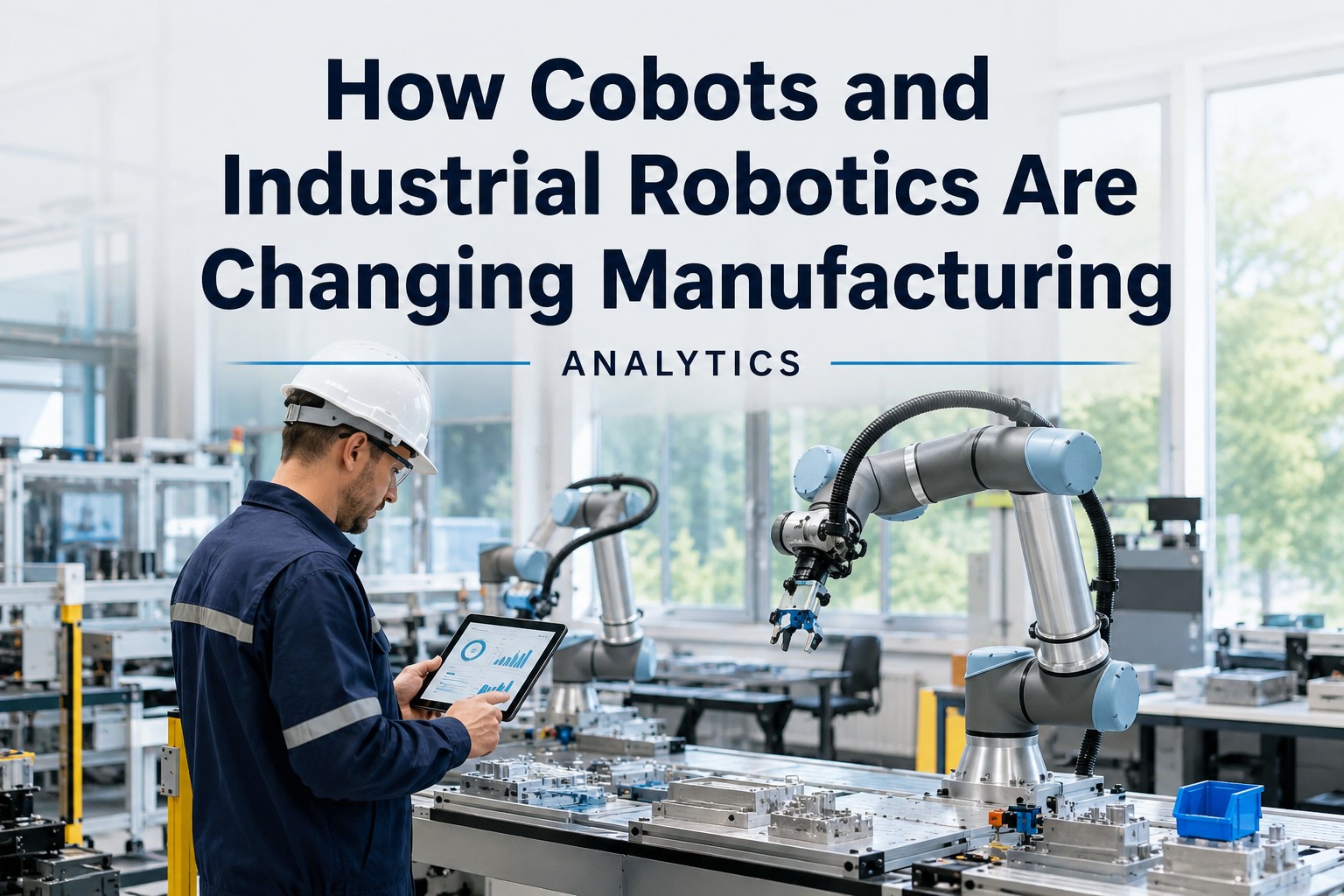
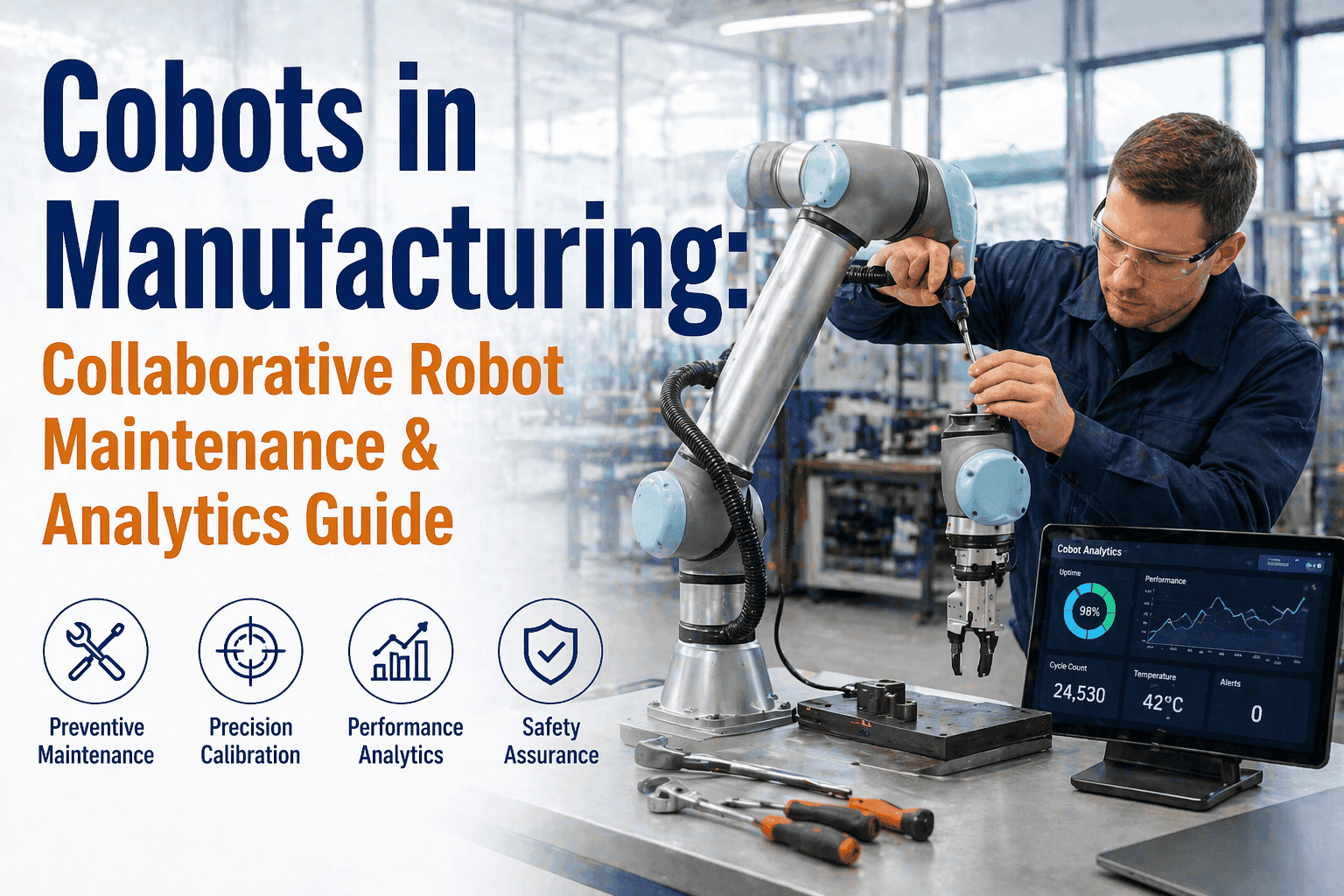
The collaborative robot market has moved well past the early-adopter phase. It was valued near $5.6 billion in 2025 and is projected to reach into the tens of billions within the next decade, growing faster than almost any other segment of industrial automation. For a manufacturing engineer staring at a stack of vendor quotes, the harder question isn't whether to deploy a cobot — it's which platform, which payload class, and which integration path actually pays back inside two years. This guide breaks down the selection criteria and cost math that iFactory's automation advisors walk manufacturers through before a single purchase order is signed.
COBOTS · SELECTION GUIDE · 2026
Cobots in Manufacturing: The 2026 Selection and ROI Guide
Universal Robots, FANUC, ABB, and Doosan are all shipping stronger cobots than a year ago. This guide compares the platforms, the true installed cost, and the use cases that reliably pay back inside 24 months.
Market Snapshot
Why Cobot Adoption Is Accelerating in 2026
Collaborative robots are safe to operate without fencing, quick to program through teach pendants and hand guidance, and dramatically cheaper to integrate than a traditional caged robot cell. That combination is why cobots are expanding the addressable automation market to small and mid-size manufacturers who previously could not justify a six-figure automation project.
18.9%
projected CAGR for the global collaborative robot market through 2030
$50K–$100K
typical full cobot installation cost versus $150K–$250K for a traditional caged robot cell
<2 yrs
typical payback period for cobot deployments in the U.S., Germany, and Japan
2M+
unfilled manufacturing positions globally driving urgency behind cobot adoption
Vendor Comparison
Universal Robots vs. FANUC vs. ABB vs. Doosan
Each of the major cobot brands has carved out a distinct strength. The right choice usually comes down to what controller platform your plant already runs, your payload ceiling, and how much integrator support you need on day one.
Leading Cobot Platform Comparison — 2026
True Cost Breakdown
What a Cobot Deployment Actually Costs Beyond the Arm
Robot Arm
$25,000–$70,000
End-of-Arm Tooling (EOAT)
$3,000–$15,000
Safety Peripherals
$2,000–$8,000
Integration Engineering (30–80 hrs)
Varies by local rate
Commissioning and First-Year Maintenance
Ongoing line item
Hardware price is the starting point, not the final cost. Manufacturing engineers who budget only for the arm consistently underestimate total deployment cost by 40 percent or more, which is the single most common reason cobot projects run over budget in year one.
Not Sure Which Cobot Fits Your Line?
iFactory's automation advisors map your payload, reach, and cycle-time requirements against the leading cobot platforms before you request a single vendor quote.
Application Fit
Where Cobots Deliver the Fastest Payback
✓
Machine Tending
Loading and unloading CNC machines and injection molding presses remains the single highest-volume cobot application, with the most mature integration playbooks available.
✓
Pick and Place / Palletizing
Higher-payload cobots like the UR20, UR30, and FANUC CRX-25iA now compete directly with entry-level traditional robots for palletizing tasks previously requiring a caged cell.
✓
Light Assembly
Force-sensing cobots handle precision assembly steps alongside human operators on mixed-model lines without the fencing that would slow the line down.
✓
Quality Inspection
Cobots paired with vision systems perform consistent, repeatable inspection routines on parts that previously relied on manual spot checks between production runs.
✓
Packaging
End-of-line packaging and case packing tasks benefit from a cobot's ability to work directly beside operators during peak-volume periods without a full cell redesign.
✓
Micro-Assembly and Electronics
Dual-arm platforms handle the delicate, two-handed precision work common in electronics and pharmaceutical micro-assembly that single-arm cobots cannot easily replicate.
Selection Checklist
Six Questions to Answer Before You Request a Cobot Quote
1
What is the actual payload and reach the task requires, including the tooling weight — not just the part weight?
2
Does your plant already run a specific brand of industrial robots, and would staying on that controller platform reduce training and service costs?
3
How dense is the certified integrator network for each brand in your region, and what is their realistic response time for service calls?
4
Have you priced the full deployment — EOAT, safety peripherals, and integration engineering — rather than just the arm?
5
Does the application need true collaborative operation without fencing, or would a higher-speed, monitored-stop configuration like ABB SWIFTI serve the task better?
6
Do you have a data plan to connect the cobot's cycle and fault data into your MES or CMMS so the investment shows up in your OEE numbers?
Deployment Timeline
What a First Cobot Deployment Looks Like Week by Week
Manufacturing engineers evaluating their first cobot often underestimate how quickly a well-scoped project moves once the platform is chosen. The timeline below reflects a typical single-station machine tending or pick-and-place deployment from decision to production.
1
Weeks 1–2: Finalize payload, reach, and cycle-time requirements, then request quotes from two or three shortlisted brands with full installed cost, not just arm price.
2
Weeks 3–5: Confirm integrator availability, order EOAT and safety peripherals, and complete a risk assessment against ISO/TS 15066 collaborative operation limits.
3
Weeks 6–9: Install, program, and commission the cell, running parallel operation alongside the existing manual process to validate cycle time and quality before full cutover.
4
Weeks 10–12: Complete operator training, connect cycle and fault data into MES or CMMS, and hand the station fully over to production with a defined maintenance schedule.
Frequently Asked Questions
Cobots in Manufacturing — Common Questions
What is the real difference between a cobot and a traditional industrial robot?
Cobots are designed with force and speed limits, along with sensing systems, that allow them to operate safely near people without a fenced cell, following the ISO/TS 15066 safety specification. Traditional industrial robots move faster and handle heavier payloads but require fencing or light curtains to protect nearby workers, which adds both cost and floor space to the deployment.
How long does a typical cobot deployment take from order to production?
A straightforward machine tending or pick-and-place application typically moves from order to production in six to twelve weeks, including integration engineering, safety validation, and operator training, while more complex multi-station deployments can take several months depending on integrator availability.
Can a small manufacturer justify a cobot without an in-house robotics engineer?
Yes. Platforms like the FANUC CRX line and Universal Robots' teach-pendant interface were specifically designed for manufacturers without dedicated robotics staff, using tablet-based drag-and-drop programming rather than the complex teach pendants traditional industrial robots require, and most certified integrators offer ongoing support contracts to fill any remaining skills gap.
Which cobot brand has the best resale value and long-term support?
Universal Robots and FANUC currently have the densest global certified integrator networks, which matters more for long-term support and resale liquidity than any single spec sheet comparison. Reach out through
iFactory's support team for a region-specific integrator recommendation before finalizing a brand decision.
Do cobots actually reduce labor costs, or just shift the labor elsewhere?
Cobots typically reallocate labor rather than eliminate it outright, moving operators from repetitive, ergonomically risky tasks into machine oversight, quality checks, and higher-value work. The ROI case is strongest when a plant is dealing with unfilled positions or high turnover on the specific task being automated, rather than simply trying to cut existing headcount.
COBOTS · MANUFACTURING · ROI-READY
Get a Cobot Selection Plan Built Around Your Line
iFactory helps manufacturing engineers compare payload, integration cost, and expected payback across every major cobot brand before a single quote is requested.



.png)