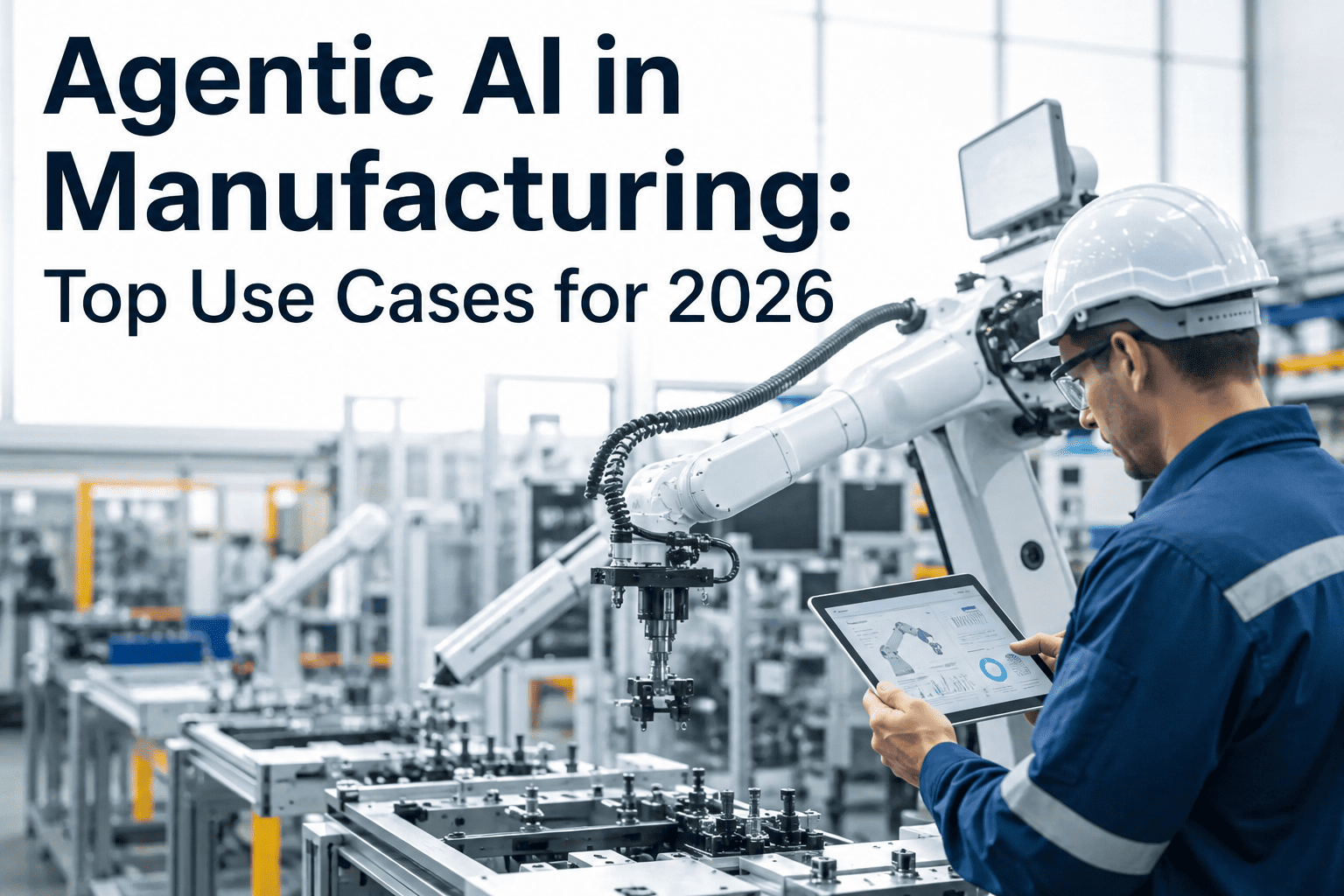
Manufacturing has spent the last two years talking about AI that can answer questions and summarize dashboards. In 2026, the conversation has moved on. Agentic AI systems are now taking action inside real plants — reading a vibration anomaly, checking parts availability in the ERP, booking a technician, and closing the work order without a human touching a single screen. This is not a future-state pitch anymore; it is a live operating model at a growing number of facilities. The organizations pulling ahead are the ones that stopped waiting for a perfect rollout plan and started running agents on real production data, and iFactory's implementation team has watched that shift happen plant by plant this year.
AGENTIC AI · MANUFACTURING · 2026 FIELD REPORT
Agentic AI in Manufacturing: The Use Cases Actually Paying Off in 2026
Not every agentic AI promise has materialized on the plant floor. This breakdown separates the use cases delivering measured value today from the ones still twelve months out — and shows where iFactory customers are already running autonomous workflows.
The Shift
Why Agentic AI Is a Different Category, Not Another Dashboard
Generative AI answers questions and drafts content. Agentic AI plans, decides, and executes multi-step workflows across the systems a plant already runs — ERP, MES, PLM, CMMS, and quality platforms — with minimal human intervention at each step. The distinction matters because it changes what the technology is actually worth to an operations leader. A chatbot that explains an OEE dip still requires a person to act on the explanation. An agent that detects the dip, traces it to a starved upstream buffer, and rebalances the schedule has closed the loop without waiting for a shift meeting.
Adoption data backs up the shift in tone from pilot to production. More than six in ten manufacturing organizations report they are now widely implementing agentic AI technology, and a meaningful share have moved past isolated pilots into scaled autonomous agent programs. The technology is not evenly distributed across every plant function yet, but the functions where it has landed are the ones with high transaction volume and repeatable, structured workflows — exactly where an agent creates the most leverage per dollar invested.
62%
of manufacturers now widely implementing agentic AI technology across at least one workflow
3–6 mo
typical ROI window for prescriptive maintenance and computer vision quality agents
40%
of manufacturers expect at least one plant operating with no human input by 2030
7
core workflow categories where agentic AI is delivering end-to-end operational outcomes today
Proven Today
Where Agentic AI Is Already Running Autonomous Workflows
These are the use cases with documented deployments — not roadmap slides. Each one follows the same pattern: an agent detects a signal, decides what it means using live context, takes an action across two or more systems, and verifies the outcome with an escalation path back to a human when confidence is low.
01
Predictive Maintenance Work Order Automation
An agent monitors vibration, thermal, and acoustic sensor streams, identifies a developing bearing failure, checks spare parts inventory in the ERP, confirms technician availability, and generates a scheduled work order — all before the fault reaches a critical stage. Human review is required only when confidence falls below a set threshold.
02
Computer Vision Quality Control With Root Cause Routing
Vision agents do not just flag a defect — they classify the defect type, correlate it against recent process parameter changes, and route the finding to the specific process engineer or line that most likely caused it, cutting root cause investigation time from days to hours.
03
Supply Chain and Procurement Coordination
Agents track supplier lead times, raw material forecasts, and open purchase orders simultaneously, automatically triggering supplier follow-ups or reallocating inventory across plants when a shortage risk crosses a defined threshold, without waiting for a planner to notice the gap.
04
Dynamic Production Scheduling
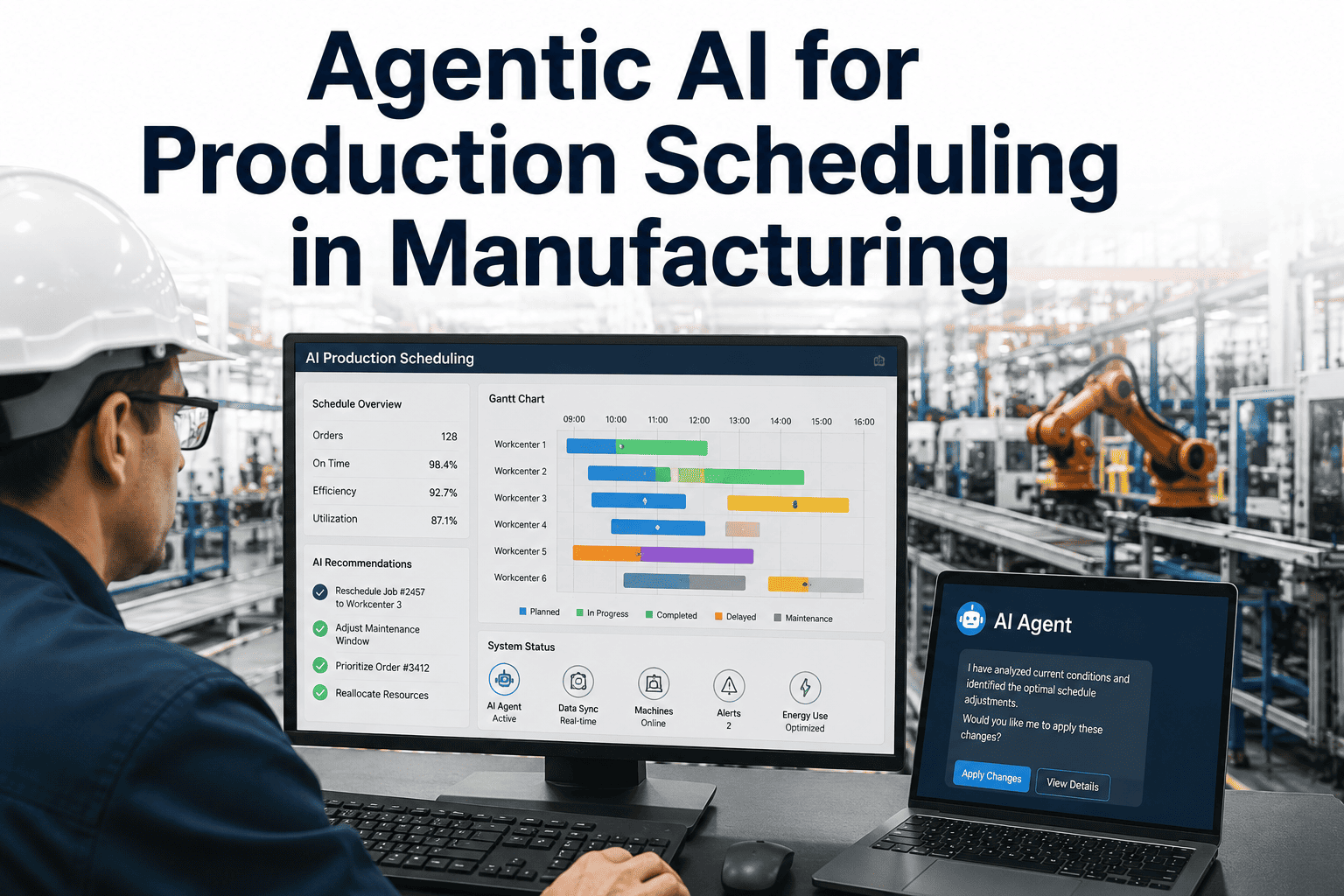
When a machine goes down or a rush order lands, scheduling agents re-sequence the production plan across constrained resources in minutes, factoring in changeover time, labor availability, and downstream inventory buffers rather than waiting for the next planning cycle.
05
Engineering and BOM Synchronization
Engineering change agents detect when a BOM revision in PLM has not propagated to MES or ERP, flag the mismatch, and either auto-correct low-risk discrepancies or route high-risk changes for engineering sign-off, closing a gap that has historically caused costly build errors.
06
Shift Handoff and Downtime Logging
Day-2 operations agents compile shift logs, downtime causes, and open action items automatically from sensor and MES data, replacing the manual handoff notes that frequently lose context between shifts and slow next-shift response time.
07
Industrial Security Triage
Security-focused agents inside the plant's operational technology network act as a force multiplier for lean industrial security teams, triaging alerts, correlating anomalous access patterns, and escalating only the events that meet a genuine risk profile.
Maturity Benchmark
Agentic AI Maturity by Use Case — 2026 Status and 12-Month Outlook
Not every agentic use case is at the same maturity level. Some are running in recommendation mode, where the agent drafts a decision for human approval. Others are already running in full execution mode inside the highest-trust manufacturers. The table below reflects the current state observed across deployments discussed at leading industrial AI forums this year.
Agentic AI Deployment Maturity — 2026
See Which Agentic Workflows Fit Your Plant
iFactory maps your ERP, MES, and CMMS stack against the seven proven agentic use cases below and shows you where autonomous execution is realistic in the next two quarters.
Common Pitfalls
Why Some Agentic AI Rollouts Stall Before Scaling
Legacy System Integration Gaps
Agents need live, structured access to ERP, MES, and CMMS data. Plants running heavily customized or air-gapped legacy systems often need a data integration layer before any agent can act reliably, and skipping this step is the single most common cause of stalled pilots.
No Defined Execution Boundary
Programs that never separate recommendation mode from execution mode tend to stay stuck in recommendation mode indefinitely, because no one has defined which decisions are low-risk enough to automate and which require sign-off.
Workforce Skill Gaps
Operators and engineers need to understand what an agent is deciding and why, or trust collapses the first time an agent makes a visible mistake. Structured upskilling closes this gap far faster than a generic training deck.
Underestimating Data Readiness
Agentic systems overcome the frozen-knowledge limitation of static AI models by connecting to real-time data sources, but only if those sources are clean and consistently structured. Fragmented or duplicate asset records quietly undermine agent accuracy long before anyone notices.
Deployment Path
A Realistic Rollout Path for Agentic AI on the Plant Floor
Q1
Pick One High-Volume, Structured Workflow
Start with predictive maintenance work orders or vision-based quality routing — both have the shortest proven ROI window and the clearest data foundation already in place at most plants.
Q2
Run in Recommendation Mode First
Let the agent draft decisions for human approval for a defined evaluation window, tracking approval rate and time saved before granting any execution authority.
Q3
Graduate Low-Risk Decisions to Execution Mode
Move the highest-confidence, lowest-risk decision types into autonomous execution while keeping every higher-risk change behind an approval gate.
Q4
Expand to a Second Workflow and Multi-Agent Coordination
Once the first workflow is stable, connect a second agent so the two coordinate across systems — for example, linking maintenance scheduling with supply chain agents so a parts shortage automatically adjusts the maintenance calendar.
Readiness Check
Signals You're Ready to Scale Agentic AI Beyond a Single Pilot
Most manufacturers get their first agentic workflow running without much trouble. The harder step is knowing when it's genuinely safe to expand from one supervised pilot into two, three, or a coordinated multi-agent program. These are the readiness signals iFactory's implementation team looks for before recommending a customer scale up.
Approval Rate Above 90% in Recommendation Mode
If your team is approving the agent's draft decisions more than nine times out of ten over a multi-week evaluation window, the agent's judgment has earned enough trust to graduate low-risk decisions into full execution mode.
Clean, Structured Data Feeding the Agent
Scaling an agent onto messy or duplicate asset records only scales the errors faster. Confirm your ERP, MES, and CMMS records are consistently structured before adding a second workflow on top of the first.
Operators Can Explain What the Agent Is Doing
If the people working alongside the agent every day can describe, in plain language, what it decides and why, trust on the floor is strong enough to support a wider rollout without pushback.
A Defined Escalation Path Exists for Every Workflow
Every agent, no matter how mature, needs a clear rule for when a decision routes to a human instead of executing automatically. Programs without this boundary tend to either stall in recommendation mode or take on risk no one signed up for.
Frequently Asked Questions
Agentic AI in Manufacturing — Common Questions
What is the difference between agentic AI and traditional workflow automation?
Traditional automation follows fixed rules within a single system and breaks when conditions change outside its script. Agentic AI plans and adapts across multiple systems, reasoning about context before acting, which is why it can handle exceptions that rule-based automation cannot. iFactory's platform documentation at
the support center walks through how this distinction plays out in a live plant environment.
How long does it take to see ROI from an agentic AI deployment?
Deployments discussed across industrial AI forums this year show prescriptive maintenance and computer vision quality control consistently delivering ROI within three to six months, while more complex coordination use cases like scheduling or supply chain reallocation typically take six to twelve months as trust in the agent's decisions builds.
Do we need to replace our ERP or MES to run agentic AI?
No. Agentic systems are designed to connect to existing ERP, MES, PLM, and CMMS platforms through standard integration protocols rather than requiring a system replacement. The integration work is real but scoped to connecting data flows, not rebuilding the underlying infrastructure your plant already depends on.
Which manufacturing function should we automate with agents first?
Start with the function that has the highest transaction volume and the most repeatable, structured workflow — predictive maintenance and quality inspection routinely top this list because the data streams are already digitized and the decision logic is well understood across most production environments.
How do we keep agentic AI decisions safe and auditable?
Mature programs define recommendation mode versus execution mode explicitly, keeping every higher-risk decision behind a human approval gate while allowing agents to draft and route lower-risk work automatically. Every agent action should generate a timestamped, auditable record that ties the decision back to the data that triggered it, which teams can review through
iFactory's support resources.
AGENTIC AI · MANUFACTURING · READY TO DEPLOY
Turn Your First Agentic Workflow Into a Working Pilot
iFactory helps manufacturing teams pick the right first use case, connect it to existing ERP and MES data, and move from recommendation mode to trusted autonomous execution.