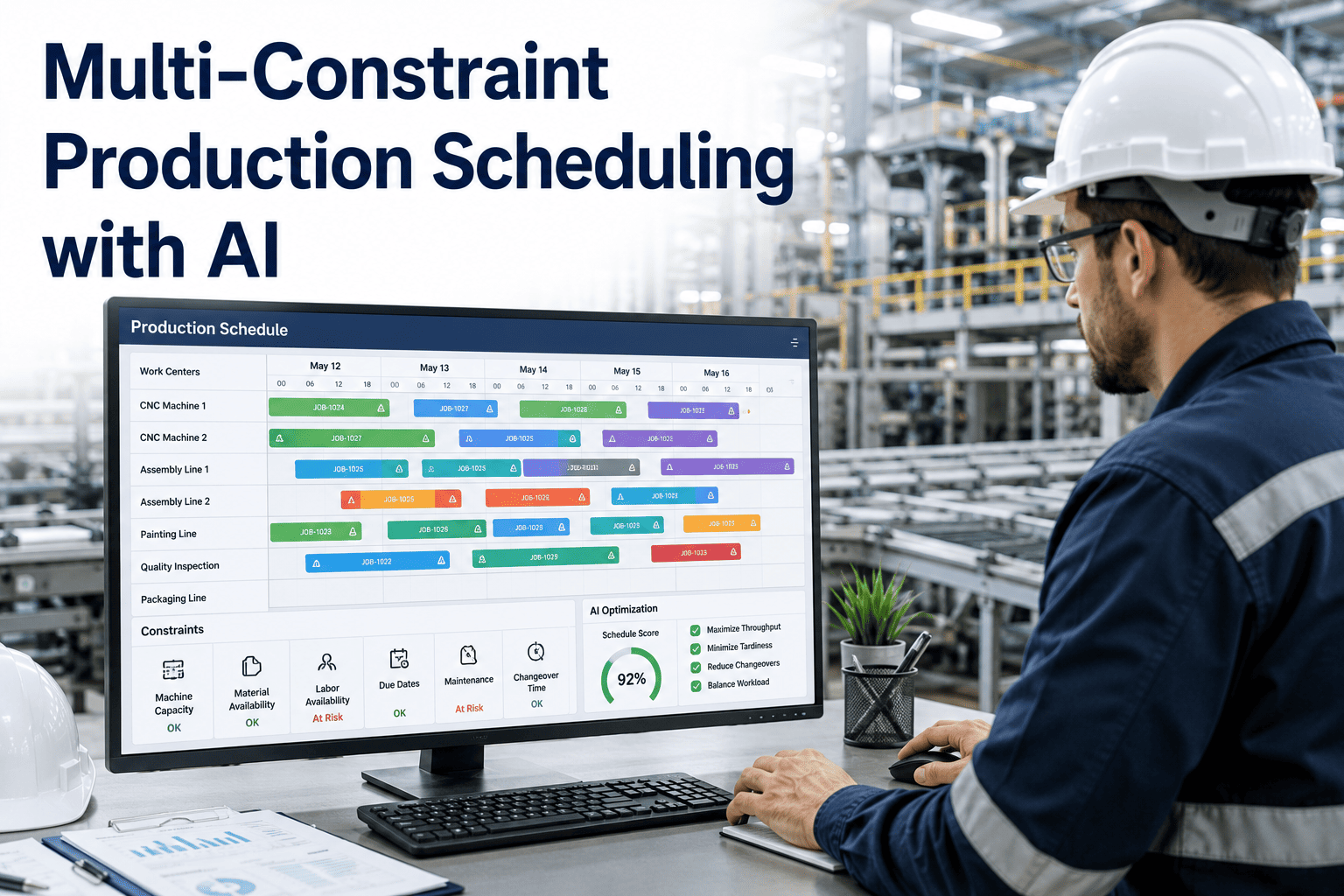
A machine goes down mid-shift. A supplier truck is running four hours late. A quality hold pulls twelve units off the line. None of these are rare events — they're Tuesday, and on a busy line all three can land in the same hour. What's rare is a scheduling system that reacts to all three at once without waking up a planner at 2am, without a 30-minute lag while someone manually checks what's affected, and without breaking a delivery commitment that was perfectly achievable if the plan had simply reacted in time. Agentic AI does exactly that, re-optimizing the schedule autonomously within guardrails a planner sets in advance, and only surfacing the decisions that genuinely need a human. Book a demo to see agentic scheduling handle a live disruption.
Agentic AI
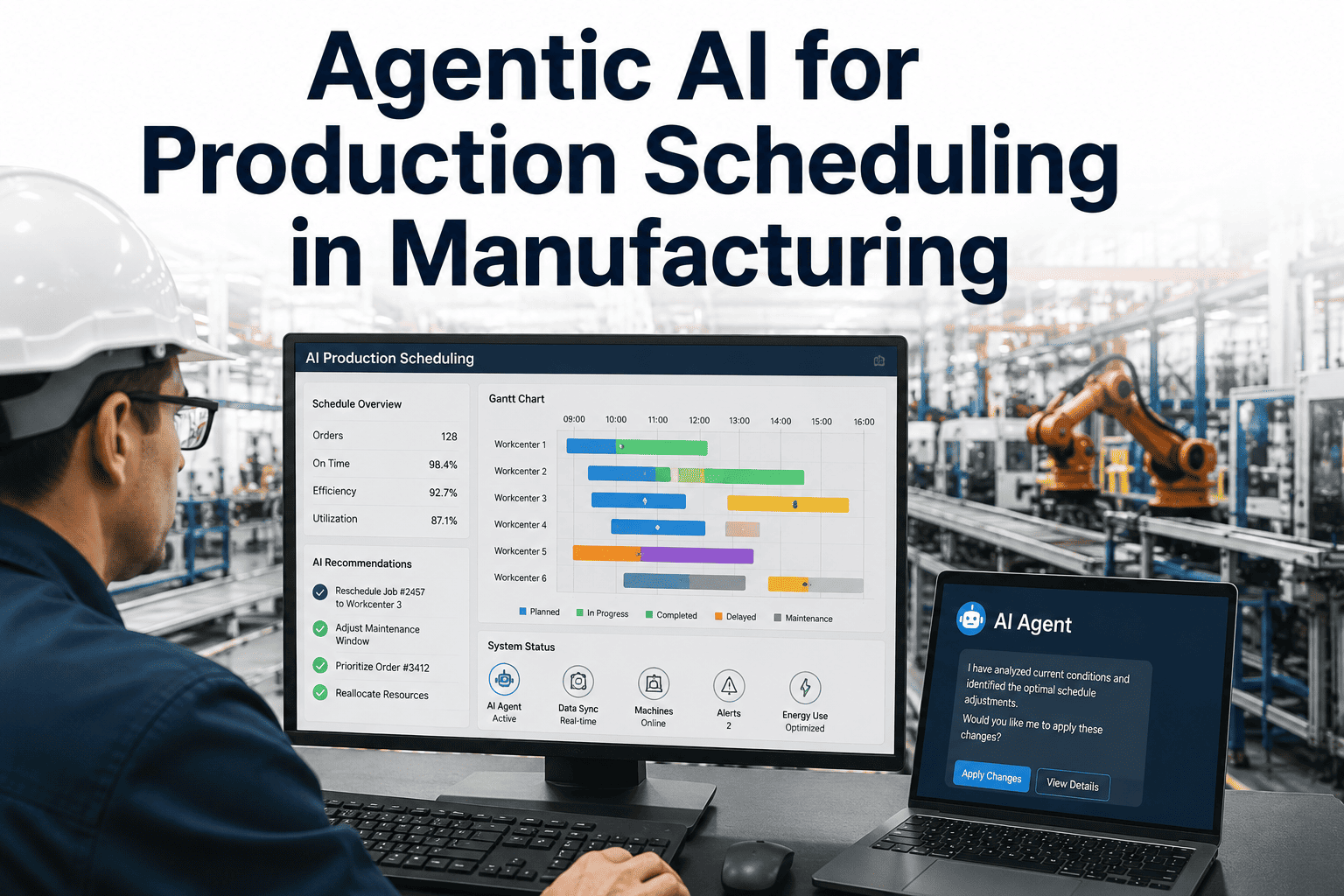
Agentic AI for Production Scheduling: When the Plan Reacts Faster Than the Problem
Most scheduling software tells a planner what changed. Agentic scheduling decides what to do about it — within limits the planner set — and only escalates the decisions that actually deserve a human's attention.
Why Traditional Scheduling Systems Can't Keep Up
A conventional advanced planning and scheduling tool generates an optimized plan, then holds it fixed until someone re-runs the optimizer, often on a fixed daily or shift-based cycle. Between those runs, the plan quietly goes stale every time a machine breaks, a material shipment slips, or a rush order lands. Planners end up manually patching the gap — reshuffling work orders by feel because the system hasn't caught up yet. Agentic AI closes that gap by treating scheduling as a continuous, event-driven process rather than a batch job.
The scheduling agent doesn't work alone — it's the coordination point for four other specialized agents, each watching one slice of the plant and feeding real-time signals into every rescheduling decision. This is what separates agentic scheduling from a single smart optimizer: the plan reacts to maintenance, materials, quality, and workforce conditions simultaneously, the same way a strong human planner would if they had perfect visibility into all four at once.
Scheduling Agent
Owns the master production schedule
Maintenance Agent
Flags equipment risk and downtime windows
Materials Agent
Tracks inbound supply and buffer stock
Quality Agent
Reports holds and rework impact
Workforce Agent
Tracks operator availability and skill
How an Agentic Scheduler Handles a Live Disruption
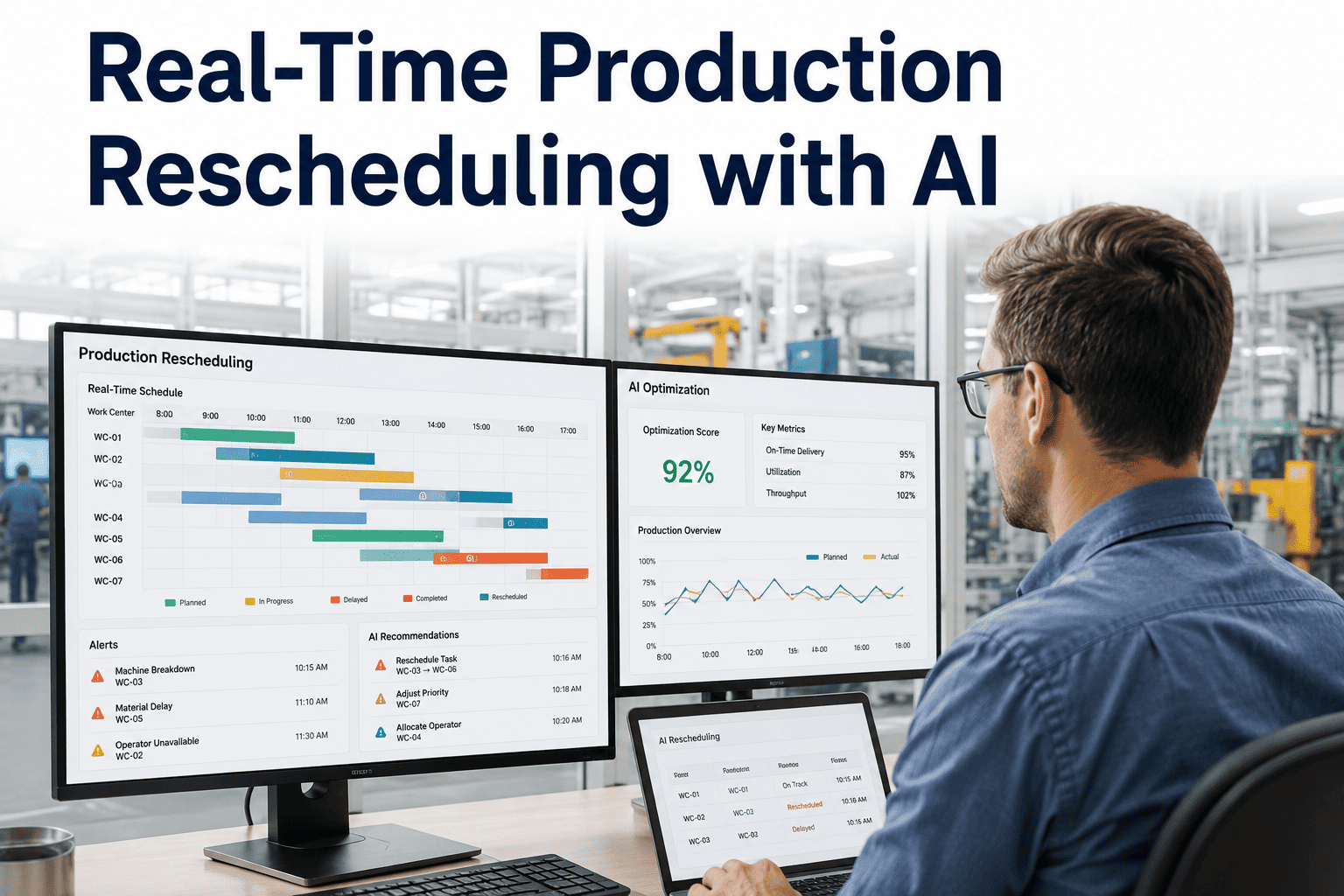
Consider a bearing failure on a mid-line machine. In a traditional system, someone notices the downtime, checks what's affected, and manually adjusts the plan — often 20 to 40 minutes after the failure. An agentic system compresses that entire sequence into seconds. Ask to see this exact scenario replayed in a demo.
T+0 sec
Failure Detected
Maintenance agent flags an anomaly on the bearing vibration signature and predicts imminent failure.
T+5 sec
Impact Assessed
Scheduling agent identifies every work order routed through the affected machine in the next 8 hours.
T+15 sec
Options Evaluated
Materials and workforce agents confirm which alternate routings have open capacity, tooling, and trained operators.
T+30 sec
Plan Republished
Affected orders are rerouted or resequenced; the maintenance window is booked without missing a delivery commitment.
Escalation Only If Needed
If no reroute meets the delivery date within guardrails, the decision escalates to a planner with full context attached.
Guardrails: What Makes This Governed, Not Autonomous Chaos
"Autonomous" tends to make plant leaders nervous, and it should — nobody wants a scheduling agent quietly making a decision that costs six figures or breaks a contractual delivery date without anyone knowing until the damage is done. That's why every agent operates inside explicit boundaries a planner defines up front, and why the industry data on agentic manufacturing consistently shows most organizations still keep a meaningful share of decisions under human review even after deploying autonomous agents at scale.
Seconds
typical time for an agentic reschedule versus 20–40 minutes manually
Majority
of agentic decisions still pass through human review in most current deployments
Staged
rollout, one guardrailed scenario at a time, outperforms a plant-wide launch
Bounded Authority
Every agent operates within spend, capacity, and delivery-date limits a planner configures — it can't act outside them.
Full Audit Trail
Every autonomous decision logs the data it saw, the options it considered, and why it chose the action it took.
Human-in-the-Loop Exceptions
Decisions that fall outside guardrails route to a planner instead of being forced through automatically.
Reversible Actions
Any schedule change an agent publishes can be manually reverted by a planner in one step if it turns out to be wrong.
Governed Autonomy
Let Agents Handle the 90%, Escalate the Rest
iFactory's agentic scheduler resolves routine disruptions in seconds and only brings planners in when a decision genuinely needs one.
Where Agentic Scheduling Works — and Where It Doesn't Yet
Not every scheduling decision belongs in an agent's hands, and pretending otherwise is exactly how pilot programs stall out before reaching production. The clearest wins come from high-frequency, well-understood disruptions with bounded options and real time pressure. Higher-stakes, lower-frequency decisions — the kind with contractual or multi-plant tradeoffs — are better served by an agent that prepares the analysis and a human who makes the final call.
| Scenario | Agentic Fit | Why |
|---|
| Machine breakdown rerouting | Strong fit | Clear rules, bounded options, fast time pressure |
| Rush order insertion | Strong fit | Well-defined constraints, repeatable decision pattern |
| Multi-plant capacity shifting | Human-reviewed | Higher stakes, contractual and cost tradeoffs involved |
| New product line ramp-up | Human-led, agent-assisted | Limited historical data for the agent to reason from |
What Plant Leaders Should Expect From an Agentic Rollout
Industry data on agentic manufacturing deployments is candid about this: a large share of agentic pilots never make it to production, usually because scope was too broad, governance wasn't defined early enough, or the organization tried to hand over autonomy before trust was actually earned. A deliberate, staged rollout is slower on paper but dramatically more likely to still be running — and expanding — a year later.
1
Start with one high-frequency, well-understood disruption type, typically machine downtime rerouting or rush order insertion.
2
Run the agent in shadow mode alongside the current process, comparing its proposed decisions to what planners actually did.
3
Grant bounded autonomy for the lowest-risk decision category once shadow-mode accuracy is proven over several weeks.
4
Expand scope to additional agents and scenarios as trust and audit history build, rather than deploying plant-wide at once.
Frequently Asked Questions
Does agentic scheduling mean the system runs without any human oversight?
No. Every agent operates inside explicit guardrails a planner defines, covering spend limits, delivery-date tolerance, and which categories of decision it's allowed to make without review. Decisions outside those guardrails are escalated automatically with full context, and most manufacturers keep a large share of decisions under human review even after agents are deployed.
Ask about guardrail configuration in a demo.
How is this different from the AI scheduling optimizers we already use?
A traditional optimizer generates a schedule when someone runs it and then holds that schedule fixed until the next run. An agentic system treats scheduling as continuous: it watches events as they happen, across multiple connected agents covering maintenance, materials, quality, and workforce, and republishes an updated plan the moment a disruption occurs rather than waiting for a scheduled re-optimization.
What happens if an agent makes a decision that turns out to be wrong?
Every action an agent takes is logged with the data it used and the reasoning behind it, and any schedule change can be manually reverted by a planner in one step. Because agents start in shadow mode and only gain bounded autonomy over a specific decision category once accuracy is proven, the risk of a costly wrong decision is deliberately minimized before autonomy is granted.
Contact support to review the rollback process.
What systems does the agentic layer need to connect to?
Typically the MES for real-time shop floor status, the ERP for order and delivery commitments, and any existing SCADA or historian data for equipment health signals. The agents read from these systems continuously and write approved schedule changes back as updated work orders, so your existing systems of record stay the source of truth.
How long does it take to move from pilot to trusted daily use?
Most plants run a single-scenario shadow-mode pilot for four to eight weeks before granting the agent bounded autonomy over that scenario, then expand scope gradually over the following two to three quarters. Industry data on agentic manufacturing deployments shows pilot-to-production abandonment is common when governance and scope are rushed, so a deliberately staged rollout materially improves the odds of reaching sustained daily use.
Book a demo to discuss a staged rollout plan.
Start With One Scenario
See Agentic Scheduling Resolve a Disruption in Seconds
iFactory's agents run in shadow mode first, prove their decisions against your planners, then earn bounded autonomy one scenario at a time.