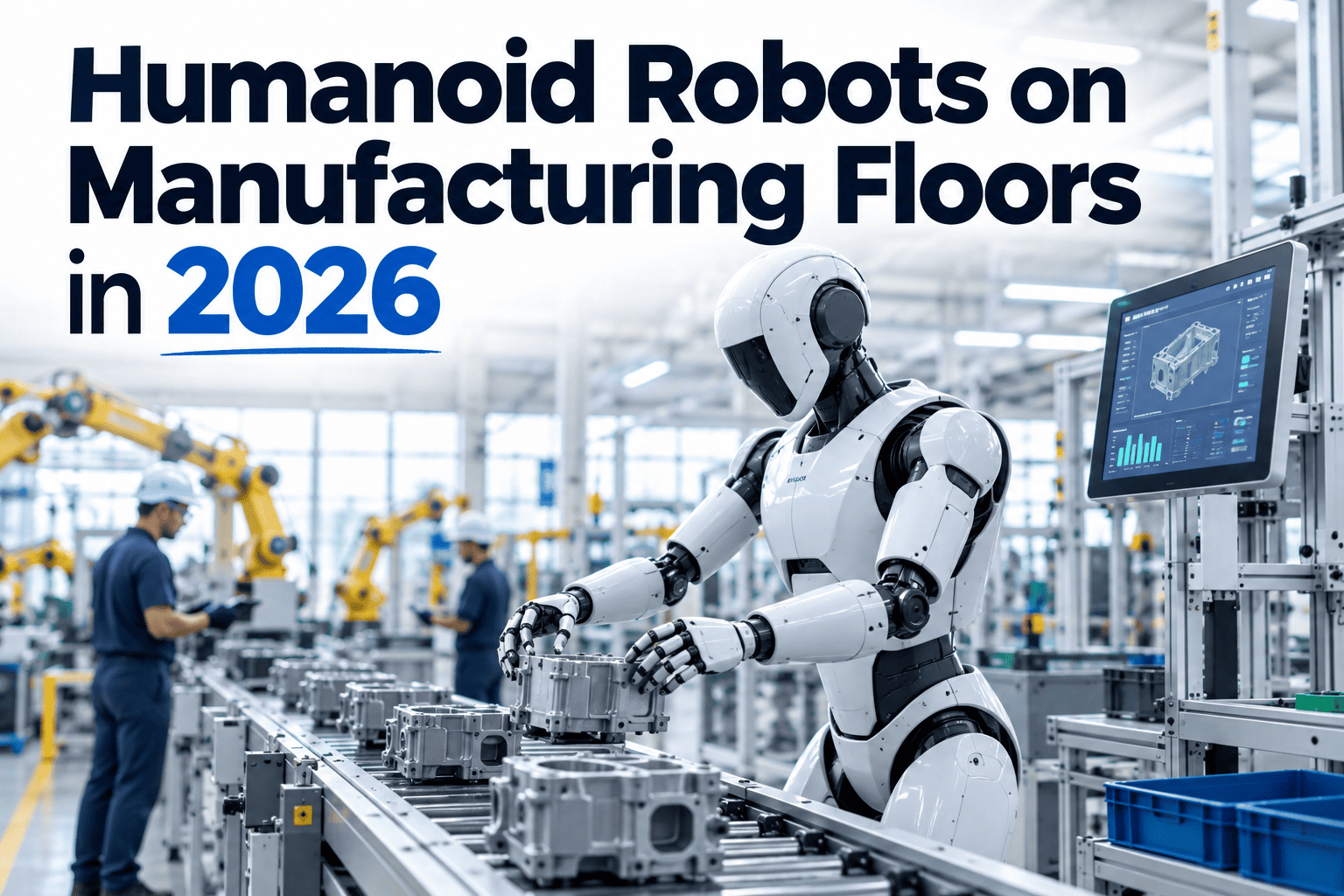
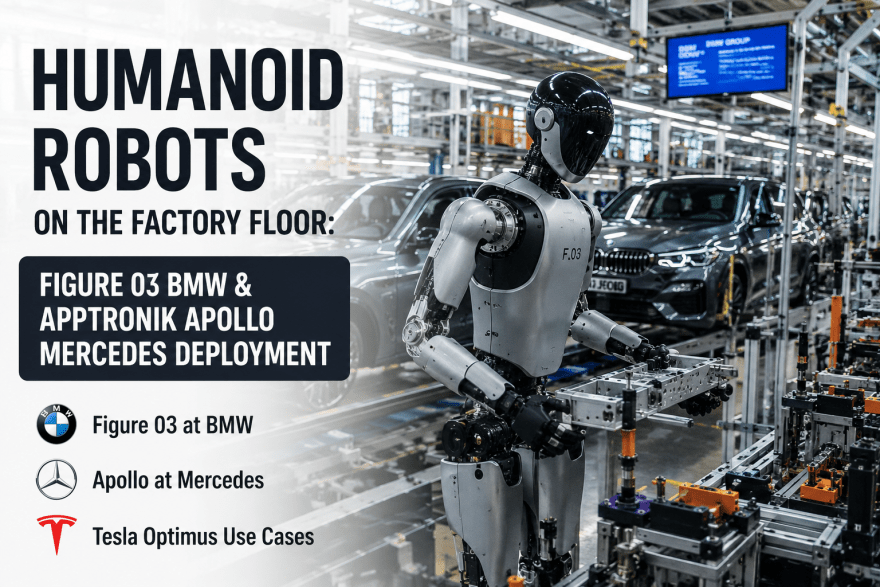
For most of the last decade, a humanoid robot on a factory floor meant a demo reel, not a shift schedule. That changed in 2026. Figure's units have logged over 1,250 operational hours building cars at BMW Spartanburg, Tesla has more than a thousand Optimus units working inside its own Fremont and Texas plants, and Apptronik's Apollo is moving assembly kits across Mercedes-Benz production lines in Berlin. None of this is a press release anymore — it is measured, timestamped production data. This page breaks down exactly what these robots are doing, where the economics genuinely work, and where the hype is still ahead of the hardware, drawing on the deployment data iFactory tracks across active manufacturing plants.
Humanoid Robots on Manufacturing Floors: What's Real in 2026
Figure, Optimus, Apollo, and AEON have all crossed from lab demo to paid production work this year. See the verified deployment data, the economics, and where humanoid robots actually belong on your floor.
2026 Snapshot
The Numbers Behind the Humanoid Robot Shift
The humanoid robot category crossed a real threshold in early 2026. Production volume, deployment hours, and commercial pricing all moved at once, and for the first time procurement teams have hard numbers to plan against instead of vendor projections.
1,250+
verified operational hours logged by Figure 02 units building cars at BMW Spartanburg
1,000+
Optimus Gen 3 units working inside Tesla's own Fremont and Gigafactory Texas plants
$25/hr
operating cost per robot-hour reported for Figure 03 units at BMW with 99%+ placement accuracy
3–6 mo
projected payback period at Tesla's stated $20K–$30K commercial Optimus target price
Verified Deployments
Real Humanoid Robot Deployments Running Right Now
Figure 02 / Figure 03 — BMW Spartanburg
Figure's robots have contributed to the production of 30,000+ vehicles at BMW's Spartanburg plant, running material handling and parts transfer for ten-hour shifts, five days a week. It is the most documented commercial humanoid deployment in the industry today.
Optimus Gen 3 — Tesla Fremont and Gigafactory Texas
Over 1,000 Optimus Gen 3 units are working across battery assembly, EV pack loading, cable routing, and connector seating. Tesla's leadership has been candid that a portion of this fleet is still generating training data rather than pure production output.
Apollo — Mercedes-Benz Berlin
Apptronik's Apollo units move assembly kits across Mercedes-Benz production lines, with the platform prioritizing deep commercial integration into existing line workflows over raw unit scale.
AEON — BMW Europe
AEON is BMW's first humanoid deployment in Europe, targeting full production on high-voltage battery assembly by the end of 2026, built around a mobile wheelbase and self-swapping battery system for continuous shift coverage.
Digit — Amazon and Toyota Facilities
Agility Robotics' Digit is handling tote and material movement inside Amazon fulfillment centers and completed a year-long commercial pilot at a Toyota facility, one of the longer-running documented humanoid programs in the sector.
Unitree H1/G1 — Asia-Pacific Manufacturing
Unitree shipped roughly 5,500 humanoid units in 2025 alone, currently the highest volume producer globally, with growing deployment across electronics and light manufacturing lines in Asia-Pacific markets.
Not Sure Which Task on Your Line Fits a Humanoid Robot?
iFactory maps humanoid, cobot, and fixed automation options against your actual workstation data so you invest in the platform that fits the task — not the one with the most headlines.
Platform Comparison
How the Leading Humanoid Platforms Compare
Each platform has optimized for a different operating model. Matching platform strengths to your specific workstation profile matters more than chasing whichever brand is generating the most headlines this quarter.
Humanoid Robot Platform Comparison — 2026
The Economics
Why the Price Curve Matters More Than the Press Coverage
2025
$150K–$250K Per Unit
At 2025 pricing, humanoid robots delivered an 18 to 36 month payback period at genuinely ergonomic-risk stations, but the business case was questionable for lower-risk, lower-injury-cost tasks.
2026
$20K–$30K Commercial Target
Tesla's stated commercial target price for external Optimus sales would collapse the payback period to 3 to 6 months for high-repetition tasks, a shift that changes who can justify a humanoid deployment at all.
Now
$25/Hour Operating Cost at BMW
Figure 03's reported $25 per robot-operating-hour at BMW Spartanburg, combined with 99%+ placement accuracy, is the clearest publicly available unit economics benchmark in the industry today.
Reality Check
What Humanoid Robots Cannot Do Yet — And Why That's Fine
Not Automotive-Line Production Speed
Traditional fixed-arm industrial robots still achieve repeatability of 0.02 to 0.05 millimeters at cycle times several times faster than any humanoid platform, with decades of proven mean-time-to-failure data behind them.
Narrow Task Range Today
Current deployments cover material handling, bin picking, and simple assembly — not the high-speed, high-precision welding and stamping that defines most automotive and electronics lines.
Reliability Still Maturing
Documented near-miss incidents, including a robot stalling mid-task and blocking an aisle for hours, show that fleet management and failure recovery protocols are still catching up to the hardware ambition.
Best Fit Is Additive, Not a Replacement
Procurement teams should treat 2026-era humanoids as a genuine long-term category to watch and pilot selectively, not a near-term drop-in replacement for the automation already installed on a high-speed line.
Total Cost View
Humanoid Robots vs. Cobots vs. Fixed Automation: Which Fits the Task
Humanoid robots are not competing to replace every automation category at once. Each form factor solves a different problem, and the strongest 2026 deployment strategies mix all three rather than betting everything on one platform.
Humanoid Robots: Best for Variable, Human-Scale Tasks
Humanoids earn their cost where a task changes station to station and a fixed-arm robot would need constant reprogramming — material handling, kitting, and mixed-model parts transfer are the current sweet spot.
Cobots: Best for Fixed, Repeatable Tasks Beside People
A collaborative arm is still the lower-cost, faster-to-deploy choice for machine tending, pick-and-place, and light assembly at a single fixed station, typically installed for a fraction of current humanoid pricing.
Fixed Automation: Best for High-Speed, High-Precision Lines
Nothing beats a traditional caged industrial robot for automotive-line welding, stamping, and high-speed assembly where repeatability of 0.02 to 0.05 millimeters and proven long-term reliability outweigh flexibility.
Where They Overlap, Pilot Before You Commit
Tasks that sit at the boundary — like variable-height palletizing or multi-SKU kitting — are exactly where a short, measured humanoid pilot against your existing cobot baseline gives the clearest answer before a larger purchase order.
Frequently Asked Questions
Humanoid Robots in Manufacturing — Common Questions
Are humanoid robots actually doing productive work in factories today, or just demos?
Both, depending on the program. Figure's BMW deployment and Apptronik's Mercedes-Benz deployment are verified commercial production work with measured hours. Tesla has acknowledged that a portion of its internal Optimus fleet is still generating training data rather than pure productive output, so it is worth asking any vendor for verified operational hours before comparing platforms.
What tasks are humanoid robots best suited for right now?
Material handling, parts transfer, bin picking, kitting, and simple assembly support are the proven categories across every documented 2026 deployment. High-speed, high-precision tasks like welding and stamping remain firmly in the domain of traditional fixed-arm industrial robots for the foreseeable future.
How much does a humanoid robot cost to deploy in 2026?
Leading platforms have historically priced between $150,000 and $250,000 per unit, but Tesla's stated commercial target of $20,000 to $30,000 for external Optimus sales would meaningfully change the addressable market if that pricing materializes at scale, so it is worth confirming current vendor pricing directly through
iFactory's support team before budgeting.
Should a mid-size manufacturer consider humanoid robots before cobots or fixed automation?
Not as a first step. Cobots and fixed automation remain the proven, lower-risk starting point for most mid-size manufacturers, while humanoid robots make the most sense as a targeted pilot on a specific ergonomic-risk or highly variable task once the economics and reliability data continue improving through 2027 and 2028.
What safety standards apply to humanoid robots on the plant floor?
Humanoid robots operating in manufacturing fall under ISO 10218 industrial robot safety requirements and ISO/TS 15066 collaborative robot safety specifications governing force and pressure limits during human interaction, alongside general workplace safety obligations that apply to any robot deployment on a production floor.
Build Your Humanoid and Automation Roadmap With Real Data
iFactory connects humanoid, cobot, and fixed automation data into one operational view, so your next automation dollar goes to the platform that actually fits the task in front of you.





.png)