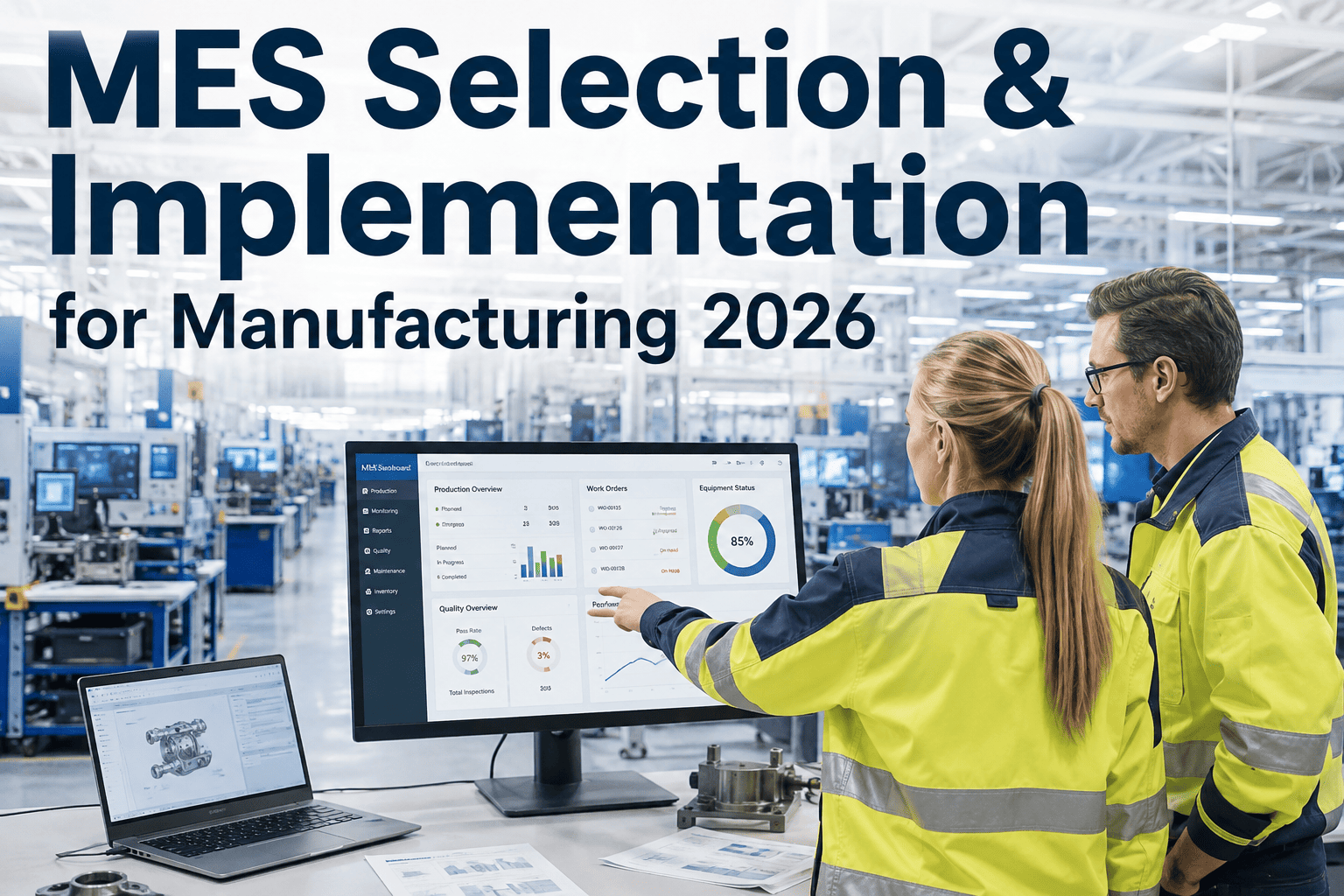
Picking a Manufacturing Execution System used to mean comparing feature checklists from a handful of enterprise vendors. That world is gone. Today a plant manager evaluating MES options is choosing between fundamentally different operating models: heavyweight platforms built for governance and multi-site standardization, lightweight OEE-first tools built for a live dashboard in 48 hours, and everything in between. Choosing wrong is expensive in a different way depending on which direction you err an over-scoped enterprise MES can turn into an 18-month IT project that never reaches the floor, while an under-scoped tool leaves you re-buying a real system in two years and repeating the entire evaluation process from scratch with less internal patience for another lengthy rollout. The right selection process starts with your production model, not a vendor's feature list. See how iFactory AI approaches MES selection and implementation by booking a demo with our team.
MES Selection and Implementation: A Framework for Choosing the Right System the First Time
Feature checklists don't predict deployment success. Production model fit, integration depth, and time-to-value do. Here's how to evaluate correctly.
Where MES Sits in the Plant: The ISA-95 Model
Every MES evaluation should start with a shared understanding of where the system fits in your plant's automation stack, because vendors that are strong at one level are often weak at another. The ISA-95 standard, still the reference architecture in 2026, defines four levels, and an MES you shortlist needs to speak fluently to the layers immediately above and below it: the PLC and SCADA data coming up from the floor, and the order and material data coming down from the ERP. Getting this wrong is the single most common reason a promising pilot never scales past one line, because the integration gaps only become visible once you try to connect a second or third data source.
SCADA can tell you a machine stopped. An MES tells you why it stopped, how long it was down, what that downtime cost, and what it did to your OEE for the shift, and it does this automatically rather than requiring a supervisor to reconstruct the story from memory at the end of the day. That distinction matters when a vendor's demo focuses heavily on dashboards rather than the underlying execution logic connecting Level 2 data to Level 4 planning, since a dashboard built on shallow data still leaves the real diagnostic work to a person.
The Four Tiers of the 2026 MES Market
Vendors today fall into roughly four tiers, each with a different cost, capability, and implementation profile. Matching your plant's size and complexity to the right tier prevents both over-buying, which drags out your timeline and budget for capability you'll never use, and under-buying, which leaves genuine gaps that surface only after go-live.
| Tier | Profile | Typical Timeline | Best Fit |
|---|---|---|---|
| Tier 1: Enterprise Incumbents | Broadest functional coverage, deepest regulatory compliance, mature IT integration | 18-36 months | Fortune 500, heavily regulated multi-site operations |
| Tier 2: Mid-Market Platforms | Strong ERP integration and industry-specific modules with faster deployment | 6-12 months | Mid-size discrete or process manufacturers |
| Tier 3: Cloud-Native MES | Modular, API-first architecture built for brownfield legacy equipment | 2-6 months | Multi-site plants with mixed machine parks |
| Tier 4: Lightweight OEE Platforms | Fast time-to-value, focused on visibility rather than full execution control | Under 30 days | Single-site plants needing rapid floor visibility |
Most manufacturers don't need an 18-month enterprise rollout to get real shop-floor visibility. iFactory AI connects to your existing PLCs and legacy equipment through IIoT gateways and delivers validated production data in days, not months.
Eight Criteria for Evaluating Any MES Vendor
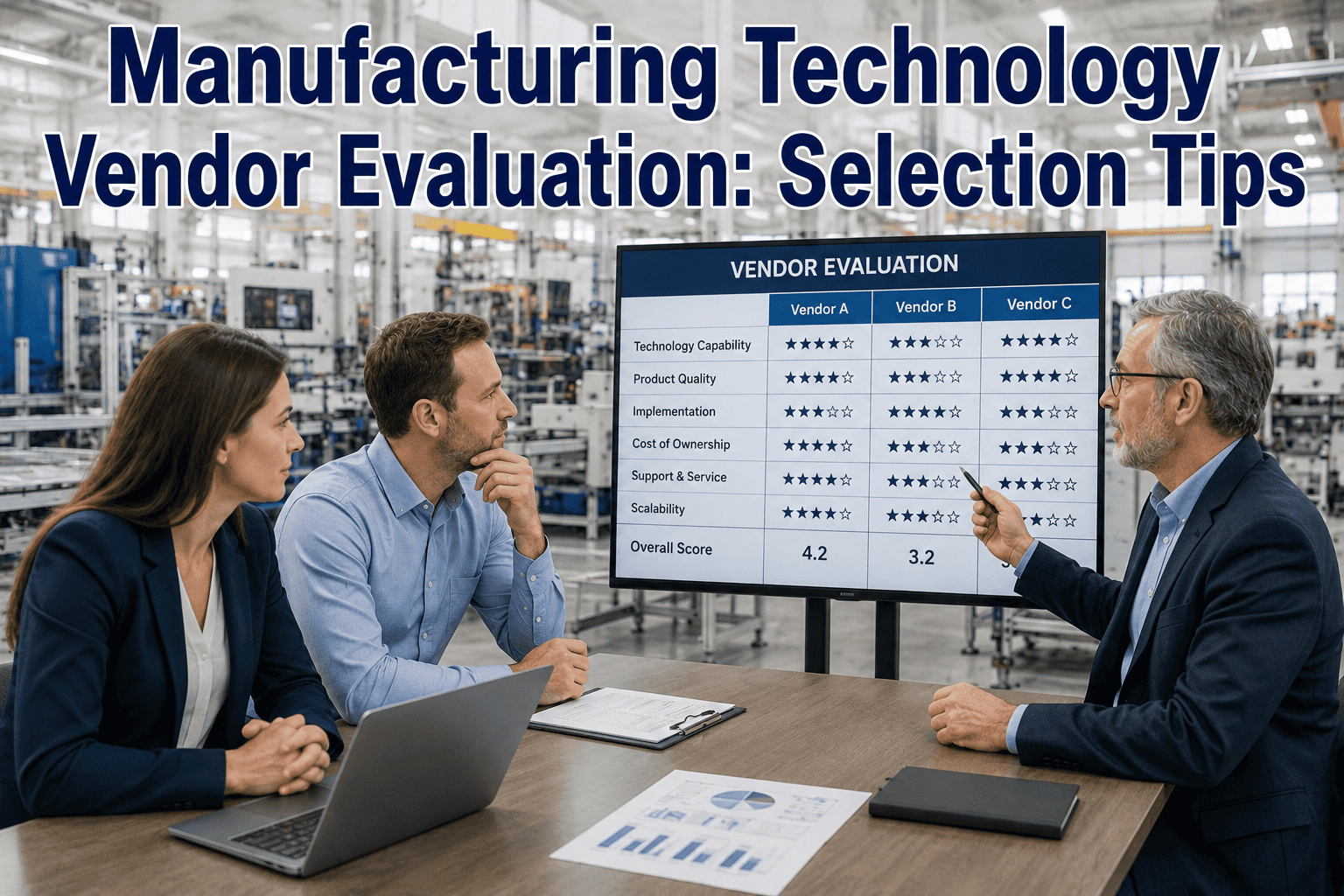
Feature checklists dominate too many MES evaluations. A vendor with two hundred features and an eighteen-month implementation timeline delivers less real value than a vendor with fifty focused features and a thirty-day go-live, because the features nobody uses cost money and the months spent waiting erode the business case. Score every vendor against the eight criteria below, weighted by what matters most to your plant.
A practitioner rule worth following: a score below three out of five on any single criterion weighted medium-high or above should disqualify a vendor outright, regardless of how strong the rest of the scorecard looks. A weak integration story or a vague answer on machine connectivity almost always resurfaces as a costly problem eight months into implementation.
Cloud, On-Premise, or Hybrid: Choosing a Deployment Model
Cloud has become the default for new MES projects, but on-premise deployment remains the right answer for plants with strict data sovereignty requirements, tight regulatory constraints, or deep integration needs with existing on-premise automation. Most vendors today offer both, so the decision usually comes down to your IT posture and your industry's compliance obligations rather than a genuine limitation on either side. Manufacturers in defense, pharmaceutical, and certain food and beverage segments frequently default to on-premise or hybrid deployment specifically because of data residency rules that a pure cloud architecture cannot satisfy, regardless of how strong the vendor's cloud offering otherwise is.
A Realistic Implementation Timeline
Implementation risk is rarely about the software itself. It is almost always about scope creep, unclear ownership, and skipping the proof-of-concept stage. The timeline below reflects a cloud-native or hybrid MES deployment for a mid-size multi-line plant.
Five Implementation Pitfalls That Derail an MES Rollout
Most failed MES projects don't fail because the software was wrong. They fail because of predictable process mistakes made during selection and rollout. Watching for these five patterns during your own evaluation will save months of rework later.
Every one of these pitfalls is avoidable with the right process discipline. The common thread is treating MES selection and rollout as a pure technology decision rather than an operational one that happens to involve software. Plants that assign a cross-functional steering committee, insist on a live proof-of-concept, and budget time for change management consistently see faster adoption and a shorter path to measurable OEE improvement than plants that skip these steps to save a few weeks upfront. Building that discipline into the project charter before a single vendor demo is scheduled is, in practice, a stronger predictor of success than any single feature on a scorecard.
Frequently Asked Questions
Can we implement an MES without replacing our old PLCs?
Yes. Modern brownfield-ready MES platforms use IIoT gateways and edge computing to extract data from legacy PLCs through standard protocols like Modbus and OPC-UA, without requiring expensive hardware upgrades. This is one of the most important criteria to verify during vendor evaluation, since many older enterprise platforms assume a greenfield plant with modern PLCs already in place. Ask any vendor for a live connectivity test against your actual equipment before committing, and see how iFactory AI handles mixed machine parks by booking a demo.
How long should MES implementation realistically take?
It depends heavily on which tier of vendor you select. Tier 1 enterprise incumbents typically require eighteen to thirty-six months for a full rollout, while cloud-native and lightweight platforms can deliver a validated live dashboard within days to a few weeks and complete a phased rollout across a mid-size plant in three to six months. If a vendor cannot show you validated production data within the first week of a proof-of-concept, that is a meaningful signal about how the rest of the implementation will go.
What is the difference between an MES and a lightweight OEE platform?
An MES manages full production execution, including genealogy, quality holds, work order dispatch, and regulatory documentation. A lightweight OEE platform focuses primarily on visibility, capturing availability, performance, and quality automatically to show you where time and output are being lost. Confusing the two categories is one of the most common evaluation mistakes it leads either to an oversized eighteen-month MES project when you actually needed floor visibility in weeks, or to an OEE tool when you genuinely needed full genealogy and compliance traceability. Our support team can help you determine which category fits your actual requirement.
Should the evaluation team include people outside of IT?
Yes, and this is one of the most consistent predictors of a successful rollout. A strong MES evaluation team includes plant operations leadership, a quality representative, a maintenance lead, and at least one frontline operator or supervisor who will use the system daily, in addition to IT. Systems selected primarily by IT stakeholders on feature-checklist criteria tend to score well on paper but see poor floor adoption, because usability for the people executing production work was never weighted heavily enough in the decision.
How many vendors should be on our shortlist before a proof-of-concept?
Two to three vendors is the practical range. Include at least one cloud-native option and one traditional deployment option to genuinely test your architectural assumptions rather than confirming a preference you already had going in. Running a proof-of-concept against more than three vendors rarely improves the decision and usually just extends the evaluation timeline without adding meaningfully new information. Book a demo to see how iFactory AI performs against your real production data as part of your shortlist.
See validated production data from your own equipment before you commit to any vendor. iFactory AI runs a live proof-of-concept on your actual lines, connectivity included.




.png)