Most manufacturing technology purchases are not decided by the best software. They are decided by whichever vendor gave the most confident demo, quoted the lowest number on page one, and answered emails the fastest during the sales cycle. Then the contract gets signed, and the plant discovers the platform cannot talk to the existing MES, the "unlimited support" clause has a footnote, and the reference customers were hand-picked for a reason. This guide breaks down how experienced manufacturing buyers actually run a vendor evaluation — RFP scope, proof-of-concept structure, reference checking, and contract terms — so the decision holds up long after go-live. For a walkthrough of how iFactory handles this process with prospective plants, book a 30-minute demo with our team.
Choosing Manufacturing Technology Is a Risk Decision, Not a Feature Decision
A structured evaluation process — with weighted scoring, a real proof-of-concept, and reference checks past month twelve — is the single biggest predictor of whether a manufacturing technology rollout survives contact with the shop floor. This page walks through the exact framework.
Why Most Manufacturing Vendor Selections Go Wrong
Ask any plant manager who inherited a stalled software rollout and the story is usually the same: procurement scored vendors on the demo, the price sheet, and a features checklist, then handed a signed contract to operations and disappeared. None of those three inputs predict whether a system survives real production data, legacy PLC quirks, and operators who were never consulted. The gap between a winning proposal and a working plant floor is where most manufacturing technology budgets quietly disappear. Industry surveys of ERP and manufacturing software buyers consistently find that dissatisfaction traces back not to the technology itself but to how the decision was made — who was in the room, what evidence was collected, and whether the winning vendor was ever tested against conditions that resembled the buyer's actual plant. A well-run evaluation costs a few extra weeks up front. A poorly-run one costs a multi-year contract, a stalled capital project, and a rebuild of trust between operations and IT that can take far longer to repair than the original rollout.
Vendors control the data, the network, and which screens get shown. A polished 45-minute demo tells you almost nothing about how the platform behaves against three years of messy sensor history and a plant network with 40% packet loss on the shop floor.
When "integration capability" and "price" are not assigned explicit weights before proposals arrive, evaluators unconsciously rationalize the vendor they already liked. Post-hoc scoring produces confident decisions with no actual evidence trail behind them.
Every vendor supplies happy customers in month three of deployment. The reference call that matters is with a plant 14 months in, after the honeymoon period, the initial configuration, and the first major system update have all happened.
Total contract value gets negotiated hard while data ownership, exit rights, and SLA credit schedules get waved through as boilerplate — until the vendor relationship sours and the plant discovers its own historian data is hard to export.
When procurement, IT, and operations each hold partial veto power but no one owns the final weighted decision, evaluations drift toward whichever stakeholder pushes hardest at the end rather than whichever vendor scored best against the agreed criteria.
The Weighted Scorecard: How Serious Buyers Actually Score Vendors
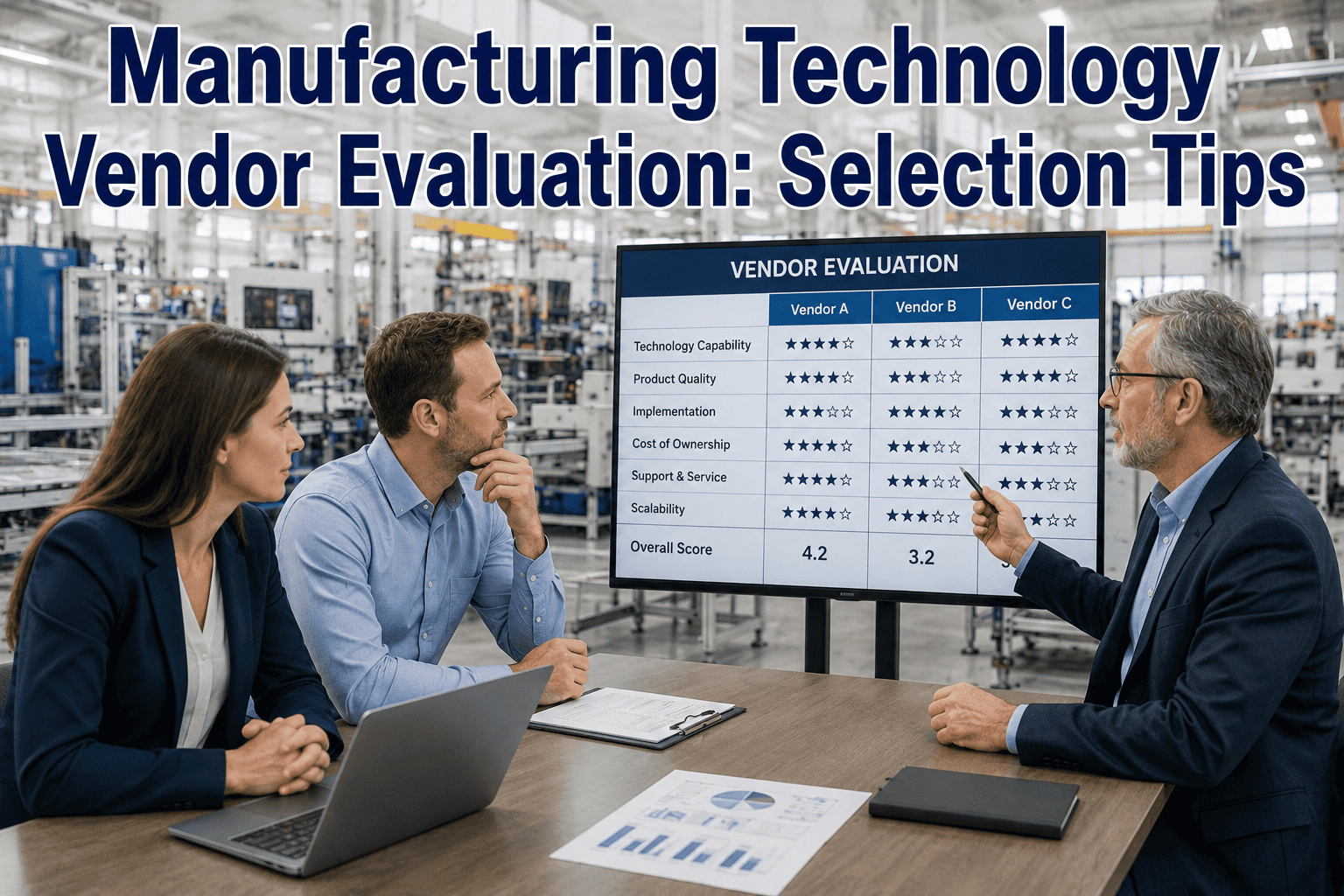
A defensible vendor decision starts with a scorecard built before any proposal arrives — not a spreadsheet reverse-engineered to justify a gut call. Five weighted categories cover the evidence that actually predicts long-term fit. Every evaluator scores every vendor against the same rubric, with written justification required for any score at the top or bottom of the scale.
Weights shift by category — a vision-inspection rollout leans harder on integration fit, while an ERP replacement leans harder on implementation support — but the discipline of assigning numbers before proposals arrive is what makes the process defensible. Every evaluator on the buying committee should score independently before comparing notes, since discussing scores as a group before individual scoring is complete tends to collapse the evaluation toward whichever voice in the room is loudest or most senior. Once individual scores are in, a short calibration session using one or two sample vendor responses helps the committee agree on what separates a strong answer from a weak one before the real scoring begins. Written justification should be mandatory for every score at the extremes of the scale — a perfect score with no explanation is just as suspicious as a failing one, and both should be defensible to someone outside the room.
Building an RFP That Actually Filters Vendors
A vague RFP produces vague proposals, and vague proposals produce a shortlist that all looks the same on paper. The strongest manufacturing technology RFPs are built around mandatory pass-fail requirements first, weighted scoring second, and enough operational specificity that a vendor cannot answer with marketing language alone. Four sections carry most of the weight.
Mandatory Requirements, Not Nice-to-Haves
Separate true disqualifiers — data residency, cybersecurity certification, integration with your specific ERP or historian — from preferences. Any vendor failing a mandatory item is dropped before scoring begins, regardless of how strong the rest of their proposal reads.
Operational Scenarios, Not Feature Lists
Instead of asking "does your platform support anomaly detection," describe an actual failure event from your plant history and ask the vendor to walk through exactly how their system would have caught it, how fast, and with what false-positive rate.
Five-Year Total Cost, Not Year-One Price
Require normalized five-year total cost of ownership covering licensing, implementation, training, ongoing support, hardware refresh, and end-of-contract migration costs. The lowest year-one bid is rarely the lowest five-year cost.
Enforceable SLAs With Credit Schedules
Require specific uptime targets, tiered response times for production-down incidents, and financial credits tied to missed targets — not aspirational language about "best-effort support" that has no teeth once the contract is signed.
Proof-of-Concept: Testing Against Reality, Not the Vendor's Sandbox
Roughly a third of manufacturing technology pilots get abandoned after the proof-of-concept stage, and the most common reason is not that the technology failed — it is that success criteria were never defined before the pilot started, so nobody could agree on whether it worked. A proof-of-concept only produces a real answer when it runs against your plant's actual conditions, using your actual historical data, over a long enough window to include at least one abnormal event rather than only steady-state operation. A two-week pilot on a quiet production week tells you very little about how a system behaves during a changeover, a supply disruption, or an unplanned maintenance event — and those are exactly the conditions the technology is supposed to help with.
Define numeric success thresholds in writing — detection accuracy, false-positive ceiling, latency, uptime — and get sign-off from operations, not just IT, before the pilot begins.
Test against your actual historical sensor data, your actual network conditions, and your actual asset age — not a clean, curated dataset the vendor prepared for the demo environment.
Have the technicians and operators who will use the system daily participate in the pilot, not just review a report at the end. Adoption resistance discovered in week two is far cheaper than adoption resistance discovered at month six.
Deliberately feed the system edge cases — sensor dropout, a known false-positive trigger, a network outage — and evaluate how gracefully it degrades, not just how well it performs under ideal conditions.
A pilot that works but has no documented path to full production scale is not a finished evaluation. Require the vendor to present the exact scaling plan before the pilot is scored as a pass.
Open-ended pilots drift indefinitely. Set a fixed evaluation date, score against the pre-agreed thresholds, and make the go or no-go call on schedule rather than letting the pilot become the default production system by inertia.
See How iFactory Performs Against Your Own Plant Data
We would rather run a proof-of-concept against your real production conditions than win a deal on a polished demo. Book a session and we will scope what a fair, evidence-based evaluation of iFactory looks like for your operation, including which of your existing systems, historical data, and success thresholds should shape the pilot from day one.
Reference Checking: The Questions That Actually Reveal Vendor Risk
Surface-level reference calls confirm what the vendor already told you. Deep reference calls surface what the vendor did not. The difference is in which questions get asked and how far past go-live the reference customer actually is. Vendors naturally offer their most satisfied customers as references, which is not dishonest, but it does mean the burden is on the buyer to ask questions that a curated reference cannot deflect with a purely positive answer. Asking about a specific incident, a specific update, or a specific adoption metric forces a concrete response instead of a general endorsement, and the tone of that concrete response usually tells you more than the words themselves.
| Reference Call Type | What Gets Asked | What It Actually Reveals |
|---|---|---|
| Surface Call (Month 1-3) | "Are you happy with the platform?" | Honeymoon sentiment — almost always positive, low predictive value |
| Deep Call (Month 12+) | "What broke after the first major update?" | Real durability of the platform and vendor's post-sale support quality |
| Support Call | "Walk me through your last P1 incident" | Whether SLA response times hold up under actual production pressure |
| Adoption Call | "How many operators stopped using it after month six?" | Whether the tool survived contact with the shop floor, not just IT |
| Exit Call | "Have you ever tried to migrate data out?" | Real data portability versus what the contract promised on paper |
Contract Negotiation: The Clauses That Matter More Than Price
Procurement teams routinely negotiate the headline price down five to ten percent while accepting standard boilerplate on the terms that actually determine long-term risk. These are the clauses worth spending negotiation time on, even if it means holding firm on price elsewhere. A useful test during negotiation is to ask what happens if the relationship ends badly two years in — not because that outcome is expected, but because a vendor's answer to that question, and how the contract actually reads on that point, reveals more about the balance of power in the relationship than almost any other question you can ask during the process.
Data Ownership and Portability
Confirm in writing that your production data, in a usable format, remains yours and is exportable on demand — not only at contract termination, and not in a proprietary format that requires the vendor's tools to read.
SLA Credit Schedules With Teeth
Negotiate specific financial credits tied to missed uptime and response-time targets, applied automatically rather than requiring the buyer to formally dispute every miss to receive compensation.
Price Protection on Renewal
Cap annual renewal price increases in the initial contract. Vendors routinely price the first contract competitively and recover margin on renewal once switching costs make the buyer a captive customer.
Defined Exit and Transition Support
Require a contractually defined transition period with vendor cooperation on data export and knowledge transfer if the relationship ends — before you need it, not negotiated under pressure during an active dispute.
Red Flags That Should Slow Down Any Vendor Decision
Some warning signs show up early in the evaluation process, well before the contract stage, if the evaluation team knows to look for them. None of these are automatic disqualifiers on their own, but two or more appearing together in the same evaluation is a strong signal to slow the process down, add another reference call, and push the vendor for more specific answers before moving forward with negotiation.
A vendor who cannot describe specifically how their platform connects to your named ERP, historian, or MES — beyond "we have an API" — has likely not done that integration in production before.
Reluctance to provide references past the twelve-month mark, or offering only references curated by their own success team, suggests the vendor is worried about what a longer relationship would reveal.
A single bundled number with no line-item breakdown of licensing, implementation, training, and support makes it impossible to compare total cost of ownership across vendors — and often hides where the real margin sits.
If the sales team cannot name who on the implementation side will actually run your rollout, you are buying a relationship with people who have not yet been assigned and may not exist yet.
What a Structured Evaluation of iFactory Actually Looks Like
We built our own sales process around the assumption that reliability engineers and plant managers should be able to run the exact evaluation described on this page against us — and we would rather lose a deal in a fair proof-of-concept than win one on a polished demo that does not hold up in production. If your evaluation committee is scoping a scorecard right now, we can share the specific reference contacts, integration documentation, and pilot structure that hold up under exactly the kind of scrutiny this page describes, rather than a generic capabilities deck.
Frequently Asked Questions
How long should a manufacturing technology vendor evaluation actually take?
A properly structured evaluation, from documented requirements through RFP responses, proof-of-concept, and contract negotiation, typically runs eight to sixteen weeks depending on the complexity of the system and the number of vendors on the shortlist. Rushing this timeline is one of the strongest predictors of post-implementation dissatisfaction, since the steps most often skipped under time pressure — deep reference checks and a real proof-of-concept against production data — are the exact steps that catch problems before signature. If you want a realistic evaluation timeline scoped to your plant's complexity, book a call with our team.
Should price or capability get more weight in the vendor scorecard?
Neither should dominate the scorecard on its own — the strongest evaluation frameworks weight production track record and integration fit higher than headline price, because total cost of ownership over five years is a far more reliable number than the year-one quote. A vendor with the lowest bid but no evidence of integrating with your specific systems typically ends up costing more once implementation delays, workarounds, and change orders are factored in. Total cost of ownership, not sticker price, is what belongs in the pricing category of your rubric.
What is the biggest mistake teams make during proof-of-concept testing?
The most common and costly mistake is starting the pilot without written, numeric success criteria agreed upon in advance by both operations and IT. Without a defined threshold for accuracy, false-positive rate, or uptime, a pilot that technically works can still fail to produce a decision, because nobody agrees on what "working" means once the results come in. The second most common mistake is testing only against clean, vendor-prepared data rather than your plant's actual historical conditions. For guidance on structuring a fair, evidence-based pilot, reach out to our support team.
How many vendor references should be checked before signing a contract?
Three to five reference calls is standard, but the count matters less than the mix — at minimum, one reference should be past the twelve-month mark, one should be a plant of comparable size and complexity to yours, and one call should go specifically to the support and reliability engineering contact rather than the executive sponsor who championed the purchase. A vendor confident in their production track record will not resist connecting you with a reference outside their curated shortlist.
What contract terms are most commonly overlooked during negotiation?
Data portability and renewal price protection are the two most consistently under-negotiated terms in manufacturing technology contracts. Buyers focus negotiation energy on the initial price and accept standard language on data export rights and renewal pricing, only to discover years later that switching vendors is far more expensive and disruptive than expected. Locking in renewal price caps and explicit data export rights at signature, when negotiating leverage is highest, prevents this problem entirely. For a review of what belongs in your specific contract, book a demo and ask our team.
Run Your Next Vendor Evaluation the Way Reliability Engineers Actually Trust
Weighted scorecards, real proof-of-concept data, references past month twelve, and contract terms that protect your plant long after the ink dries. See how iFactory holds up under exactly this kind of scrutiny, on your own timeline and against your own criteria.