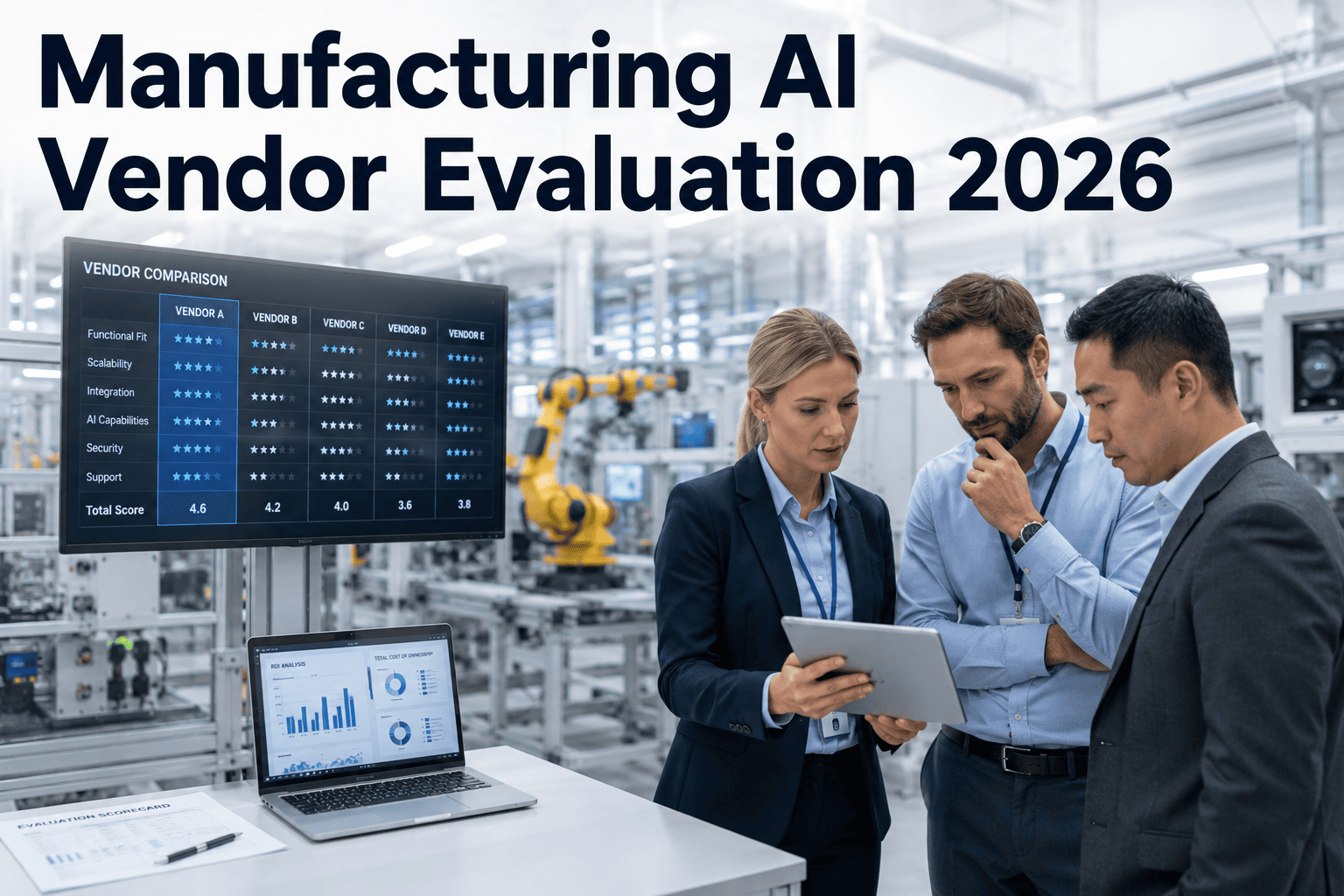
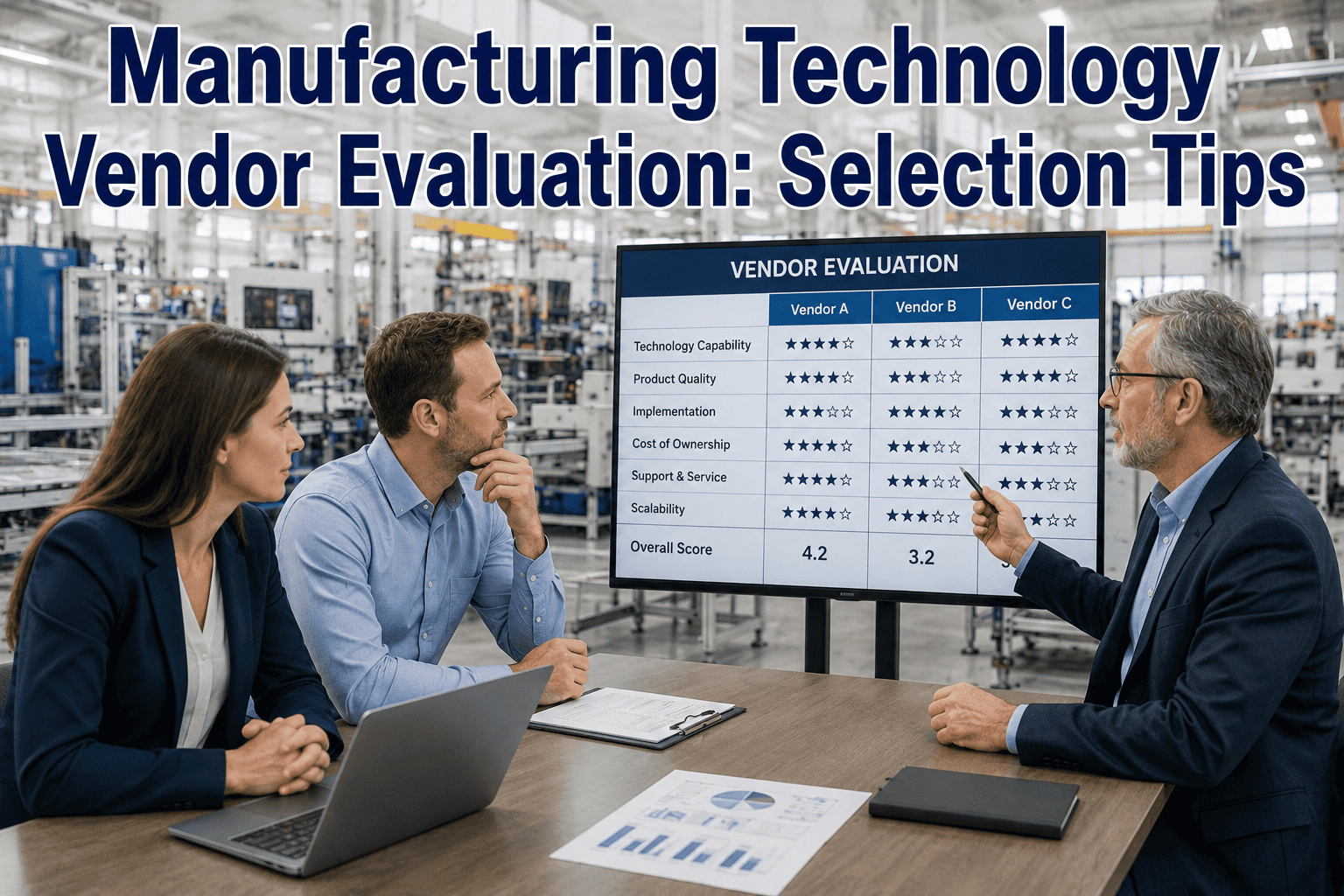
A vendor demo can make almost any AI product look production-ready. Feed it a dozen clean, curated examples and watch it perform flawlessly — that is what a demo is designed to do. The real test happens when the same system meets your actual production data: inconsistent tag names, messy shift logs, sensor gaps, and edge cases no demo ever includes. Most manufacturing AI vendors have never been asked to prove their platform survives that transition, because most buyers never ask the questions that would force them to. Book a session with our team if you want a second opinion before you sign anything this quarter.
Buyer's Guide · 2026
Manufacturing AI Vendor Evaluation: 5 Questions to Ask in 2026
Most manufacturing AI vendors fail the first real deployment, not the demo. These five questions separate a genuine industrial AI product from a marketing wrapper around a general-purpose model.
80%+
of enterprise AI projects fail to deliver the promised business value
Why the Demo Is the Wrong Test
Vendor demos run on the vendor's data, on the vendor's terms, in a controlled environment built specifically to make the product look good. That is not dishonest — it is simply not the test that matters. What matters is whether the system holds up against your historian's gaps, your operators' shorthand for downtime reasons, and the years of inconsistent tagging that exist in every real plant. A platform that cannot handle that transition will not fail loudly. It will fail quietly, months after the contract is signed, when accuracy drifts and nobody notices until the numbers stop making sense.
This gap between demo performance and production performance is well documented across enterprise AI more broadly, not just in manufacturing. A widely cited 2026 analysis found that a natural language tool categorizing sample support tickets with near-perfect accuracy in a demo dropped by nearly thirty points once it was tested against real, messy production tickets — the same pattern shows up constantly in industrial deployments, where a model trained and tuned on clean pilot data quietly degrades once it meets the tag inconsistencies and missing fields of a full production environment. The lesson is not that demos are worthless. It is that a demo alone should never be the basis for a contract decision.
The 5 Questions That Separate Real Vendors From Wrappers
Q1
Can we pilot on our real data before we sign anything?
Why it matters: A vendor confident in their product will run a two-to-four-week pilot against your actual, unfiltered production data at little or no cost. A vendor who insists on a longer commitment before you see real performance, or who only offers demos on their own curated data, is telling you something about how their system performs outside a controlled setting.
Q2
Which specific model or method powers this, and what did you build on top of it?
Why it matters: Very few companies train models from scratch — that is not a red flag by itself. The red flag is a vendor who cannot or will not name what powers their system and describe the industrial-specific engineering layered on top of it. An honest answer names the underlying approach and explains the manufacturing-specific work built around it.
Q3
How does this connect to our existing SCADA, historian, MES, and ERP systems?
Why it matters: Integration depth is one of the highest-signal evaluation criteria in industrial AI specifically, because it determines whether deployment takes weeks or becomes a year-long custom engineering project. Ask for the specific protocols supported — OPC-UA, MQTT, REST — and whether the integration pattern has been repeated across multiple plants, not built once for one client.
Q4
Can you show us three reference clients in a comparable operating environment?
Why it matters: Industry classification is not enough — a reference in food and beverage packaging tells you little about performance in a continuous-process refinery. Ask for references with comparable operational complexity, and call them directly. Ask specifically about performance after the first six months, not just at go-live.
Q5
How do you monitor and catch model drift after deployment?
Why it matters: AI systems degrade differently than traditional software — accuracy erodes silently as plant conditions change, while the dashboard keeps showing green. A serious vendor has a documented process for monitoring live performance and retraining on a defined cadence. A vendor who treats deployment as the finish line, not the starting point, is setting you up for the exact silent failure pattern that sinks most enterprise AI programs.
Ask us all five questions directly — we would rather earn the contract than win the demo
Red Flags vs. Green Flags: What the Answers Actually Sound Like
| Evaluation Area |
Red Flag |
Green Flag |
| Pilot Access |
"We can get you a demo, but real data pilots come after signing" |
"Let's run two to four weeks on your data before you commit to anything" |
| Technical Transparency |
"That's proprietary, we can't discuss the model or method" |
Names the underlying approach and the industrial engineering built around it |
| ROI Promises |
Guarantees a specific ROI figure before any diagnostic work is done |
Wants to understand your data and process before estimating any outcome |
| Security Documentation |
"We're working on our SOC 2 report, should have it soon" |
Shares current compliance documentation on request, same day |
| Post-Launch Support |
Deployment is treated as the final deliverable in the contract |
Documented drift monitoring and retraining cadence built into the plan |
What "AI-Powered" Actually Means in an Industrial Product
By 2026, the label "AI-powered" has become close to meaningless on its own — it is applied to features ranging from a genuinely trained predictive model to a simple rules-based alert with a new name. The distinction matters because it determines what the product can and cannot do as your operating conditions change. Ask which specific features use a trained model, which use simple thresholds or rules, and what each one would look like without the AI label attached. A vendor who can answer that clearly, feature by feature, understands their own product. A vendor who calls everything AI usually has not thought that hard about it themselves.
This distinction is not a matter of semantics. A rules-based threshold alert and a trained predictive model behave very differently as your process changes over time. A fixed threshold stays fixed regardless of how your equipment ages or your product mix shifts, quietly generating false alarms or missing real ones as conditions drift. A properly trained and monitored model adapts, or at minimum flags when its own confidence has dropped. Buyers who never separate the two often end up disappointed by a feature that was never designed to learn in the first place.
Vendor Evaluation Scorecard
Pilot Proof
Will they run a real-data pilot before contract signature, at reasonable cost?
Technical Honesty
Can they name the underlying model and explain what they built on top of it?
Integration Depth
Do they support your actual SCADA, historian, and ERP stack out of the box?
Comparable References
Can they connect you with clients at a similar operational complexity?
Drift Monitoring
Is there a documented plan for catching silent performance decay post-launch?
Exit Terms
Is data export and contract exit defined clearly before you ever need it?
Frequently Asked Questions
How long should a fair vendor pilot actually run?
Two to four weeks is typically enough to see whether a platform holds up against real production data, provided the pilot covers a full range of operating conditions rather than a single quiet shift. Longer pilots are reasonable for complex, multi-asset use cases, but a vendor who insists on months before showing any real performance is usually stalling rather than being thorough.
Book a pilot scoping call if you want help structuring a fair evaluation window.
Is it a red flag if a vendor builds on top of an existing foundation model instead of their own?
No — very few organizations in the world have the resources to train a competitive frontier model from scratch, and building thoughtfully on top of an established one is standard, sound engineering practice. The actual red flag is a vendor who is not transparent about doing this, or who cannot clearly describe the industrial-specific tooling, integrations, and domain tuning they have added on top of the base model.
What should be in the contract to protect us if the vendor relationship doesn't work out?
At minimum, the contract should define data ownership in writing, a clear data export process at cancellation, pricing escalation caps for renewal years, and specific SLA terms with defined penalties for missed uptime or performance commitments. Write your exit strategy before you sign, not after a relationship has soured — it keeps your options open and keeps the vendor accountable throughout the engagement.
How do we evaluate a vendor's claimed accuracy numbers?
Ask what dataset produced the number, whether it was measured on curated or real production data, and how recently it was validated. A 95% accuracy figure from a controlled demo dataset says very little about performance on your actual, messier operating data. The only accuracy number worth weighing heavily is one measured during a pilot run against your own unfiltered production history.
Should the sales team or the implementation team answer our technical questions?
Always request a technical architecture session with the team that will actually implement and support your deployment, not solely the sales team that closes the deal. The people who sell the platform and the people who deliver it are frequently different, and a vendor who resists connecting you directly with their implementation team before signature is worth a second look.
Compare Us Against Anyone
Ask iFactory the Five Questions. We're Ready For All of Them.
Real-data pilots, transparent architecture, references in your exact sector, and documented drift monitoring built into every deployment. Come compare us against your shortlist.