Most manufacturing AI projects that fail did not fail because the model was poorly built. They failed because the data feeding it was inconsistent, incomplete, or arrived too late to be useful — and nobody checked for that before the project started. A Manufacturing IT Lead sitting down to scope a new AI initiative needs an honest answer to one question before any vendor conversation begins: is the plant's data actually ready to support this, or does readiness work need to happen first. A structured checklist across sensor coverage, data quality, integration architecture, and governance gives that answer in a single working session instead of discovering the gaps mid-deployment. iFactory's platform is built to run this exact readiness assessment against your live plant data. Book a demo to see your data readiness score calculated directly from your systems.
AI-Driven · Manufacturing IT · Data Readiness Checklist
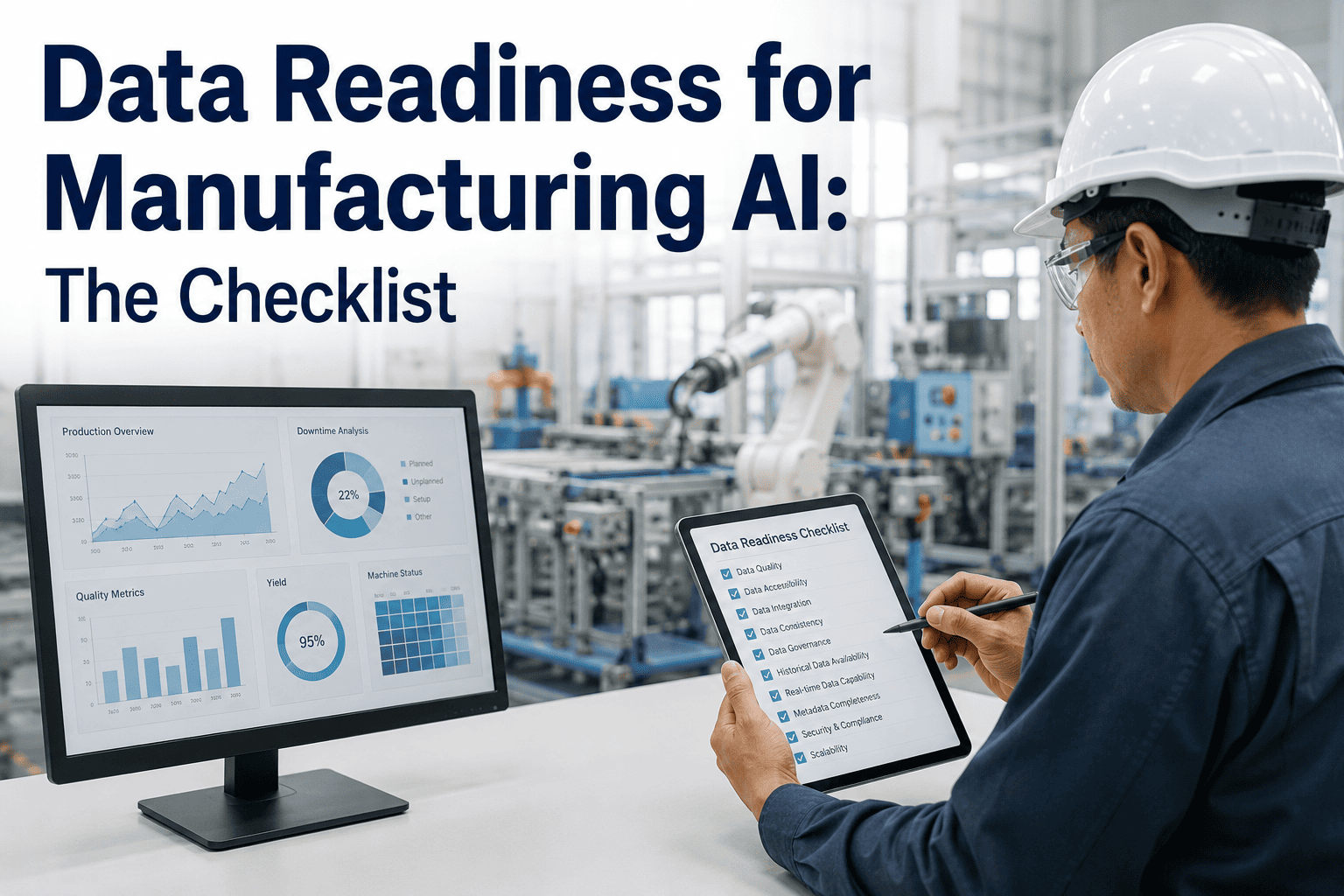
The Data Readiness Checklist Manufacturing AI Projects Are Built On
Sensor coverage, data quality, integration architecture, and governance — four checklists that tell you exactly what to fix before the model ever sees your production data.
85%
Of AI projects fail primarily because of poor data quality, not model selection
61%
Of manufacturers rate their OT and IT integration as basic or effectively non-existent
80%+
Sensor coverage on critical assets required before real-time AI use cases are reliable
12–18 mo
Typical time to close OT and IT convergence gaps once they block a pilot from scaling
Why Models Fail on Good Ideas
Four Data Gaps That Sink a Manufacturing AI Project Before It Starts
Every one of these gaps is detectable in a single readiness assessment — the problem is that most plants only discover them after the model is already underperforming.
Coverage
Critical Assets Were Never Instrumented
A model can only learn from equipment that reports data. Gaps in sensor coverage on the assets that matter most produce blind spots no amount of algorithm tuning can fix.
Quality
The Data Existed But Couldn't Be Trusted
Frozen sensor readings, impossible values, and inconsistent tag naming across systems mean the raw data volume looked sufficient while its actual reliability was not.
Silos
SCADA, MES, and ERP Never Spoke the Same Language
A downtime event logged automatically in one system and recorded manually in another means the AI model inherits the same disconnect the plant floor already struggles with.
Ownership
No One Owned Data Accuracy After Go-Live
Data readiness is treated as a one-time cleanup exercise instead of an ongoing responsibility, so quality that looked fine at project kickoff degrades quietly within months.
01
Checklist Layer One
Sensor and Tag Layer
Before any data pipeline work begins, confirm the plant floor is physically instrumented well enough to feed an AI model.
✓Critical assets — the equipment where a failure directly stops production — have sensor coverage above 80%
✓Sensor sampling frequency matches the process speed, not a generic default interval
✓Tag naming follows one consistent convention across every line and every site
✓Every tag is mapped to its physical asset, operational mode, and normal operating range
02
Checklist Layer Two
Data Quality Layer
Volume of data is not the same as trustworthy data. This layer confirms the data itself holds up under model training.
✓Automated checks flag impossible values, frozen readings, and out-of-range sensor output
✓Missing batches, incomplete shift logs, and sensor dropouts are tracked as a measured completeness rate
✓Data reaches the analytics layer within the latency the use case actually requires
✓At least six to twelve months of clean, labeled historical data exists for model training
03
Checklist Layer Three
Integration and Architecture Layer
This is where most manufacturing AI projects actually stall — not in the model, but in the connections between systems.
✓SCADA, MES, CMMS, QMS, and ERP data can be joined on a shared asset and time reference
✓A defect in one system and an incident in another map to the same underlying event
✓OPC-UA or an equivalent standardized protocol is used instead of proprietary point-to-point links
✓The architecture supports adding a second and third use case without rebuilding the pipeline
04
Checklist Layer Four
Governance and Security Layer
Data readiness is not just a technical question — it is also who owns it, who can access it, and who keeps it that way.
✓A named owner is accountable for accuracy and consistency in each data domain
✓Role-based access controls govern who can read or write to OT and IT data sources
✓A data catalog documents what data exists, where it lives, and how it is structured
✓Data quality is monitored continuously, not verified only at project kickoff
iFactory Scores Your Plant Against All Four Checklists Automatically.
Sensor coverage, data quality, integration architecture, and governance — assessed against your live SCADA, MES, and ERP systems, with a prioritized gap-closing plan attached.
Where Does Your Plant Stand
Four Readiness Stages, From Fragmented to AI-Ready
Stage 1
Foundational Gaps
Sensor coverage is inconsistent, systems are siloed, and no one owns data quality. AI pilots here typically stall before shadow mode.
Stage 2
Partial Connectivity
Core assets are instrumented and some systems are integrated, but tag naming and data quality checks are inconsistent across lines.
Stage 3
Integrated but Unscaled
One line or one use case runs reliably on clean, connected data, but the architecture has not yet been proven to extend to a second site.
Stage 4
AI-Ready
Sensor coverage, data quality, integration, and governance all clear the checklist, and adding a new use case is a configuration exercise, not a rebuild.
Before vs. After
A Plant Without a Data Foundation vs. a Plant With One
Layer
Not Data-Ready
Data-Ready
Sensor Coverage
Critical equipment has gaps discovered only after model accuracy underperforms
80%+ coverage on critical assets confirmed before any modeling begins
Data Quality
Frozen readings and impossible values pass through undetected
Automated checks flag anomalies before they reach the model
System Integration
MES, CMMS, and ERP data cannot be joined without manual reconciliation
Systems share a common asset and time reference for automatic joins
Ownership
No one is accountable when data quality degrades after go-live
A named owner monitors and maintains quality continuously
Scaling
Each new line requires a new, custom integration project
A second and third use case reuse the same data foundation
From the Field
What a Readiness Assessment Actually Found
We assumed our data was in good enough shape to start a quality-inspection AI pilot because our historian was full of readings going back four years. The readiness assessment found that thirty percent of our critical stations weren't tagged consistently between the historian and the MES, so a defect flagged on the floor and a defect logged in quality control were technically two different records most of the time. We spent three weeks fixing tag naming and joining the two systems on a shared asset ID before touching the model. That felt like lost time in the moment. It saved us from training a model on data that looked complete and wasn't, which would have taken months to diagnose after the fact.
— Manufacturing IT Lead, Precision Components Manufacturer, Two U.S. Plants
30%Critical stations with inconsistent tag naming across systems
3 weeksTime spent closing the gap before model training began
1 asset IDShared reference now used to join every production and quality record
Conclusion
Data Readiness Is Not a Prerequisite. It's the Project.
The manufacturers who see real returns from AI almost always share the same starting point: they treated sensor coverage, data quality, system integration, and governance as the actual work, not as a formality before the "real" AI project began. A model trained on inconsistent tags, unmonitored sensor drift, or siloed systems will not become reliable through better algorithm selection — it needs a data foundation underneath it first.
iFactory's platform runs this four-layer readiness check against your live plant systems and produces a prioritized plan for closing whatever gaps it finds. Book a Demo to see your plant's data readiness score.
Frequently Asked Questions
Manufacturing Data Readiness — What IT Leads Ask First
How much sensor coverage does a plant actually need before starting an AI pilot?
Industry benchmarks point to roughly 80% sensor coverage on critical assets — the equipment whose failure directly stops production — as the threshold where real-time AI use cases become reliable. Coverage below that level does not make a pilot impossible, but it does mean the model will have meaningful blind spots on exactly the equipment where predictions matter most, which shows up as inconsistent accuracy rather than a clean failure.
Book a demo to have your current sensor coverage measured against this benchmark.
What is the difference between having a lot of data and being data-ready?
A historian full of years of readings is not the same as data-ready. Readiness depends on whether that data is accurate, complete, arrives on time, uses consistent naming across systems, and carries the context — asset, operational mode, batch, shift — that turns a raw sensor value into something a model can actually learn from. Plants routinely discover they have enormous data volume and a low readiness score at the same time.
Why does OT and IT integration block so many manufacturing AI projects?
Operational technology systems like SCADA and PLCs were built for control and safety, not for feeding machine learning pipelines, while IT infrastructure was built for enterprise applications, not millisecond-interval sensor streams. A majority of manufacturers describe their OT and IT integration as basic or effectively non-existent, which caps AI maturity regardless of how advanced the data science team is, because the model simply cannot see the operational data it needs in a usable form.
How long does closing a major data readiness gap typically take?
Closing OT and IT convergence gaps that block scaling typically takes twelve to eighteen months when tackled as a standalone infrastructure project, but a targeted readiness assessment can identify the highest-priority gaps and close the most damaging ones — tag standardization, critical sensor gaps, and system joins — in a matter of weeks rather than committing to a full convergence program upfront.
Contact support to scope a prioritized gap-closing plan for your plant.
Who should own data readiness inside a manufacturing IT organization?
Data readiness works best as a named, ongoing responsibility rather than a one-time cleanup task assigned to whoever is free before a project kickoff. The strongest model assigns a specific owner to each data domain — production, quality, maintenance — who is accountable for tag consistency, quality monitoring, and access control in that domain on a continuing basis, since data quality that looks fine at project launch reliably degrades within months without an owner watching it.
Find Out Exactly Where Your Plant's Data Readiness Gaps Are
Sensor coverage, data quality, integration architecture, and governance — scored against your live plant systems, with a prioritized plan for closing every gap the checklist finds.