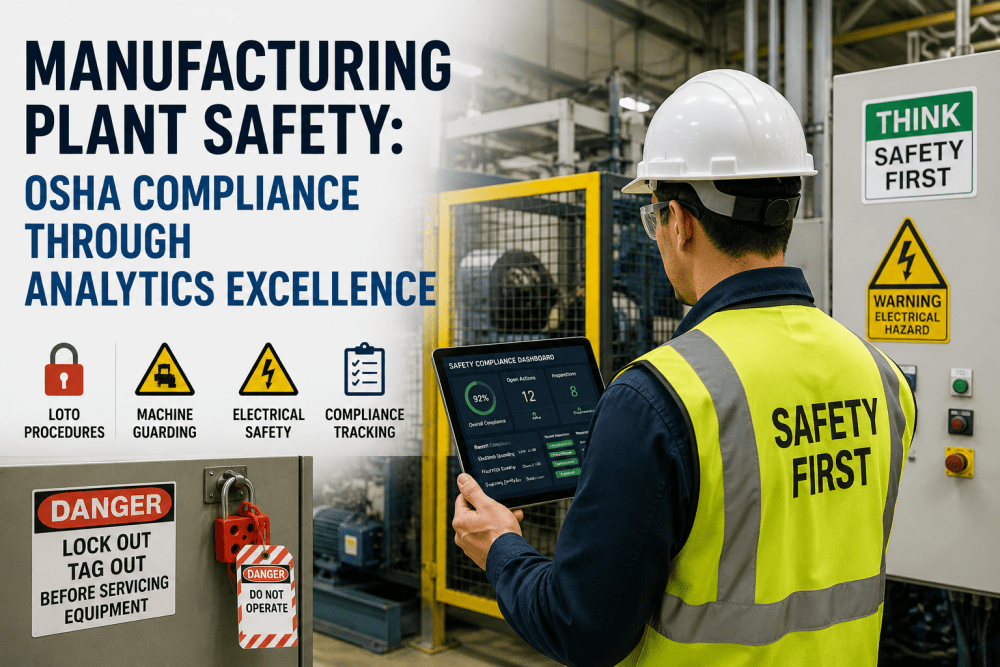
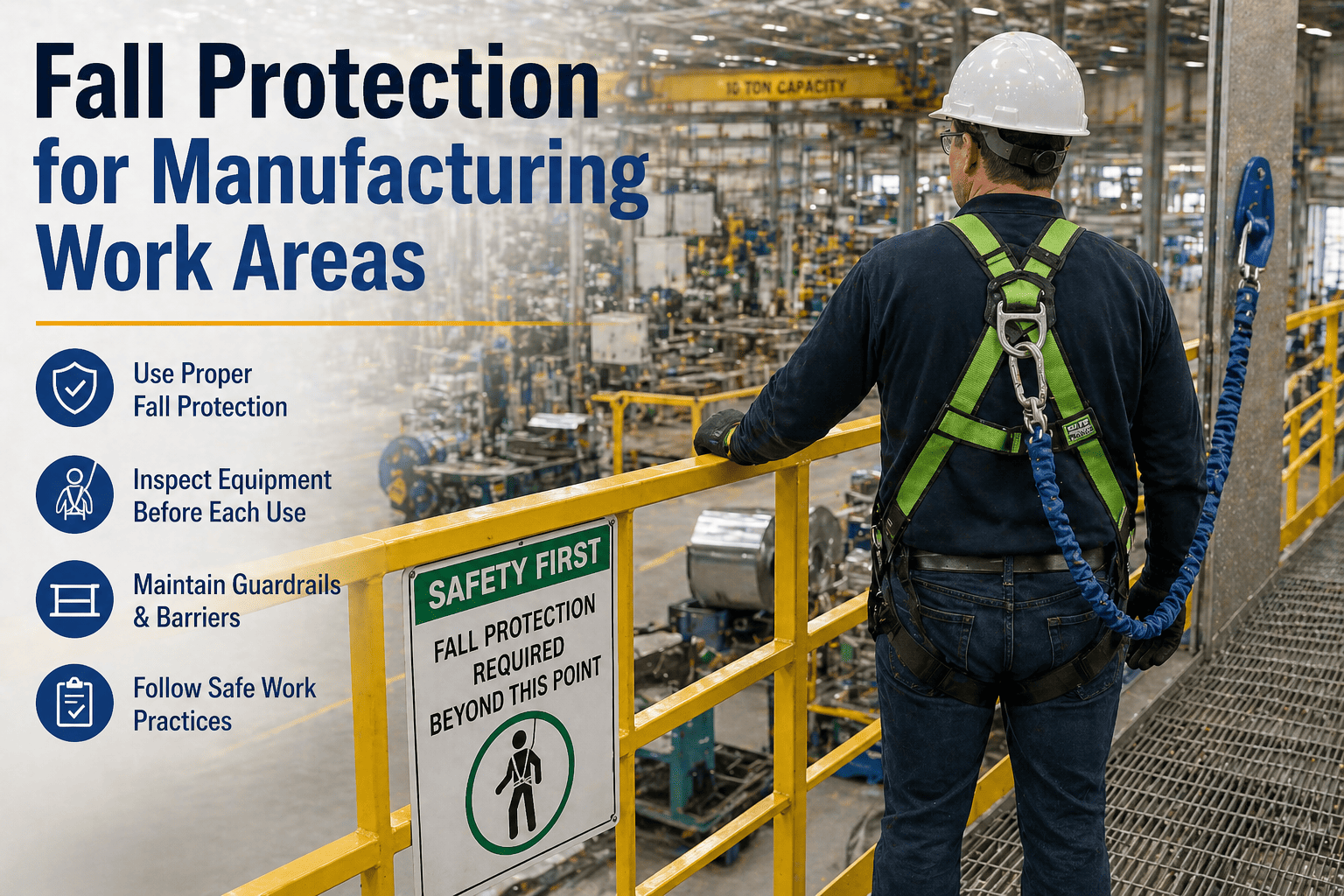
Manufacturing plants face escalating OSHA compliance complexity with 2,100+ safety standards, regulatory inspection frequency increasing 34% since 2022, and average OSHA violation penalties rising to $18,600 per citation causing production halts and reputation damage. Most plants rely on static annual safety audits missing 68% of emerging compliance gaps, inconsistent inspection protocols across shifts, and reactive incident investigation occurring too late to prevent similar accidents. iFactory's AI-powered manufacturing plant safety compliance platform eliminates this vulnerability, automating OSHA safety checklist audits across machine guarding, fall protection, lockout/tagout, chemical safety, electrical safety, and ergonomics with real-time monitoring detecting compliance gaps before OSHA inspections occur. Book a Demo to see how iFactory deploys automated safety compliance monitoring across your automotive manufacturing operations within 8 weeks.
2,100+
OSHA manufacturing standards requiring plant compliance and monitoring
$18,600
Average OSHA violation penalty per citation across manufacturing plants
68%
Safety compliance gaps missed by annual audits discovered during OSHA inspection
8 wks
Full deployment timeline from safety audit to live OSHA compliance monitoring
Every OSHA Violation Halts Production. Every Compliance Gap Multiplies Risk. Automation Eliminates Both.
iFactory's safety compliance platform automates the complete OSHA manufacturing safety checklist including machine guarding, fall protection, lockout/tagout, chemical safety, electrical safety, PPE compliance, and ergonomics monitoring across your entire plant facility 24/7 without manual inspection fatigue or blind spots.
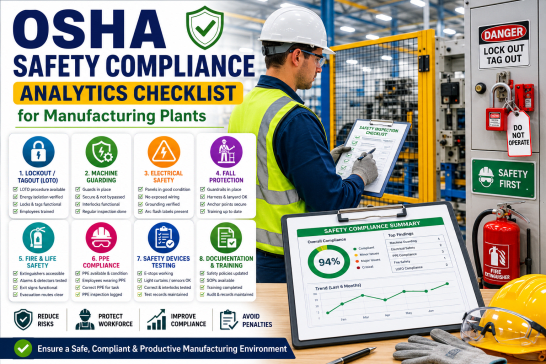
Complete OSHA Manufacturing Safety Checklist for Plant Compliance
OSHA manufacturing safety compliance requires systematic verification across 2,100+ standards spanning machine safety, fall protection, chemical handling, electrical safety, lockout/tagout procedures, ergonomics, and personal protective equipment. Traditional annual safety audits miss 68% of compliance gaps discovered during OSHA inspections because manual inspection cannot achieve continuous monitoring coverage. iFactory automates the complete OSHA manufacturing safety checklist with real-time monitoring detecting compliance violations within hours of occurrence. See a live demo of automated OSHA safety compliance monitoring and violation detection in real automotive manufacturing environments.
1.1
All moving machinery guarded with fixed machine guards meeting ANSI B19.1 standards
Required: Monthly verification and documentation
1.2
Lockout/tagout devices present and accessible for all energy isolation points
Required: Monthly device inventory audit with ID verification
1.3
Authorized personnel trained and certified in lockout/tagout procedures annually
Required: Training documentation with competency assessment
1.4
Press machine safety interlocks tested and documented monthly with defect repair logs
Required: Test results logged with date and technician ID
1.5
Robotic work cells enclosed with safety perimeters and emergency stop systems functional
Required: Weekly functional test of emergency stops with documentation
1.6
Conveyor systems guarded with emergency stops accessible from operating positions
Required: Visual inspection twice weekly with maintenance log
2.1
Fall arrest harnesses and lanyards present and inspected before each use
Required: Pre-use inspection checklist with date and worker signature
2.2
Anchorage points rated for minimum 5,000 pounds and certified annually
Required: Certification tags visible with inspection date and engineer signature
2.3
Guardrails installed on elevated platforms with minimum 42-inch height and 200-pound force resistance
Required: Monthly structural integrity verification with documentation
2.4
Safety nets installed for work at heights above 25 feet with proper clearance and mesh size
Required: Quarterly net integrity inspection and repair logs
2.5
Personnel trained in fall protection procedures with documented competency assessment
Required: Annual training with quiz scores above 80% documented
2.6
Scaffolding systems inspected and certified by qualified engineer before use
Required: Certification tags on all scaffold sections with inspection date
3.1
Safety Data Sheets available for all hazardous chemicals used in manufacturing
Required: SDS maintained in digital system with accessible format for all workers
3.2
All chemical containers labeled with hazard pictograms and signal words per GHS standards
Required: Monthly label verification audit with defect repair documentation
3.3
Hazardous chemicals stored in appropriate cabinets with segregation by chemical class
Required: Weekly storage area inspection with temperature and compatibility verification
3.4
Spill response kits positioned at chemical use locations with staff trained in containment procedures
Required: Quarterly kit inspection and refill with training documentation current
3.5
All workers trained in hazard communication and chemical handling with documented competency
Required: Annual training with quiz above 80% and hands-on demonstration
3.6
Emergency eyewash and shower stations present within 10 seconds travel time of chemical use areas
Required: Weekly functional testing and water flow documentation
4.1
Arc flash hazard assessment completed by qualified engineer with study dated within 5 years
Required: Assessment report on file with updated label placements
4.2
All electrical equipment labeled with arc flash hazard category and personal protective equipment required
Required: Monthly label audit with replacement of faded or missing labels
4.3
Circuit breakers and disconnect switches tested and maintained according to manufacturer specifications
Required: Annual maintenance with testing documentation and defect repair logs
4.4
Qualified electrical workers trained in arc flash hazards and safe work practices with annual refresher
Required: Training documentation with competency assessment results
4.5
Personal protective equipment rated for calculated arc flash hazard with fit testing and condition checks
Required: Inspection before each use with defect retirement documentation
4.6
Grounding and bonding systems tested annually with continuity and impedance documentation
Required: Test results on file with failed connections corrected within 48 hours
5.1
PPE hazard assessment completed for all job tasks identifying required protection
Required: Assessment document on file with job-to-PPE mapping
5.2
Hard hats inspected before each shift with damage or cracks leading to immediate retirement
Required: Damaged hat retirement log with replacement documentation
5.3
Safety glasses with appropriate lens and side shield protection provided and used by all personnel
Required: Daily observation of compliance with corrective action log
5.4
Hearing protection provided and used in areas exceeding 85 decibels with annual audiograms
Required: Audiogram results tracked with baseline comparison and corrective actions
5.5
Respirators fitted, trained, and maintained per ANSI Z88.2 with annual fit testing documentation
Required: Fit test results on file with expiration dates tracked
5.6
Work gloves and foot protection appropriate for hazard and inspected before use
Required: Daily observation of compliance with replacement log
6.1
Workstation ergonomic assessment completed for all assembly line positions with adjustments documented
Required: Assessment report with photo evidence of adjustments
6.2
Hand tools selected for low vibration and grip force reducing repetitive strain injury risk
Required: Tool specifications documented with vibration testing results
6.3
Material handling equipment positioned to minimize lift height and distance reducing back strain
Required: Workstation photo documentation with dimension measurements
6.4
Shift rotation and job task variation implemented to prevent repetitive motion illness
Required: Rotation schedule documented with task assignments
6.5
Workers trained in proper lifting, bending, and reaching techniques with annual refresher
Required: Training documentation with competency demonstration
6.6
Injuries and near-misses related to ergonomics tracked with corrective action implementation
Required: Incident log with root cause analysis and prevention measures
7.1
Emergency action plan documented with evacuation routes, assembly points, and communication procedures
Required: Plan on file with posting in multiple plant locations
7.2
Fire extinguishers installed and maintained per NFPA standards with annual inspection documentation
Required: Inspection tags current with service records on file
7.3
Personnel trained in fire extinguisher operation and fire prevention with annual refresher training
Required: Training attendance documentation with competency verification
7.4
Emergency lighting and exit signs operational and clearly visible from all locations
Required: Weekly functional testing with outage repair logs
7.5
Evacuation drills conducted quarterly with timing and issues documented
Required: Drill records with attendance and areas needing improvement
7.6
Fire suppression systems serviced annually by qualified contractor with inspection documentation
Required: Service tags current with repair logs filed
8.1
All work-related injuries and illnesses recorded on OSHA Form 300 within 24 hours of awareness
Required: Log maintained in accessible location with annual summary posting
8.2
Incidents investigated with root cause analysis identifying corrective actions within 30 days
Required: Investigation reports on file with implementation verification
8.3
Near-miss incidents tracked and investigated with corrective actions preventing future occurrence
Required: Near-miss log maintained with trending analysis quarterly
8.4
OSHA 301 incident report forms completed for all recordable injuries with witness statements
Required: Forms retained for 5 years with incident classification verified
8.5
Lost-time incident data tracked with analysis of trends and prevention strategies implemented
Required: Trending reports to safety committee monthly with management review
8.6
Corrective actions verified implemented and effective in preventing recurrence
Required: Verification documentation with follow-up investigation if effectiveness questionable
Manual Safety Checklists Miss 68 Percent of OSHA Violations. Automated Compliance Catches Them All.
iFactory automates the complete OSHA manufacturing safety checklist above with continuous monitoring detecting violations in real-time before OSHA inspections occur. Eliminate compliance gaps, reduce incident risk, and pass regulatory audits with confidence.
How iFactory Automates OSHA Safety Compliance Monitoring
Automated safety compliance platforms eliminate the reliance on manual checklists, shift-dependent inspection quality, and reactive incident investigation. iFactory monitors OSHA safety requirements continuously across all eight compliance categories, detecting violations within hours of occurrence and alerting safety managers before regulatory inspection exposure. See a live demo of automated OSHA compliance monitoring detecting machine guarding violations, chemical storage issues, and PPE non-compliance in real-time.
01
Real-Time Safety Monitoring
AI monitors machine guarding, lockout/tagout compliance, fall protection systems, chemical storage conditions, electrical safety, and PPE usage across all plant areas 24/7. Detects violations within hours enabling immediate corrective action before worker exposure or OSHA inspection discovery.
02
Automated Inspection Documentation
Generates complete OSHA safety inspection records automatically with photo evidence, timestamp documentation, and personnel identification. Eliminates manual inspection errors and provides defensible documentation for OSHA audits and third-party certification programs.
03
Incident Investigation Automation
Automatically investigates incidents capturing root causes, identifying contributing factors, and recommending corrective actions within 24 hours. Correlates incidents with compliance gaps enabling systematic safety improvements not just reactive injury response.
04
Safety Training Verification
Tracks training completion, competency assessment, and refresher schedules for lockout/tagout, fall protection, chemical handling, electrical safety, and PPE compliance. Alerts managers to upcoming training expirations preventing compliance gaps from untrained personnel.
05
Equipment Maintenance Automation
Schedules and documents inspection of safety-critical equipment including fall arrest systems, fire suppression equipment, emergency eyewash stations, and PPE. Generates maintenance alerts before inspection dates expire preventing compliance violations.
06
OSHA Audit Preparation
Generates complete compliance documentation packages for OSHA inspections including safety inspection records, training files, incident investigations, equipment certifications, and corrective action evidence. Reduces OSHA inspection duration and citation likelihood.
07
Safety Trend Analysis
Analyzes safety incident patterns identifying high-risk areas, unsafe behaviors, and systemic compliance gaps. Recommends targeted interventions for maximum risk reduction enabling data-driven safety strategy not guesswork.
08
Mobile Safety Reporting
Field workers report hazards, near-misses, and violations through mobile app capturing location, photo, and description automatically. Enables frontline safety participation and faster hazard identification reducing response time from days to hours.
Why Automated OSHA Safety Checklists Outperform Manual Inspection
Traditional manual safety checklists depend on inspector availability, experience variation, and fatigue tolerance resulting in inconsistent compliance verification and missed violations. iFactory automation provides continuous monitoring, objective documentation, and systematic gap identification eliminating human factors that allow violations to persist. Talk to our OSHA compliance specialists and compare your current safety verification approach to automated monitoring.
| Capability |
Manual Safety Checklists |
iFactory Automated Monitoring |
| Inspection Frequency |
Annual or quarterly audits missing 68% of emerging violations. Shift-dependent quality variation with inspector experience gaps. |
Continuous 24/7 monitoring detecting violations within hours. Objective algorithmic assessment eliminating human judgment variation. |
| Violation Detection Speed |
Average 12-18 days between violation occurrence and discovery during scheduled audit. Incidents often occur before inspection. |
Real-time detection within 2-4 hours enabling immediate corrective action before worker exposure or regulatory discovery. |
| Documentation Completeness |
Manual documentation inconsistent with missing details, photos, and personnel information. Difficult to defend during OSHA audit. |
Automated documentation with photo evidence, timestamp, location, and personnel ID for every inspection. Defensible audit trail. |
| OSHA Violation Cost |
Average $18,600 penalty per violation with 12-18 month investigation and settlement process. Production impact from shutdown during investigation. |
Proactive corrections prevent violations reducing OSHA exposure. Pre-inspection readiness eliminates extended investigation timelines. |
| Training Compliance |
Training completion tracking manual with expiration dates easily missed. Refresher training often overdue by months. |
Automated tracking with alerts 60 days before expiration. Training compliance 100% current preventing training gaps. |
| Incident Investigation Quality |
Root cause analysis often superficial with corrective actions reactive not preventive. Similar incidents recurring 3-4 times before pattern identification. |
Systematic investigation capturing root causes, contributing factors, and targeted corrections. Trend analysis prevents pattern recurrence. |
| Deployment Timeline |
Annual audit program requires no deployment. But compliance gaps accumulate throughout year unchecked. |
8-week deployment providing continuous monitoring from week 1. Compliance foundation established before first OSHA inspection risk. |
Stop Risking OSHA Violations. Stop Losing Production to Compliance Shutdowns. Deploy Automated Safety Monitoring in 8 Weeks.
iFactory automated OSHA safety compliance monitoring ensures continuous adherence across machine guarding, fall protection, lockout/tagout, chemical safety, electrical safety, PPE compliance, ergonomics, and incident response, fully automated from day 1 with zero compliance gaps by week 8.
24/7 continuous OSHA compliance monitoring across all manufacturing categories
Zero compliance gaps identified by week 8 full deployment audit
Violation detection within 2-4 hours enabling immediate corrective action
280K plus annual OSHA penalty avoidance per manufacturing plant