In a manufacturing plant, equipment failure is rarely sudden—it is preceded by measurable signals that go unread. The difference between a scheduled repair and a catastrophic breakdown often traces to a single practice: systematic inspection. Yet many plants still operate on tribal knowledge, clipboard checklists that have not been updated in years, or no checklist at all. A complete, structured factory equipment inspection checklist transforms reactive maintenance into planned reliability, extends asset life and keeps production lines running. Here is what every plant should be checking, how often and how to digitize the entire workflow with a modern inspection management platform.
Factory Reliability Toolkit
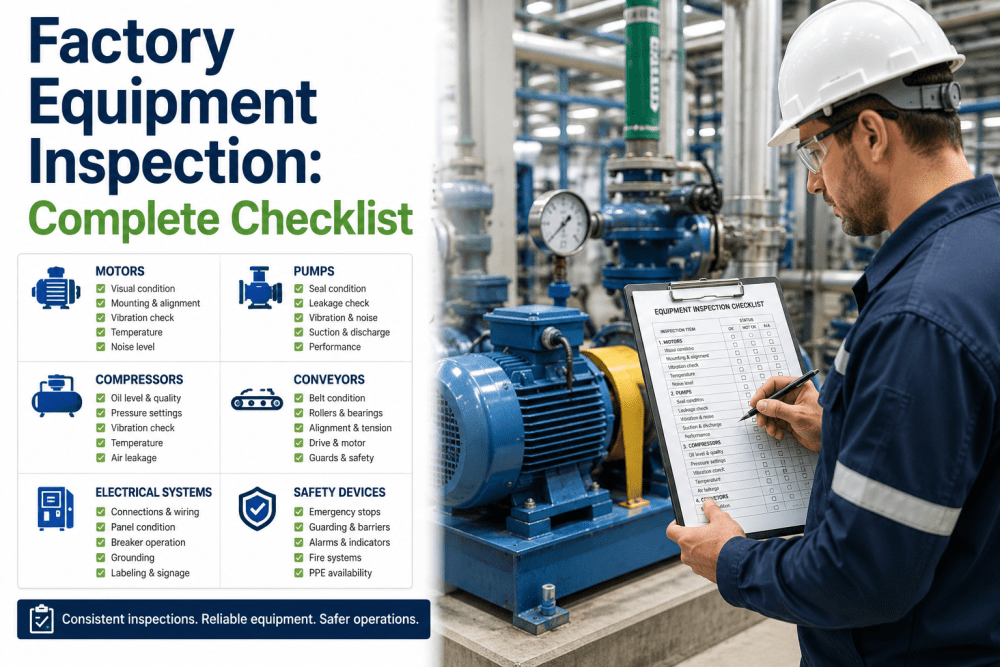
Factory Equipment Inspection: Complete Checklist
Unplanned downtime costs manufacturers $260,000 per hour on average. A structured inspection checklist catches failures early, extends asset life by up to 30%, and keeps production on schedule. Here is the complete guide.
Why a Structured Inspection Checklist Is the Foundation of Reliability
Unplanned downtime remains the single largest source of lost productivity in manufacturing. The inspection management approach that prevents it rests on a simple premise: check the equipment before the equipment fails you. A structured checklist ensures no asset is overlooked, no critical parameter is skipped, and every finding is documented in a way that builds a reliability history over time.
3X
Higher asset lifespan with structured inspections
45%
Lower maintenance costs with preventive programs
60%
Of unplanned failures show warning signs first
85%
Of top-performing plants use digital checklists
Without a checklist, inspections vary by shift, by technician, and by memory. One operator checks vibration on the motor; the next skips it because the morning was busy. A digital checklist enforces consistency, captures readings in real time, and flags readings that fall outside acceptable ranges before they become failures.
The Complete Factory Equipment Inspection Checklist by Category
The following checklist covers the six critical asset categories found in virtually every manufacturing plant. Each category includes specific inspection points, recommended frequencies, and acceptable-condition criteria. Use this as a starting point and customize it to your facility's equipment roster and OEM recommendations.
Cabinet cleanliness, ventilation, and seal integrity
Frequency: Monthly • Quarterly thermography
Safety Devices & Emergency Systems
Emergency stop pull-cord and push-button test
Light curtain and presence sensor alignment
Interlock switch actuation on all guards
Fire suppression system pressure and inspection tag
Gas detection sensor calibration
Safety signage visibility and legibility
Frequency: Daily visual • Monthly functional test
Structural & Facility Systems
Racking and storage system structural integrity
Overhead crane and hoist load test certification
Floor condition and drainage
Lighting levels at workstations and aisles
HVAC filter condition and airflow
Compressed air system leaks and dryer condition
Frequency: Monthly • Quarterly structural audit
Quick-Reference Inspection Schedule
Asset Category
Daily
Weekly
Monthly
Quarterly
Motors & Drive Systems
—
Vibration & temperature
Current draw & thermography
Insulation resistance
Conveyors & Material Handling
Visual walk & e-stop
Belt tracking & rollers
Drive motor & chain lube
Structural alignment
Pumps, Valves & Piping
—
Seal leakage & pressure
Performance curve & vibration
Valve stroke test
Electrical Panels
—
—
Voltage & thermal scan
Full thermography & megger
Safety Devices
Visual & e-stop check
—
Full functional test
System integration test
Structural & Facility
—
—
Floor & racking check
Crane & hoist certification
Ready to Standardize Your Inspections?
Digitize Your Complete Inspection Checklist
Stop relying on paper clipboards and tribal knowledge. iFactory AI digitizes your entire inspection workflow with customizable checklists, automated scheduling, and real-time compliance dashboards.
How iFactory AI Digitizes Your Inspection Workflow
A paper checklist might get the job done on a good day, but it creates data silos, loses detail between shifts, and makes trend analysis nearly impossible. The iFactory AI inspection management platform replaces the clipboard with a structured digital workflow that captures every reading, flags every anomaly, and builds a reliability history that grows more valuable with every inspection cycle.
From Clipboard to Cloud: The Digital Inspection Workflow
1
Create
Build Checklists
Customize inspection templates per asset category with pass-fail criteria and measurement ranges
2
Schedule
Auto-Assign
Time-based or usage-based triggers route inspections to the right technician automatically
3
Execute
Mobile Field Capture
Technicians complete inspections on tablet or phone with photo attachments and signature capture
4
Analyze
Trend & Report
Dashboards show compliance rates, recurring findings, and asset condition trends in real time
iFactory AI integrates with SAP, PLC sensors, and existing CMMS systems. Book a 30-minute walkthrough and we will map your current asset list to a digitized inspection program.
Expert Review: Industry Best Practices for Equipment Inspection
Dave Murdock
Former Plant Engineering Director, General Motors • 32 years in manufacturing reliability
"The plants that consistently hit 95%+ OEE are the ones where the inspection checklist is treated as a living document, updated every quarter based on what the data is showing. If your checklist hasn't changed in two years, it's already obsolete. The shift to digital checklists is not about eliminating paper—it's about closing the loop between what you find during inspection and what you do about it before the next shift starts. That feedback cycle is where real reliability gains come from."
Murdock's observation echoes what high-performing plants have demonstrated for decades: an inspection checklist is only as valuable as the action it drives. The most effective programs combine three disciplines—standardized checklists, digital data capture, and closed-loop corrective action—into a single workflow. iFactory AI was built to deliver exactly that combination.
Implementing Your Inspection Program: A Step-by-Step Approach
Building an inspection program from scratch or upgrading an existing one follows a repeatable sequence. These five steps will take you from asset inventory to sustained reliability improvement.
Step 1
Asset Inventory & Criticality
Document every piece of equipment, assign criticality (production impact, safety risk, replacement cost), and prioritize inspection frequency accordingly.
Step 2
Checklist Development
Write inspection points per asset category using OEM guidelines, historical failure data, and industry standards like NFPA 70B and ISO 14224.
Step 3
Digital Deployment
Load checklists into iFactory AI, assign schedules by calendar or runtime, and train technicians on the mobile inspection workflow.
Step 4
Execute & Capture
Run the inspection cycle for 90 days while capturing every finding, measurement, and photo. Let the data surface early patterns.
Step 5
Review & Refine
Review findings quarterly, adjust checklist content and frequency based on actual failure modes, and close the loop with corrective actions.
Conclusion
A factory equipment inspection checklist is not a compliance formality—it is the operational backbone of plant reliability. The difference between a plant that catches a failing bearing on a Tuesday morning and one that discovers it during a catastrophic breakdown on a Saturday night is a structured, consistently executed inspection program. By digitizing that program with iFactory AI, you eliminate data gaps, enforce consistency across shifts, and build a reliability history that makes every subsequent inspection more intelligent. The checklists in this guide give you the starting point; the platform gives you the execution. Book a Demo to see it in action on your own asset data.
Frequently Asked Questions
How often should factory equipment be inspected?
Frequency depends on asset criticality, OEM recommendations, and operating conditions. As a general guideline, high-criticality equipment such as conveyors and safety devices should receive daily visual checks and weekly mechanical inspections. Motors and pumps benefit from weekly vibration and temperature checks with monthly performance analysis. Lower-criticality assets like structural systems can be inspected monthly with quarterly audits. The most effective approach is risk-based: assign frequency based on the consequence of failure and adjust as condition data accumulates.
What is the difference between preventive maintenance and inspection?
Inspection is the data-gathering step: checking vibration, temperature, pressure, alignment, and visual condition to detect early signs of deterioration. Preventive maintenance is the intervention step: replacing filters, lubricating bearings, adjusting belts, and replacing worn components based on a schedule or condition trigger. Inspections tell you what needs preventive maintenance and when. Running PM without inspection data means you are either over-maintaining or missing the right window. The two disciplines work together in a complete reliability program.
Should we use paper checklists or digital inspection tools?
Digital inspection tools consistently outperform paper in every metric that matters: compliance rates, data accuracy, trend analysis, and audit readiness. Paper checklists get lost, skip questions, and leave data trapped in a binder where no one can trend it. Digital platforms like iFactory AI enforce completion of every field, flag out-of-range readings instantly, and build a searchable history that reveals recurring patterns. Top-performing plants are 3X more likely to use digital checklists, and the gap in reliability performance between digital and paper users continues to widen.
How do I create an inspection checklist for my specific plant?
Start with the master checklist in this guide and customize it to your equipment roster. Pull OEM manuals for each asset and extract the manufacturer-recommended inspection points and frequencies. Review your own historical failure data to add checks that would have caught previous breakdowns earlier. Consult industry standards such as NFPA 70B for electrical equipment and ISO 14224 for failure mode classification. Finally, review the checklist with your most experienced technicians and plant engineers, then commit it to a digital platform where it can evolve based on actual findings.
What are the most commonly missed inspection points?
The most frequently overlooked items across manufacturing plants include: infrared thermography of electrical connections (a leading cause of electrical fires), bearing lubrication condition on motors, emergency stop device functionality on conveyors, compressed air system leaks, and guard interlock switch alignment on safety systems. These items are often missed not because they are difficult to check, but because they are not on the checklist or the checklist is not followed consistently. A digitized checklist with mandatory completion fields eliminates this gap by design.
Stop Reacting. Start Inspecting.
Deploy a Digital Inspection Program in 30 Minutes
Bring your asset list and criticality matrix to a free walkthrough. We will build your complete digital inspection program with checklists, schedules, and real-time dashboards in a single session.