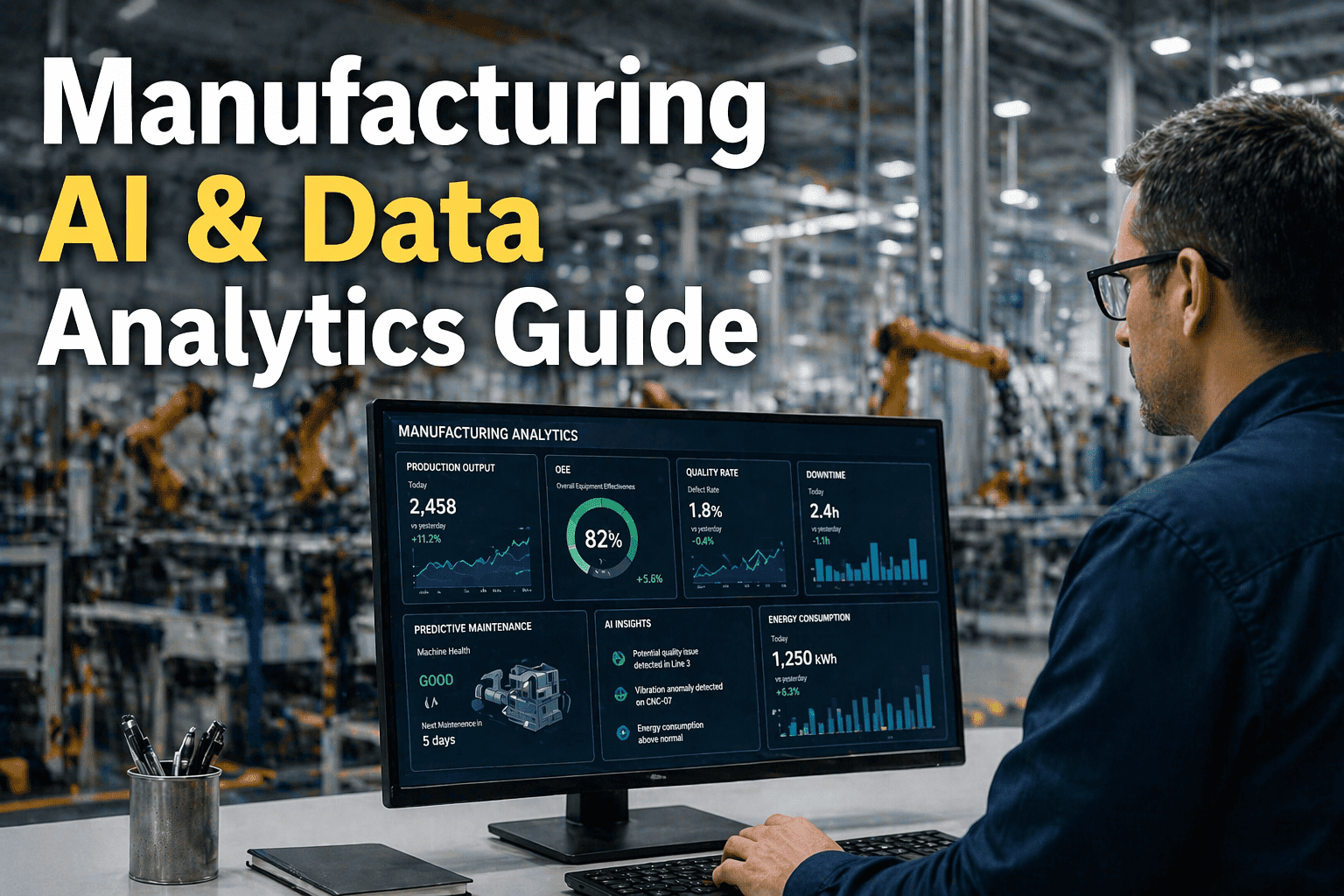
Ask five people on a plant floor how a single OEE number was calculated, and you will often get five different answers pulled from five different spreadsheets, historians, and MES exports that were never built to talk to each other. A single production line can generate sensor readings from a dozen points every second, while the ERP system tracks orders in daily batches and the quality lab logs results in a shared drive nobody outside the team ever opens. None of these systems were designed with each other in mind, so engineers spend hours reconciling numbers instead of acting on them. A manufacturing data lake and warehouse architecture exists to close exactly that gap, giving raw sensor streams, production records, and quality data one common home built for both audits and AI, and getting that foundation right the first time is what iFactory's data platform team helps manufacturers do.
DATA ARCHITECTURE · MANUFACTURING ANALYTICS · 2026
Manufacturing Data Lake and Warehouse: The Architecture Behind Every AI Initiative That Actually Works
Historian tags, MES transactions, ERP records, and quality results rarely live anywhere they can be queried together. Here is how a lake, warehouse, and analytics layer fit into one platform, what breaks when a plant skips one of them, and how to plan an architecture that survives contact with real production data.
The Reality on the Floor
Where Manufacturing Data Actually Lives Right Now
Before any lake or warehouse conversation makes sense, it helps to see how fragmented the starting point usually is. Most plants are not short on data. They are short on a place where that data can be trusted, joined, and queried without an engineer manually stitching files together every week.
7–12
disconnected systems feeding a typical plant's reporting, from historians and MES to spreadsheets and shared drives
60%+
of engineering time on data projects reported as data cleaning and reconciliation rather than analysis
1 sec
typical historian tag interval, versus daily or weekly batch updates from ERP and quality systems
100M+
records per day processed by well-built manufacturing lakehouse platforms at multi-site scale
The Architecture
Five Layers, One Platform: How the Data Actually Flows
A manufacturing data platform is not one piece of software. It is a stack of purpose-built layers, each handling data differently, that together turn scattered readings into something a plant manager, an auditor, or a machine learning model can actually use. Skipping a layer does not remove the need for it, it just means someone rebuilds it manually later, usually under deadline pressure.
01 · Sources
Historians, MES, ERP, LIMS, SCADA, Manual Logs
Every system that already exists on the plant floor keeps running exactly as it is. Nothing here changes; the platform simply reads from it.
02 · Ingestion
Streaming and Batch Pipelines
Time-series tags stream in near real time while ERP and quality records arrive in scheduled batches, both normalized into a common event format.
03 · Data Lake
Raw Storage, Any Format, Schema at Read Time
Sensor streams, images from vision systems, PDFs, and log files land here untouched, preserving the full history needed to retrain models later.
04 · Data Warehouse
Curated Tables, Schema at Write Time
Cleaned, validated, and modeled data for OEE, quality, and cost reporting, structured so BI dashboards load in seconds instead of minutes.
05 · Analytics & AI
Dashboards, Predictive Models, Work Orders
Plant managers see live dashboards, reliability teams get predictive maintenance alerts, and finance gets a cost view that reconciles with the plant floor.
Stop Rebuilding the Same Report Every Month
iFactory connects your historian, MES, ERP, and quality systems into one governed lake and warehouse architecture, so every dashboard and AI model draws from the same trusted numbers.
Choosing the Right Foundation
Data Lake vs. Data Warehouse vs. Lakehouse: What Manufacturing Actually Needs
These three terms get used almost interchangeably in vendor pitches, but they solve different problems. Most manufacturing environments end up needing all three concepts represented somewhere in the architecture, even if a single lakehouse platform now handles two of them at once.
Manufacturing Data Architecture Comparison — 2026
Common Mistakes
Five Ways Manufacturers Get This Architecture Wrong
Most failed data platform projects do not fail because the technology was wrong. They fail because one of these five decisions was skipped early on and became expensive to fix once dashboards and models already depended on the flawed foundation.
Skipping the Raw Archive Tier
Teams that only build a warehouse and never a lake lose the raw historian data needed to retrain predictive models later, forcing an expensive re-collection effort months down the line.
Skipping the Reporting Tier
Querying raw time-series data directly for a quarterly board report is slow, expensive, and fragile, which is exactly what a curated warehouse layer is meant to prevent.
Tightly Coupling Every Pipeline
When ingestion, storage, and reporting pipelines are wired directly to each other, a single schema change in the MES can silently break every downstream dashboard overnight.
No Named Data Owner
Without a data steward accountable for quality and governance, both the lake and the warehouse quietly decay into duplicate tables, inconsistent naming, and numbers nobody fully trusts.
Treating It as a One-Time Project
New sensors, new lines, and new product families keep arriving, so a platform built once and never revisited falls behind the plant it is supposed to represent within a year.
Where the Value Shows Up
What a Unified Platform Actually Enables
A
Multi-Site OEE Comparison
Leadership compares OEE, scrap rate, and downtime across every plant in one dashboard instead of waiting for a monthly rollup spreadsheet from each site.
B
Predictive Maintenance Models
Reliability teams train failure prediction models on years of historian data stored in the lake, then score live equipment readings against them in real time.
C
Genealogy and Traceability
Quality teams trace a finished product back through every machine setting, batch record, and inspection result that touched it, in seconds instead of days.
D
Energy and Emissions Reporting
Sustainability teams pull verified energy consumption figures straight from the warehouse layer instead of manually reconciling utility bills with production output.
E
AI-Ready Data for Vision and NLP
Image data from inspection cameras and free-text maintenance notes sit in the lake in their native format, ready for computer vision and language models without a separate export step.
F
Audit-Ready Compliance Records
Regulated manufacturers pull immutable, timestamped production and quality records directly from the warehouse when an auditor asks for evidence, rather than assembling it by hand.
Getting There
A Practical Rollout Path, Not a Big-Bang Migration
Manufacturers who succeed with this architecture almost never build the whole thing at once. They prove value on one plant or one use case, then extend the same platform outward once the pipelines and governance model are already working.
1
Inventory Every Data Source
List every historian, MES, ERP, LIMS, and spreadsheet feeding current reports, along with who owns each one and how often it updates.
2
Stand Up the Raw Lake First
Begin archiving raw historian and MES data untouched, even before reporting pipelines exist, so no historical data is lost while the rest of the platform is built.
3
Model One Warehouse Use Case
Pick a single high-value report, such as multi-site OEE, and build the curated warehouse tables needed to support it end to end.
4
Assign a Data Steward
Name one owner accountable for schema changes, data quality checks, and access governance before opening the platform to more teams.
5
Expand Site by Site
Onboard additional plants using the same pipelines and schema standards, so every new site strengthens the platform instead of fragmenting it further.
Frequently Asked Questions
Manufacturing Data Lake and Warehouse — Common Questions
Do we need both a data lake and a data warehouse, or is one enough?
Most manufacturing environments benefit from both, since they solve different problems: the lake preserves raw historian and sensor data in its original form for machine learning and audits, while the warehouse holds cleaned, structured tables built for fast BI reporting. Relying on only one usually means either slow, expensive reports or a missing archive for future AI projects.
How long does a manufacturing data platform implementation typically take?
A single-plant proof of value covering historian ingestion and one core report can often be live within eight to twelve weeks, while full multi-site rollout with governance, quality checks, and AI-ready pipelines typically spans six to twelve months depending on how many source systems need integration.
Can this architecture integrate with our existing historian and MES without replacing them?
Yes, the platform is designed to read from existing historians, MES, ERP, and quality systems rather than replace them, and
iFactory's integration team connects to standard industrial protocols and APIs so plant-floor systems keep running exactly as they do today.
How is data quality maintained once multiple plants feed the same platform?
Data quality depends on validation rules applied at ingestion, a named data steward accountable for schema and naming standards, and automated checks that flag anomalies before they reach a dashboard, rather than relying on manual review after numbers are already published.
What is the difference between this and just adding more dashboards to our current BI tool?
Dashboards only display data that is already clean and joined; if the underlying historian, MES, ERP, and quality data is not unified first, every new dashboard just reproduces the same reconciliation work by hand. Building the lake and warehouse layer first means every future dashboard, report, and AI model draws from the same trusted foundation.
MANUFACTURING DATA PLATFORM · 2026
Give Every Report, Model, and Dashboard One Source of Truth
iFactory builds the data lake and warehouse architecture that connects your historian, MES, ERP, and quality systems into a single AI-ready platform.