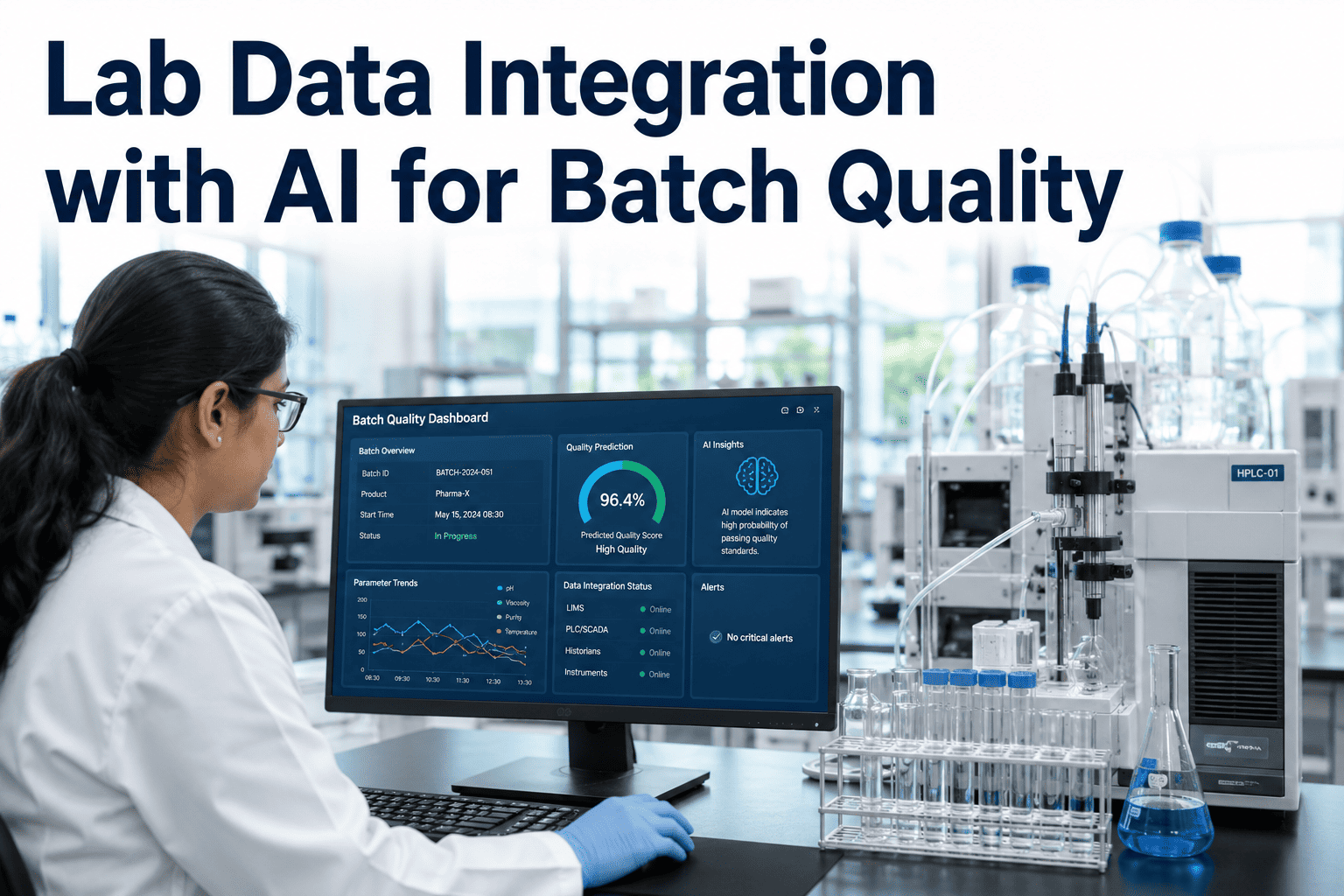
Somewhere between the moment a batch finishes production and the moment your lab signs off on it, hours disappear. Samples sit in a queue, technicians run assays, results get typed into a LIMS, and a QA engineer refreshes a screen waiting for numbers that decide whether product ships or sits. That gap, four to twenty-four hours in most plants, is quiet, invisible on any dashboard, and enormously expensive. AI-driven lab data integration closes it by connecting instruments, LIMS, and production systems into one live stream QA can act on the moment results land, and teams exploring this shift often start with a conversation through a quick planning call.
Close the Lab-to-Line Gap Before It Costs You a Shift
Every hour a batch waits on lab confirmation is an hour of tied-up inventory, idle downstream capacity, and QA engineers doing manual data entry instead of investigating trends.
Where the Hours Actually Go
Sample Transit and Queue Time
Physical samples travel from the line to the lab and wait behind other jobs before testing even starts, adding delay before any data exists.
Manual Result Transcription
Technicians key results from instruments into spreadsheets or LIMS screens, a step prone to transposition errors and its own backlog.
Disconnected Systems
LIMS, MES, and ERP rarely talk to each other automatically, so QA engineers refresh screens or wait on emails to know a batch has cleared.
Reactive Deviation Handling
Out-of-spec results surface only after the full test cycle finishes, long after the process condition that caused them has moved on.
How AI-Driven Lab Integration Works
Instead of results arriving as isolated data points, an integration layer streams every reading into a shared model that watches specs, trends, and batch context continuously.
This isn't a rip-and-replace of your quality systems. It's a connective layer that sits quietly between equipment you already own, translating raw instrument output into structured, spec-checked data your QA team can trust the moment it appears, without asking anyone to learn a new primary system of record.
Instrument Capture
Analyzers and lab instruments push results directly into the integration layer as soon as a run completes, no manual entry required.
Automated LIMS Sync
Results map to the correct batch record in the LIMS automatically, matched against sample IDs and production timestamps.
AI Spec Checking
A model compares incoming values against specification limits and historical batch patterns, flagging anomalies before a human even opens the file.
Release Recommendation
QA engineers get a ranked release queue with context, confidence, and any deviation flags, cutting review time from a full read-through to a quick check.
What Changes on the Floor
Faster Batch Release
When results sync automatically and get checked against spec the moment they land, QA no longer waits for someone to compile a report. Batches that used to sit overnight can clear within the same shift, freeing warehouse space and downstream lines sooner.
Lower Holding Inventory
Plants carry safety stock partly to absorb release delays. Shrinking the lab-to-release window directly shrinks how much finished or intermediate product needs to sit idle waiting for a green light.
Fewer Transcription Errors
Automated capture removes the manual re-keying step where digits get swapped or units get mismatched, which matters most in regulated environments where a single data entry mistake can trigger a full investigation.
Earlier Trend Detection
Because the AI layer watches results across batches, not just against a single spec limit, it can flag a slow drift toward an out-of-spec condition days before any individual result actually fails.
See Your Lab Data Flow in Real Time
A short walkthrough shows exactly how your LIMS, instruments, and batch records connect, and where the biggest time savings would land in your specific process.
Manual Workflow vs AI-Integrated Workflow
| Step | Manual Process | AI-Integrated Process |
|---|---|---|
| Result capture | Technician transcribes readings manually | Instruments push results automatically |
| LIMS matching | Manual lookup of batch and sample ID | Automatic matching on capture |
| Spec checking | Reviewed after full test cycle completes | Checked continuously as data arrives |
| Deviation flagging | Identified during manual review | Flagged instantly with trend context |
| Release decision | Hours after last result logged | Minutes after last result logged |
A Realistic Scenario
Consider a mid-size specialty chemical plant running three shifts, where finished batches typically waited eight to twelve hours for lab clearance because results were emailed between the lab and QA in batches rather than streamed continuously. Technicians ran assays on schedule, but the handoff between instrument, spreadsheet, and LIMS added its own delay on top of the actual testing time, and QA engineers often didn't see a complete result set until the next shift started.
After integrating lab instruments directly with the LIMS and layering in automated spec checking, the same plant cut its average release window to under two hours. QA engineers stopped spending their mornings chasing down overnight results and instead reviewed a prioritized queue, with the AI layer surfacing the two or three batches that actually needed a closer look. Warehouse teams noticed the change first, since finished goods stopped piling up in the hold area waiting on paperwork that had, in effect, already been sitting complete for hours.
The bigger shift was cultural: QA moved from reactive data entry to actual quality investigation, which is the work most engineers were trained for in the first place. Supervisors reported that root-cause conversations started happening the same day a trend appeared, rather than a week later once someone finally noticed a pattern across several batch reports.
Readiness Checklist Before You Integrate
Confirm which instruments in your lab support direct digital output rather than manual readouts, since that determines your initial integration scope.
Map your current LIMS fields against production batch records to identify where sample IDs and timestamps might not align cleanly today.
Pick one high-volume product line as a pilot, so early wins are visible before rolling the integration out plant-wide.
Document your current specification limits and historical deviation records, since these train the AI layer to recognize normal variation accurately.
Align QA, lab, and IT teams early, since integration touches systems each group owns separately in most plants.
What This Changes for the QA Engineer's Day
For most QA engineers, the job was never supposed to be data entry. Yet on a typical shift, a meaningful chunk of the day goes to chasing lab results, cross-checking spreadsheets against LIMS records, and manually confirming that a batch's numbers actually match its paperwork before anyone can sign a release. When that busywork disappears, the role shifts back toward what it was designed for.
Before Integration
Mornings start with checking overnight emails for lab results, manually re-entering values into the batch record, and calling the lab to confirm a sample was actually run. Deviations are caught during a full read-through review, often hours after the process condition that caused them has already changed.
After Integration
Results are already synced and spec-checked by the time a QA engineer opens their queue. The morning starts with a short list of batches that actually need attention, sorted by risk, with trend context attached. Investigation time goes toward genuine quality questions instead of confirming that numbers were typed correctly.
This shift also changes how QA teams are staffed. Instead of scaling headcount linearly with batch volume, plants can add production lines or shifts without a proportional increase in manual review time, because the AI layer absorbs the repetitive verification work that used to require another set of eyes.
Metrics Worth Tracking After Integration
Average hours between last production step and final batch release, tracked weekly to confirm the lag is actually shrinking rather than just feeling faster.
Count of transcription corrections logged per month, which should trend toward zero once manual re-keying is removed from the workflow.
Average value or volume of product sitting in a released-pending state, a direct financial indicator of how much cash is tied up waiting on paperwork.
How often the AI layer flags something that turns out to be normal variation, which should decrease over time as the model sees more batches from your specific process.
Frequently Asked Questions
Does lab data integration require replacing our existing LIMS?
No, most integrations connect to your current LIMS rather than replacing it. The integration layer sits between instruments and the LIMS, pushing captured results in automatically while your existing workflows and approval chains stay intact. Teams typically keep their LIMS vendor and simply remove the manual re-entry step. You can review compatibility details through support before committing to a rollout plan.
How does the AI decide what counts as a deviation?
The model is trained on your historical batch data, specification limits, and prior deviation records, so it learns what normal variation looks like for each product line. Rather than applying a single static threshold, it accounts for process context, meaning a result flagged in one product line might be perfectly normal in another. Engineers can also adjust sensitivity as more batches run through the system.
What happens if an instrument goes offline mid-batch?
The system logs the gap and flags the affected batch record so QA knows a result is missing rather than assuming it passed. Once the instrument reconnects, remaining results sync automatically and the batch record updates. This is safer than manual workflows, where a missed entry can go unnoticed until someone manually cross-checks the paperwork.
Is this approach suitable for regulated industries like pharma or food?
Yes, automated capture actually strengthens audit trails in regulated environments because every result is timestamped and traceable back to the originating instrument, removing the ambiguity of manual transcription. Many regulated plants adopt this specifically to reduce data integrity findings during audits. It's worth discussing your specific compliance requirements on a scoping call before implementation.
How long does a typical integration take to deploy?
Most single-site integrations with a standard LIMS and a handful of instrument types deploy within four to eight weeks, depending on how many instrument protocols need mapping. Plants with highly customized LIMS configurations or many legacy instruments may take longer. A phased rollout, starting with the highest-volume product line, is usually the fastest way to see measurable results early.
Stop Waiting on Lab Results to Move Product
See how integrated, AI-checked lab data could shrink your release window and free up inventory that's currently sitting idle.