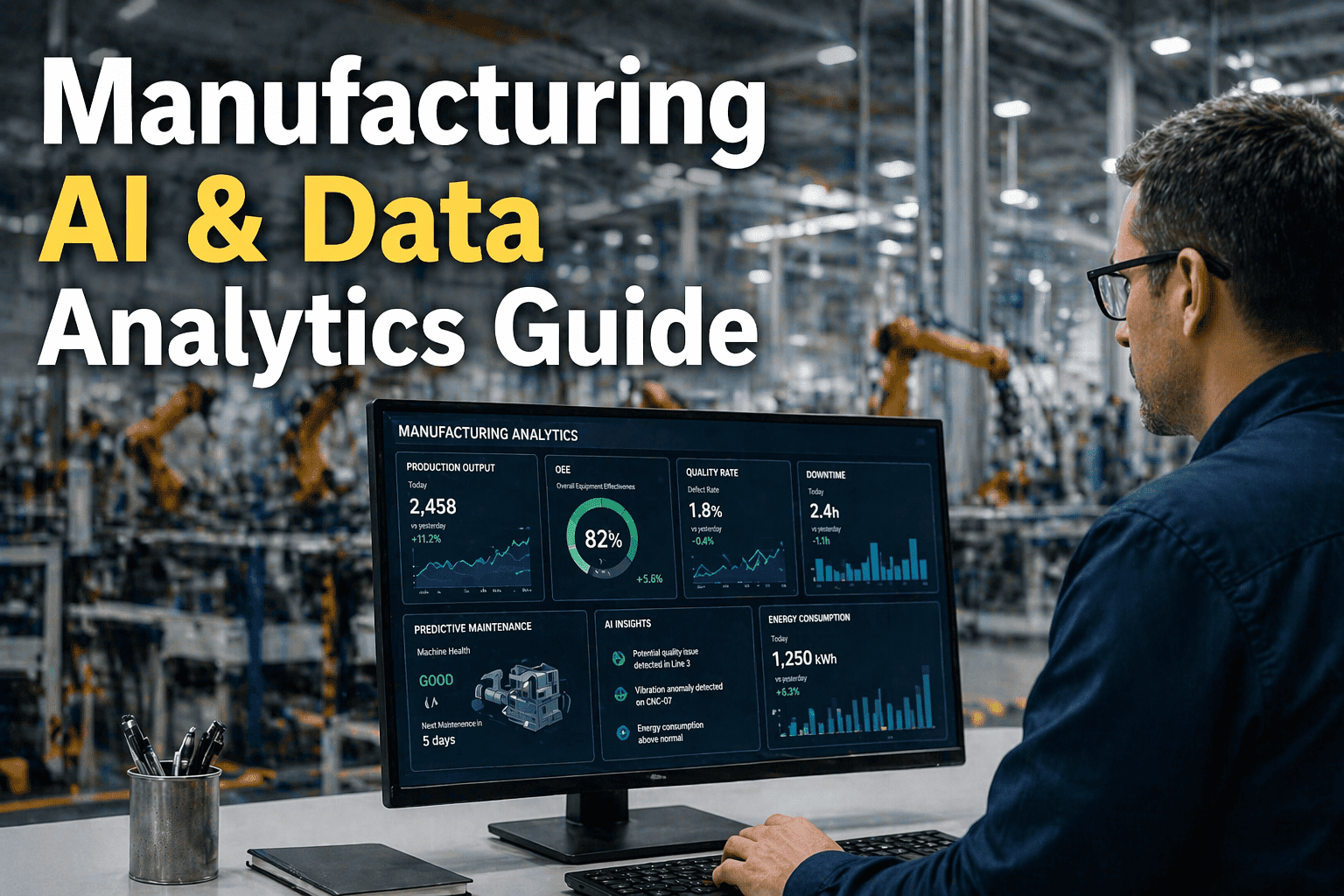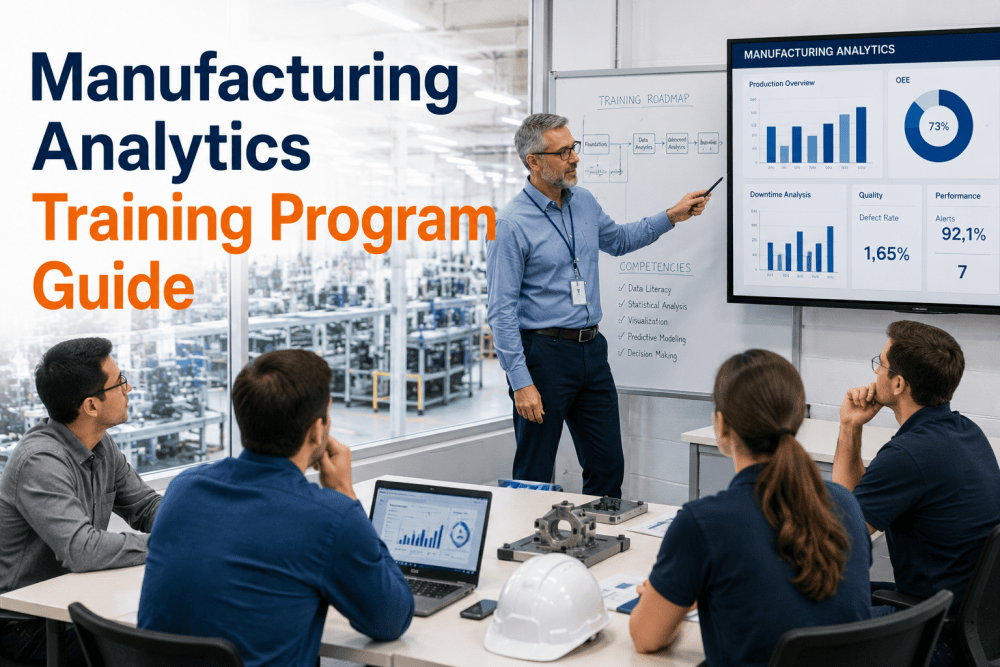
Manufacturing analytics training is the structured process of building workforce capability to collect, interpret, and act on production data — from OEE dashboards and predictive maintenance alerts to quality trend analysis and energy consumption patterns. As U.S. manufacturing facilities deploy increasingly sophisticated technology platforms — MES, CMMS, AI vision, and digital twin systems — the limiting factor on realizing the promised ROI is no longer the technology itself. It is the availability of a workforce trained to use the technology effectively. A 2025 Manufacturing Institute survey found that 68% of plant floor supervisors and 81% of production operators reported they do not regularly use analytics tools to inform daily decisions, citing lack of training as the primary barrier. iFactory AI's platform includes built-in training pathways, role-based learning modules, and guided analytics workflows that accelerate workforce upskilling alongside platform deployment.
Build a Manufacturing Analytics Training Program That Converts Data Into Daily Decisions
iFactory AI enables manufacturing facilities to develop structured analytics training programs with role-based dashboards, guided workflows, and competency tracking — turning every shift into a data-driven learning opportunity.
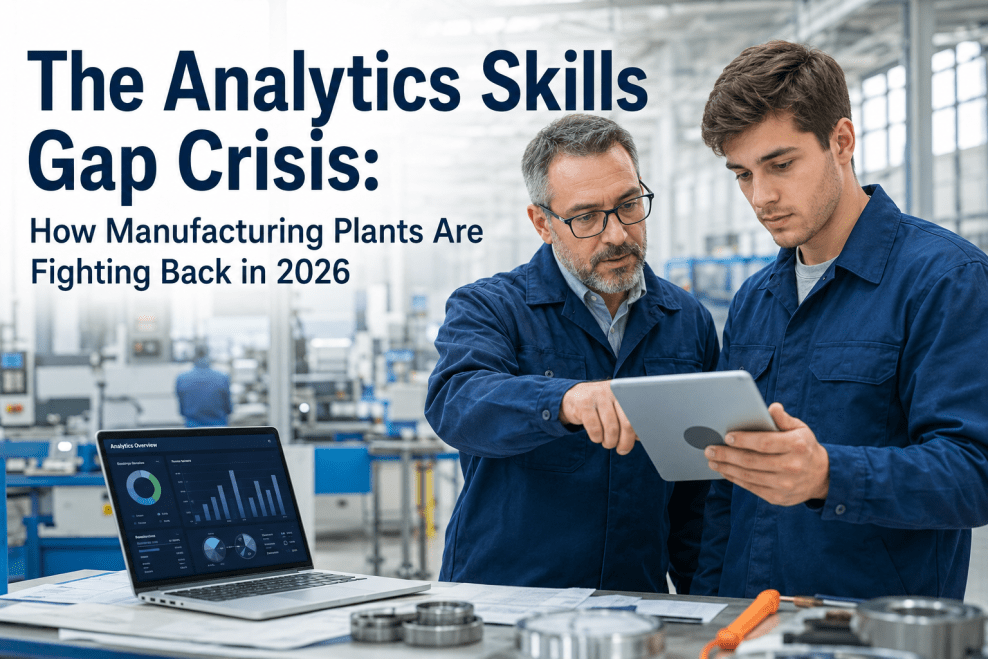
The Manufacturing Analytics Skills Gap — Why Structured Training Programs Are Critical for Workforce Competitiveness
The average U.S. manufacturing facility has invested significantly in data collection infrastructure — PLC-connected sensors, SCADA historians, MES transaction logs, and CMMS maintenance records. These systems generate thousands of data points per shift. But the workforce that operates the plant floor was not trained in data analytics. Most production supervisors and operators came up through the trades — machining, welding, electrical, assembly — where the primary decision-making tools were visual inspection, mechanical judgment, and tribal knowledge passed down through senior operators. The introduction of analytics dashboards, predictive models, and digital twin interfaces represents a fundamental shift in how plant-floor decisions are made, and the workforce needs structured training to make that transition successfully.
The gap between data availability and data literacy creates a measurable productivity deficit. Facilities with structured analytics training programs achieve OEE improvement rates that are 23% higher than facilities that deploy analytics tools without accompanying training, according to a 2025 benchmarking study by the Manufacturing Leadership Council. The implication is clear: analytics training is not a soft-cost add-on to a technology investment — it is the mechanism that converts technology capability into operational results. Book a Demo to discuss how iFactory's training framework accelerates analytics adoption for your workforce.
Core Competencies for Manufacturing Analytics — A Role-Based Training Framework That Aligns Skills With Plant-Floor Functions
A manufacturing analytics training program should be organized around four competency domains that progress from foundational data literacy to advanced analytical decision-making. Each domain maps to specific roles on the plant floor, enabling training to be targeted to the learner's function rather than delivering a generic curriculum that fails to address role-specific needs. The table below presents the competency framework with associated iFactory platform modules that support each domain.
| Competency Domain | Target Roles | Key Skills Developed | iFactory Platform Module |
|---|---|---|---|
| Data Literacy Foundations | All production and maintenance personnel | Reading dashboards, interpreting trend charts, understanding OEE components, recognizing data quality issues, navigating analytics interfaces | OEE Analytics, Production Monitoring |
| Maintenance Analytics | Maintenance technicians and planners | Interpreting vibration and thermal data, understanding PM compliance metrics, analyzing MTBF and MTTR trends, prioritizing work orders by criticality score | CMMS, Predictive Maintenance, Asset Management |
| Quality Analytics | Quality inspectors and process engineers | Using SPC charts, analyzing defect Pareto distributions, correlating process parameters with quality outcomes, setting control limits from historical data | Quality Control Management, AI Vision |
| Operational Decision-Making | Supervisors and plant managers | Prioritizing improvement actions from data, building business cases from analytics, leading data-driven shift review meetings, setting performance targets from benchmarks | Analytics Reporting, Digital Twin, Energy Monitoring |
iFactory's platform includes role-based dashboard presets and guided analytics workflows that reinforce each competency during daily use — turning the analytics platform itself into a continuous training tool. Book a Demo to review the role-based analytics interface configured for your facility's team structure.
Building the Analytics Training Program — A Three-Phase Approach to Sustainable Workforce Upskilling
Successful manufacturing analytics training programs follow a phased structure that builds foundational skills before introducing advanced concepts, with each phase including hands-on practice using the facility's own production data. The three-phase approach below is designed to achieve analytics competency within 6 to 10 weeks while minimizing disruption to production schedules.
Phase One: Skills Assessment and Role Mapping
Assess current analytics proficiency across all roles using a structured self-assessment matrix covering dashboard navigation, data interpretation, and decision application. Map training requirements to job functions based on the analytics features each role will use in daily operations. Prioritize training cohorts based on platform deployment timeline — operators on the first production line to receive analytics dashboards train first, followed by supporting maintenance and quality personnel. The assessment phase also identifies power users who can serve as peer trainers in later phases.
Phase Two: Structured Curriculum Delivery
Deliver role-based training in cohorts of 8 to 12 participants using a blended approach: instructor-led sessions for conceptual foundations (4 to 6 hours total), followed by hands-on lab sessions where trainees work with actual production data from their own work areas (6 to 8 hours total). Each module concludes with a practical assessment requiring the trainee to perform a specific analytics task — interpret an OEE trend chart, identify a quality anomaly from SPC data, or prioritize maintenance actions from a predictive alert dashboard. Trainees must pass each module assessment before advancing.
Phase Three: Reinforcement and Certification
Establish ongoing reinforcement through daily analytics review huddles (15 minutes per shift, led by the shift supervisor using a structured dashboard review template), weekly data-driven improvement challenges, and monthly certification milestones. iFactory's platform supports the reinforcement phase with role-based dashboard presets that show each user the metrics most relevant to their function, guided analytics workflows that prompt users through data investigation steps, and automated summary reports that model the analytics decision-making process. Certification is awarded at three levels — foundational, intermediate, and advanced — with each level requiring demonstrated competency in specific analytics tasks using live production data.
Launch a Structured Analytics Training Program Backed by a Platform That Reinforces Learning Every Shift
iFactory AI's unified platform includes role-based dashboards, guided analytics workflows, and automated reporting that accelerate workforce upskilling — turning every shift into a training opportunity and every dashboard interaction into skill reinforcement.
Measuring Analytics Training Impact — Key Performance Indicators That Quantify Program Success
The business case for analytics training investment rests on measurable improvements in operational performance metrics that directly affect plant profitability. Facilities that implement structured analytics training programs consistently document improvements across five key performance categories within 6 to 12 months of program launch. The table below presents documented impact ranges from manufacturing facilities that have deployed analytics training programs alongside iFactory's platform.
| Performance Category | Measurement Method | Documented Improvement Range | Annual Value per Facility |
|---|---|---|---|
| OEE Improvement | Pre- and post-training OEE comparison for trained production lines vs. control lines | 8–15% relative OEE improvement within 6 months | $120K–$280K |
| Downtime Reduction | Unplanned downtime hours per month before and after training for maintenance teams | 18–30% reduction in unplanned downtime events | $90K–$200K |
| Quality Defect Reduction | First-pass yield improvement and scrap reduction on lines with trained quality personnel | 12–22% reduction in defect rates within 4 months | $60K–$150K |
| Decision Speed Improvement | Time from data availability to corrective action implementation for trained supervisors | 35–50% reduction in decision latency | $80K–$170K |
| Employee Retention | Voluntary turnover rate among trained analytics users vs. non-trained peers | 20–35% lower turnover among analytics-trained personnel | $50K–$120K |
Combined annual value across all five categories typically reaches $400K–$920K per facility — delivering an ROI on the training program investment of 8:1 to 15:1 within the first 12 months. The most significant gains concentrate in OEE improvement and downtime reduction, which together represent 50–55% of total quantified value. Book a Demo to develop your facility's analytics training ROI projection using iFactory's program modeling tool.
What Workforce Development Leaders Say About Manufacturing Analytics Training
Analytics Training Is the Bridge Between Technology Investment and Operational Performance
Manufacturing analytics training is not a discretionary HR expense — it is a strategic operational investment that determines whether a facility's technology platform delivers its full ROI. The data collection infrastructure has been installed. The analytics dashboards have been configured. The predictive models have been trained. But without a workforce that can interpret a trend chart, investigate an anomaly, and translate a data insight into a corrective action, those investments remain latent capability rather than active operational improvement. A structured analytics training program — organized around role-based competencies, delivered through a phased approach, and reinforced through daily platform interaction — converts technology investment into measurable operational results.
iFactory AI's platform supports every phase of the analytics training lifecycle: role-based dashboard presets that align with the competency framework, guided analytics workflows that reinforce classroom learning during daily operations, automated competency tracking that measures skill development over time, and integrated certification management that documents workforce capability. The platform handles the reinforcement phase automatically — turning every shift, every dashboard review, and every analytics interaction into a training opportunity that builds sustainable analytics capability across the plant floor workforce. Book a Demo to see how iFactory's platform accelerates analytics competency development for your manufacturing facility.
Frequently Asked Questions About Manufacturing Analytics Training Programs
How long does it take to train a production operator in manufacturing analytics?
A structured analytics training program for production operators typically requires 12 to 16 hours of total instruction and practice time spread over 4 to 6 weeks, delivered in 2-hour sessions twice per week. The training includes conceptual foundations (4 to 6 hours) covering dashboard navigation, OEE components, and trend chart interpretation, followed by hands-on lab sessions (6 to 8 hours) using actual production data from the operator's own work area. iFactory's platform accelerates this timeline by providing role-specific dashboard presets and guided analytics workflows that reduce the learning curve and allow operators to begin using analytics tools productively after the first 4 hours of training.
What is the typical ROI for a manufacturing analytics training program?
Facilities that implement structured analytics training programs report ROI within 4 to 8 months through improved OEE, reduced downtime, and fewer quality defects. A medium-size facility with 50 analytics-trained operators across five production lines typically documents $400,000 to $920,000 in annual improvement directly linked to training-enabled analytics use, representing an 8:1 to 15:1 return on the training program investment. The most significant gains come from OEE improvement (8–15% relative improvement) and unplanned downtime reduction (18–30% reduction in downtime events), which together account for 50–55% of total quantified value.
What competencies should a manufacturing analytics training program cover?
A comprehensive analytics training program should cover four competency domains: data literacy foundations (dashboard navigation, trend chart interpretation, OEE component understanding, data quality recognition), maintenance analytics (vibration and thermal data interpretation, PM compliance metrics, MTBF and MTTR trend analysis, work order prioritization by criticality), quality analytics (SPC chart reading, defect Pareto distribution analysis, process parameter correlation with quality outcomes, control limit setting), and operational decision-making (action prioritization from data, business case development from analytics insights, data-driven shift review leadership, performance target setting from benchmarks). Each domain maps to specific plant-floor roles and should be delivered through role-specific training tracks.
How does iFactory's platform support manufacturing analytics training?
iFactory's platform supports analytics training through four integrated mechanisms: role-based dashboard presets that show each user the metrics most relevant to their function, guided analytics workflows that prompt users through data investigation steps with structured root-cause prompts, automated competency tracking that measures skill development by monitoring dashboard interaction patterns and decision quality, and integrated certification management that documents workforce capability at foundational, intermediate, and advanced levels. These features reduce the time to analytics competency by approximately 40% compared to platforms without embedded training support, and they ensure that skills developed in the classroom are reinforced through daily platform use.
What is the first step in building a manufacturing analytics training program?
The first step is conducting a skills assessment across production, maintenance, and supervisory roles to identify current analytics proficiency levels and specific skill gaps relative to the analytics features each role will use in daily operations. iFactory's platform deployment team includes a structured readiness assessment that maps current workforce analytics capability against platform feature requirements, producing a targeted training plan focused on the highest-impact skill gaps first. The assessment identifies which roles need foundational data literacy training, which roles are ready for advanced analytics skill development, and which individuals have the aptitude to serve as peer trainers or analytics champions who can support ongoing adoption after the formal training program concludes.
Accelerate Analytics Competency Across Your Plant Floor — Platform, Training, and Certification in One Integrated System
iFactory AI's unified analytics platform includes role-based dashboards, guided workflows, automated competency tracking, and integrated certification management — enabling your facility to build sustainable analytics capability that turns every shift into a data-driven decision-making opportunity.