A global discrete manufacturer operating 30 plants across eight countries faced a challenge familiar to most multi-site operations leaders: each facility ran its own maintenance systems, defined OEE differently, managed spare parts independently, and reported performance metrics in formats that could not be compared across sites. The result was a $47 billion enterprise operating with plant-level blind spots — unable to identify which facilities were truly high-performing and which were masking chronic reliability issues behind locally optimized metrics. iFactory AI deployed its enterprise AI platform across all 30 plants over 36 weeks, standardizing maintenance operations, predictive analytics, and production monitoring on a single unified system of record. Within 12 months of enterprise-wide go-live, the manufacturer achieved 22% OEE improvement, reduced annual maintenance spend by $4.2M, and established a standardized operations framework that enabled cross-plant benchmarking and continuous improvement at enterprise scale.
Standardize AI Across Your Multi-Site Manufacturing Operations — 30 Plants in 36 Weeks
iFactory AI's enterprise platform unifies maintenance, predictive analytics, and production monitoring across all your plants on a single system of record — with measurable ROI at every phase of deployment.
What This Global Manufacturer Achieved With Enterprise AI Standardization
These are measured results from a $47 billion discrete manufacturer that deployed iFactory AI's enterprise platform across 30 plants in 8 countries. Every metric was verified against plant-level operations data before and after deployment, with auditable traceability to individual equipment assets.
The Standardization Challenge Across 30 Independent Plants
Before deploying iFactory AI, this manufacturer operated with fragmented systems, inconsistent processes, and no enterprise-wide view of asset performance. The following pain points were identified during the initial assessment phase and directly informed the deployment strategy.
Eight different CMMS platforms operating independently across sites
Each plant had selected its own maintenance system over decades of independent operation. The result was a maintenance data landscape where work orders, asset hierarchies, and failure codes could not be compared across sites. One plant tracked breakdowns by equipment type; another by production line. The corporate engineering team spent 40 percent of its time manually reconciling data from incompatible systems just to produce quarterly reliability reports for leadership — time that should have been spent on improvement initiatives.
OEE measured 18 different ways across the enterprise
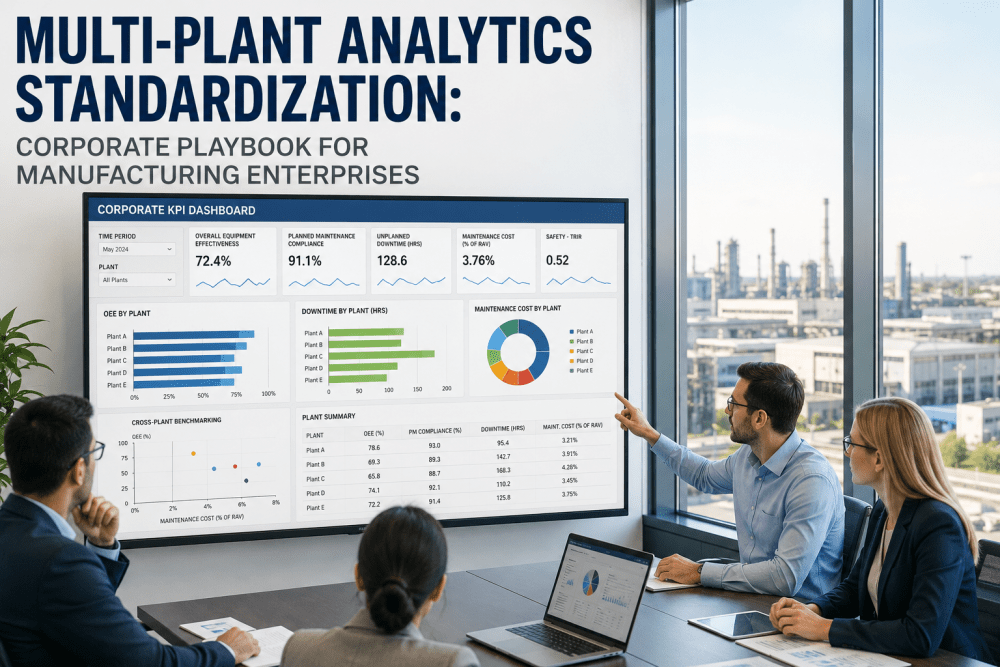
The most fundamental manufacturing KPI was calculated differently at nearly every plant. Some facilities included changeover time in availability calculations; others excluded it. Quality definitions ranged from first-pass yield to final inspection pass rate. The result was a reported OEE range of 55–85 percent across the enterprise, but the variance was driven more by measurement methodology than actual performance differences. Plant managers optimized against local definitions, creating perverse incentives that masked true improvement opportunities.
No enterprise-wide visibility into asset reliability or performance
Without standardized data, failure codes, or KPI definitions, the corporate operations team could not identify which plants were performing well and which were struggling. Best practices developed at high-performing sites remained isolated because there was no mechanism to compare performance or share improvement methodologies. Each plant operated as an independent optimization island within a $47 billion enterprise that should have been leveraging cross-site learning as a competitive advantage.
The iFactory AI Multi-Site Deployment Framework: Governance First, Rollout in Waves
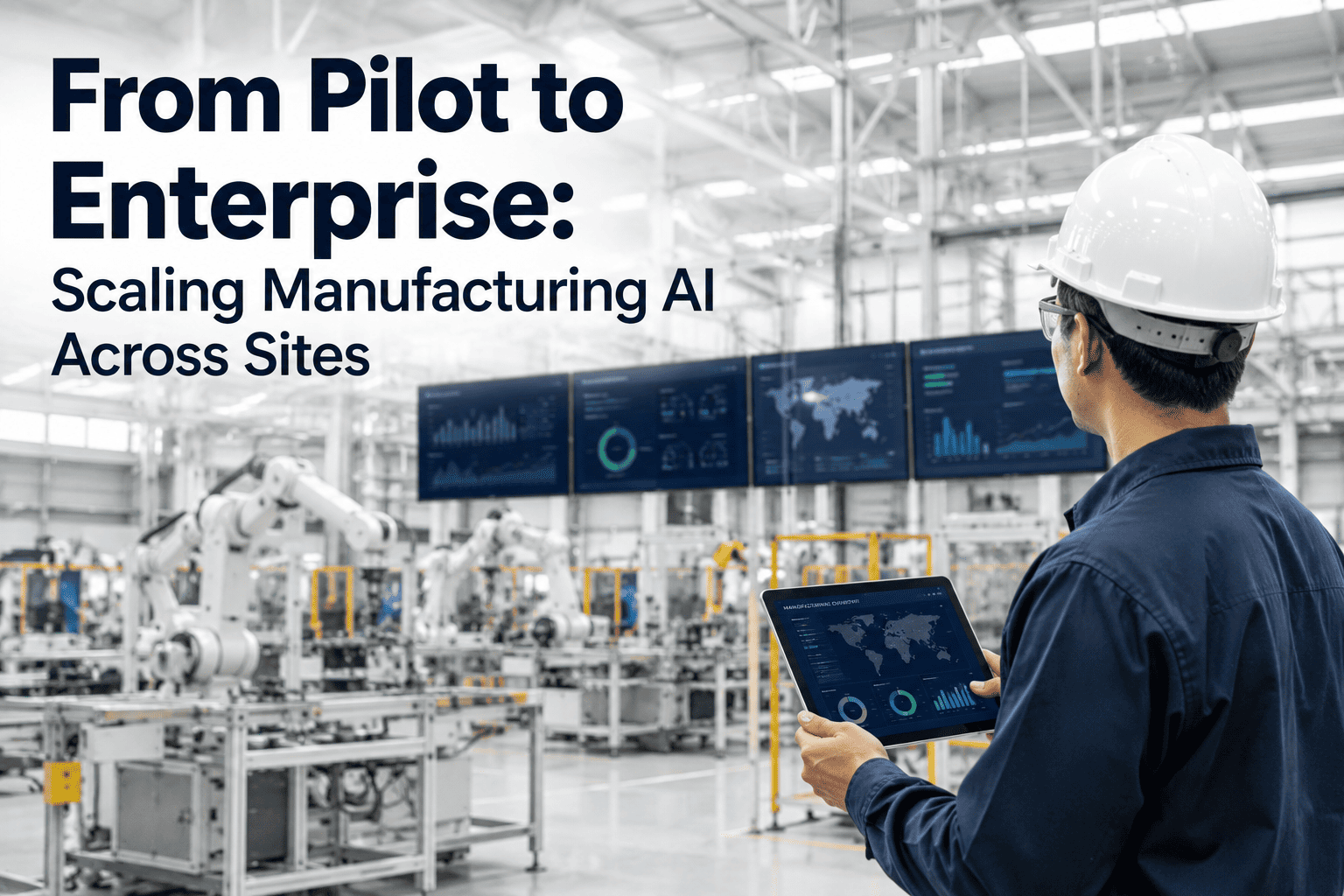
iFactory AI's enterprise deployment model is designed for organizations standardizing operations across multiple plants. Rather than attempting a big-bang rollout that risks disruption at every site, the platform follows a phased wave approach that builds momentum, validates ROI at each stage, and transfers knowledge to site teams for self-sufficient operation.
Governance & Standards Definition
Define enterprise-wide data standards: asset hierarchy taxonomy, standardized failure codes, OEE calculation methodology, and 40+ additional KPI definitions. Establish the governance framework for configuration management, user roles, and change control across all 30 plants. Deliverable: Enterprise Standards Playbook.
Reference Plant Pilot
Deploy iFactory AI at a representative reference plant to validate the standards framework in live production. Train site teams, refine configurations based on real-world data, and document deployment procedures. Measure ROI against baseline metrics to build the business case for enterprise rollout. Timeline: 6–8 weeks.
Regional Wave Rollout
Deploy across remaining plants in regional waves of 3–5 facilities per wave. Each wave includes standardized configuration templates, remote platform provisioning, onsite training, and go-live support. Lessons from each wave feed into the next, continuously improving deployment efficiency. Timeline: 3–5 plants every 4 weeks.
Enterprise Optimization & AI Maturity
With all plants on the unified platform, activate cross-site benchmarking dashboards, enterprise predictive maintenance models trained on the combined equipment dataset, and AI-driven prescriptive analytics. Establish the Center of Excellence for ongoing platform governance and continuous improvement at scale.
Book a Demo to review the enterprise deployment framework for your multi-site manufacturing network.
Enterprise AI Capabilities That Enabled 30-Plant Standardization
The following platform capabilities were critical to enabling standardization at enterprise scale while respecting the operational autonomy that each plant needed to maintain production continuity during the transition.
Centralized Configuration Management
All plant configurations — asset hierarchies, KPI definitions, alert thresholds, user roles — are managed from a single enterprise console. Local plants maintain flexibility to configure site-specific parameters within the enterprise framework, ensuring consistency without sacrificing operational relevance.
Standardized KPI Framework
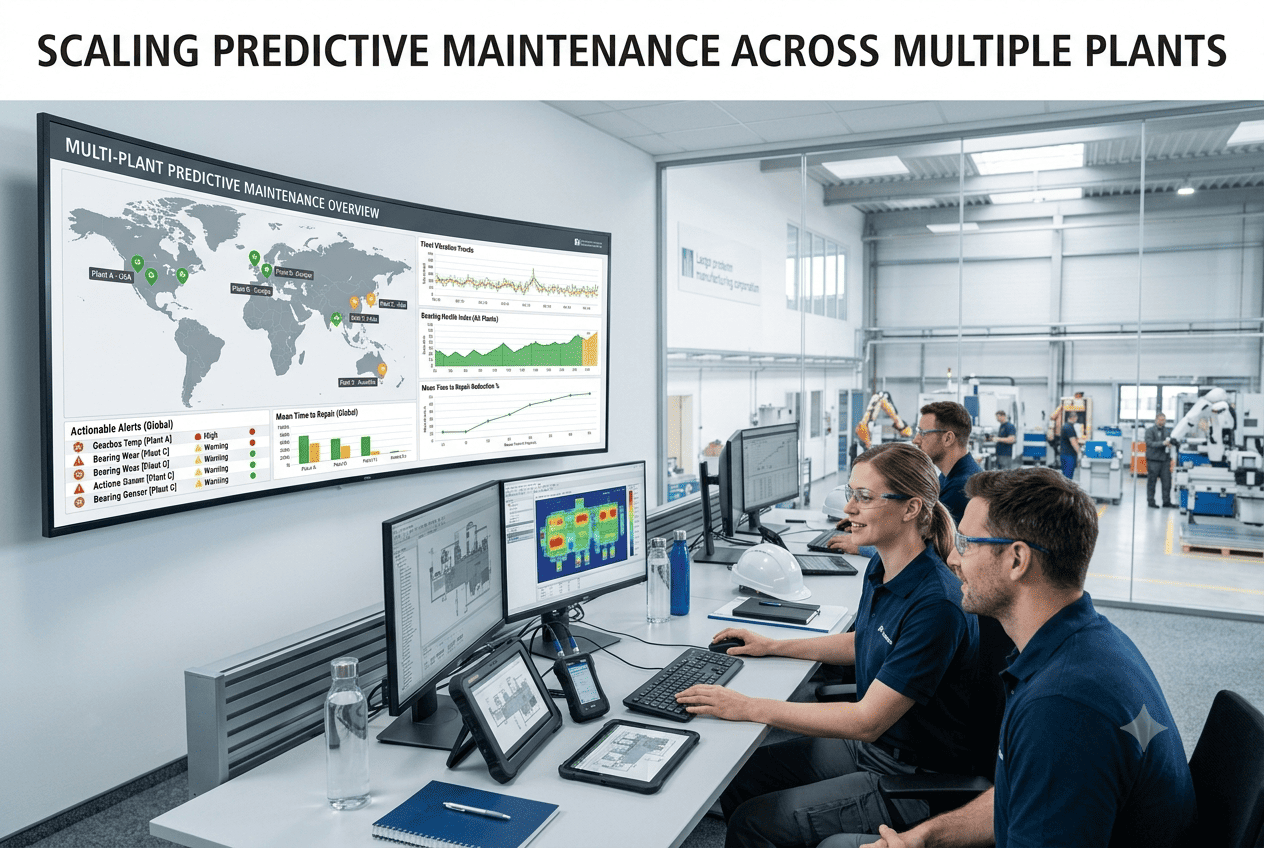
OEE, MTBF, MTTR, and 40+ additional KPIs are calculated identically at every plant. Cross-site benchmarking becomes meaningful when every facility measures performance against the same definitions, enabling corporate operations to identify top performers and underperformers with confidence.
Enterprise Data Lake & AI Training
iFactory AI aggregates data from all 30 plants into a unified enterprise data lake, enabling AI model training across the entire equipment population — 10x more data than any single plant generates — and delivering CEO-level dashboards that show true enterprise performance at a glance.
You do not need to replace your existing systems. You need an enterprise AI layer that unifies them. Book a Demo to see how iFactory AI connects to your existing CMMS, MES, and production systems across all your plants.
Industry Perspective On Enterprise AI Standardization In Multi-Site Manufacturing
"The hardest part of any multi-site digital transformation is not the technology. It is getting 30 plant managers to agree on what OEE means, how to categorize a downtime event, and which KPIs matter most to the enterprise. What this case study demonstrates is that a phased governance-first approach — define the standards, validate at one plant, then deploy in waves — can work at scale. The 22 percent OEE improvement is impressive, but what matters more is that the enterprise now has a single source of truth for asset performance across all 30 plants. That data foundation enables AI models to train on a dataset five to ten times larger than any single plant could generate, and that is where the real compounding value comes from."
Enterprise AI Standardization Across Multi-Site Manufacturing — Frequently Asked Questions
Enterprise AI Standardization Is The Foundation For Manufacturing Competitiveness At Scale
The manufacturer in this case study proved that enterprise-wide AI standardization across 30 plants is achievable within a single fiscal year — provided the deployment follows a governance-first, phased wave approach that respects plant-level operational requirements while enforcing enterprise-level data and KPI standards. The 22 percent OEE improvement and $4.2 million annual maintenance savings are the measurable outcomes, but the lasting value is the data infrastructure that enables continuous improvement at enterprise scale: cross-site benchmarking, enterprise-wide predictive models, and a single source of truth for asset performance across all 30 facilities.
For manufacturing operations leaders managing multi-site networks, the competitive advantage belongs to organizations that can standardize their data, compare plant performance objectively, and deploy AI across their entire equipment population. The technology to do this exists today. The question is whether your organization will be the one setting the enterprise standard — or catching up to it. Book a Demo to start your enterprise AI standardization journey with iFactory AI.
Ready To Standardize AI Across Your Multi-Site Manufacturing Operations?
You have seen the results from a 30-plant enterprise deployment. Now see iFactory AI in action on your own multi-site operations data. We will set up a live walkthrough tailored to your manufacturing network in under 30 minutes.