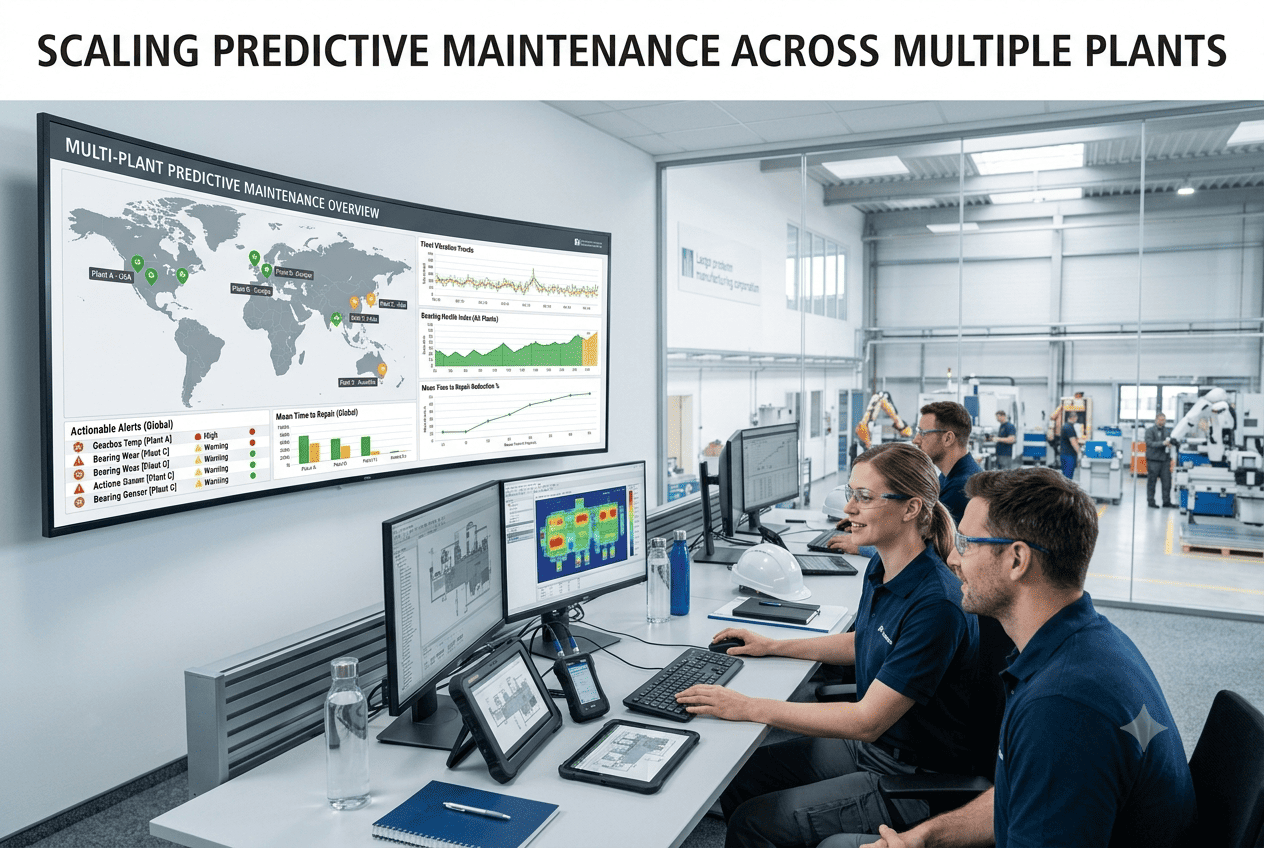
Most manufacturing AI programs do not fail in the lab — they fail in the gap between a working pilot on one line and a governed program running across twenty plants. A model that predicts bearing failure with 97% accuracy on three CNC machines can quietly stall the moment IT, security, and a dozen plant managers with different SCADA versions get involved. The pattern shows up so often that industry researchers now have a name for it: the pilot trap. If your team is staring at a successful proof of concept and wondering why the rollout has not moved in six months, talk to an iFactory enterprise architect about your scaling plan.
iFactory Enterprise Scaling
From Pilot to Enterprise: Scaling Manufacturing AI Across Sites
A successful pilot proves the model works. It says nothing about whether your organization can run it at fifty sites, under four different IT teams, without it quietly breaking by month nine. Here is the architecture that makes scale survivable.
The Pilot Trap, By the Numbers
Enterprise AI scaling has become a well-documented problem, not a rare exception. Recent industry research puts hard numbers on what most operations leaders already sense from experience: the gap between "the pilot worked" and "the program is running across every site" is where most manufacturing AI budgets quietly disappear.
70–89%
Of enterprise AI pilots never reach full production scale
21%
Of organizations report having a mature AI governance model
85%
Of stalled projects trace back to data quality, not the model
18mo
Typical setback in confidence after a failed multi-site rollout
Why the Pilot Works and the Rollout Doesn't
A pilot is built on curated, clean data from a handful of assets that someone on your data science team personally assembled by hand. Site 14 in a different country, on a different historian, with a different naming convention for the same sensor, has none of that curation. The model that scored 97% in the pilot sees inconsistent tag names, missing timestamps, and unlabeled downtime codes — and its accuracy quietly erodes long before anyone notices the dashboard has gone stale. This is a structural problem, not a modeling problem, and it is the single largest reason enterprise AI programs stall between proof of concept and production.
The second reason is organizational, not technical. A pilot usually runs under the sponsorship of one enthusiastic champion — a plant manager, a reliability engineer, a digital transformation lead — who personally chases down data issues, trains operators informally, and keeps the project alive through sheer effort. That model does not survive contact with a second, third, and fourth site, each with its own priorities, its own IT team, and its own skepticism about a tool that worked "somewhere else." Without a formal governance structure and a documented rollout playbook, every new site becomes a fresh negotiation instead of a repeatable deployment.
The Four-Stage Enterprise Scaling Roadmap
1
Validate
Prove the model on one line, with real production data, not a curated sample. Document exactly which data sources, tags, and integrations made the pilot work — this becomes your scaling blueprint.
2
Standardize
Build a common data architecture — tag naming, historian integration pattern, alert taxonomy — that any plant can adopt without a custom engineering project. This is the layer most programs skip, and the one that determines whether site three takes two weeks or six months.
3
Replicate
Roll the standardized pattern out to a second and third site in different regions or business units. Treat this as the real test of your architecture, not the original pilot site — this is where hidden assumptions surface.
4
Govern
Establish a Center of Excellence with a named business owner, an exception process, and a performance review cadence. Programs without this step degrade quietly — accuracy drifts, trust erodes, and the tool gets ignored within a year.
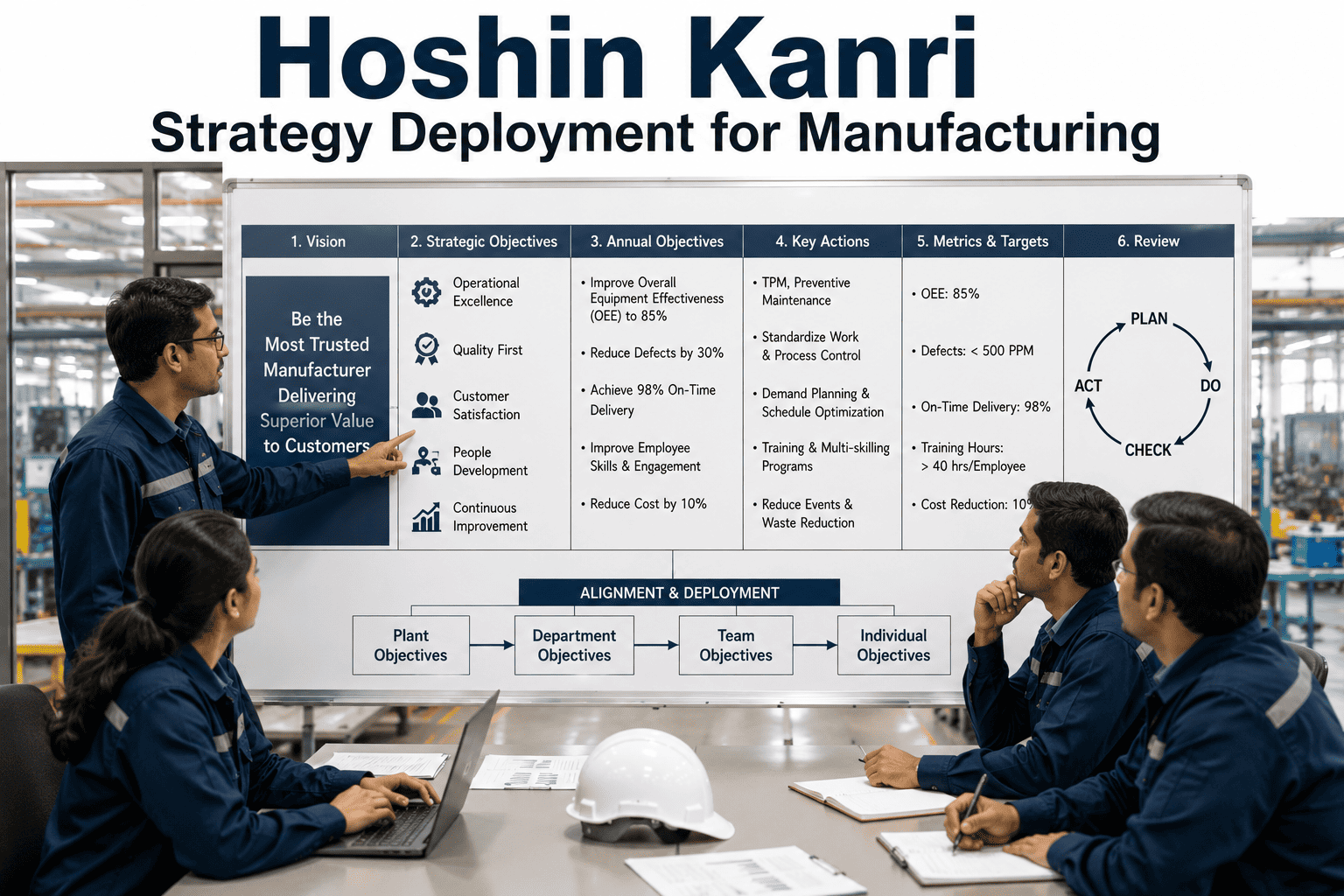
Most organizations move through these four stages in sequence, but the mistake we see most often is skipping straight from Validate to Replicate — copying the pilot to a new site without ever building the standardization layer in between. It looks faster on a project timeline, but it means every site is a custom build, every integration is bespoke, and the tenth site takes just as long as the first. The standardize stage feels slow because it produces no new dashboards or headlines. It is also the stage that determines whether your program compounds or plateaus.
Site Pilot vs. Enterprise Program: What Actually Changes
The table below is a useful gut check for any team currently planning a rollout budget. If your program still looks like the pilot column across most rows, that is not a failure — it simply means the next dollar you spend should go toward the architecture and governance columns before it goes toward a fifth site.
| Dimension |
Single-Site Pilot |
Enterprise Program |
| Data Foundation |
Manually curated, cleaned by hand for the pilot window |
Standardized ingestion layer with automated quality checks per site |
| Ownership |
Informal — often owned by whoever ran the pilot |
Named business owner with defined escalation and review process |
| Integration |
Point-to-point connection to one line or historian |
Repeatable integration pattern across SCADA, MES, and ERP variants |
| Success Metric |
Model accuracy in a controlled test window |
Sustained P&L impact across sites, measured quarterly |
| Change Management |
One enthusiastic team, largely self-directed |
Structured training and adoption plan per site and shift |
See how iFactory's standardized data layer turns a one-site pilot into a repeatable rollout pattern
Five Pillars of an Enterprise-Ready AI Architecture
Unified Data Layer
One ingestion and normalization pattern that any plant can plug into, regardless of which SCADA or historian version it runs. This is the single investment that turns each new site from a custom engineering project into a configuration exercise.
Center of Excellence
A small, dedicated team that owns the scaling playbook, trains local champions, and prevents every site from reinventing the wheel. This team becomes the institutional memory that survives staff turnover and leadership changes.
Governance and Ownership
A named accountable owner per deployed use case, with defined thresholds for when a model is retrained, retired, or escalated. Without this, tools that worked in month one degrade silently as conditions change and no one is watching.
Change Management
Structured training for operators and supervisors — the leading cause of tool abandonment is a workforce that never trusted the output enough to act on it during a busy shift.
Financial Tracking
A dollarized ROI model tracked per site, per quarter — not a one-time business case built for the initial pilot approval and never revisited again.
Enterprise Scaling Readiness Checklist
Before you approve a rollout budget beyond the pilot site, confirm each of these is true. Programs that skip more than one of these items are the ones showing up in next year's abandonment statistics. This checklist is not about the model's technical performance — by the time you are asking these questions, the model has almost certainly already proven it works. It is about whether the organization around the model is ready to carry it past a single site.
01
The pilot ran on unfiltered production data for at least eight weeks, not a curated sample
02
A documented data standard exists that a second site can adopt without custom engineering
03
A named business owner is accountable for the tool's performance after go-live
04
Operators and supervisors were trained on why the model flags what it flags, not just how to click through it
05
ROI is measured quarterly per site, with a defined threshold for pausing or retraining underperforming models
Frequently Asked Questions
How long does it realistically take to scale from one site to twenty?
With a standardized data architecture in place, most manufacturers move from pilot to a handful of additional sites within two to three months, and reach broad enterprise coverage within twelve to eighteen months. The timeline is driven almost entirely by how much custom engineering each new site requires — programs that build a repeatable pattern early move far faster than those that treat every rollout as a fresh project. For a realistic timeline based on your current architecture,
book a scaling assessment with our team.
Do we need to standardize our SCADA systems before we can scale AI?
No. A well-designed data layer normalizes tag names, formats, and timestamps at the ingestion point, which means sites running different SCADA or historian versions can still feed a common model. Full SCADA standardization is a multi-year capital project most manufacturers cannot wait for — the data layer is what makes scaling possible in the meantime.
What is the single biggest reason enterprise AI rollouts stall?
Data quality and governance, in roughly that order. Pilots succeed on hand-curated data that does not exist at production scale, and even programs that survive that gap often stall because no one is named as the accountable owner once the original pilot team moves on. Both problems are organizational, not technical, which is why they are addressable with the right architecture and process from day one.
How do we get plant managers to actually adopt the tool instead of ignoring it?
Adoption follows trust, and trust follows explainability. Operators and supervisors need to understand why a model flagged a specific asset, not just receive an alert with no context. Programs that invest in structured, role-specific training during rollout see materially higher sustained usage than those that treat training as a one-time onboarding session.
Should we build our own scaling architecture or use a platform?
Most manufacturers underestimate the engineering effort required to build and maintain a standardized data layer across dozens of sites with varying infrastructure. A platform built specifically for multi-site industrial deployment removes years of internal build time and lets your team focus on the use cases themselves rather than the plumbing underneath them.
Stop Re-Piloting. Start Scaling.
Your Next Twenty Sites Deserve a Real Architecture, Not Another Pilot
iFactory's enterprise scaling framework gives manufacturing leaders a standardized data layer, a governance model, and a proven rollout playbook — so the second site takes weeks, not another six-month pilot.