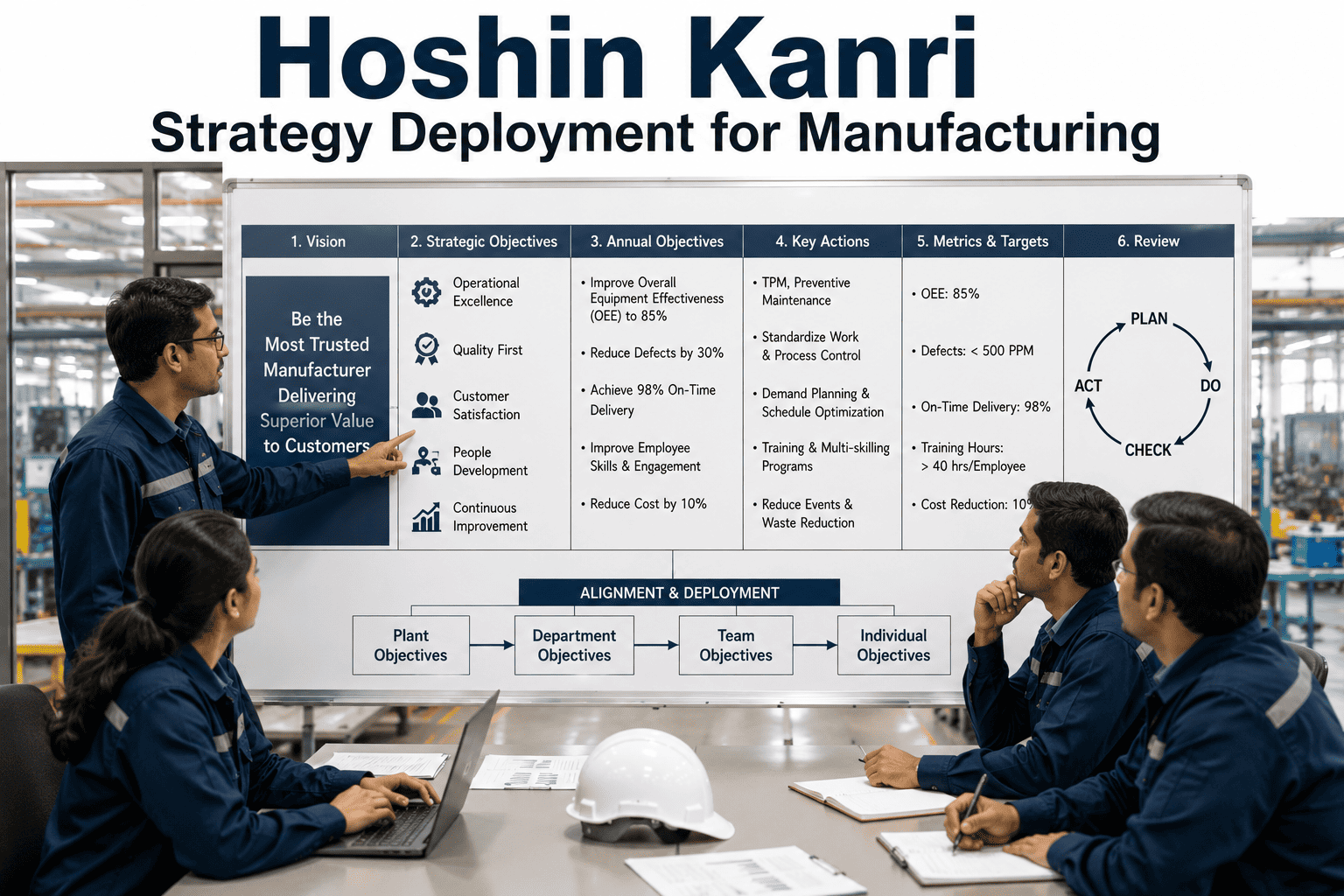
A strategic plan that lives in a slide deck the board approved in January and nobody on the shop floor has seen by June is not a strategy — it is a document. Hoshin Kanri, the Japanese policy deployment method used by Toyota and other world-class manufacturers, exists specifically to close that gap by cascading breakthrough objectives down through every level of the organization using a one-page X-matrix and a negotiated catchball process. This page walks through how the X-matrix connects long-term goals to daily shop-floor work, how catchball keeps that connection honest instead of a top-down mandate, and where most manufacturing deployments break down. Plants ready to build their first X-matrix can start the conversation with the iFactory support team.
Connect the Boardroom Strategy to What Actually Happens on the Night Shift
Hoshin Kanri cascades breakthrough objectives through a one-page X-matrix and a negotiated catchball process, so every improvement project on the floor traces directly back to a strategic priority leadership actually set.
Why MBO and OKRs Alone Don't Reach the Shop Floor
Management by objectives sets goals and checks them once a year. OKRs set goals and check them quarterly. Neither method includes a structured mechanism for negotiating those goals with the people who actually have to deliver them, which is exactly where Hoshin Kanri's catchball process earns its place in a manufacturing environment.
A target arrives from above with no negotiation, so the production manager receiving it has no structured way to flag that it is unrealistic given current constraints, resulting in a plan built on compliance rather than genuine commitment.
The target moves back and forth between levels — proposed, challenged, adjusted, and re-proposed — until both leadership and the team responsible for delivering it agree it is both ambitious and achievable, producing real ownership instead of paper compliance.
The Four Quadrants of the X-Matrix
The X-matrix is Hoshin Kanri's signature visualization tool — a single page that shows how long-term breakthrough goals connect to this year's objectives, which improvement projects deliver those objectives, and which metrics prove it is actually happening.
Breakthrough Goals
The three-to-five-year strategic direction — the handful of outcomes that would fundamentally change the plant's competitive position if achieved, kept deliberately few in number.
Annual Objectives
What must be achieved this year to move toward each breakthrough goal — specific, time-bound targets that translate a multi-year direction into a twelve-month commitment.
Improvement Priorities
The specific projects and initiatives — a changeover-time reduction project, a quality system overhaul, a new maintenance program — that will actually deliver each annual objective.
Metrics & Targets
The specific, numeric measures that prove each improvement priority is on track — the numbers a daily or weekly management review actually looks at.
See an X-Matrix Built Around Your Plant's Own Priorities
Book a walkthrough and iFactory will show how the X-matrix connects to live shop-floor metrics, so the improvement priorities on it are tracked automatically rather than updated by hand once a month.
The Correlation Dots: Where the X-Matrix Earns Its Name
Beyond the four quadrants, the X-matrix places correlation dots at the intersections between them — showing which annual objective supports which breakthrough goal, and which improvement priority drives which annual objective. Those intersections are what expose a disconnected plan before it launches.
| Intersection | What the Dot Confirms | What a Missing Dot Reveals |
|---|---|---|
| Annual Objective ↔ Breakthrough Goal | This year's target genuinely moves the multi-year strategic direction forward | An objective exists that has no real connection to the long-term strategy |
| Improvement Priority ↔ Annual Objective | The chosen project will plausibly deliver the annual target it's assigned to | A pet project is running with no real link to what leadership actually committed to |
| Metric ↔ Improvement Priority | Progress on the project is measured by a number the team actually reviews | A project is running with no defined way to know if it's working |
The Catchball Process, Round by Round
Catchball is what separates Hoshin Kanri from a conventional cascading goal mandate. Objectives are not simply pushed down the org chart — they move back and forth, tested for feasibility and resourcing at every level, until genuine agreement is reached rather than assumed.
A Composite Scenario: The Plant Where the Strategy Finally Reached the Floor
A multi-plant industrial equipment manufacturer had run an annual strategic planning offsite for years, producing a polished slide deck that named "operational excellence" as a top breakthrough goal. Six months later, a survey of shop-floor supervisors found that fewer than one in five could describe what that goal meant for their own department's daily targets.
The company built its first plant-level X-matrix the following planning cycle, translating "operational excellence" into a specific annual objective — a defined reduction in changeover time across the three highest-volume lines — and ran a genuine three-round catchball process with the production managers who would own delivery. The first round exposed that the initially proposed changeover target assumed maintenance support that did not exist on second shift; the second round adjusted the target and added a maintenance staffing commitment from leadership in exchange. By the third round, both sides had a target they actually believed in, tied to two specific improvement priorities and a weekly-reviewed changeover-time metric visible on the floor.
The plant now builds a fresh X-matrix every annual cycle and reviews the metric quadrant weekly at the shift-supervisor level, rather than only at the annual leadership offsite where the original goal had quietly stalled for years.
The company's continuous improvement lead later noted that the hardest part of the rollout was not building the X-matrix itself but resisting the temptation to skip straight to the improvement priorities without genuinely working through the catchball rounds first. The first draft of the matrix, built without input from the production managers, looked complete and well-formatted, but the correlation dots did not survive real scrutiny once those managers were finally asked whether the improvement priorities actually connected to something they controlled. Rebuilding the matrix with their direct input took longer than the original top-down version, but it was the version that actually held once deployed, because the people running the changeover-time project had helped define the target rather than simply inheriting it.
That distinction — between a matrix that looks structured and one that functions — is what separates organizations that treat Hoshin Kanri as a documentation exercise from those that use it as it was designed. A matrix filled in correctly on paper but built without real catchball negotiation will pass a superficial review while quietly failing to change behavior on the floor, which is exactly the failure mode the method exists to prevent.
Where an X-Matrix Fits Alongside Daily Shop-Floor Management
An X-matrix that only appears once a year at a planning offsite provides no early warning when an improvement priority starts to drift. The plants that get the most value from Hoshin Kanri connect the East quadrant's metrics directly into their existing daily and weekly management routines — tier meetings, shift handoffs, gemba walks — so a metric drifting off target surfaces the same week it happens rather than the same quarter.
This is also where the improvement priorities on the X-matrix naturally connect to a plant's broader continuous improvement system. A kaizen event or an A3 problem-solving effort chosen because it happens to be convenient that month is a very different commitment from one chosen because the X-matrix's correlation dots show it directly supports a negotiated annual objective. Connecting the two systems — strategy deployment at the top and daily problem-solving discipline underneath it — is usually what determines whether a plant's improvement activity compounds year over year or simply resets with each new planning cycle.
Mistakes That Turn Hoshin Kanri Into Just Another Slide Deck
Skipping Catchball Entirely
Building the X-matrix in a leadership room and announcing it to the floor turns Hoshin Kanri into exactly the top-down mandate it was designed to replace.
Setting Too Many Breakthrough Goals
A list of ten strategic priorities dilutes focus so badly that none of them get the resourcing or attention needed to actually move. Three to five is the usual practical ceiling.
Leaving Correlation Dots Unverified
Filling in every quadrant without genuinely checking whether each improvement priority connects to an annual objective produces a matrix that looks complete but functions no better than an ordinary plan.
Building the Matrix Once a Year and Filing It
An X-matrix that is only reviewed at the annual planning offsite provides no early warning when a metric drifts off track mid-year.
Letting Lower-Level Matrices Drift
In a multi-level cascade, department matrices can start reflecting locally convenient priorities rather than genuine support for the level above, quietly breaking the alignment the whole system depends on.
Treating Metrics as a Reporting Exercise
A metric that is updated for the record but never discussed in a real management review fails to drive the countermeasure conversation the East quadrant is meant to trigger.
Is Your Organization Ready to Deploy Hoshin Kanri
Leadership can name three to five genuine breakthrough goals
If the list of strategic priorities runs past five, the deployment needs a prioritization conversation before the X-matrix is built, not after.
Department leaders are willing to push back on a proposed target
Catchball only works if the culture genuinely permits a manager to say a target is unrealistic without professional consequence for raising it.
Metrics can be reviewed on a cadence shorter than annual
A weekly or monthly review rhythm is what keeps the East quadrant's metrics functioning as an early warning system instead of a year-end report card.
There is appetite to cascade the matrix below the plant level
The full benefit of Hoshin Kanri shows up when department and team-level matrices connect back to the plant matrix, not when only one top-level matrix exists in isolation.
Frequently Asked Questions
What is the difference between Hoshin Kanri and a standard strategic plan?
A standard strategic plan is typically produced once a year in a leadership offsite and distributed as a document or slide deck, with no structured mechanism for negotiating targets with the people responsible for delivering them or reviewing progress on a defined cadence. Hoshin Kanri, by contrast, is a complete deployment system built around the X-matrix and the catchball process, explicitly designed to cascade the strategy through every level of the organization and connect it to daily and weekly management reviews on the shop floor. The result is strategic execution rather than strategic planning — the discipline that ensures a boardroom decision actually changes what happens on a production line, not just what appears in a quarterly report. Manufacturers wanting to see how this connects to live shop-floor data can talk to iFactory support about their own deployment.
How long does a full Hoshin Kanri catchball cycle typically take?
Most organizations run two to four rounds of catchball negotiation between each pair of organizational levels, with each round taking anywhere from a few days to a couple of weeks depending on how much resourcing or feasibility disagreement surfaces. Across a multi-level manufacturing organization — executive team, plant leadership, department, team level — the full cascade from initial breakthrough-goal proposal to fully committed team-level X-matrices can take four to eight weeks in a first-time deployment. Once the system is established and running annually, subsequent cycles tend to move faster because the organization already understands the rhythm and the prior year's matrix provides a strong starting reference point for the negotiation.
Does every department need its own X-matrix, or is one plant-level matrix enough?
A single top-level X-matrix rarely covers a plant's full scope on its own, and larger organizations typically build a top-level matrix for plant leadership, then successive department and team-level matrices below it, each one translating the level above into priorities scoped to its own authority. This cascade is what makes catchball function in practice, since each level negotiates its own matrix content with the level above and below it during deployment. Smaller, single-line operations can sometimes function with just one or two matrix levels, but any organization with multiple departments or shifts generally benefits from cascading rather than relying on one document to represent every function's priorities.
What happens when a metric on the X-matrix shows an improvement priority is off track?
An off-track metric is meant to trigger a structured countermeasure conversation at the next scheduled review, not wait until the annual planning cycle to be addressed. The team responsible for that improvement priority investigates the root cause of the gap, proposes a corrective action, and if the target itself turns out to have been unrealistic given conditions that changed since the original catchball round, that renegotiation happens through the same catchball mechanism rather than a unilateral target change from either side. This is one of the reasons a defined, frequent metric review cadence matters — without it, an off-track priority can drift for months before anyone with the authority to act on it even notices. Booking a demo shows how a live metrics dashboard tied to the X-matrix surfaces this drift automatically.
Can Hoshin Kanri work alongside OKRs or an existing performance management system?
Yes, and many organizations run Hoshin Kanri as the strategic backbone while using OKRs or existing performance systems for more frequent operational goal tracking within the objectives the X-matrix has already set. The key is making sure the two systems stay connected rather than running in parallel with no relationship — an OKR set at the department level should trace back to an improvement priority on the X-matrix, not exist as an independent goal invented separately. Organizations that already have a mature OKR or performance management culture often find the transition to Hoshin Kanri easier, since the underlying discipline of setting measurable, time-bound targets is already familiar; what Hoshin Kanri adds is the structured, bidirectional catchball negotiation and the explicit visual linkage back to multi-year breakthrough goals.
Give Your Strategy a Direct Line to the Shop Floor
iFactory's platform connects X-matrix improvement priorities to live production metrics, so the East quadrant updates automatically and leadership sees drift the same week it happens. Book a walkthrough to see it built around your own breakthrough goals.