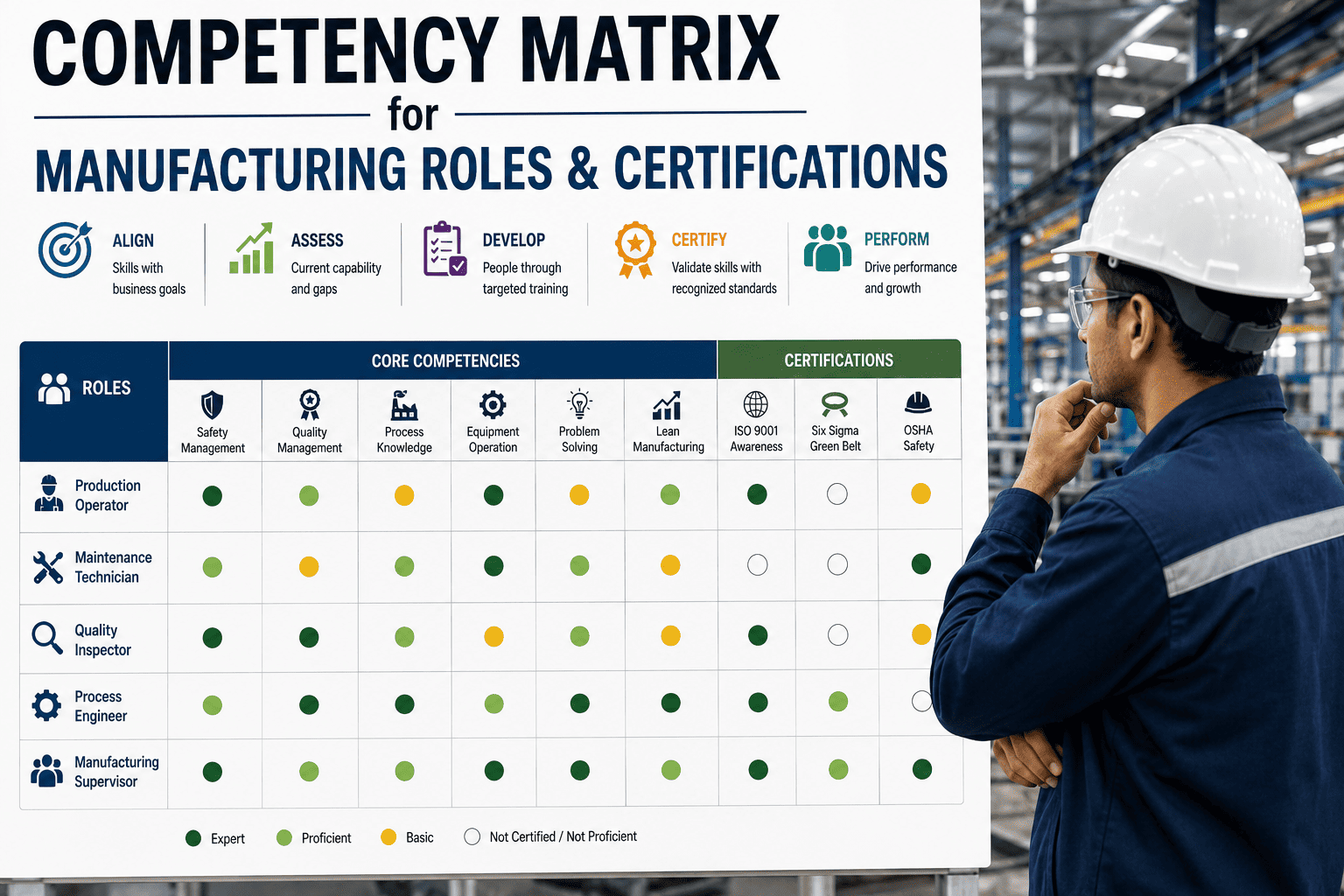
Ask a shift supervisor what happens if the one person certified to run the autoclave calls in sick, and you will usually get an uncomfortable pause before an answer. Most plants know their equipment inside and out but have a much fuzzier picture of who can actually operate it, who is certified, and whose certification quietly expired last month. A competency matrix fixes that by mapping every required skill against every role in a single visual grid, turning "I think Dave knows how to run that" into a documented, auditable fact. See how ifactory support helps plants build one that actually gets used.
Map Every Skill Against Every Role, Certification Included
A competency matrix that tracks required skills, current proficiency, and certification expiry in one place, so a training gap or a lapsed qualification shows up before it becomes a compliance finding or a stalled line.
The Question Every Plant Struggles to Answer Fast
"Who can do this job if the usual person is out" sounds like it should have an easy answer, but in most plants it lives in a supervisor's memory rather than a document. That works fine until the supervisor is also out, or retires, or the plant grows past the point where one person can track every certification and skill by memory. A competency matrix exists to move that knowledge out of individual heads and into a structured record that any manager can check in seconds, which matters most exactly when the usual expert is unavailable.
This problem tends to compound quietly rather than announce itself. Every retirement, transfer, or new hire changes who actually holds a given skill, but without a matrix to update, that shift in coverage goes unrecorded until the exact moment it matters, usually during an absence or a sudden ramp in demand. Plants that rely on memory alone often discover a coverage gap the hard way, when a line goes down because the only person who knew how to troubleshoot a specific fault happened to be on vacation that week.
The Proficiency Scale That Makes the Grid Meaningful
A color-coded grid is only as useful as the scale behind it, and vague labels like "good" or "needs work" fall apart the moment two different supervisors rate the same person differently. A clear scale with observable criteria at every level keeps ratings consistent no matter who is filling in the matrix. This is exactly where a numeric scale paired with plain-language behavioral anchors earns its keep, since it forces every rater to point to an observable action rather than a general impression before assigning a level.
Find Out Which Skills Have Only One Certified Person
Share your current roles and certifications and we will show you where a single absence could actually stop a line.
The Four Building Blocks of a Working Matrix
A competency matrix that actually gets used in daily decisions is built from four pieces working together, not just a spreadsheet with names down one side and skills across the top. Skip any one of the four and the matrix turns into a document people fill out once and never open again.
These four pieces work in sequence rather than in isolation. Role requirements define what good looks like, the proficiency scale gives every rater a shared vocabulary for describing where someone stands against that standard, certification tracking anchors the regulated pieces of that standard to a hard deadline, and the training plan closes whatever distance remains between the two. Leave one link out and the chain breaks in a predictable way: requirements without a consistent scale produce ratings nobody trusts, and a scale without certification tracking misses the regulatory deadlines that carry real legal exposure.
Why Certification Tracking Belongs in the Same System
Certification tracking often lives in a separate binder or a compliance officer's personal spreadsheet, disconnected from the skills matrix that operations actually uses to schedule shifts. That separation is exactly how expired certifications go unnoticed until an auditor or, worse, an incident brings them to light. Keeping certification status inside the same matrix as skill proficiency means an expiring qualification shows up right next to the role it affects, and a scheduler can see at a glance that the only certified forklift operator on a shift has a renewal due in two weeks.
The value compounds once certification data and skill ratings sit in the same record, because the two are rarely independent of each other. A certification tells you someone passed a course on a specific date, while the proficiency rating tells you whether they have kept that skill sharp since. An operator whose certification is technically still valid but whose proficiency rating has drifted down after months away from the task represents a real risk that a certification-only tracking system would completely miss, since the paperwork looks fine even though the actual capability has quietly eroded.
| Certification Type | Typical Renewal Cycle | Risk If It Lapses Unnoticed |
|---|---|---|
| Forklift or powered equipment operation | 1-3 years | Operator continues running equipment without valid authorization |
| Confined space or working at height | 1-2 years | Safety-critical task performed by someone no longer certified |
| Quality or process auditor certification | 1-3 years | Audit findings signed off by someone without current standing |
| Equipment-specific operator qualification | Varies by manufacturer | Warranty or insurance exposure if an uncertified operator causes damage |
Not sure which certifications on your floor are closest to lapsing? Send us your current tracking sheet and we will help you spot the risk before an audit does.
Turning Gaps Into a Training Plan That Actually Runs
A matrix full of red cells is only useful if it leads to a training plan someone actually executes. The plants that get real value from this exercise rank gaps by operational risk rather than by how many people are missing a skill, prioritizing the roles where a single point of failure could stop a line over the ones where the gap is inconvenient but not urgent.
Ranking by risk rather than volume changes which training gets funded first, and often surprises leadership when the exercise is done properly. A skill missing across a large share of the workforce might look urgent on paper, but if every shift still has at least two competent people covering it, the operational exposure is actually low. A skill held by only one person, even if it affects a small number of shifts, carries far more risk because a single absence, illness, or resignation can stop the line entirely. Sorting the matrix by coverage depth rather than raw gap count is usually the fastest way to find where training budget will actually reduce risk instead of just filling in more green cells for their own sake.
Turn Your Skill Gaps Into a Ranked Training Schedule
We will help you identify single points of failure first, then sequence training against the gaps that carry the most operational risk.
Mistakes That Turn a Matrix Into Shelfware
The most common mistake is building the matrix once during an audit scramble and never updating it again, which means it is accurate for exactly one week a year and misleading the rest of the time. A second mistake is letting the skill list grow without limit, trying to capture every minor task an operator might perform, which produces a matrix so large that nobody wants to maintain it and ratings drift out of date within a month. A third mistake is applying the proficiency scale inconsistently across shifts or supervisors, so a rating of competent from one manager means something different than the same rating from another, quietly eroding trust in the whole system. Keeping the skill list focused on what actually matters for safety and output, updating ratings on a fixed schedule, and training raters to apply the scale the same way are what keep a matrix alive instead of becoming a document nobody opens.
A fourth mistake is treating the matrix purely as a compliance artifact instead of an operational tool schedulers actually use. When the matrix only comes out for an audit, nobody notices a coverage gap until it becomes a crisis, but when shift leads check it every time they build a schedule, single points of failure surface naturally as part of daily work rather than requiring a special review. That shift, from an annual compliance exercise to a routine scheduling input, is usually what separates a matrix that gets maintained from one that quietly goes stale.
A fifth mistake, easy to overlook, is building the matrix without ever asking the operators being rated for their own input. Self-assessment is not a substitute for a supervisor's rating, but comparing the two often surfaces a mismatch worth investigating, whether that means an operator underselling a skill they have quietly mastered or overestimating one they have not practiced recently. Involving the workforce in the process, rather than treating the matrix as something done to them, also tends to improve how honestly gaps get reported in the first place.
Frequently Asked Questions
Build a Competency Matrix That Tracks Skills and Certifications Together
Bring your current roles, skills, and certification records to the call. We will show you where the gaps and single points of failure actually are.