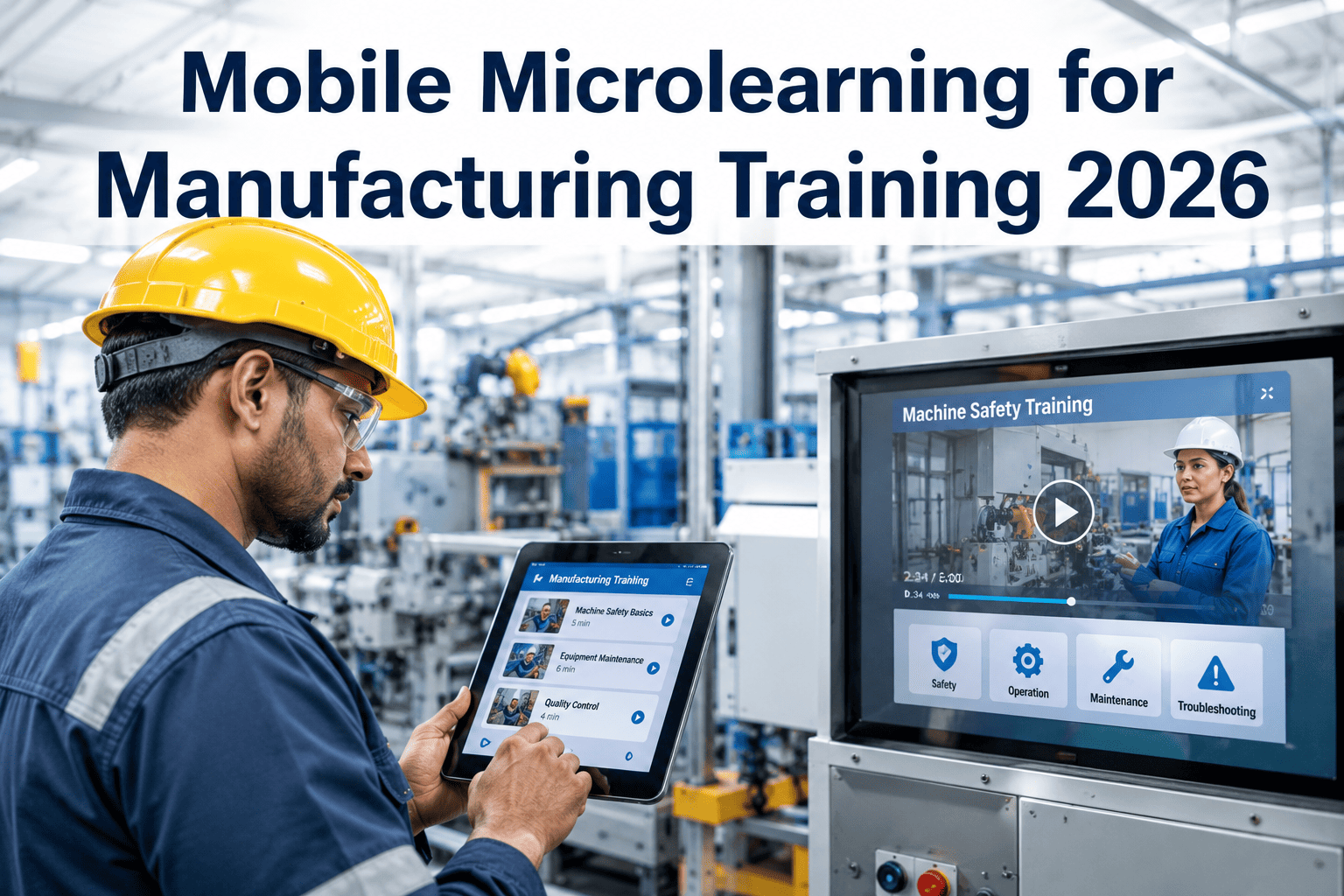
A new hire on a production floor forgets most of what a classroom session covered before their first shift is even over. That is not a discipline problem — it is how memory works. Without reinforcement, people forget roughly half of new information within an hour and up to ninety percent within a week, which means the two-hour onboarding session a facility spends real money delivering is largely gone before the trainee ever touches the equipment it was supposed to prepare them for. iFactory's mobile microlearning platform replaces that single long session with short, targeted lessons delivered right at the point of work, when the knowledge is actually needed.
Workforce & Adoption · Training Delivery
Stop Losing Training the Moment the Classroom Session Ends
Bite-sized video lessons, quiz-based checks, and just-in-time skill refreshers delivered straight to a worker's phone — built for the pace and pressure of a real production floor, not a conference room.
The Research Behind the Format
Why Short Lessons Beat Long Ones, by the Numbers
Microlearning is not a trend built on intuition — it is built on decades of memory research plus a growing body of workplace data showing the same pattern repeat: shorter, more frequent training consistently outperforms long-form sessions on completion, retention, and cost. The figures below summarize where that evidence currently stands, drawn from a mix of learning-science research and current corporate training benchmarks.
80%
Average completion rate for microlearning modules, versus roughly 20% for long-form courses
25–60%
Range of retention improvement reported across microlearning studies compared to traditional training
75%
Mobile learners' daily engagement rate with microlearning content on their devices
40–60%
Cost reduction microlearning delivers compared to traditional classroom-style training
18%
Better exam performance reported for microlearning groups versus traditional training groups
70%
Higher completion rates for microlearning sessions specifically on mobile devices
The Problem Microlearning Actually Solves
What Happens to Training Inside a Worker's Memory
The forgetting curve is not a manufacturing-specific idea, but its consequences are especially expensive on a production floor, where a forgotten step can mean a safety incident, a quality escape, or a damaged machine. This is the timeline knowledge actually follows without reinforcement — and it explains why a single long training session, however well delivered, cannot be the whole strategy.
Forgotten within 1 hour, no reinforcement
Forgotten within 24 hours, no reinforcement
Forgotten within 1 week, no reinforcement
Recall improvement with spaced microlearning vs. massed study
Training Where the Work Actually Happens
Put the Lesson on the Phone, Not in a Room Down the Hall
iFactory delivers short video lessons and quiz-based checks directly to workers' mobile devices, timed to the moment a skill is actually needed — a new machine, a process change, a refresher before a shift starts.
Why This Matters More in Manufacturing Than Almost Anywhere Else
The Industry Facing the Steepest Training Math
Manufacturing carries a combination of pressures that makes training efficiency a genuine operational issue, not a nice-to-have. Annual turnover in production roles commonly runs 30 to 38%, meaning a meaningful share of the workforce is being retrained every single year. Replacing one production worker costs an estimated $20,000 to $40,000 once recruiting, onboarding, and lost productivity are counted, and much of that cost is tied directly to how long it takes a new hire to reach full competency.
At the same time, the skills required on the floor keep shifting as automation and digital tools spread through production. The people delivering training are stretched across compliance updates, new equipment rollouts, and safety refreshers, usually without a proportional increase in training staff or classroom time. A format that delivers a lesson in minutes rather than hours, and that a worker can complete between tasks rather than during a scheduled session, directly addresses the capacity constraint most training teams are actually working against — without asking them to do more with the same hours in a day.
How It Fits Into a Shift
From Onboarding Day One to a Refresher Six Months Later
Mobile microlearning is not a one-time onboarding tool. It follows a worker through their tenure, adapting to what they need at each stage rather than delivering the same fixed curriculum regardless of experience.
01
Day-One Onboarding
New hires complete role-specific foundational lessons at their own pace, in short sessions rather than a single overwhelming orientation day.
02
Pre-Shift Micro-Refreshers
A short lesson before a shift starts reinforces a procedure that has been flagged as high-risk or recently changed, without pulling anyone off the floor.
03
In-the-Moment Lookup
Facing an unfamiliar machine setting or a process step they have not done in months, a worker pulls up the exact lesson they need on their phone, right at the station.
04
Supervisor Visibility
Completion and quiz performance data roll up to supervisors, surfacing knowledge gaps by worker, team, or procedure before they turn into an incident.
What This Looks Like in Practice
Four Everyday Training Moments, Solved Differently
The clearest way to understand the difference mobile microlearning makes is to look at ordinary training situations that come up on almost every production floor, and compare how each plays out under a traditional classroom model versus a mobile microlearning model.
A new operator joins the line
Traditional: a full-day orientation session covering everything at once. Microlearning: role-specific lessons completed over the first week, each one reinforced with a quiz before moving to the next.
A machine setting changes
Traditional: wait for the next scheduled training session, or rely on a verbal handoff between shifts. Microlearning: a short video update is pushed to every affected worker's phone the same day.
An annual safety refresher is due
Traditional: a single long session most workers forget within weeks. Microlearning: the same content broken into short reinforcement lessons spaced across the year, matching how memory actually retains information.
A worker returns from an extended leave
Traditional: a supervisor manually re-walks them through procedures, pulling time from the floor. Microlearning: the worker completes a targeted refresher on their own device before their first shift back.
Where This Delivers the Fastest Return
Training Situations Where Bite-Sized Delivery Wins
Mobile microlearning is not the right format for every kind of training, but it is a strong fit for the situations manufacturing facilities encounter constantly.
High-turnover production roles
Where a large share of the workforce needs onboarding every year, faster time-to-competency directly reduces the cost of each departure.
Frequent process or equipment changes
A new machine setting or updated SOP can be pushed as a short lesson the same week it changes, instead of waiting for the next scheduled training block.
Multi-shift and multi-site operations
Mobile delivery reaches every shift and every location consistently, without requiring a trainer to physically repeat the same session multiple times.
Safety and compliance refreshers
Short, frequent reinforcement keeps critical procedures current in memory, rather than relying on an annual session that fades within weeks.
Common Questions
Frequently Asked Questions
Does mobile microlearning actually replace hands-on training, or does it work alongside it?
It works alongside hands-on training, not in place of it. Physical skills still need physical practice under supervision, especially for anything safety-critical. Where microlearning adds the most value is in preparing a worker before that hands-on session and reinforcing what they learned afterward, so the supervised practice time is spent building skill rather than repeating information the worker could have absorbed on their own beforehand. Facilities that pair the two approaches typically see the supervised session become shorter and more focused, since the worker already arrives with the baseline knowledge in place.
How do we know workers are actually watching the lessons and not just clicking through them?
Quiz-based checks immediately after each lesson are the primary safeguard — a worker who skips through content without absorbing it will visibly struggle on the check, and that result surfaces to the supervisor rather than disappearing into a completion log. Completion tracking paired with quiz performance gives a far more honest picture of actual learning than completion tracking alone, which only confirms a video played, not that anything was understood.
What does it take to build the initial library of lessons for our specific procedures?
Most facilities start by identifying the highest-risk or highest-frequency procedures — the tasks new hires get wrong most often, or the safety steps with the most serious consequences if skipped — and building short videos filmed directly on the actual equipment used on the floor. This produces a focused, high-value initial library faster than trying to convert an entire existing training curriculum at once.
Support can walk through a content-prioritization approach for a specific facility's procedure list.
Will this work for workers who are not comfortable with technology or mobile apps?
The format is intentionally simple by design — short videos and multiple-choice quizzes require far less digital fluency than a full learning management system built for desktop use. Most rollouts find that the format itself is not the barrier; the barrier is usually a lack of familiarity with any structured training tool, which a short in-person walkthrough during onboarding typically resolves within a single shift.
How long does it take to see a measurable difference in training outcomes after switching to this format?
Completion rate improvements are usually visible almost immediately, since the shorter format removes the main reason workers abandon long-form training. Retention and error-rate improvements take longer to confirm, typically measured at 30- and 90-day intervals against pre-rollout baselines.
Book a demo to walk through how a rollout would be measured against a specific facility's current training metrics.
Training Should Fit the Shift, Not Interrupt It
Give Every Worker the Right Lesson, at the Right Moment
iFactory's mobile microlearning platform delivers short video lessons and quiz-based checks directly to the floor, replacing forgettable long-form sessions with training that actually sticks.