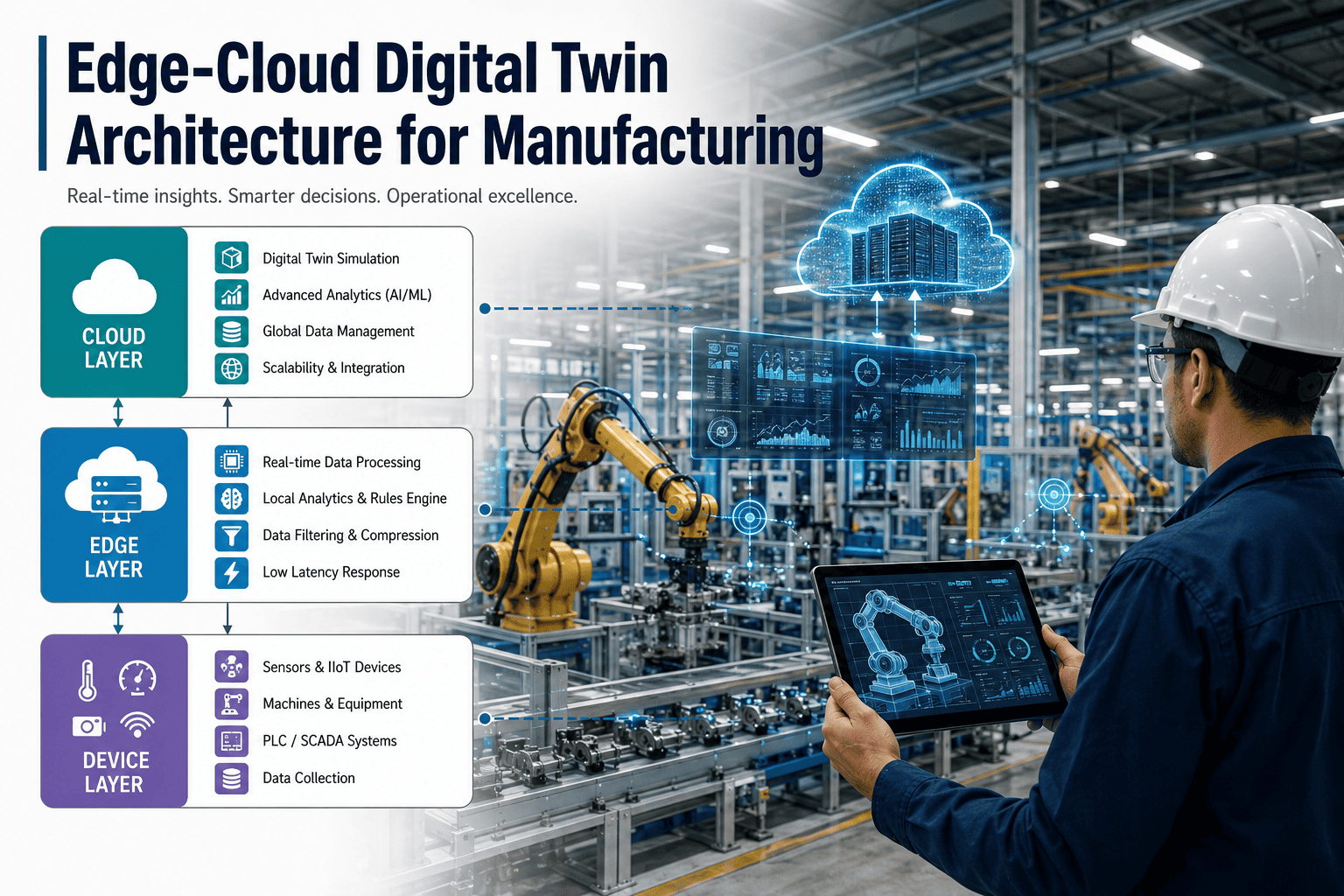
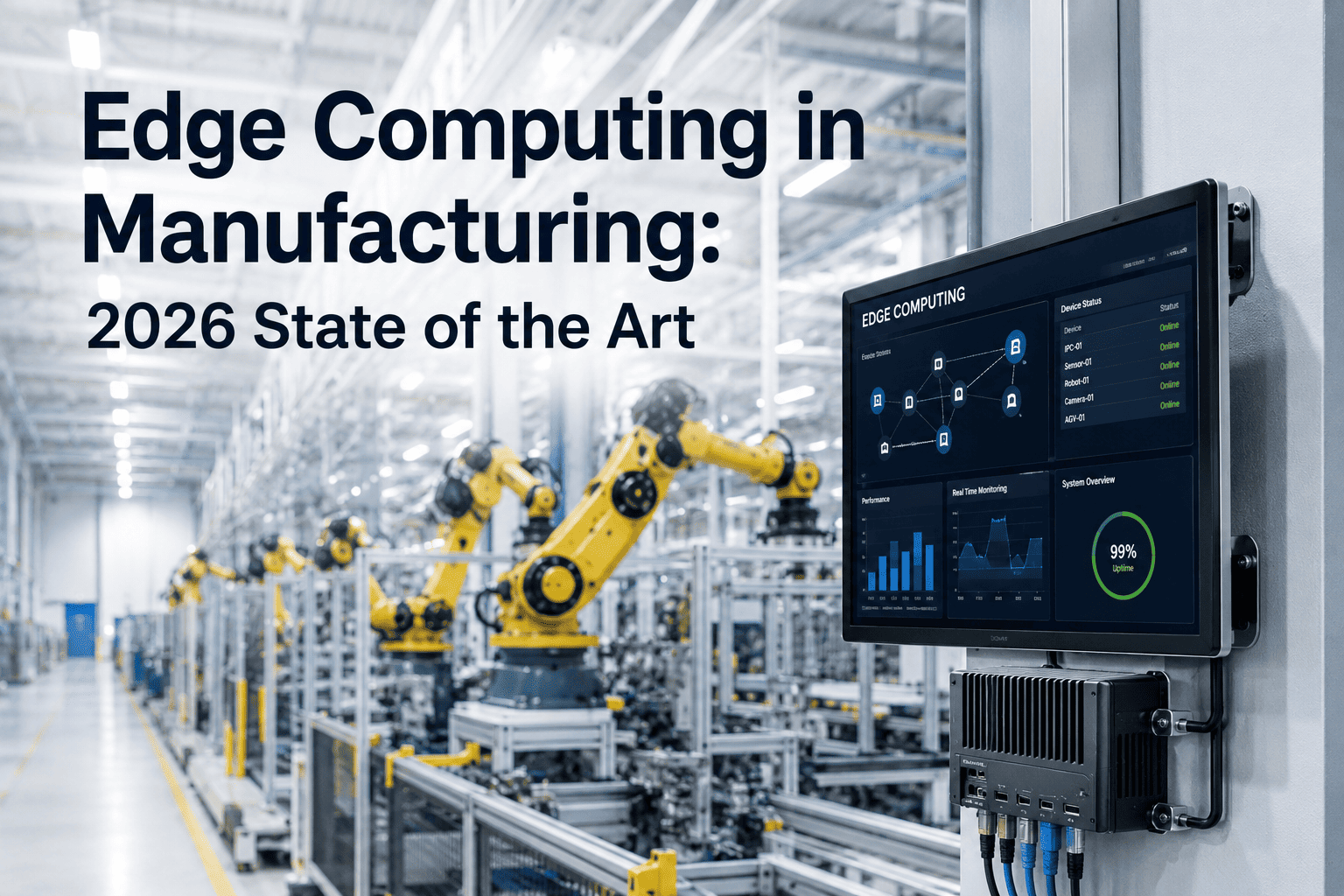
A digital twin that depends entirely on a cloud connection is only as reliable as the network link between the plant floor and the data center, and on a production line where deviations happen in milliseconds, that link is rarely fast enough to matter. Round-trip latency to a cloud region can run anywhere from tens to hundreds of milliseconds, which is perfectly fine for a dashboard refresh but far too slow for a twin that needs to catch a deviation before the next machine cycle completes. The answer most manufacturing teams land on isn't choosing edge or cloud, it's architecting for both: local inference at the edge for anything time-sensitive, and cloud-based training, fleet comparison, and long-term history for everything else. iFactory's platform is built on exactly this edge-cloud model, and you can book a demo to see how the split is configured for your production environment.
DIGITAL TWIN · EDGE-CLOUD ARCHITECTURE · LOCAL INFERENCE · FLEET MANAGEMENT
Your Twin Needs to Think in Milliseconds and Learn Over Months
No single location can do both well. Edge-cloud architecture splits the work: fast, local inference where timing is critical, and cloud-scale training, storage, and fleet comparison where scale and history matter most.
EDGE LAYER
Local Inference
Sub-50ms Response Time
Operates During Network Loss
CLOUD LAYER
Model Training and Retraining
Fleet-Wide Comparison
Long-Term History and Storage
THE SINGLE-LOCATION PROBLEM
Why a Twin Running Entirely in One Place Breaks Down
Every digital twin architecture decision ultimately comes down to a tradeoff between response speed and analytical depth, and putting everything in one location forces you to sacrifice one for the other. The figures below reflect the gap between what production timing actually demands and what a cloud-only or edge-only architecture can realistically deliver.
150-300ms
Typical Round-Trip Latency to a Cloud Region Over a Plant Network
<10ms
Inference Time Achievable When the Model Runs at the Edge
40%
Of Plants Report Network Interruptions That Disrupt Cloud-Only Monitoring
3-5x
More Bandwidth Consumed Streaming Raw Sensor Data Than Edge-Filtered Data
THE ARCHITECTURE SPLIT
What Belongs at the Edge, and What Belongs in the Cloud
The core design decision in any edge-cloud twin is deciding which workloads need to run close to the machine and which can tolerate the delay of a cloud round trip. Getting this split right is what determines whether the twin is genuinely useful on the floor or just another dashboard.
Runs at the Edge
Real-Time Anomaly Detection
Deviation from normal operating patterns is flagged locally, in time to intervene before the next cycle, without waiting on a network round trip.
Sensor Data Filtering and Aggregation
Raw signal data is cleaned, compressed, and reduced to meaningful features locally, so only relevant data is sent upstream instead of a constant raw stream.
Offline Continuity
Inference and local alerting keep running through a network outage, since the edge model does not depend on an active cloud connection to function.
Runs in the Cloud
Model Training and Retraining
Training on large historical datasets requires compute capacity that isn't practical to keep on the floor, so model updates are trained centrally and pushed back down.
Cross-Line and Cross-Site Comparison
Comparing performance across machines, lines, or plants requires a consolidated view that only a central data store can provide.
Long-Term Historical Storage
Years of operating history, needed for trend analysis and lifecycle decisions, is retained centrally rather than on space-constrained edge hardware.
THE FULL STACK
Five Layers of an Edge-Cloud Digital Twin Architecture
An edge-cloud twin is built as a stack of layers, each responsible for a distinct part of the journey from a raw sensor signal on the floor to a fleet-wide insight in a dashboard. Understanding what each layer does makes it much easier to evaluate whether a proposed architecture will actually hold up in production.
05
Cloud Training and Fleet Dashboard
Historical data from every connected edge node feeds model retraining and a fleet-wide view where performance can be compared across lines, plants, and equipment types.
04
Secure Cloud Sync Layer
Filtered data, model performance metrics, and alert history are synced upstream on a schedule that respects available bandwidth, with local buffering during outages.
03
Edge Inference Engine
A trained model runs locally against live sensor data, producing predictions and anomaly flags within milliseconds, independent of cloud connectivity.
02
Edge Gateway and Local Compute
A ruggedized local compute device aggregates data from multiple machines, handles protocol translation, and hosts the inference engine close to the equipment it serves.
01
Field Devices and Sensors
PLCs, sensors, and existing controllers generate the raw signal data the entire twin is built on, typically communicating over OPC-UA, Modbus, or MQTT.
Design an Architecture That Fits Your Actual Network, Not a Generic Template
iFactory's platform helps plant and IT teams design the right edge-cloud split for their specific line speed, network reliability, and data volume. Book a demo to see the architecture mapped to your production environment.
HEAD TO HEAD
All-Cloud vs Edge-Cloud Hybrid Twin Architecture
The comparison below covers the dimensions that most directly determine whether a twin architecture holds up under real plant floor conditions, including unreliable networks and machine cycles measured in milliseconds.
NETWORK RESILIENCE
What Happens to Your Twin When the Network Goes Down
Plant networks are rarely as stable as an office network, between scheduled maintenance windows, Wi-Fi interference from equipment, and the occasional switch failure. An edge-cloud architecture is specifically designed to keep functioning through these interruptions rather than losing visibility the moment connectivity drops.
Inference Never Pauses
Because the trained model lives on the edge device, anomaly detection and local alerting continue uninterrupted even when the connection to the cloud is completely down.
Data Buffers Locally
Sensor readings and alert events are queued on the edge device during an outage and synced upstream automatically once connectivity returns, with no data gap in the historical record.
Bandwidth Recovers Gracefully
When connectivity returns after an extended outage, the sync layer prioritizes the most recent and most critical data first, rather than flooding a recovering network link all at once.
Model Updates Apply Safely
A newly retrained model is validated in the cloud before being pushed to edge devices, and the previous version stays available as a fallback if the new one behaves unexpectedly.
MEASURED OUTCOMES
Results From Edge-Cloud Digital Twin Deployments
These figures reflect manufacturing sites where a twin was redesigned from a cloud-only architecture to an edge-cloud hybrid model and tracked over a minimum six-month period following deployment.
94%
Faster Anomaly Detection
Compared to Cloud-Only Round-Trip Response Time
70%
Less Bandwidth Consumed
Through Edge-Side Filtering Before Cloud Sync
Zero
Monitoring Gaps
During Recorded Network Outages at Deployed Sites
3.1x
Faster Fleet Rollout
Of Model Updates Across Connected Edge Nodes
FREQUENTLY ASKED QUESTIONS
Questions From IT, OT, and Digital Transformation Leaders
What kind of hardware is needed to run inference at the edge?
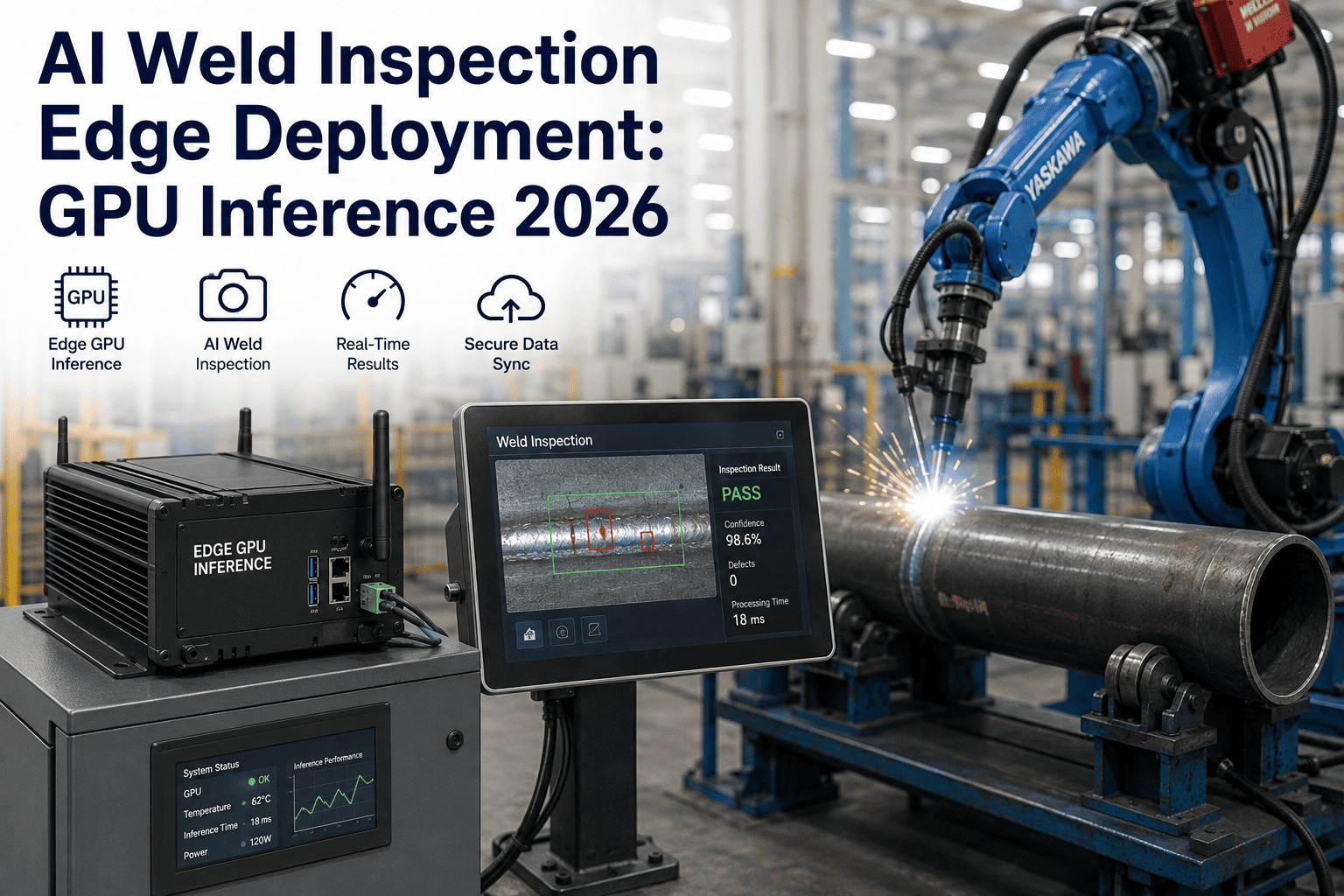
Edge inference typically runs on a ruggedized industrial gateway or compute device sized to the model complexity and number of connected machines, rather than requiring specialized AI hardware in every case. Simpler anomaly detection models can run on modest industrial PCs, while more complex vision or multivariate models may need a device with dedicated inference acceleration.
Book a demo to get a hardware recommendation sized to your specific use case.
How does a model trained in the cloud actually get deployed down to edge devices?
Once a model is retrained and validated centrally, it is packaged and pushed to connected edge devices through a managed deployment pipeline, typically during a maintenance window or a scheduled low-activity period to avoid disrupting production. The previous model version remains available on the device as a fallback, so a problematic update can be rolled back without losing local inference capability.
Can this architecture connect to older PLCs and machines that were never designed for IIoT?
Yes, edge gateways are commonly used to bridge legacy protocols like Modbus or proprietary PLC interfaces into a standardized format the rest of the architecture can consume, without requiring a full controls upgrade on the machine itself. This is often the most practical entry point for plants with a mix of newer and decades-old equipment.
Contact our support team to discuss integration options for your existing controls.
How much of our plant's network bandwidth does an edge-cloud twin actually consume?
Because raw sensor data is filtered and aggregated at the edge before anything is sent upstream, bandwidth consumption is typically a fraction of what a cloud-only architecture streaming raw data would require, often reducing overall data transfer significantly. The exact figure depends on sensor sampling rates and how much of the raw signal is retained versus summarized, which is assessed during the architecture design phase.
Do we need to replace our existing cloud data platform to adopt an edge-cloud architecture?
Not necessarily. iFactory's edge layer is designed to integrate with common cloud data platforms rather than requiring a full replacement, syncing filtered data into whatever central data environment your organization already uses. In many cases the larger change is adding edge compute capability to the floor rather than migrating your existing cloud infrastructure.
Book a demo to see how this fits alongside your current systems.
Build a Twin That Responds in Milliseconds and Learns Over Months
iFactory's edge-cloud architecture gives you real-time local inference and fleet-wide cloud intelligence in a single connected system, without forcing a tradeoff between speed and scale. Book a demo to see it designed for your production environment.