Digital Twin for Manufacturing Equipment: Virtual Replica

By Johnson on August 1, 2026

digital-twin-manufacturing-equipment-virtual-replica

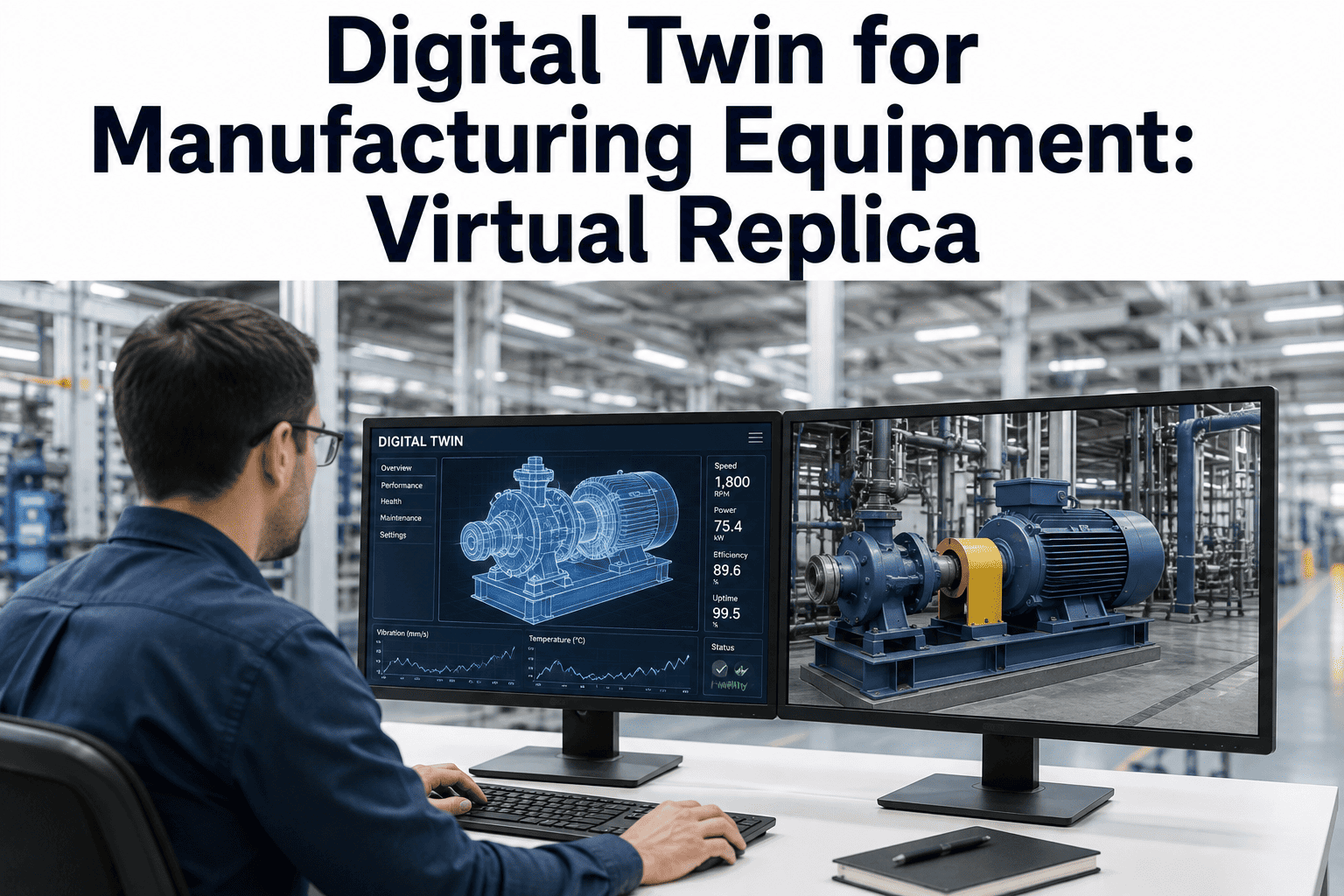
Every major equipment failure on a production floor is preceded by warning signs that existed somewhere in the sensor data long before the machine actually stopped, but traditional monitoring rarely connects those individual signals into a meaningful prediction until it is too late to act. A digital twin closes that gap by building a live, continuously updated virtual replica of the physical asset, one that runs simulations against real operating data instead of just displaying a dashboard of numbers a technician has to interpret under time pressure. The difference between watching raw sensor values and having a model that actually understands what those values mean together is the difference between reacting to a failure and preventing one. Our digital twin implementation team can walk through which of your critical assets are the strongest candidates for a virtual replica.

Digital Twin for Equipment

A Virtual Replica That Predicts Failure Before the Machine Stops

Real-time sensor fusion, physics-based simulation, and what-if scenario testing that turn scattered equipment data into an early, specific warning instead of a surprise breakdown.

Prediction Layer
Simulation Layer
Live Sensor Layer
Physical Asset

Why Traditional Monitoring Misses What a Digital Twin Catches

Conventional condition monitoring watches individual variables — a temperature reading, a vibration threshold, a pressure limit — and flags an alert when one crosses a fixed line. This approach works reasonably well for single-cause failures, but most real equipment failures develop through a combination of factors interacting over time, and a threshold-based system has no way to see that interaction until several variables have already drifted far enough to trip their individual alarms, often close to the point of actual failure.

A digital twin instead models the equipment's physics and historical behavior together, so it can recognize a developing failure pattern from the combined trajectory of multiple signals well before any single one crosses a simple threshold. This is why digital twin-based prediction consistently outperforms conventional monitoring on complex, multi-component failure modes, where the early warning signs are subtle in isolation but unmistakable once the model understands how the variables relate to each other.

90-95%
predictive accuracy for complex, multi-component failure modes
60-70%
typical accuracy from conventional single-variable monitoring
85-90%
of catastrophic failures preventable with mature twin deployment
up to 30%
reduction in unplanned downtime reported in production deployments

It is worth being direct about what these accuracy figures actually represent, since a percentage on its own can be misleading without context. The 90 to 95 percent range typically refers to correctly predicting that a failure will occur within a defined future window, not predicting the exact minute a machine will stop, and the model's accuracy on any specific asset depends heavily on how much historical operating and failure data was available to train it. Facilities evaluating a digital twin vendor should ask specifically how accuracy was measured and over what asset population, since a figure drawn from a well-instrumented, data-rich asset class will not automatically transfer to a different equipment type with sparser historical records.

The Three Layers Every Working Digital Twin Needs

A digital twin is not a single piece of software, it is three connected layers working together, and a deployment that only builds one or two of them tends to disappoint, since the value comes specifically from the connection between live data, physics-based simulation, and predictive output.

Layer 1
Sensor Fusion
Continuous data streams from vibration, temperature, pressure, and load sensors feeding a unified real-time view of the asset's current operating state.
Layer 2
Physics-Based Simulation
An engineering model of the equipment's mechanics and thermodynamics that projects how current conditions will evolve, enabling what-if scenario testing without risking the physical asset.
Layer 3
Predictive Output
Machine learning models trained on historical failure data that translate the simulation's trajectory into a specific remaining-useful-life estimate and maintenance recommendation.
Curious which layer your current monitoring setup is missing? Book a demo and we will assess your existing sensor and modeling coverage.

Many manufacturers already have a partial implementation without realizing it, since sensor fusion in some form has existed on critical equipment for years in the form of SCADA and historian systems collecting continuous data streams. What is usually missing is the connective tissue between that raw data and a genuine physics-based simulation layer, which requires modeling the actual mechanical and thermal behavior of the specific asset rather than simply charting historical trends. Building this middle layer is typically the most technically demanding part of a digital twin project, since it requires engineering expertise specific to the equipment type, but it is also the layer that unlocks the what-if scenario testing and predictive accuracy that distinguishes a true digital twin from an enhanced dashboard.

One-Way Versus Two-Way Digital Twins: A Critical Distinction

Not every system marketed as a digital twin actually closes the loop back to the physical asset, and this distinction meaningfully affects how much operational value the deployment delivers.

One-Way Digital Twin
Data flows from the physical asset into the model, and the model reflects real-time equipment state, but its output does not automatically feed back into physical operations. Useful for visibility and reporting, but requires a human to act on every insight manually.
Two-Way Digital Twin
The physical asset informs the model, and the model's predictions and simulation results drive real-world maintenance work orders or operational adjustments automatically, closing the loop between prediction and action.

Most organizations are better served starting with a one-way deployment and earning their way to a two-way loop rather than attempting full automation from day one. A one-way twin lets the maintenance and engineering teams validate the model's predictions against real outcomes over several cycles, building the confidence needed before allowing the system to automatically generate work orders without a human review step. Moving to full two-way automation before that trust has been established tends to create friction, since a single false-positive work order that pulls a technician off a real priority to chase a phantom issue can undermine confidence in the entire system for months afterward, even if the underlying model is otherwise accurate.

From Prediction to Work Order: How the Loop Actually Closes

The operational value of a two-way digital twin comes from the specific mechanism connecting a predicted failure trajectory to an actual maintenance action, rather than leaving that translation to manual judgment.

1
Baseline Established
The twin learns the asset's normal operating envelope across load, temperature, and vibration conditions from historical data before any prediction work begins.
2
Deviation Detected
Live sensor data is continuously compared against the baseline, and the simulation layer flags when the combined trajectory of several variables starts diverging from normal.
3
Remaining Useful Life Calculated
The predictive model translates the deviation into a specific estimate of how much operating time remains before the degradation reaches a failure threshold.
4
Work Order Triggered
A maintenance work order is generated automatically in the CMMS, pre-populated with the specific component, the predicted failure mode, and the recommended intervention window.
5
Outcome Fed Back
The actual maintenance finding is logged back into the model, refining its prediction accuracy for the next cycle rather than treating each prediction as a one-off event.

The feedback step at the end of this cycle is what separates a genuinely learning system from a static model that was calibrated once and left unchanged. Every time an actual maintenance finding is logged back against a prediction, the model has an opportunity to refine its understanding of how a specific failure mode actually develops on that particular piece of equipment, which over time produces a more accurate, more asset-specific prediction than a generic model trained only on industry-wide failure data. Skipping this feedback step, whether due to a disconnected work order system or simply a maintenance team that does not log detailed findings, quietly caps the model's accuracy at whatever level it achieved during initial calibration.

Six Use Cases Generating the Strongest ROI Today

Use Case What the Twin Does
Predictive maintenance Continuous degradation simulation triggers work orders before failure
What-if scenario testing Evaluates alternate operating parameters without risking the physical asset
Plant-level scheduling Models production schedules against maintenance windows and capacity limits
Design validation Tests equipment modifications virtually before physical implementation
Fleet-wide benchmarking Compares twin models across similar assets to isolate outlier performance
Root cause investigation Replays historical sensor data through the model to isolate failure origin
Want to see which of these use cases fits your highest-value assets first? Talk to our team about a prioritized rollout plan.

What a Mature Digital Twin Deployment Actually Delivers

The market growth behind this technology reflects demonstrated operational results rather than speculative interest, with the global digital twin market expanding rapidly as manufacturers move from pilot programs into full production deployment across critical asset fleets. That shift matters for buyers evaluating the technology today, since a mature, widely deployed capability carries far less implementation risk than an emerging one, and the accumulated body of production deployment data across industries gives new adopters a much clearer picture of realistic timelines and expected returns than would have been available even a few years earlier.

Fewer
Catastrophic Failures
Early, multi-variable pattern recognition prevents the majority of failures that conventional monitoring would only catch after the fact.
Lower
Total Maintenance Cost
Shifting from scheduled and reactive maintenance to condition-based intervention reduces both unnecessary service and emergency repair cost.
Faster
Root Cause Investigation
Replaying historical data through the twin lets engineers isolate a failure's true origin far faster than manual log review.

Frequently Asked Questions

Which equipment should we prioritize for a digital twin, given limited budget?
Prioritize assets that combine high failure cost, complex or multi-variable operating conditions, and sufficient existing sensor data availability, since these three factors together determine both the potential value and the feasibility of an early deployment. Equipment with a history of unplanned downtime that has been hard to explain through simple threshold monitoring is often the strongest candidate, since that is precisely the kind of complex, multi-factor failure pattern a digital twin is best suited to catch. Simpler equipment with a single well-understood failure mode may not justify the modeling investment, since conventional threshold-based monitoring often performs adequately there already. Reach out to our team to score your asset list against these prioritization criteria.
How much historical data do we need before a digital twin can make reliable predictions?
The exact amount depends on the equipment type and how frequently failures naturally occur, but as a general rule, the model needs enough historical operating data to have observed the equipment across a full range of normal conditions and, ideally, at least a handful of past failure or near-failure events to calibrate against. Assets with very infrequent failures can still be modeled effectively by leaning more heavily on the physics-based simulation layer, which does not require historical failure examples in the same way the machine learning prediction layer does. In practice, most deployments start generating useful directional insight within the first few months of live sensor data collection, with prediction accuracy continuing to improve as more operating history accumulates. Book a demo to discuss data requirements for your specific equipment types.
Do we need to replace our existing CMMS to implement a digital twin?
No, in most cases the digital twin integrates with the existing CMMS rather than replacing it, since the CMMS remains the system of record for maintenance work orders, technician assignments, and parts inventory. The twin's role is to feed predictive insight into that existing workflow, typically by generating a work order automatically once its prediction crosses a defined threshold, pre-populated with the specific component and recommended intervention window. This integration approach tends to be far less disruptive than a full system replacement, and it lets maintenance teams keep using the tools and processes they are already trained on while gaining the predictive capability layered on top. Talk to our team about integrating twin predictions with your current CMMS platform.
What is the realistic timeline from starting a digital twin project to seeing measurable downtime reduction?
Most deployments follow a similar arc: the first few months are spent on sensor integration and baseline model calibration, followed by a validation period where the model's predictions are checked against actual maintenance findings before being trusted to automatically trigger work orders. Measurable downtime reduction typically becomes visible within six to twelve months for assets with reasonably frequent operating cycles, though equipment with rare failure events naturally takes longer to demonstrate statistically meaningful improvement simply because there are fewer failure occurrences to measure against. Setting this expectation clearly at the outset avoids the common mistake of judging the program a failure after only a few weeks, before the model has had enough operating cycles to prove its accuracy. Book a walkthrough to see a realistic project timeline for your specific asset types.
Can a digital twin be used for equipment we are still designing, not just equipment already in operation?
Yes, and this is one of the more underused applications of the technology. A physics-based simulation model can be built and tested against a proposed design before the physical equipment is ever built, allowing engineers to evaluate how different design choices would perform under expected operating conditions and identify potential failure points early, when changes are far cheaper to make. Once the physical equipment is built and commissioned, the same twin model can transition from a design validation tool into an operational predictive maintenance tool by connecting it to live sensor data, giving the equipment a digital twin from its very first day of operation rather than building one retroactively after years of accumulated wear. Reach out to discuss building a twin model during your next equipment design or procurement cycle.
Stop Reacting to Equipment Failures

Build a Digital Twin That Predicts the Next Failure Before It Happens

Share your current sensor coverage and maintenance history and we will show you which assets are the strongest candidates for a digital twin and what the deployment path would look like.
3
Twin architecture layers
90-95%
Prediction accuracy
30%
Downtime reduction
6
High-ROI use cases

Share This Story, Choose Your Platform!