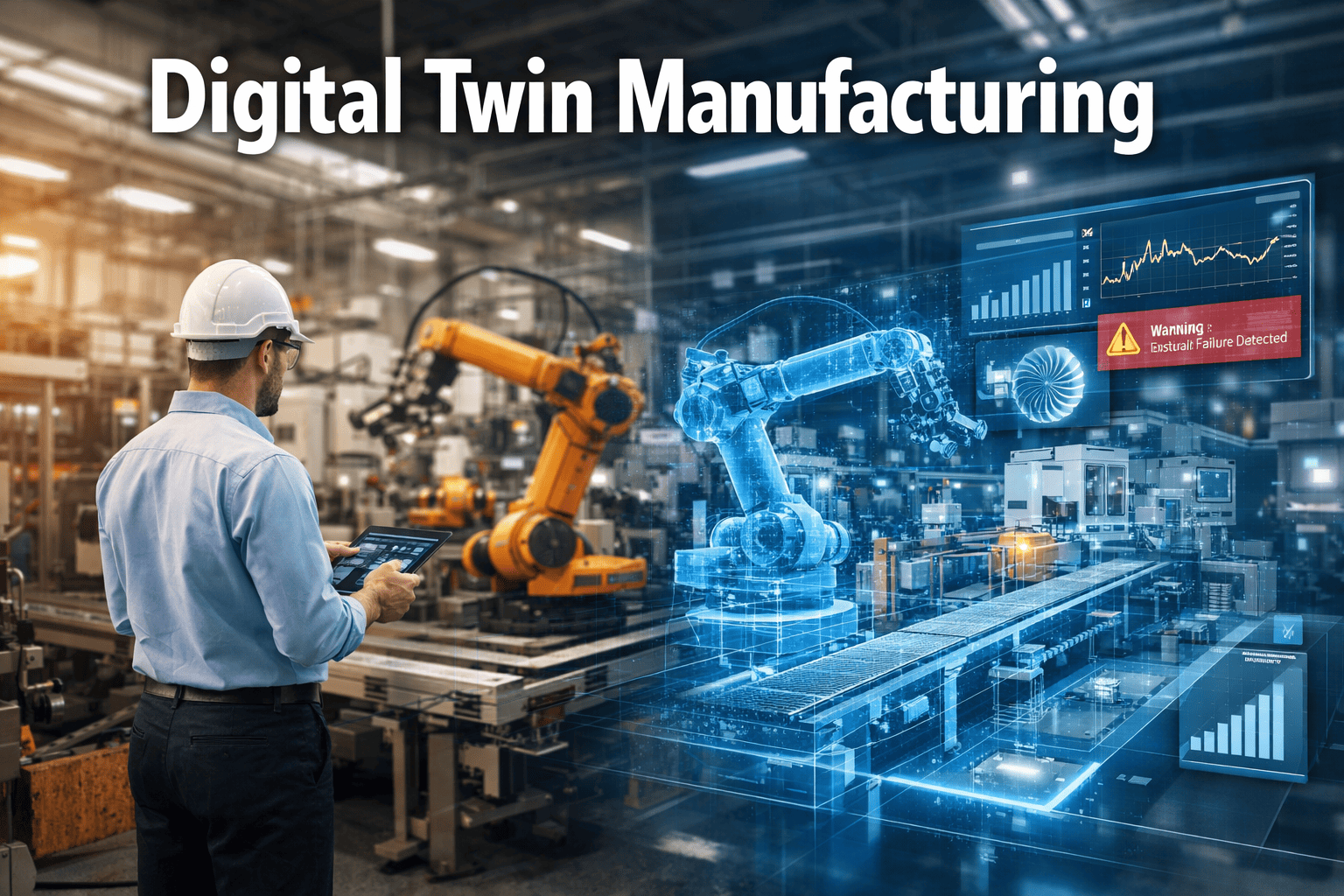
Digital Twin Technology in Manufacturing: Simulate Failures Before They Happen
By Ethan Walker on May 19, 2026
Digital twin technology is quietly becoming the most powerful competitive edge in U.S. manufacturing. While your competitors are still discovering failures after they happen — through unplanned downtime, scrapped batches, or safety incidents — leading plants are simulating those failures weeks in advance and fixing them in a virtual environment before they touch the physical floor. According to recent industry data, manufacturers deploying digital twins have reduced unplanned downtime by up to 36% and cut commissioning time by 40%. The global digital twin market for manufacturing is projected to reach $48.2 billion by 2030. The question is no longer whether to adopt this technology — it is how fast you can implement it before your competition does.
Digital Twin Impact: By the Numbers
36%
Reduction in Unplanned Downtime
40%
Faster Plant Commissioning
$48.2B
Market Size by 2030
25%
Improvement in OEE
3x
Faster Root Cause Analysis
What Is a Digital Twin — And What It Is Not
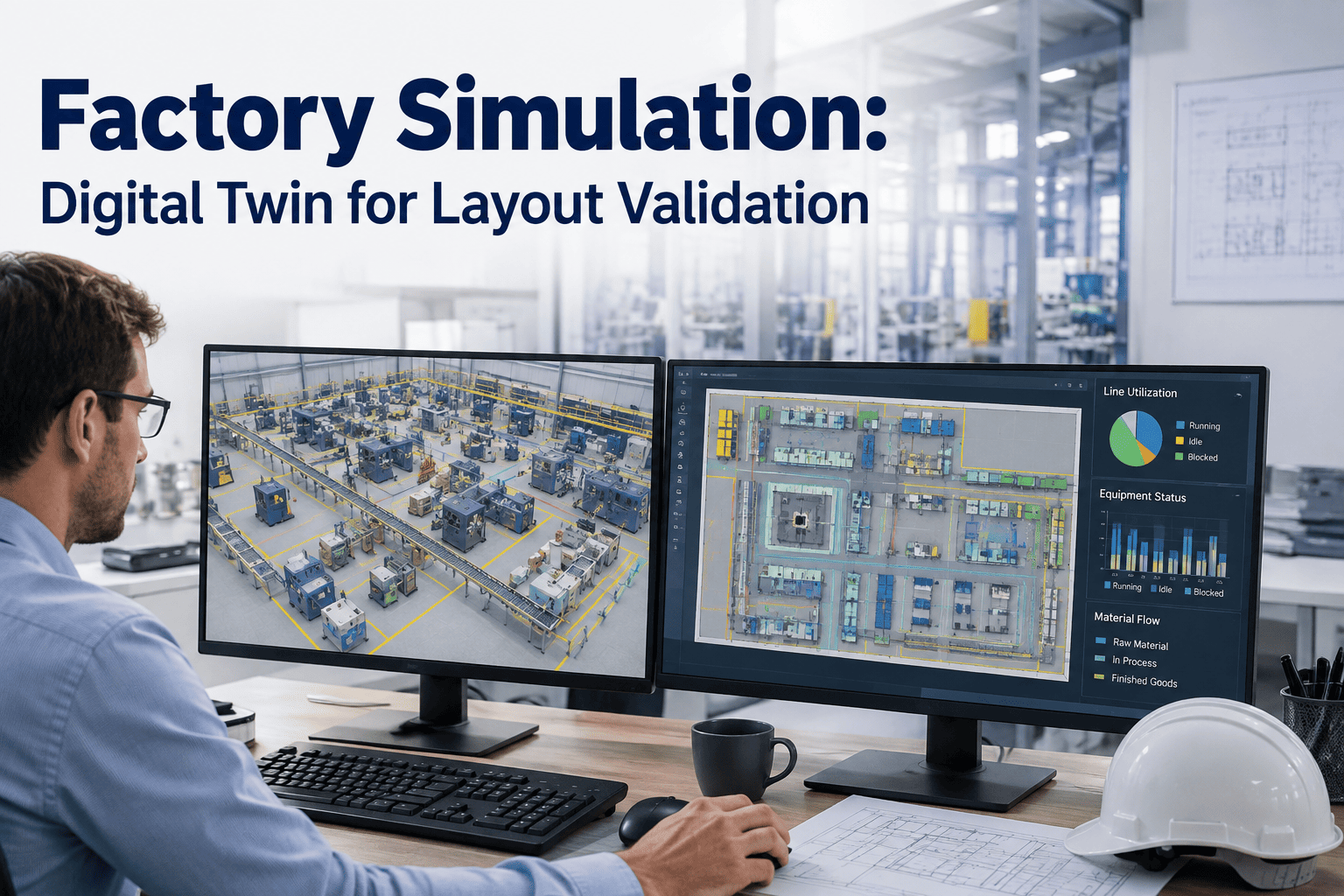
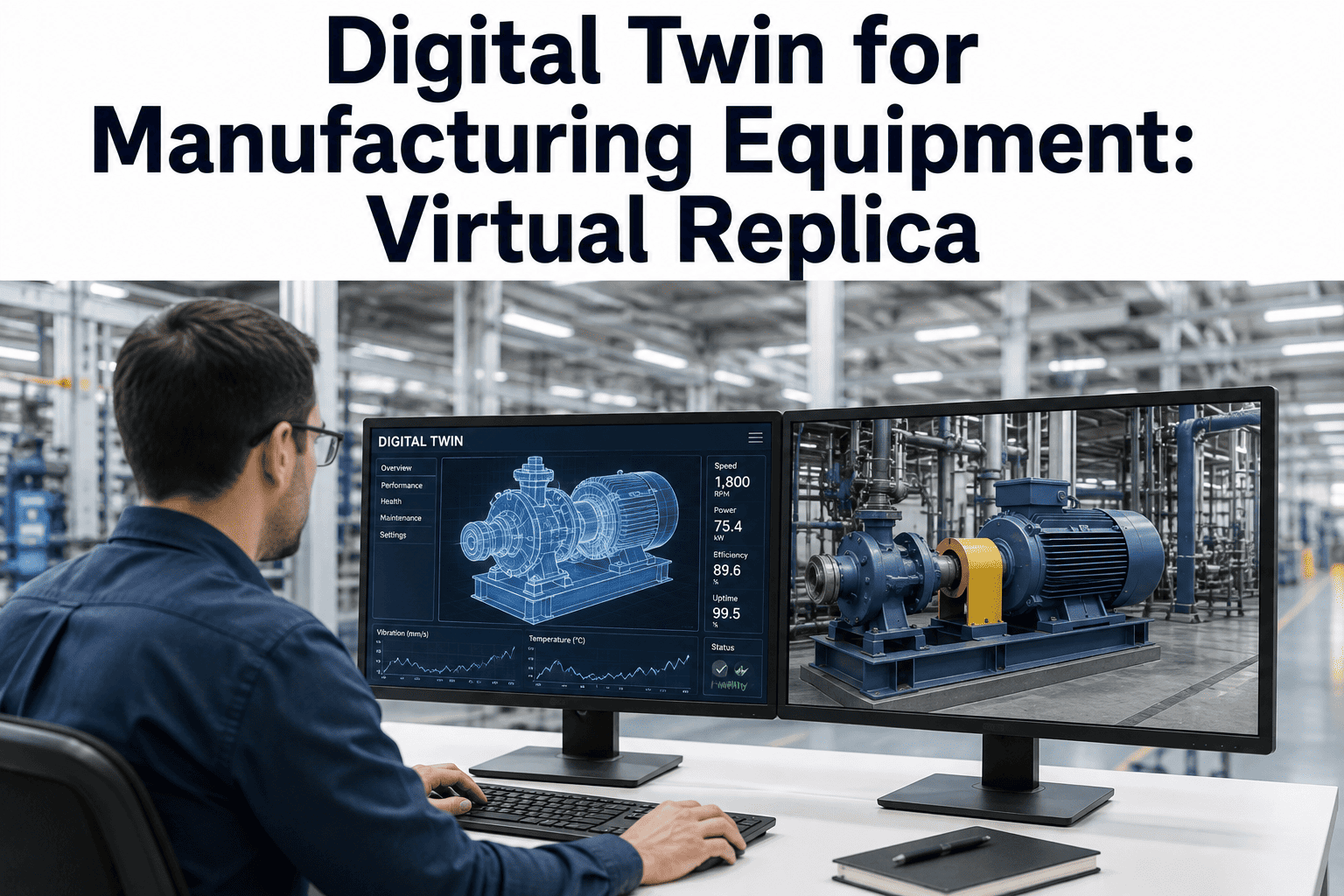
A digital twin is a live, data-synchronized virtual replica of a physical asset, process, or facility. It is not a static 3D model. It is not a CAD file. It is not a dashboard. A true digital twin ingests real-time sensor data, mirrors the actual behavior of its physical counterpart, and enables simulation, prediction, and optimization in a risk-free virtual space.
Capability
Static 3D Model
Digital Twin
Real-time data sync
Failure simulation & scenario testing
Predictive maintenance triggers
Process optimization without downtime
Integration with CMMS & EAM
Historical replay & anomaly detection
The three types most relevant to manufacturing are asset twins (individual equipment units), process twins (entire production lines), and facility twins (whole plant environment). Most mature implementations combine all three in a layered architecture — feeding data from individual machines up through production lines and ultimately into a full-plant model.
Evaluating digital twin platforms for your facility? Book a demo to see how iFactory's Digital Twin AI stacks up — live, with your asset types and use case.
How Digital Twins Simulate Failures Before They Happen
This is the capability that delivers the clearest ROI and the hardest to achieve without the right platform. Failure simulation works by running physics-based models or ML-trained behavior models against current and projected operating conditions — identifying degradation paths before they manifest physically.
Failure Prediction Workflow
01
Sensor Data Ingestion
Vibration, temperature, pressure, current draw, and cycle count data streams continuously into the twin from PLCs, IoT sensors, and SCADA systems.
02
Baseline Behavior Modeling
The twin establishes normal operating ranges using historical run data and OEM specifications. Deviations as small as 2–3% trigger flagging.
03
Degradation Simulation
Physics-based or ML models project current wear trajectories forward — estimating Time to Failure (TTF) under current, best-case, and worst-case operating loads.
04
Scenario Testing
Engineers run "what-if" scenarios — increased throughput, temperature spikes, delayed maintenance — to see downstream effects without touching the physical line.
05
CMMS Work Order Generation
When simulation predicts failure risk exceeds threshold, the system auto-generates a predictive maintenance work order — with the root cause already identified.
Want to see failure simulation in action for your plant? Book a demo and explore how iFactory's Digital Twin integrates directly with your maintenance workflow.
Four High-Value Use Cases for Manufacturing Digital Twins
Not every use case delivers equal value. The following four represent the highest ROI applications based on real-world deployments across discrete and process manufacturing environments.
01
Virtual Commissioning
Greenfield & Expansion
Before a single machine runs in a new facility, the entire production line is simulated — validating PLC logic, robot programming, conveyor speeds, and safety interlocks. Toyota and BMW have both cited 30–50% reductions in commissioning time using this approach. Errors caught in simulation cost nothing to fix; errors caught on the physical floor can cost weeks of delay.
Time savings:Up to 50% faster commissioning
02
Predictive Maintenance Optimization
Asset Management
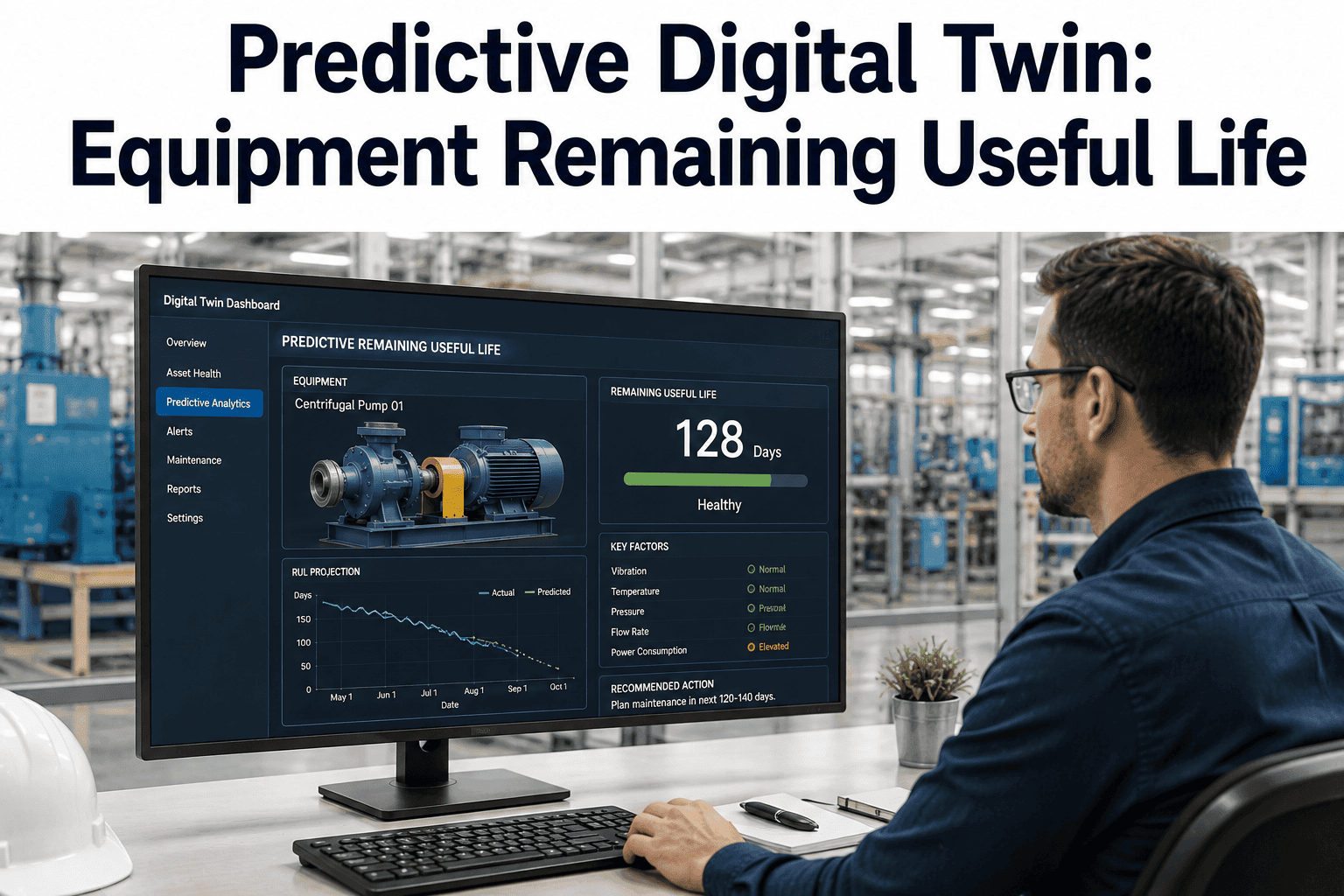
Rather than replacing components on a fixed schedule — which wastes good parts — digital twins calculate remaining useful life dynamically. A CNC spindle running at 60% of normal load still has useful life left even if the calendar says replace it. The twin knows this. Integration with your CMMS ensures work orders are generated at the optimal intervention point, not too early and never too late.
Cost reduction:20–35% lower maintenance spend
03
Process Parameter Optimization
Production Efficiency
Line speed, temperature setpoints, material feed rates, and cycle times all have an optimal configuration that changes based on product mix, environmental conditions, and machine age. Digital twins run thousands of parameter combinations in simulation to find the configuration that maximizes throughput and yield — then push recommended setpoints to operators. No trial-and-error on live production.
Throughput gain:8–15% improvement in OEE
04
Energy Consumption Simulation
Sustainability & Cost
Peak demand charges are one of the largest controllable cost items in manufacturing. Digital twins model energy draw across the entire facility — identifying which sequence of equipment startups minimizes peak demand, and which process adjustments cut kWh consumption without affecting output. One automotive supplier reduced energy costs by $2.1M annually after twin-driven scheduling optimization.
Energy reduction:12–22% lower utility costs
Which Use Case Fits Your Plant Right Now?
Whether you are focused on reducing unplanned downtime, cutting commissioning time on a greenfield build, or optimizing energy costs — iFactory's Digital Twin AI is built around your specific use case, not a generic platform demo.
One of the most common mistakes in digital twin projects is trying to twin everything at once. The right approach is phased — starting with your highest-value, highest-risk assets and expanding from there. Here is the implementation roadmap that delivers results without overwhelming your team or budget.
Phase 1 — Months 1–3
Foundation & Asset Inventory
Conduct full OT asset inventory and tag all equipment in CMMS
Deploy IoT sensors on Tier 1 critical assets (top 10–20 by downtime impact)
Establish historian and data pipeline to twin platform
Define KPIs: TTF accuracy, false positive rate, work order lead time
Phase 2 — Months 4–6
Asset Twin Deployment
Build behavior models for Tier 1 assets using 90+ days of sensor history
Configure failure mode libraries and degradation thresholds
Integrate twin alerts with CMMS for automated work order generation
Validate predictions against known failure history — tune model accuracy
Phase 3 — Months 7–12
Process Twin & Simulation
Expand to process twins covering full production lines
Enable scenario simulation for parameter optimization
Train maintenance and engineering teams on simulation tools
Begin energy consumption modeling and optimization runs
Phase 4 — Months 12+
Facility Twin & Continuous Intelligence
Deploy full facility twin integrating asset, process, and environmental data
Integrate with ERP for production scheduling and capacity planning
Expand to supply chain and logistics simulation
Not sure which phase your plant is ready for? Book a demo and our team will map your current asset management maturity to the right starting point — no pressure, no generic pitch.
Integrating Digital Twins with Your CMMS and Analytics Stack
A digital twin running in isolation is a science project. A digital twin fully integrated with your CMMS, MES, and analytics platform is a competitive weapon. The integration architecture determines whether your investment delivers operational value or collects dust.
Digital Twin Platform
Real-time simulation engine
Data Inputs
IoT & PLC Sensors
SCADA / HMI
OEM Asset Data
Historian Database
Actionable Outputs
CMMS Work Orders
MES Schedule Updates
Analytics Dashboards
Operator Alerts
The most critical integration is twin-to-CMMS. When a digital twin detects a degradation pattern that will reach critical threshold in 14 days and it should automatically create a predictive work order in your CMMS — pre-populated with the likely failure mode, required parts, estimated labor hours, and recommended maintenance window. This is what separates digital twin projects that deliver ROI from those that stay in the pilot phase indefinitely.
Already running a CMMS but not sure it supports twin integration? Explore iFactory's CMMS solution — purpose-built for predictive workflows — or book a demo to see the twin-to-work-order pipeline live.
Ready to connect your digital twin to a CMMS that was built for this integration? Book a demo and see iFactory's native Digital Twin AI module paired with full CMMS workflow automation.
Expert Review
"The shift from reactive to predictive maintenance is well understood — but digital twins take it a level further. You are not just predicting failure; you are understanding why it will fail, what the downstream consequences are, and what the optimal intervention looks like. That combination — prediction plus consequence modeling plus CMMS integration — is where the real value lives. Plants that implement this fully typically see full ROI inside 18 months."
— Industry 4.0 Implementation Lead, U.S. Tier 1 Automotive Supplier, 2026
18 mo
Average Full ROI Timeline
73%
Of Fortune 500 Manufacturers Using Twins
$1.3M
Average Annual Savings Per Facility
Conclusion
Digital twin technology has crossed from emerging concept to operational necessity for manufacturers who want to compete on efficiency, reliability, and cost. The ability to simulate failures before they happen — to test process changes in a virtual environment before touching the floor, to generate predictive maintenance work orders weeks ahead of actual failure — represents a fundamental shift in how manufacturing plants are operated and managed. The phased implementation path is clear, the ROI is proven, and the integration capabilities now exist to connect twin intelligence directly into your CMMS and analytics workflows. The question is not whether digital twins will be standard in manufacturing. They already are, at the plants ahead of you. The question is when your facility catches up — and whether you do it proactively, or under competitive pressure.
See iFactory Digital Twin AI in Action
From failure simulation to automated CMMS work orders — iFactory's Digital Twin module connects your virtual and physical plant in one unified platform. Purpose-built for manufacturing, deployed in weeks, not months.
A digital twin is a live, data-synchronized virtual replica of a physical asset, production line, or entire facility. Unlike static 3D models or dashboards, it ingests real-time sensor data, mirrors actual machine behavior, and enables simulation, predictive analysis, and optimization — all without risk to physical operations.
How does a digital twin simulate failures before they happen?
The twin uses physics-based or machine learning models to establish a normal operating baseline for each asset. As sensor data deviates from baseline, the model projects degradation trajectories forward — estimating time to failure under various load conditions. Engineers can also run manual "what-if" scenarios to test the impact of operating changes before applying them to the physical asset.
How long does it take to implement a digital twin?
A phased approach typically delivers the first asset-level twins within 3–6 months, with process twins and full facility models operational by month 12. The key dependencies are sensor infrastructure availability, data historian access, and CMMS integration readiness. Greenfield plants with modern sensor networks and CMMS platforms can move significantly faster.
What is the ROI of digital twin technology in manufacturing?
Industry data puts average full ROI at 18 months for manufacturing digital twin deployments. The primary value drivers are reductions in unplanned downtime (typically 25–36%), lower maintenance costs through condition-based intervention (20–35% savings), and throughput improvements from process optimization (8–15% OEE gain). Energy cost reductions add additional savings of 12–22% in many facilities.
How does a digital twin integrate with a CMMS?
A mature digital twin integration with CMMS enables bidirectional data flow: the twin pulls asset configuration and maintenance history from the CMMS to improve model accuracy, and pushes predictive alerts and auto-generated work orders back into the CMMS when simulation identifies imminent failure risk. The work order arrives pre-populated with failure mode, required parts, estimated labor, and recommended scheduling window.