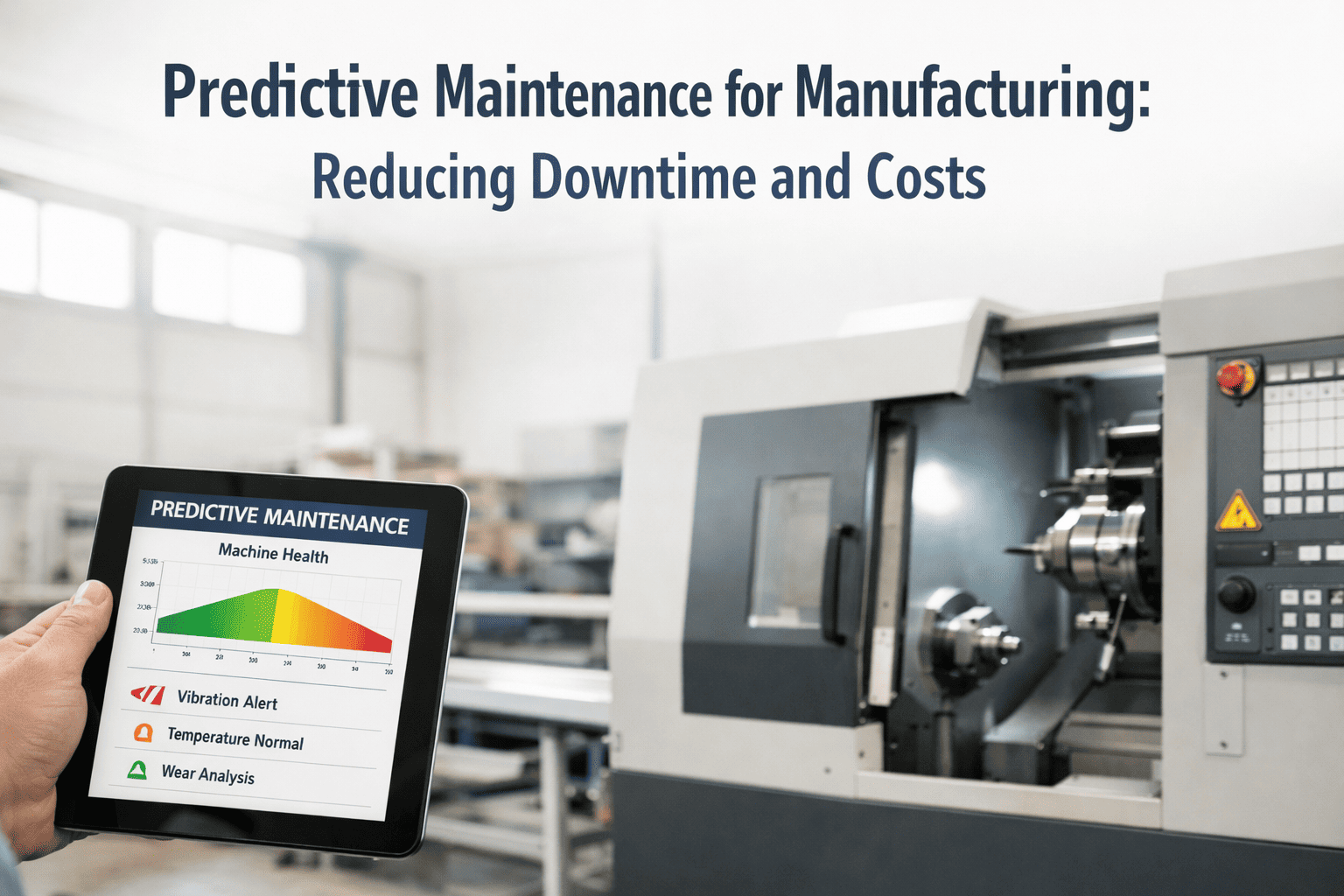
Unplanned downtime is the single most expensive operational failure in manufacturing — costing plants hundreds of thousands of dollars per hour, with automotive and semiconductor facilities reporting even steeper losses during critical production runs. Yet most plants are still managing downtime reactively, dispatching maintenance crews after the line has already stopped, scrambling to diagnose root cause while product misses its shipping window. The manufacturers pulling ahead are replacing that reactive firefighting with data-driven visibility — capturing machine signals continuously, detecting failure patterns before breakdowns occur, and linking every downtime event to a root cause so the same failure cannot repeat. This article explains how that shift happens, what it costs to delay it, and what a structured downtime reduction program looks like in practice. Book a demo to see real-time downtime tracking in action on your production floor.
Quick Answer
Unplanned downtime costs manufacturers millions per year per facility, driven by equipment failures that could have been predicted the majority of the time with proper monitoring. iFactory's downtime tracking and root cause analysis platform captures machine stop events in real time, automatically categorizes failure modes, surfaces trending patterns before breakdowns occur, and generates MTTR/MTBF analytics that maintenance teams use to eliminate repeat failures. Plants implementing structured downtime tracking see substantial reductions in unplanned stops within 90 days of deployment.
Why Unplanned Downtime Is Getting Worse, Not Better
Most manufacturers have invested in newer, faster, more complex equipment over the past decade. That investment drives throughput — but it also increases downtime exposure. A single PLC failure on an integrated line can stop many interdependent workstations simultaneously. A sensor fault on a robotic arm can trigger a safety interlock that shuts down the entire cell while a technician hunts for the fault code. The same complexity that drives productivity amplifies the impact of every failure.
Three structural forces are making unplanned downtime worse across the industry. First, aging equipment maintenance backlogs: capital expenditure constraints have extended equipment lifecycles beyond OEM recommendations, increasing failure probability on assets running past their design service life. Second, workforce knowledge gaps: experienced maintenance technicians who understood machine behavior intuitively are retiring, replaced by newer technicians who have technical training but lack the pattern recognition that comes from years on a specific line. Third, data invisibility: most plants track downtime through manual operator logs — paper forms or spreadsheet entries completed hours after the event, missing the granular machine-state data needed to identify true root cause.
Millions
Average annual downtime cost per plant
800+ hrs
Average unplanned downtime per year per plant
~40%
Of downtime caused by repeat failures with no root cause closure
Majority
Of manufacturers still using reactive maintenance as primary strategy
The Real Cost of a Single Breakdown Event
Surface-level downtime cost calculations only count lost production — the parts not made while the line was stopped. The true cost of a breakdown event runs several times higher once all the financial consequences are captured. Understanding the full cost picture is what drives organizational willingness to invest in prevention.
| Cost Category |
Typical Impact |
Calculation Basis |
Often Missed? |
| Lost production output |
Hourly rate × downtime hours |
Varies widely by line type and product value |
No — tracked |
| Labor cost (idle operators) |
Significant per hour |
Operators paid while line is stopped |
Sometimes |
| Overtime recovery cost |
Elevated labor rate for missed shifts |
Making up lost volume on weekend/night |
Usually missed |
| Scrap and rework from restart |
Variable per restart event |
Parts scrapped during line restabilization |
Usually missed |
| Emergency parts / expediting |
Substantially above standard part cost |
Overnight freight, premium supplier pricing |
Usually missed |
| Customer penalties / missed SLA |
Can be substantial per missed shipment |
Contractual delivery penalties, expedite fees |
Usually missed |
| Root cause investigation time |
Several hours of engineering time |
Engineer hours at loaded rate |
Usually missed |
When a tier-1 automotive supplier calculates the cost of a multi-hour stamping press failure, the actual event cost — including idle labor, overtime to recover schedule, scrap on restart, and the expedited part shipped overnight — frequently far exceeds the initial lost-production estimate. The hidden cost multiplier is why downtime reduction delivers ROI that line managers consistently underestimate before they see the full cost accounting.
Root Cause Categories: Where Downtime Actually Comes From
Effective downtime reduction requires understanding which failure categories are consuming the most production hours — not which failures happen most frequently. A bearing failure that stops the line for several hours is a bigger problem than many brief sensor faults even if the sensor faults occur more often. Plants that have deployed structured downtime tracking consistently find the same distribution across root cause categories.
~1/3
Mechanical Failure
Bearing wear, belt failure, seal degradation, lubrication breakdown. Highest average downtime per event. Predictable with vibration and temperature monitoring. Most preventable category with condition-based maintenance.
~1/5
Electrical / Controls
PLC faults, sensor failures, drive trips, wiring intermittency. Often recurring — same sensor fails repeatedly because root cause (moisture ingress, vibration) is not addressed after first event.
~1/6
Tooling / Consumables
Tool breakage, insert failure, worn dies, expired cutting tools. High frequency events. Predictable with cycle count tracking and wear rate modeling against historical tool life data.
~1/7
Process / Quality Holds
Line stops triggered by out-of-spec conditions, quality escapes discovered mid-run, first article failures. Often attributed to "downtime" but root cause is process instability or measurement gaps, not equipment failure.
Smaller share
Material / Changeover
Wrong material staged, incomplete changeover, setup errors, missing components. Entirely preventable with proper changeover standardization and material verification at point of use.
Smaller share
Operator / Human Factor
Incorrect operation, missed PM task, safety interlock triggered by procedural error. Trainable and reducible through standardized work and error-proofing, but requires accurate attribution — often misclassified as equipment failure in manual logs.
The critical insight from this distribution: the majority of downtime hours (mechanical + electrical categories) are predictable with the right sensor data and monitoring cadence. These are not random failures — they are failures that emit warning signals weeks before the line stops.
See It In Action
Is your plant missing failure signals hiding in your machine data?
iFactory's platform surfaces warning patterns before breakdowns occur — giving your maintenance team the visibility to act before the line stops.
How AI-Driven Downtime Tracking Works: The Five-Stage Process
Moving from reactive breakdown response to predictive downtime prevention is not a single technology purchase — it is a systematic capability build that follows a defined sequence. The workflow below shows how iFactory structures the transition from raw machine data through actionable maintenance intelligence.
1
Real-Time Machine Signal Capture
iFactory connects to existing PLCs, SCADA systems, and machine controllers via OPC-UA, Modbus, and direct I/O integration — no hardware modifications required on most equipment. System captures machine state (running, stopped, faulted, idle), cycle counts, process parameters (spindle load, temperature, pressure, vibration), and fault codes at high resolution. Every stop event — planned and unplanned — is timestamped automatically, eliminating dependence on operator log entries.
High-Resolution Signal Capture
Integration: OPC-UA / Modbus / I/O
Coverage: All line equipment
2
Automatic Downtime Classification
AI classifies every stop event using fault codes, machine state sequences, and historical pattern matching. System distinguishes between planned stops (scheduled maintenance, changeover, break), unplanned stops (equipment fault, material shortage, quality hold), and micro-stops under 2 minutes that accumulate into significant production loss. Classification happens in real time — maintenance supervisor sees a categorized downtime event quickly after the line stops, not at end-of-shift when manual logs are submitted.
Near-Instant Classification
Multiple failure mode categories
Micro-stop Detection: Yes
3
Root Cause Analysis & Fault Pattern Detection
System correlates each downtime event with machine parameter history leading up to the stop. For a bearing failure event, the system retrieves the vibration trend in the hours prior, identifies the point at which vibration amplitude crossed a warning threshold, and shows the maintenance team that the failure was detectable well before breakdown. Repeat failure detection: if the same fault code appears on the same machine within a defined window, system flags it as recurring and escalates to engineering for permanent corrective action, not just repair-and-restart.
Extended pre-failure history window
Repeat Failure Detection
Multi-parameter Correlation
4
MTTR / MTBF Analytics & Trend Monitoring
Platform calculates Mean Time To Repair (MTTR) and Mean Time Between Failures (MTBF) for every machine, failure category, and maintenance technician. When MTBF trends downward over time on a critical line, the system alerts a reliability engineer that failure frequency is accelerating, triggering proactive inspection before the next catastrophic failure. MTTR benchmarking by technician identifies training gaps where specific technicians take significantly longer on specific failure types, enabling targeted skills development rather than blanket retraining.
MTBF Trending: Real-time calculation
MTTR Benchmarking: By technician + failure type
Alert Threshold: Configurable per asset
5
Predictive Maintenance Scheduling & Corrective Action Closure
System generates predictive maintenance work orders based on condition data and MTBF trends — not fixed calendar intervals. When a conveyor drive motor shows increasing current draw over time, a work order is generated to inspect motor windings and clean the cooling fan during the next planned downtime window, before failure occurs. Corrective action tracking: every repeat failure generates a mandatory root cause closure requirement. Engineering teams document the permanent fix, and the system monitors for recurrence to measure whether corrective action was effective by tracking MTBF improvement post-repair.
Downtime event closed. Root cause: bearing wear from insufficient lubrication. Corrective action: automated lubrication system installed. MTBF showed significant improvement post-correction. Repeat failure eliminated.
Downtime Problems AI Tracking Eliminates
The cards below represent the most common downtime management failures that cause production losses, repeat breakdowns, and maintenance budget overruns. Each is a structural problem with a specific data solution — not a people problem that more headcount solves.
Repeat Failures With No Root Cause Closure
Problem: The same hydraulic pump failure on a CNC machining center occurs multiple times in six months. Each time, the technician replaces the pump, the line restarts, and the event is logged as "hydraulic failure." No investigation into why the pump fails. The root cause — contaminated hydraulic fluid degrading pump seals — is never identified. The maintenance team spends heavily on pump replacements and extended downtime over those months.
AI fix: Platform flags the recurring failure, auto-escalates to engineering, and retrieves hydraulic fluid temperature and pressure data from all events. A clear pattern emerges: fluid temperature is consistently elevated above spec before each failure. Root cause identified: clogged heat exchanger causing thermal degradation. Permanent fix: heat exchanger cleaning PM added to schedule. Zero repeat failures in the months following corrective action.
Manual Downtime Logs With Inaccurate Data
Problem: Operators record downtime on paper shift logs. Entries are completed at break or end of shift, not at the time of the event. A multi-hour breakdown is recorded as "machine fault" with no additional detail. Duration is frequently rounded. A significant portion of events have no cause code. The maintenance planner cannot identify which machines or failure types are consuming the most production hours because the data is too incomplete to analyze.
AI fix: Every stop event is captured automatically from the machine signal at high resolution. Duration is precise. Fault codes are automatically pulled from the PLC. The operator is prompted on a touchscreen for a quick cause confirmation shortly after restart. Data completeness improves dramatically — from incomplete manual logs to near-complete automated capture. The maintenance planner now has reliable Pareto data to prioritize PM investments on the highest-impact failure modes.
Calendar-Based PM That Misses Actual Failure Timing
Problem: Preventive maintenance on an injection molding machine is scheduled every 90 days based on OEM recommendations. The machine runs at full capacity in summer and reduced capacity in winter. Calendar-based PM performs maintenance too infrequently in summer — bearings can fail before the interval is up. It performs maintenance unnecessarily in winter — technicians replace components that still have significant remaining useful life.
AI fix: Platform tracks actual cycle counts and operating hours, calculating a wear-based PM schedule adjusted for real utilization. In high-demand periods, PM is triggered earlier based on cycle count thresholds. In low-demand periods, PM is extended because thresholds are not yet reached. Result: fewer failures between PM intervals, reduction in unnecessary parts replacement, and maintenance labor reallocated to higher-priority tasks.
No Visibility Into Micro-Stops Accumulating Production Loss
Problem: A packaging line reports high uptime on manual logs — operators only record stops exceeding several minutes. An actual OEE study reveals significantly lower availability when micro-stops (jams, sensor faults, label misfeeds under two minutes) are captured. Hundreds of micro-stop events per shift, each averaging under a minute, accumulate into hours of lost production per shift that never appear in the maintenance system. The team managing visible breakdowns is missing the real production loss driver.
AI fix: Platform captures every machine state change regardless of duration. A micro-stop Pareto analysis shows a label misfeed sensor accounts for a large share of micro-stops. Sensor alignment is adjusted and firmware updated: micro-stop frequency drops substantially. Line availability improves significantly with no capital investment — purely from visibility into previously invisible loss.
Maintenance Budget Allocation Based on Perception, Not Data
Problem: A plant manager allocates the majority of the maintenance budget to one assembly line because it generates the most noise from production supervisors. Downtime data analysis (when eventually performed) reveals a different line is responsible for the bulk of total unplanned downtime hours due to aging servo drives that fail intermittently — but never loudly enough to generate supervisor complaints. Budget allocation is optimized for political pressure, not actual production impact.
AI fix: Dashboard ranks all production equipment by total unplanned downtime hours, cost impact, and MTBF trend. The highest-impact line appears immediately. A capital budget request is supported by weeks of downtime history, repair cost accumulation, and projected ROI on servo drive replacement. Data-driven allocation redirects maintenance budget to the highest-impact asset, producing a meaningful reduction in plant-wide unplanned downtime hours.
No Traceability Between Downtime and Shift / Operator Variables
Problem: The same welding robot experiences a significantly higher fault rate on night shift compared to day shift. The plant manager assumes it is equipment-related and authorizes a costly robot overhaul. No improvement follows. A root cause investigation eventually reveals the night-shift changeover procedure skips a coolant purge step, causing weld contamination that triggers fault codes. The correct diagnosis would have cost a fraction of the overhaul expense.
AI fix: Platform links every downtime event to shift, operator, production program, and preceding changeover sequence. Night-shift fault concentration becomes visible in the dashboard within weeks of deployment. A shift-specific changeover log comparison reveals the missing purge step. The procedure is updated and the operator retrained. Robot fault rate equalizes across shifts. A significant overhaul cost is avoided, and root cause is corrected with zero capital expenditure.
Implementation Roadmap: From Manual Logs to Predictive Maintenance
Deploying structured downtime tracking follows a four-phase sequence. Most plants reach full production deployment within 6 to 10 weeks from kickoff, with measurable downtime reduction visible in the first 30 days as data completeness replaces manual log gaps.
Week 1–2
Asset Inventory & Integration Mapping
iFactory engineering team maps all production equipment, identifies PLC and SCADA communication protocols, and defines critical assets for Phase 1 deployment. Failure mode library built from existing maintenance records, OEM documentation, and operator knowledge interviews. Integration points confirmed: OPC-UA on newer CNC equipment, Modbus RTU on legacy PLCs, direct digital I/O on equipment without network capability. Communication architecture defined, no production interruption required during integration planning.
Week 3–4
Connection & Signal Validation
Edge hardware installed at production network level. Machine connections established and validated: signal quality confirmed, data latency tested, fault code dictionary mapped to iFactory classification categories. Baseline data collection begins — the first few weeks of clean data establish the normal operating envelope for each machine (cycle time distribution, typical idle patterns, expected fault code frequency) against which anomalies will be detected.
Week 5–7
Dashboard Configuration & Alert Calibration
Production and maintenance dashboards configured for plant-specific roles: maintenance supervisor view (real-time machine status, active faults, MTTR tracking), reliability engineer view (MTBF trending, repeat failure analysis, PM schedule optimization), plant manager view (OEE impact, downtime cost, department comparison). Alert thresholds calibrated using baseline data — thresholds set relative to each machine's actual historical behavior, not generic OEM specs. This reduces false alarms that cause alert fatigue and erode trust in the system.
Week 8–10
Team Training & Corrective Action Process Integration
Maintenance technicians trained on downtime event review, root cause entry, and corrective action closure workflow. Production operators trained on micro-stop confirmation touchscreen. First Pareto analysis performed on initial downtime data: top failure modes identified, corrective action investigations assigned. System connected to CMMS for work order generation. Downtime reduction targets established using baseline from manual log period vs. first AI-tracked period comparison.
Measured Results from Deployed Facilities
Significant
Average Reduction in Unplanned Downtime Hours
4×+
Average MTBF Improvement After Root Cause Closure
Near-Complete
Downtime Data Completeness vs. Incomplete Manual Logs
Millions
Average Annual Production Loss Recovered Per Plant
30 days
Time to First Measurable Downtime Reduction
Notable
Reduction in Unnecessary PM Parts Replacement
Expert Review
"The single biggest insight I have taken from nearly two decades in reliability engineering is that most unplanned downtime is not unpredictable — it is simply unmonitored. We had a stamping press that 'randomly' failed several times per year, consuming hundreds of thousands of dollars in downtime costs annually. When we finally connected condition monitoring and reviewed the signal history, the bearing failure was preceded by a vibration anomaly that appeared well before every single event. That is not a random failure — that is a failure we were choosing not to see because we were not collecting the data."
"The shift from reactive to predictive maintenance is not primarily a technology problem. It is a data problem. Plants that have implemented structured downtime capture — even before they deploy predictive analytics — routinely achieve meaningful downtime reduction simply from accurate Pareto data that redirects maintenance effort to the right machines and failure modes. The technology amplifies what good data already enables."
From the Field
"We were tracking downtime on paper shift logs for many years. When we pulled the last year of data to build a business case for a new press, we could not tell which machine was our biggest downtime contributor because the logs were too inconsistent — different operators categorized the same failure type in different ways. After deploying iFactory, we had reliable Pareto data within 30 days. The top finding shocked us: an older conveyor drive was responsible for nearly a third of our total unplanned downtime hours but had never generated a formal maintenance work order because the failures were short enough that operators just restarted the line. After replacing the drive, our plant-wide OEE improved substantially. We had been leaving significant production value on the floor because we could not see where the losses were coming from."
Maintenance Manager
Precision Metal Fabrication Facility, Tier 2 Automotive Supplier, Ohio USA
Frequently Asked Questions
QHow long does it take to see measurable downtime reduction after deployment?
Most plants see measurable impact within 30 days — not because the technology eliminates failures instantly, but because accurate Pareto data immediately redirects maintenance effort to the highest-impact machines and failure modes. The first 30-day downtime report typically reveals a handful of high-frequency, high-duration failure patterns that were invisible in manual logs. Corrective actions on those patterns drive an initial meaningful downtime reduction. Full predictive capability with MTBF trending and condition-based PM scheduling delivers further improvements at the 60–90 day mark once sufficient baseline data has accumulated.
Book a demo to see the 30-day quick-win analysis for your line.
QDoes the system require expensive sensors or hardware on existing equipment?
For most modern equipment (post-2005 CNC machines, robots, and automated lines), iFactory connects through existing PLC communication ports using OPC-UA or Modbus — no additional hardware required beyond the edge computing unit. Older equipment without network connectivity uses low-cost digital I/O signals (machine running/stopped) that can be wired in quickly per machine. Condition monitoring sensors (vibration, temperature) are added selectively on high-priority assets where predictive detection justifies the additional investment. The platform delivers significant value from signal data alone before any sensors are added.
QHow does the system handle downtime that occurs across multiple machines simultaneously?
Platform captures machine state for every connected asset independently and in parallel. When a cascading failure stops multiple machines (e.g., a power event affecting an entire cell), the system logs simultaneous stop events across all affected assets and flags the correlated timing — helping maintenance distinguish a common-cause event (one root cause stopping multiple machines) from coincidental simultaneous failures. The cascading failure analysis view shows which machine stopped first and by what duration, critical for identifying the initiating fault in integrated line architectures.
QCan the system integrate with our existing CMMS (SAP PM, Maximo, Infor)?
iFactory integrates with SAP PM, IBM Maximo, Infor EAM, and most major CMMS platforms via REST API and standard data export formats. Integration enables bidirectional workflow: iFactory detects a developing failure and automatically creates a work order in the CMMS with the machine ID, fault description, and recommended action; technician completes work in CMMS; completion data returns to iFactory for MTTR calculation and corrective action tracking. For plants without a CMMS, iFactory's built-in work order module handles maintenance workflow end-to-end.
QHow do you calculate ROI before deployment to justify the investment?
iFactory's pre-deployment ROI model uses three inputs: (1) current unplanned downtime hours per month from existing logs or estimates, (2) production value per hour on affected lines, and (3) average maintenance repair cost per downtime event. The model applies a conservative downtime reduction assumption in year 1 — a threshold consistently achieved or exceeded in documented deployments. For most plants, the platform investment pays back within weeks to a few months depending on line value.
Book a demo to walk through the ROI model for your specific line.
Conclusion
Unplanned downtime is not an equipment problem — it is a data problem. The machines are emitting warning signals before they fail. The failure patterns are repeating because root causes are never permanently closed. The maintenance budget is being misallocated because Pareto data is too incomplete to guide decisions. None of these problems require replacing equipment or hiring more maintenance technicians. They require structured, automatic capture of machine state data and the analytical tools to turn that data into actionable maintenance intelligence.
Plants that have made this transition are not simply reducing downtime hours. They are fundamentally changing the economics of their production operation — recovering production capacity that was silently being consumed by failures no one was tracking, eliminating repeat breakdowns that had been accepted as normal, and building the condition-monitoring foundation that makes predictive maintenance operationally achievable rather than aspirationally distant.
Unplanned downtime losses are not a fixed cost of manufacturing. They are recoverable. Book a demo with iFactory to see how structured downtime tracking can start recovering yours within 30 days.
Stop Losing Production Value to Failures You Could Have Predicted
iFactory's downtime tracking and root cause analysis platform gives you the real-time machine data, failure pattern detection, and MTBF analytics your maintenance team needs to move from reactive breakdown response to predictive production control.
Real-Time Machine Monitoring
Automated Root Cause Analysis
MTTR / MTBF Analytics
Repeat Failure Detection
Predictive Maintenance Scheduling