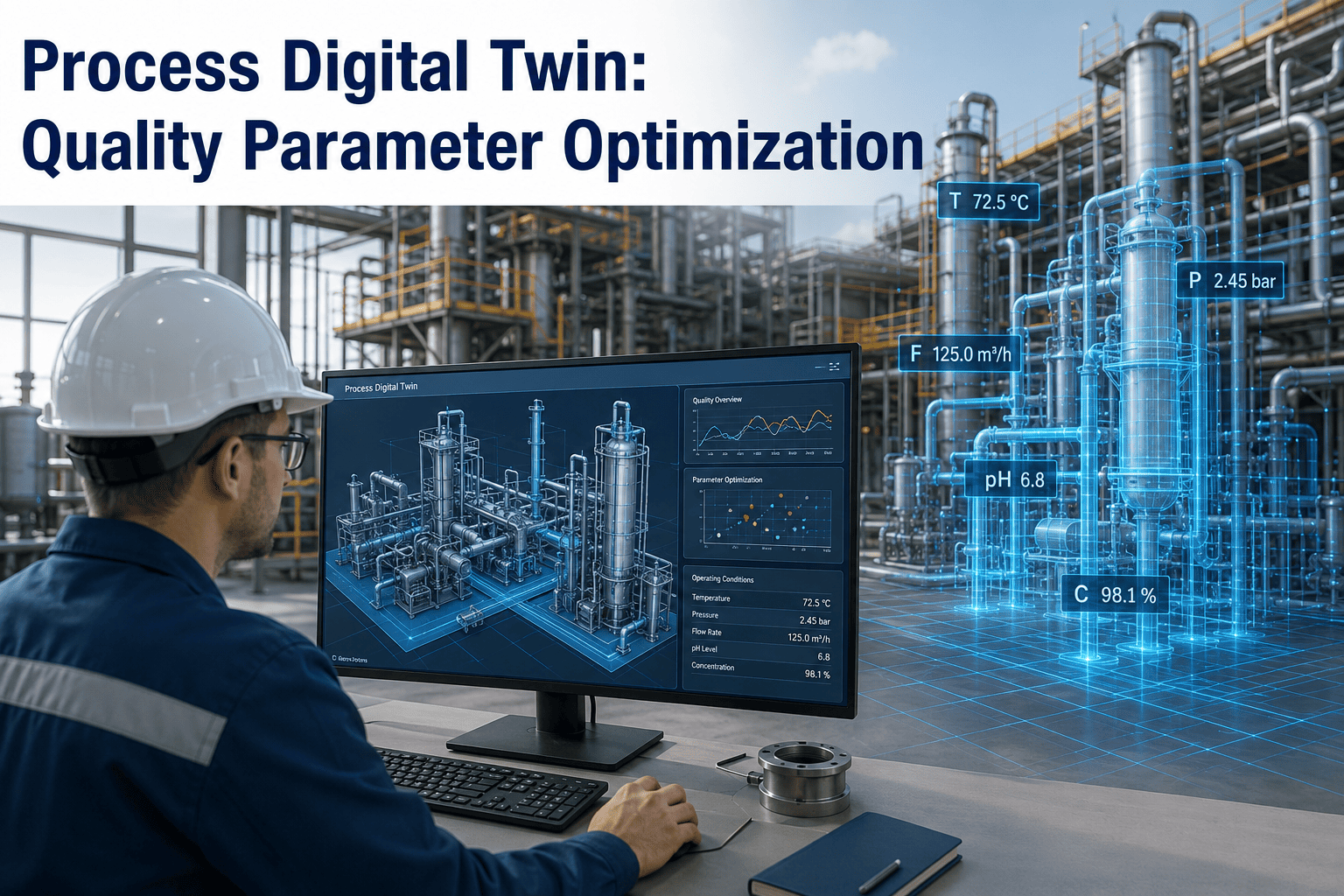
Most batch and continuous processes are still run on a fixed recipe card that was validated once, years ago, and never touched again — even though raw material lots, ambient humidity, and equipment wear drift constantly underneath it. A process digital twin changes that by holding a live, continuously updated model of the process, so every parameter that actually drives quality can be watched, tested, and adjusted before a batch goes bad rather than after a lab result comes back. This page walks through how a quality-focused process twin identifies which parameters matter, runs sensitivity analysis across them, and locks in the exact combination — the golden batch — that a plant should be reproducing on every run. Manufacturers exploring this for their own process lines can start the conversation with the iFactory support team.
Stop Chasing Quality Deviations. Start Modeling the Parameters That Cause Them.
A process digital twin turns "why did this batch fail spec" into a question you can answer before the batch finishes — by simulating parameter combinations, ranking their impact on quality, and locking in the recipe that produces the golden batch every time.
Why a Fixed Recipe Card Cannot Hold Quality By Itself
A recipe card assumes the process around it stays constant. In reality, raw material composition shifts between lots, ambient temperature and humidity move with the seasons, and mechanical components wear in ways that quietly change how a setpoint translates into an actual physical condition. A process digital twin closes that gap by comparing what the recipe assumes against what the live process is actually doing, continuously.
The same temperature, mix ratio, and cycle time are applied regardless of incoming material variation, so quality drifts silently until a lab test or a customer complaint catches it — usually after several batches have already shipped.
The twin re-simulates the batch continuously against current inputs, flags the parameters pulling the predicted outcome away from the golden batch profile, and recommends the adjustment before the physical process ever leaves the acceptable window.
Parameter Sensitivity: Knowing Which Dials Actually Matter
Every process has a long list of adjustable parameters, but only a handful of them drive most of the quality variance. Sensitivity analysis inside the twin runs simulated sweeps across each parameter independently, holding the others constant, to rank which ones deserve tight control and which ones can be left alone.
Temperature Profile
Small deviations in ramp rate or hold temperature typically produce the largest single swing in quality outcome across chemical, food, and materials processes — usually the first parameter a sensitivity sweep flags for tight control.
Mix Ratio / Feed Rate
The ratio between raw material streams determines the chemistry or composition of the output directly, so even a small feed-rate imbalance compounds across the full batch cycle rather than averaging itself out.
Pressure / Line Speed
Pressure and speed interact with temperature rather than acting alone, so the twin's sensitivity ranking usually places them behind the top two — important to hold steady, but forgiving of small excursions on their own.
Ambient Humidity
Humidity matters for hygroscopic materials and coating processes specifically, but the sensitivity sweep usually shows it contributing only a minor share of total variance once temperature and mix ratio are controlled.
See a Sensitivity Sweep Run Against Your Own Process Data
Book a walkthrough and iFactory will show how the twin ranks your actual parameters by quality impact, using a sample of your own historical batch data.
The Recipe Optimization Loop, Step by Step
Once the twin knows which parameters matter, it runs a closed loop that keeps nudging the recipe toward the golden batch profile rather than leaving the plant to rediscover the right settings by trial and error every time conditions shift.
What "Golden Batch" Actually Means Inside the Twin
The golden batch is not a single historical run frozen in time — it is a live statistical profile of the parameter combinations that have reliably produced in-spec quality, continuously refreshed as new confirmed-good batches are added. The twin uses that profile as the target every future batch is steered toward.
| Parameter | Golden Batch Range | Drift Signal | Twin Response |
|---|---|---|---|
| Reaction Temperature | Tight band around validated setpoint | Ramp rate deviates from reference curve | Adjust heating profile before hold phase begins |
| Feed Ratio | Validated stoichiometric ratio | Composition assay drifts from target | Recalculate feed rate for current material lot |
| Mix Time / Speed | Validated agitation window | Predicted homogeneity falls below threshold | Extend or adjust mix duration in real time |
| Cooling / Cure Rate | Validated cooling curve | Predicted structural property drifts | Modify cooling curve for remaining cycle |
A Composite Scenario: The Batch That Would Have Failed Spec
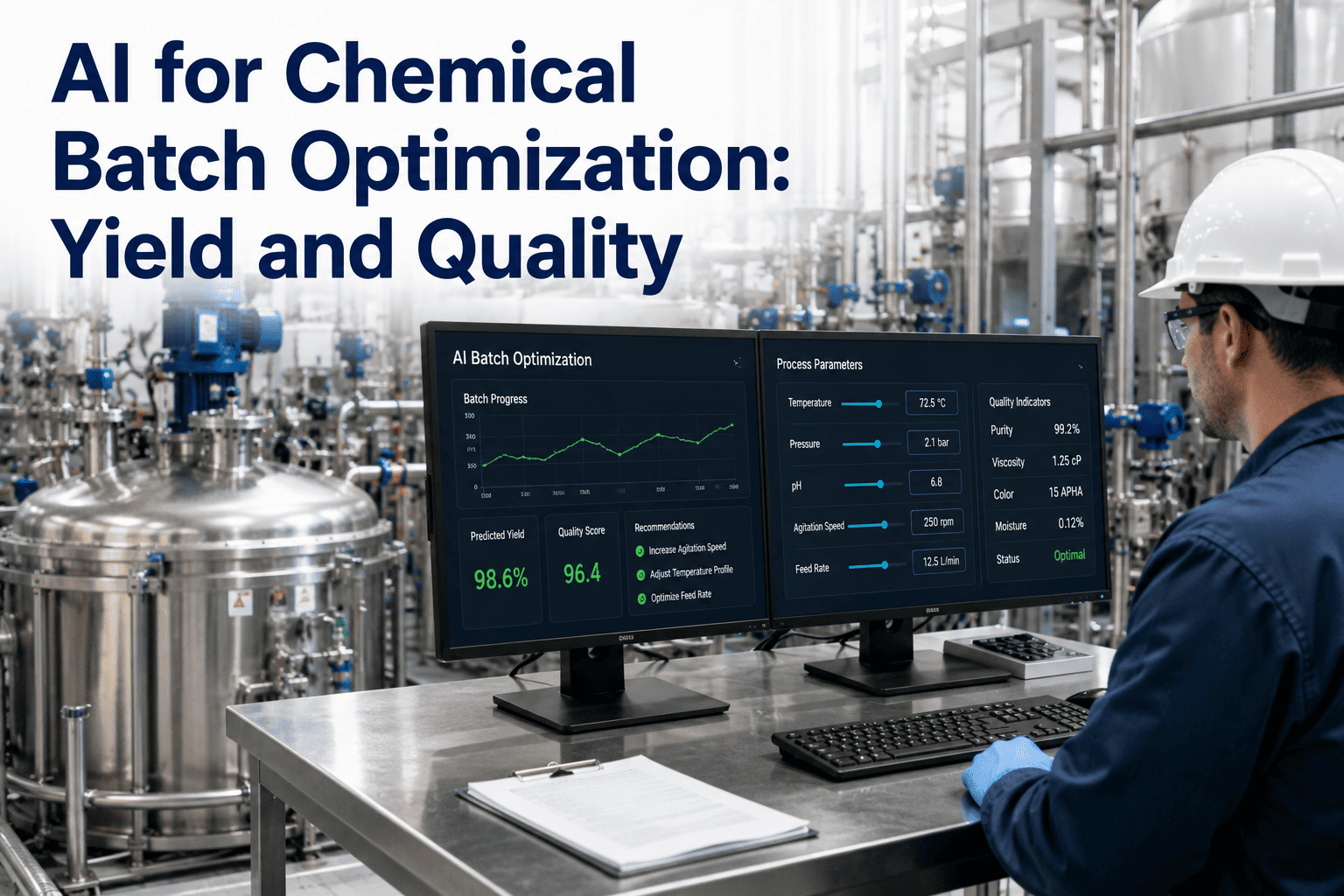
A specialty chemical producer running a multi-stage batch reactor was seeing an intermittent viscosity failure roughly once every fifteen to twenty batches, with no obvious single cause showing up in the operator logs. The plant stood up a process digital twin fed from the existing historian and ran a sensitivity sweep across the full parameter set used in that reactor stage.
The sweep isolated feed ratio and mix time as the two parameters driving nearly all of the viscosity variance, with temperature contributing far less than operators had assumed. Once the twin was put into closed-loop advisory mode, it began flagging feed-ratio drift roughly two hours into a run — well before the viscosity failure would have shown up in the end-of-batch lab result — and recommending a feed-rate correction sized to the current material lot's assay. Over the following quarter, viscosity-related batch failures dropped from roughly one in seventeen to fewer than one in ninety, without any change to the underlying recipe specification.
Mistakes That Undermine a Quality-Focused Process Twin
Modeling Every Parameter Equally
Treating a dozen parameters as equally important dilutes the model's attention and slows down the sensitivity analysis. Rank parameters first, then build tight control around the two or three that actually move quality.
Freezing the Golden Batch Profile
A golden batch defined once and never updated slowly falls out of step with new material suppliers and equipment condition. The profile needs to refresh as confirmed-good batches accumulate.
Skipping Sensitivity Analysis Entirely
Jumping straight to optimization without first ranking parameter impact leads teams to tightly control parameters that barely matter while ignoring the ones that actually drive variance.
Building the Twin on Sparse Historical Data
A twin trained on a narrow slice of historical batches — mostly good runs, few edge cases — will not recognize a real deviation when one occurs. The model needs both good and marginal batches represented.
Leaving the Loop Fully Open
A twin that only reports predictions without a defined path to an operator action or an automated adjustment produces insight nobody acts on in time to matter.
Ignoring Interaction Effects
Parameters rarely act alone — temperature and pressure, or feed ratio and mix time, often interact. A sensitivity analysis that only tests one parameter at a time can miss a combined effect that matters more than either parameter alone.
Is Your Process Ready for Quality-Focused Twin Modeling
You have a process historian with sufficient parameter history
The twin needs enough historical batch data — including both good and marginal runs — to build an initial model and identify which parameters carry the most quality signal.
Quality outcomes are recorded against specific batches or runs
Lab results, inspection outcomes, or downstream quality metrics need to be traceable back to the exact batch and parameter set that produced them, or the twin has nothing to learn from.
Operators can act on a recommended adjustment mid-run
A twin's recommendation is only useful if there is a real path — manual or automated — to change a setpoint before the batch finishes, not just a report generated after the fact.
Leadership has agreed which quality metric the golden batch optimizes for
Yield, a specific quality attribute, or a combination of both need to be defined up front, since the golden batch profile is only meaningful relative to a chosen target.
Where Sensitivity Analysis Fits Inside a Broader Quality System
Parameter sensitivity analysis rarely stands alone as a one-time exercise. Plants that get the most value out of a process digital twin treat it as a recurring input into their quality management system, re-running the sensitivity sweep whenever a new material supplier is qualified, a piece of equipment is replaced or overhauled, or a product formulation changes. Each of those events can quietly shift which parameters carry the most quality risk, and a sensitivity ranking that was accurate a year ago may no longer reflect the current state of the line.
The twin's output also becomes a natural input for operator training and standard work. Instead of a generic instruction to "watch the temperature closely," a shift supervisor can point to the specific sensitivity ranking for the current product run and explain exactly why feed ratio deserves more attention than pressure this week. That specificity tends to build far more trust in the system among operators than a black-box alarm ever could, because the reasoning behind each recommendation is visible and traceable back to real historical data rather than a fixed rule someone wrote down once and never revisited.
This same feedback loop also helps quality and process engineering teams justify capital requests with a much stronger evidence base than an anecdotal complaint pattern. When a sensitivity ranking consistently shows a particular piece of equipment — an aging heat exchanger, a worn agitator, a mixing valve with growing backlash — as the source of drift in a high-impact parameter, that finding turns a subjective maintenance request into a documented, quantified case tied directly to quality outcomes and yield loss. Over time, the accumulated sensitivity history across many product runs becomes a record of exactly where the process is most fragile, which is often more useful for planning upgrades than a generic reliability audit.
Frequently Asked Questions
What is a golden batch in the context of a process digital twin?
A golden batch is the statistical profile of parameter combinations that have reliably produced an in-spec, high-quality outcome, built from confirmed-good historical runs rather than a single idealized batch frozen in time. The process digital twin keeps this profile current by continuously folding in new confirmed-good runs, so it reflects the current state of raw materials and equipment rather than conditions from years ago. Every live batch is then compared against this profile in real time, and any parameter drifting away from it becomes a specific, attributable signal rather than a vague quality complaint. Teams that want to see how a golden batch profile is built from their own historian data can reach out through iFactory support for a walkthrough.
How is parameter sensitivity analysis actually performed inside the twin?
The twin runs simulated sweeps across each parameter's plausible range, holding all other parameters constant, and records how much the predicted quality outcome shifts for each increment of change. Parameters that produce a large swing in predicted outcome for a small change in value rank as high sensitivity, while parameters that barely move the outcome rank low and can generally be left under looser control. More advanced sensitivity studies also test parameters in combination, since some quality effects only appear when two variables move together rather than independently. This ranking is what tells a quality team where to focus tightening effort instead of spreading control resources evenly across every dial on the line.
Does a process digital twin replace lab testing and quality inspection?
No — a process digital twin predicts likely quality outcomes from live parameter data so a plant can intervene earlier, but it does not replace the confirmatory lab test or inspection step that verifies the actual product met specification. The twin's real value is shrinking the gap between when a deviation starts and when it is caught, since most quality problems today are only discovered after a lab result comes back, by which point several batches may already be affected. Lab and inspection data continue to feed back into the twin as the ground truth that keeps its predictions calibrated and its golden batch profile accurate over time.
How much historical data is needed before a twin can make reliable recommendations?
There is no fixed number, but the model needs enough batches to cover the normal range of material lot variation, seasonal conditions, and at least a reasonable sample of marginal or borderline outcomes, not just clearly good and clearly bad extremes. Processes with frequent batches and well-instrumented historians can often stand up a usable initial model within a few months of data, while lower-volume or sparsely instrumented processes take longer to accumulate enough signal. In the interim, the twin can still run in an advisory, lower-confidence mode while it continues learning from each new confirmed outcome. Booking a demo is the fastest way to get a specific estimate against your own data volume.
Can this approach work for continuous processes, not just batch manufacturing?
Yes, though the golden batch concept translates into a golden operating window rather than a single batch profile, since continuous processes do not have a discrete start and end point the way a batch does. The same sensitivity analysis and parameter-ranking approach applies — the twin identifies which continuous process variables carry the most quality impact and monitors live data against the validated operating window rather than a batch-by-batch comparison. The recommendation loop works the same way: a live deviation from the golden window triggers an attributed, specific adjustment recommendation rather than a generic alarm.
Turn Your Process Data Into a Model That Protects Quality
iFactory's digital twin platform is built to ingest live process data, rank parameter sensitivity, and hold a continuously updated golden batch profile so quality deviations are caught before they leave the line. Book a walkthrough to see it against your own process.