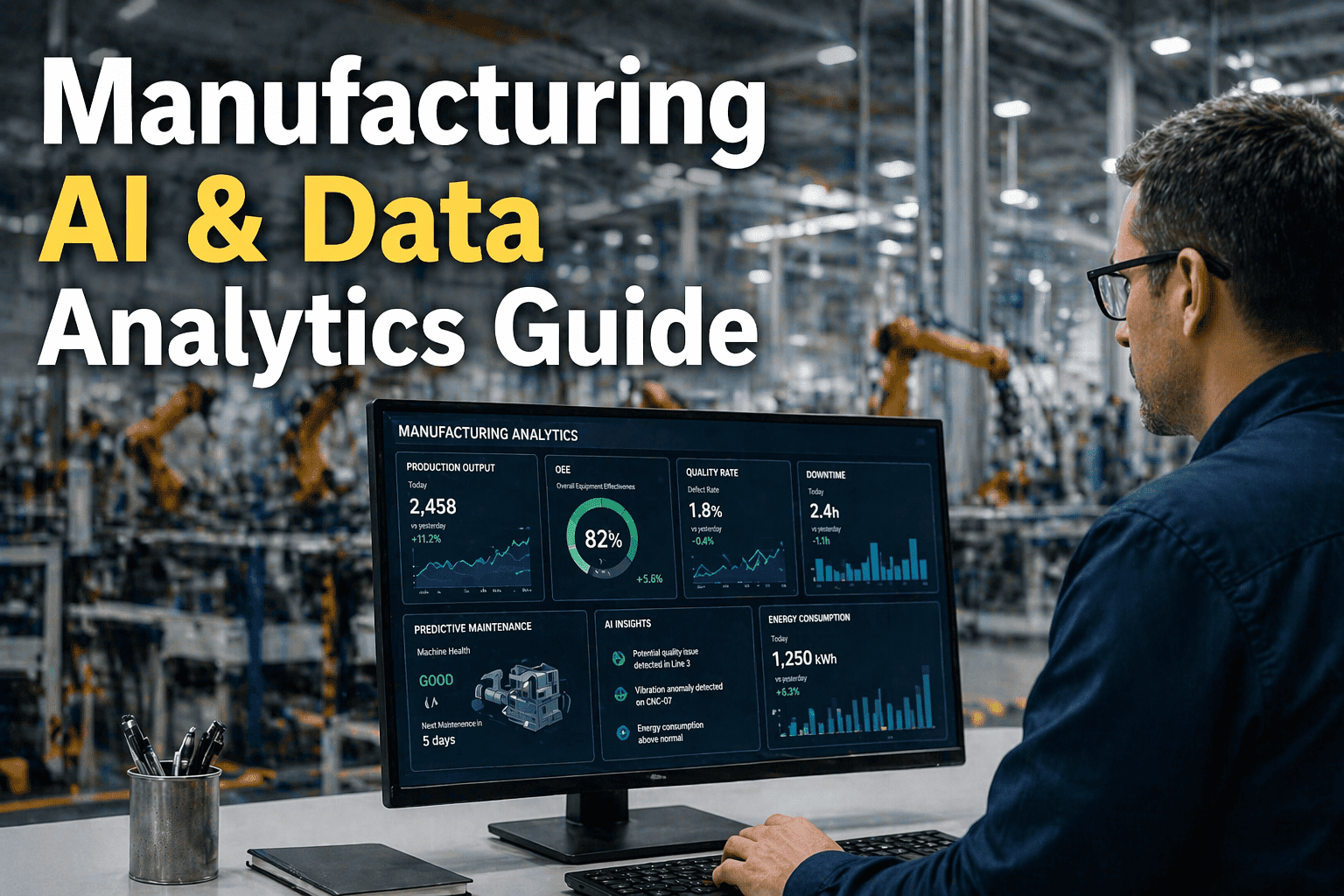
The production supervisor at a Midwestern automotive parts plant stared at the OEE dashboard during the morning shift handoff. Red indicators across three production lines — availability loss on Line 2, performance degradation on Line 4, and a quality defect spike on Line 7. The data was all there, displayed in real time on the 55-inch screen mounted in the production office. But the supervisor could not interpret what the red indicators meant for the shift plan. He had been a production leader for 14 years, promoted from setup technician because he knew the machines, the materials, and the workflow. Nobody had taught him to read an OEE trend chart or correlate a quality deviation with the process parameter shift that caused it. He was not alone. Across U.S. manufacturing, the technology infrastructure for data-driven operations has been deployed, but the workforce that operates the plant floor was never trained to use it. The analytics skills gap — the chasm between the data available and the workforce's ability to interpret and act on that data — has become the single largest barrier to realizing the ROI of manufacturing's digital transformation investments.
Close the analytics skills gap in manufacturing — and unlock the full ROI of your plant-floor data infrastructure
iFactory AI's unified platform combines role-based analytics training, guided workflows, and competency tracking to transform data-literate operators from a goal into a measurable outcome.
Why the manufacturing analytics skills gap threatens the ROI of your technology investments
U.S. manufacturing has invested heavily in data collection and analytics infrastructure. PLC-connected sensors, SCADA historians, MES transaction logs, CMMS maintenance records, and energy monitoring systems generate thousands of data points per shift at the average mid-size facility. Yet a 2025 Manufacturing Institute survey found that 68 percent of plant floor supervisors and 81 percent of production operators do not regularly use analytics tools to inform daily decisions — with lack of training cited as the primary barrier. The result is a measurable productivity deficit: facilities with structured analytics training programs achieve OEE improvement rates 23 percent higher than facilities that deploy analytics tools without accompanying workforce development.
The analytics skills gap is not a human resources problem — it is a capital productivity problem. Every dashboard that goes unread, every alert that is ignored because the operator does not trust the data, and every root cause investigation that takes three days instead of three hours represents a direct drag on the return from your technology investment. Book a Demo to see how iFactory's role-based analytics platform bridges the skills gap by design.
Core competencies for closing the analytics skills gap — a role-based framework for workforce development
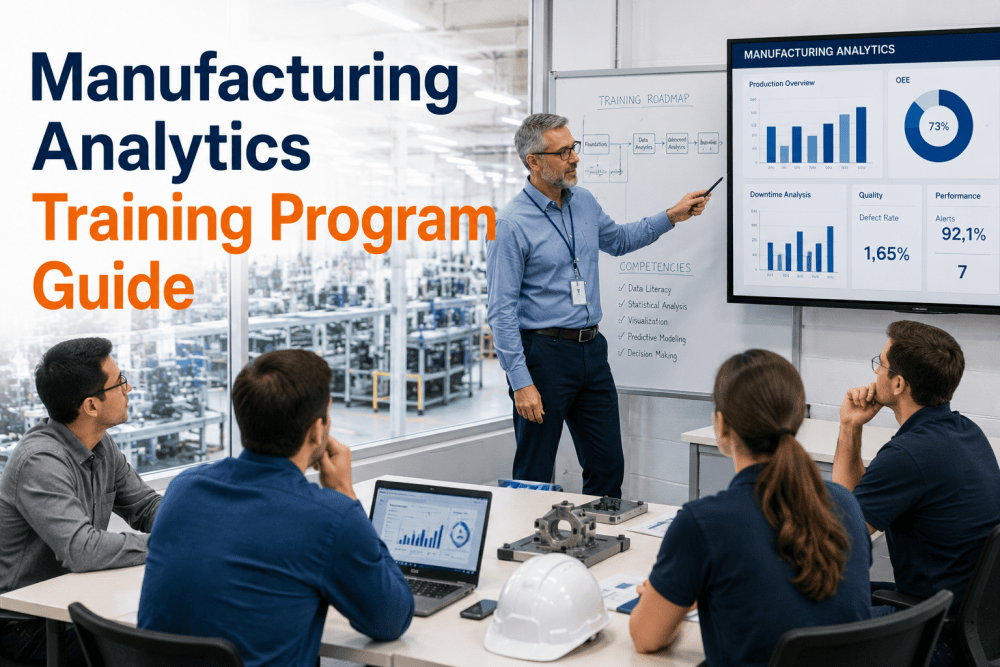
Closing the analytics skills gap requires more than generic computer literacy training. Manufacturing analytics competency is role-specific: an operator needs different data interpretation skills than a maintenance technician, and a plant manager needs different analytical decision-making capabilities than a shift supervisor. The framework below organizes analytics workforce development into four competency domains aligned with specific plant-floor functions.
Data Literacy Foundations
Reading dashboards, interpreting trend charts, understanding OEE components (availability, performance, quality), recognizing data quality issues, and navigating analytics interfaces. Target roles: all production and maintenance personnel.
Maintenance Analytics
Interpreting vibration and thermal data, understanding PM compliance metrics, analyzing MTBF and MTTR trends, prioritizing work orders by criticality score, and recognizing early failure patterns in equipment data. Target roles: maintenance technicians and planners.
Quality Analytics
Using SPC charts for process control, analyzing defect Pareto distributions, correlating process parameters with quality outcomes, setting control limits from historical data, and recognizing early quality drift signals. Target roles: quality inspectors and process engineers.
Operational Decision-Making
Prioritizing improvement actions from data insights, building business cases from analytics findings, leading data-driven shift review meetings, setting performance targets from benchmarks, and communicating data insights to cross-functional teams. Target roles: supervisors and plant managers.
Each domain is supported by iFactory platform modules that include role-based dashboard presets and guided analytics workflows — turning the analytics platform into a continuous training tool that reinforces competency development during daily operations. Book a Demo to see the competency framework applied to your facility's team structure.
The analytics skills gap is not a training problem — it is a platform design problem. When analytics tools are designed with role-based interfaces and guided workflows, the platform itself becomes the primary vehicle for skill development. Book a Demo to see iFactory's role-based analytics approach.
Building a workforce analytics upskilling program — a four-phase approach to closing the skills gap
Successful manufacturing analytics upskilling programs follow a structured four-phase approach that moves the workforce from foundational data literacy to independent analytical decision-making. Each phase is designed to build on the previous one, with practical assessments at every stage.
Assess & Map
Conduct a facility-wide analytics skills assessment using a structured self-assessment matrix covering dashboard navigation, data interpretation, and decision application. Map current proficiency against the analytics features each role will use. Identify power users who can serve as peer trainers.
Foundational Training
Deliver foundational data literacy training to all production and maintenance personnel in cohorts of 8 to 12 participants. Focus on dashboard navigation, trend chart interpretation, OEE understanding, and data quality recognition. Use actual production data from each participant's work area for hands-on exercises.
Role-Specific Deepening
Deliver role-specific analytics training in maintenance analytics, quality analytics, or operational decision-making depending on each participant's function. Each track includes 6 to 8 hours of hands-on lab sessions using role-specific dashboards and real plant data.
Reinforce & Certify
Establish ongoing reinforcement through daily analytics review huddles, weekly data-driven improvement challenges, and monthly certification milestones. iFactory's platform supports this phase with role-based dashboard presets and guided analytics workflows that reinforce classroom learning during daily use.
Close the analytics skills gap at your facility with a platform designed for workforce development
iFactory AI's unified platform includes role-based dashboards, guided analytics workflows, automated competency tracking, and integrated certification management — enabling your facility to build sustainable analytics capability that turns every shift into a data-driven decision-making opportunity.
Industry perspective on closing the manufacturing analytics skills gap
"The analytics skills gap in manufacturing is not a failure of the workforce — it is a failure of the training model. We have been trying to teach data literacy the same way we teach safety training: a one-time classroom session with a PowerPoint deck and a multiple-choice quiz. That approach does not work for analytics because analytics is not a knowledge domain — it is a practice domain. You cannot learn to interpret an OEE trend chart by reading about it. You have to do it, repeatedly, in the context of your own production line, with your own machines and your own quality data. The facilities that are successfully closing the analytics skills gap are the ones that have stopped treating analytics training as a classroom event and started embedding it into the daily workflow — using the analytics platform itself as the training vehicle, with role-based interfaces that guide users through data interpretation until those steps become habitual."
How leading manufacturers measure progress in closing the analytics skills gap
Closing the analytics skills gap requires measurement at two levels: individual competency progression and facility-wide operational impact. The table below presents the key performance indicators that leading manufacturers use to track both dimensions, with documented improvement ranges from facilities that have deployed structured analytics upskilling programs.
| Measurement Dimension | Key Performance Indicator | Baseline | 6-Month Target | 12-Month Target |
|---|---|---|---|---|
| Individual Competency | Analytics proficiency assessment score | 35–45% pass rate | 65–75% pass rate | 85–95% pass rate |
| Individual Competency | Dashboard utilization rate per shift | 12–18% of shifts | 45–60% of shifts | 75–90% of shifts |
| Operational Impact | OEE relative improvement | — | 4–8% improvement | 8–15% improvement |
| Operational Impact | Unplanned downtime reduction | — | 8–15% reduction | 18–30% reduction |
| Operational Impact | Quality defect rate reduction | — | 6–12% reduction | 12–22% reduction |
| Retention & Culture | Voluntary turnover among analytics-trained personnel | 18–25% annual | 15–20% annual | 12–16% annual |
iFactory's platform includes automated competency tracking that measures each user's analytics skill development over time, providing facility leadership with a real-time view of skills gap closure progress across the entire plant floor workforce. The platform tracks dashboard interaction patterns, decision quality indicators, and certification milestone completion to provide an objective measure of workforce analytics capability. Book a Demo to see how iFactory's competency tracking dashboard monitors skills gap closure in real time.
Closing the analytics skills gap is the defining competitive advantage for next-generation manufacturing
U.S. manufacturing has spent the past decade building the technology infrastructure for data-driven operations. The sensors are installed. The dashboards are configured. The predictive models are running. But the workforce that operates the machines, maintains the equipment, and manages the production schedules was not trained in data analytics — and the gap between what the technology can deliver and what the workforce can interpret is the single largest barrier to manufacturing's digital transformation. Closing that gap does not require a massive training budget or a multi-year academic program. It requires a deliberate approach to analytics workforce development built around three principles: role-based competency frameworks that align training with function, phased program structures that build skills progressively, and analytics platforms designed to reinforce learning through daily use.
iFactory AI's platform was built on the principle that the analytics system itself should be the primary vehicle for skills development. Role-based dashboard presets show each user the metrics most relevant to their function. Guided analytics workflows prompt users through data investigation steps with structured prompts. Automated competency tracking measures skill development and identifies where additional support is needed. The platform does not just deliver data — it builds the workforce capability to act on that data, shift after shift, until data-driven decision-making becomes the default operating mode for every role on the plant floor. Book a Demo to discuss how iFactory can help your facility close the analytics skills gap.
Frequently asked questions about closing the analytics skills gap in manufacturing
Ready to close the analytics skills gap at your manufacturing facility?
iFactory AI can have a role-based analytics upskilling program running at your facility within four weeks — with competency measurement from day one and documented ROI within six months. The technology to close the skills gap is available. The question is how soon your facility will start building the data-literate workforce that the next decade of manufacturing will require.