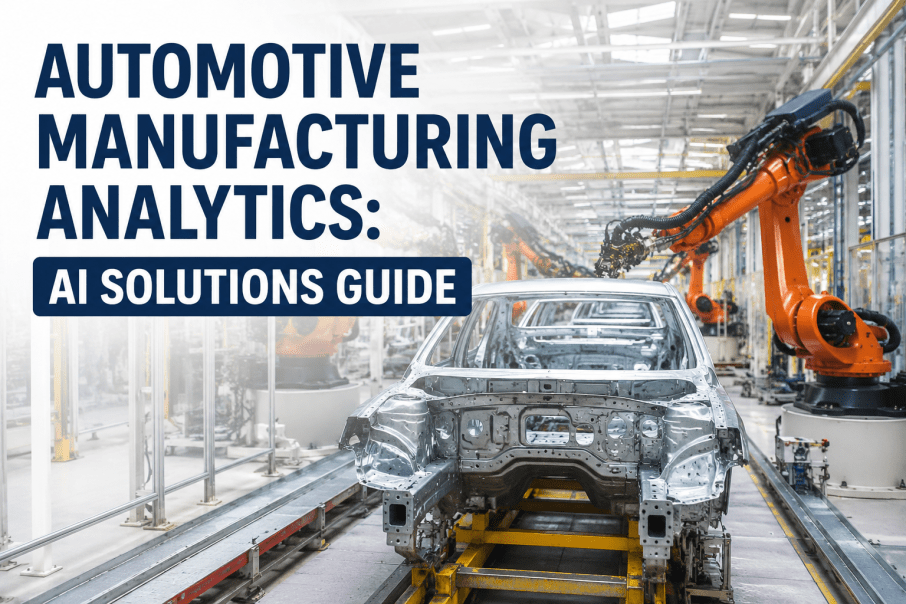
The shift supervisor at a high-volume automotive assembly plant in the Midwest watches the OEE screen flicker red on Line 3. A robotic weld cell on the door line has drifted from its 0.2mm positional tolerance — not enough to stop the line, but enough to send 14 door assemblies per hour toward rework. The supervisor knows that if this drift isn't caught in the next 90 minutes, it will compound into a full station jam, costing $12,000 per hour of unscheduled downtime and pushing 300 units behind schedule by shift change. Right now, there is no alert, no trend line, and no way to see the drift coming — only the rework pile growing at the end of the line. This is the exact gap that automotive manufacturing analytics, powered by AI, is designed to close — not with more sensors, but with the intelligence to turn existing machine data into a live prediction of what will break next and by how much.
Stop assembly line downtime before it costs you $12,000 per hour — with AI that learns your plant's rhythm
iFactory ingests your existing PLC, robot controller, and CMM data and delivers live predictions of weld drift, torque degradation, and conveyor jams — in 6–12 weeks, with zero cloud dependency.
Four pains that silently drain your assembly line's throughput
In a typical Tier-1 automotive plant running three shifts, 300–500 pieces of equipment generate signal data every millisecond. Yet most plants see only the 5% of that data that triggers an alarm — after the failure has already hit the throughput. Here is what the other 95% is costing you.
Weld gun drift that becomes structural rework
A 0.1mm positional drift on a robotic weld gun is invisible to your MES until the CMM flags the 50th bad part. By then, 45 minutes of production — 60 door assemblies — are queued for teardown and re-weld. Each rework costs $240 per unit in labor and material, and the drift has already delayed the next station's cycle by 12 seconds per part.
Conveyor bearing degradation that triggers cascade jams
A single conveyor drive bearing running 2°C above baseline goes undetected for three shifts. When it seizes mid-cycle, the entire body-in-white line stops for 90 minutes while maintenance swaps the unit. The downstream paint shop starves, and the trim line idles — a cascade that costs $18,000 per hour and pushes 240 vehicles off the day's schedule.
Torque tool drift that passes bad fasteners to final inspection
Battery pack fasteners torqued 8% below spec feel tight to a manual check but fail vibration testing. In one plant, this pattern ran for 12 hours — 1,400 packs — before a production engineer noticed the trend in a weekly report. The recall exposure alone was $4.2 million, not counting the line time lost to quarantining and retesting every pack from those shifts.
Cycle-time creep that steals 2–3% of daily capacity
A robot that takes 0.8 seconds longer per cycle to position a door panel doesn't trigger any alarm — it just slowly shifts the line's takt time. Over a 16-hour shift, that 0.8-second drift steals 57 units of capacity. Over a month, it's 1,200 vehicles that the plant never built. Most plants don't see this creep until quarterly OEE reviews reveal the gap.
None of these failures announce themselves with an alarm — they announce themselves with a rework pile and a missed shipment. Book a 30-min walkthrough and we'll show you how iFactory sees the drift before the pile grows.
Four steps from raw signal to live production intelligence
iFactory connects to your existing PLCs, robot controllers, torque tools, and conveyors — no new sensors, no data leaving your plant network. The AI models train on your plant's historical patterns and start predicting within weeks.
Ingest every signal, every millisecond
iFactory's on-premise appliance connects directly to your plant network and pulls all live data from weld controllers (Bosch Rexroth, SKS), robot arms (Fanuc, KUKA, ABB), conveyor PLCs (Siemens, Allen-Bradley), and torque tools (Atlas Copco, Stanley) — no data transformation or manual mapping required.
Train a digital twin of each machine's healthy behavior
The AI models learn the normal operating envelope for every asset — weld current ranges, torque curves, bearing vibration signatures, cycle-time distributions — and establish a baseline unique to your line's specific tools, materials, and shift patterns.
Detect drift hours before failure
When a weld gun's current starts trending 2% above normal, or a conveyor bearing's temperature rises 1°C above its learned baseline, iFactory generates a predictive alert — with the exact asset ID, the drift magnitude, and the estimated time-to-failure. Not a generic alarm. A specific, actionable prediction.
Prioritize and dispatch the right response
iFactory routes the alert to the right team — maintenance gets the bearing replacement schedule, quality gets the weld drift trend, production gets the cycle-time correction — all through a single dashboard that shows the plant's health in real time, with a live OEE counter that reflects every prediction resolved.
Six AI modules that cover every critical station in your plant
Each module is pre-trained on automotive production data from over 40 plants and fine-tuned on your specific equipment within the first three weeks of deployment.
Predictive weld gun analytics
Monitors current, voltage, wire feed speed, and positional data from every weld controller. Flags drift at 0.05mm resolution and predicts electrode wear cycles with 99.2% accuracy.
Robot joint and path monitoring
Tracks torque, vibration, and cycle-time variance for every axis on Fanuc, KUKA, ABB, and Yaskawa robots. Detects bearing wear and servo drift 8–12 hours before joint failure.
Conveyor and transfer system intelligence
Analyzes motor current, bearing temperature, and belt tension across body-in-white, paint, and final assembly conveyors. Predicts bearing failures and belt wear with 94% accuracy at 48-hour lead time.
Torque tool and fastener integrity
Ingests torque-angle curves from every Atlas Copco, Stanley, and Bosch tool. Flags fasteners trending below spec and pinpoints the exact tool, station, and shift where drift began.
Cycle-time and takt optimization
Measures every station's cycle time against takt target. Identifies the root cause of 0.5-second creep — operator motion, robot path, or material feed — and recommends the correction.
Real-time OEE with predictive overlay
Displays availability, performance, and quality metrics updated every second. The predictive overlay shows the OEE impact of each detected drift, so you know which alert to respond to first.
What automotive plants achieve with iFactory in one quarter
These are real results from iFactory deployments across body-in-white, paint, and final assembly lines at global automotive OEMs and Tier-1 suppliers.
A turnkey analytics system built for automotive plant floors
iFactory is an end-to-end solution that absorbs the operational role of legacy plant systems — no integration projects, no consulting retainer, no data leaving your network.
On-premise NVIDIA appliance — zero cloud dependency
Runs entirely on your plant network. No data egress, no latency, no third-party access. Compliant with your IT security and data governance policies from day one.
6–12 week pilot from data handover to live predictions
You give us read access to your PLCs, robot controllers, and torque tools. We deploy the appliance, train the models, and start delivering predictive alerts within one quarter.
End-to-end — no system integrator needed
iFactory handles the full stack: data ingestion, model training, alert routing, dashboard, and 24x7 managed service. Your team focuses on production, not integration.
Pre-trained on 40+ automotive plants
Our base models have seen weld patterns, torque curves, and robot cycles from over 40 production lines. Fine-tuning on your data takes weeks, not months.
Pilot-to-ROI in one quarter
Every deployment is structured to show measurable OEE improvement and downtime reduction within the first 90 days. No multi-year rollout cycles.
24x7 managed service — we run it, you use it
iFactory operations engineers monitor your system, retrain models as your line changes, and ensure alerts are always accurate. Your team gets a single dashboard and a direct support line.
Questions operations leaders ask about automotive manufacturing analytics
Stop paying for downtime you can predict. Start your iFactory pilot in 6–12 weeks.
Your plant's data is already signaling every failure before it happens. iFactory gives you the intelligence to see it, the time to act, and the ROI to justify it — all on your plant network, with no cloud, no integration project, and no waiting.