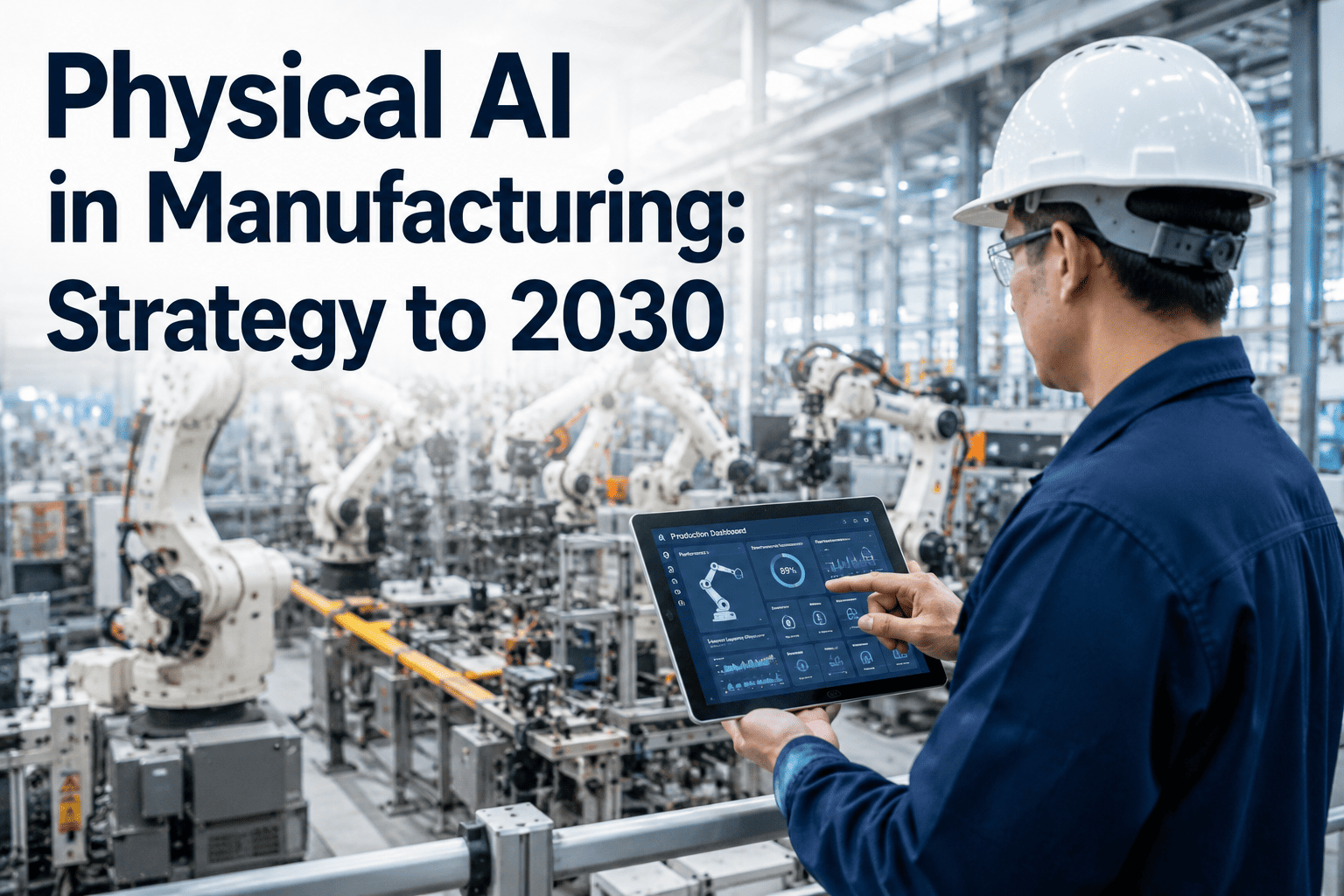
Physical AI is the label the industry has settled on for systems that combine reasoning models with embodied hardware — robots, humanoids, and autonomous platforms that perceive a factory floor, reason about what they see, and act on it without a human writing a rule for every scenario in advance. Recent industry surveys already put a majority of manufacturers in active engagement with physical AI in some form, while multi-thousand-unit humanoid deployment contracts are now being signed by major industrial suppliers. The strategic question for innovation leaders is no longer whether physical AI belongs on a five-year roadmap, but how to sequence the investment so that 2026 pilots turn into 2030 production capability instead of an expensive dead end. Innovation and operations leaders building that roadmap can book a demo to see how iFactory AI's integration layer supports physical AI pilots today while staying vendor-neutral as the technology matures.
Build a Physical AI Roadmap That Survives Contact With Your Actual Plant Floor
iFactory AI connects autonomous inspection, humanoid pilots, and mobile robotics into the same operational data layer as the rest of your plant — so a physical AI pilot in 2026 becomes a governed, scalable capability by 2030 instead of an isolated experiment.
Physical AI Is Not Another Robotics Cycle — It Is Reasoning AI Given a Body
Conventional industrial robots execute fixed motion programs with extraordinary precision but almost no ability to handle a scenario their programmer did not anticipate. Physical AI systems pair a reasoning model — the same class of technology behind modern language and vision models — with sensors and actuators, so the system can interpret an unfamiliar box, an unexpected obstacle, or a novel part, and decide how to respond rather than fault out. That combination is what is now moving humanoid robots, autonomous mobile robots, and AI-guided manipulators from research demonstrations into live production environments across automotive, aviation, electronics, and logistics.
The shift is happening faster than most five-year technology roadmaps assumed. A major industrial supplier has already signed one of the largest disclosed humanoid robot deployment agreements to date, covering an estimated 1,000 to 2,000 units across its global sites by 2032, with the first robots clocking in for box handling shifts before the end of this year. That kind of commitment from a conservative industrial buyer is the clearest signal yet that physical AI has crossed from pilot curiosity to procurement line item.
A Realistic Physical AI Milestone Map, 2026 Through 2030
Every plant network's path will differ, but the milestone sequence below reflects the pattern already visible across the manufacturers moving fastest — starting with the lowest-risk capability and only adding humanoid-assisted production once the sensing, data, and integration layer underneath it is proven.
Structured Pilots
Autonomous inspection, patrol, and box or material handling pilots begin at single sites, focused on tasks with clear success criteria and low safety risk.
Multi-Site Scaling
Successful pilots expand to a second and third facility, integrating physical AI data feeds into existing MES and safety systems rather than running them standalone.
Humanoid-Assisted Production
Humanoid robots enter live assembly line roles at flagship plants, with unit costs beginning a gradual decline as production volume increases.
Fleet Standardization
Plant networks move from site-by-site pilots to unified fleet orchestration, with shared data governance and consistent safety certification across facilities.
AI-Driven Factory Conversion
Leading manufacturers target full conversion of select sites to AI-driven operation, combining humanoids, mobile robots, and reasoning-based process control.
The Three Pillars Any Physical AI Strategy Has to Get Right
Innovation leaders evaluating physical AI vendors and pilots tend to focus first on the robot hardware, but the hardware is the least differentiated part of the stack. Two manufacturers can buy the identical humanoid platform and end up with completely different outcomes eighteen months later, and the difference almost always traces back to one of the three pillars below rather than to the robot itself. The pillars below are where strategies actually succeed or stall.
World Models and Reasoning AI
The reasoning layer interprets an unstructured scene — an unfamiliar box orientation, a partially blocked path, a novel part — and decides on an action instead of faulting out. This is the layer where lab-to-floor performance gaps show up most, since a model trained in simulation can behave very differently under real plant lighting, clutter, and noise.
Robotics Foundation Models and Embodied Learning
Generalizable manipulation and locomotion skills that transfer across tasks and, increasingly, across different robot platforms, are what separate physical AI from single-purpose automation. A strategy built around one narrow skill set for one robot model ages quickly as the underlying foundation models improve.
Sensing, Integration, and Data Governance
The unglamorous layer that determines whether a pilot scales: connecting physical AI systems into existing PLCs, MES, and safety infrastructure, and giving operations leaders one place to see fleet health, task success rate, and incident history across every robot and every site.
A Phase-by-Phase Investment and Risk Framework
Innovation directors building a business case need more than a single ROI number — they need a framework that shows the board where investment and risk actually sit at each stage, so funding can be released in step with proven capability rather than committed all at once.
| Phase | Capability Focus | Typical Timeline | Investment Level | Primary Risk |
|---|---|---|---|---|
| Foundational | Autonomous inspection and patrol pilots | 2026-2027 | Low to Moderate | Integration with existing OT systems |
| Scaling | Multi-site material and box handling | 2027-2028 | Moderate | Reliability gap in unstructured tasks |
| Production | Humanoid-assisted assembly roles | 2028-2029 | High | Unit economics and workforce integration |
| Standardization | Fleet-wide orchestration and governance | 2029-2030 | High | Data governance and safety certification |
| Maturity | Full AI-driven factory conversion | 2030 and beyond | Very High | Organizational change management |
What Separates Manufacturers Building Real Advantage From Those Waiting It Out
Waiting for the Technology to Mature
- No structured pilot in place; physical AI treated as a future concern rather than a 2026 planning item
- Vendor and platform decisions deferred until a single dominant standard emerges
- Plant data and safety systems not yet prepared for robot fleet integration
- Workforce planning for physical AI has not started
Building a Phased Strategy Now
- Low-risk pilots running today in inspection, patrol, or material handling roles
- Integration layer built to be vendor-neutral as robotics foundation models evolve rapidly
- Plant data and safety infrastructure already extended to support fleet-level physical AI
- Workforce transition planning underway alongside technology piloting, not after it
How One Innovation Team Is Actually Sequencing Its Physical AI Roadmap
Innovation leaders who started physical AI pilots early tend to describe the same lesson: the hardest part was never getting a robot to work in a demo, it was deciding what data infrastructure had to exist first so a successful pilot did not become a one-off science project.
Our board wanted a humanoid pilot on the assembly line by the end of last year, and we talked them out of it. We started instead with autonomous inspection robots patrolling our two largest plants, specifically because the risk was low and it forced us to solve the integration problem — getting robot-generated data into the same systems our OEE and quality teams already use — before we had a humanoid on the floor creating safety and liability questions we were not ready to answer. That decision looks conservative in hindsight, but it means our fleet management, safety certification, and data governance work is already done. When we do bring in humanoid-assisted handling later this year, it plugs into infrastructure we have already tested for eighteen months, instead of us building the entire stack under the pressure of a live production deadline.
Physical AI Manufacturing Strategy — Frequently Asked Questions
What is physical AI and how is it different from traditional industrial automation?
Physical AI combines reasoning models, the same class of technology behind modern AI systems, with sensors and actuators, so a robot can interpret an unfamiliar scene and decide how to act instead of executing only a pre-written motion program. Traditional industrial automation is precise but brittle when conditions vary even slightly, while physical AI systems are designed to generalize across variation. Manufacturers exploring what this means for their own floor can book a demo to walk through the distinction against their current automation base.
Should manufacturers wait for humanoid robot costs to fall before starting a physical AI strategy?
Waiting is a reasonable choice for the humanoid hardware specifically, since current Western-made units cost roughly $90,000 to $100,000 and the market needs to reach a much lower price point before small and mid-sized manufacturers can justify the investment. It is not a reasonable choice for the surrounding strategy, since the integration layer, data governance, and safety certification work that any physical AI deployment needs takes far longer to build than the hardware takes to get cheaper. Teams weighing timing can contact support to discuss what groundwork makes sense to start now.
What is a realistic first step for a physical AI strategy in 2026?
The manufacturers moving fastest are not starting with humanoid-assisted assembly — they are starting with autonomous inspection, patrol, or material handling pilots, which carry lower safety risk and clear success criteria while still forcing the organization to solve the harder integration and data governance problems underneath. That sequencing protects the humanoid or advanced manipulation investment for later, once the foundational data layer is proven. Reach out to book a demo to scope a first pilot appropriate to your facility.
How big is the gap between lab performance and real-world reliability for physical AI systems?
It is currently significant and worth planning around rather than ignoring. Industry data shows lab-tested physical AI policies achieving success rates near 95 percent, while real-world deployments often see that drop closer to 60 percent due to lighting conditions, surface textures, and other environmental factors that a controlled test does not capture. This is exactly why phased pilots with close monitoring, rather than a single big-bang rollout, remain the more defensible approach for 2026 and 2027. Contact support for guidance on realistic reliability benchmarks for a specific use case.
How does iFactory AI support a physical AI strategy without locking a manufacturer into one robot vendor?
iFactory AI functions as the integration and data governance layer that sits underneath whichever physical AI hardware a manufacturer chooses, connecting fleet health, task success rate, and safety incident data from inspection robots, mobile platforms, and humanoid pilots into the same dashboards used for the rest of plant operations. Because that layer is vendor-neutral, a manufacturer can add or swap robot platforms as the technology matures through 2030 without rebuilding its data and governance foundation each time. Innovation teams can book a demo to see this integration layer against their current or planned robot fleet.
Build Your Physical AI Strategy on an Integration Layer That Outlasts Any Single Robot Vendor
iFactory AI connects inspection robots, mobile platforms, and humanoid pilots into the same operational data and governance layer as the rest of your plant — so every phase of your 2026-2030 roadmap builds on the last one instead of starting over.