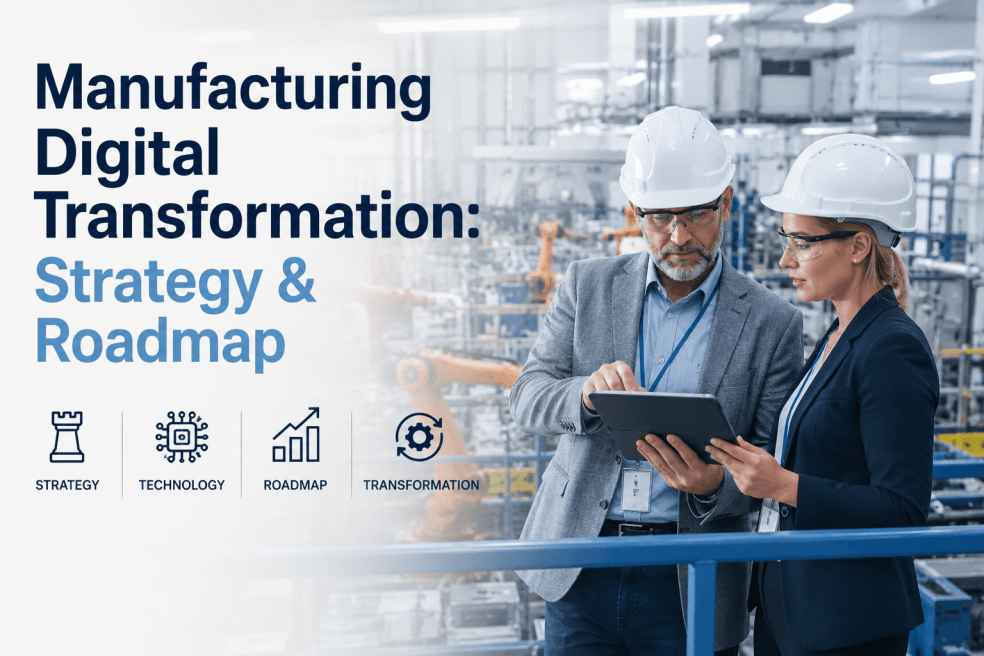
Manufacturing Digital Transformation: Strategy & Roadmap
By Hannah Baker on June 6, 2026
Manufacturing digital transformation is the strategic integration of advanced technologies — AI vision, predictive analytics, digital twin simulation, robotics orchestration, MES, and CMMS — into every layer of factory operations to improve productivity, quality, and decision-making speed. For plant managers and operations executives across U.S. manufacturing, the question is no longer whether to invest in digital transformation but how to sequence the investments for maximum return within acceptable risk and timeline constraints. iFactory AI provides the unified platform that connects these technologies into a single operational system — enabling manufacturers to execute a phased, measurable digital transformation strategy without the integration complexity of assembling multiple standalone solutions.
STRATEGY GUIDE · MANUFACTURING DIGITAL TRANSFORMATION · INDUSTRY 4.0
Manufacturing Digital Transformation: Strategy & Roadmap for Smart Factory Implementation
A phased framework for U.S. manufacturing leaders planning, implementing, and scaling digital transformation across production operations — covering technology selection, ROI planning, change management, and measurable outcomes.
of manufacturers have active Industry 4.0 initiatives in progress across production operations
40%
average OEE improvement reported by facilities with fully integrated smart factory platforms
12–18
month average payback period for digital transformation programs using unified MES-CMMS-AI platforms
3.5x
increase in production visibility after deploying integrated MES and real-time monitoring systems
The Digital Transformation Imperative — Why U.S. Manufacturing Must Modernize Now
The competitive pressure on U.S. manufacturing facilities has reached a point where digital transformation is no longer a strategic differentiator — it is a prerequisite for sustained operation. Global supply chain complexity, labor availability constraints, rising energy costs, and customer demand for real-time order visibility are converging to make digital operations infrastructure as essential as the production equipment itself. Facilities operating with paper-based work orders, manual data entry, siloed production systems, and reactive maintenance strategies are structurally unable to compete with digitally integrated factories that can adjust production schedules in real time, predict equipment failures before they cause downtime, and trace every unit's complete production history in seconds.
iFactory AI's platform addresses this imperative by providing a unified digital operations backbone that connects MES for production execution, CMMS for maintenance management, AI Vision for quality inspection, Digital Twin for simulation and optimization, and Robotics AI for fleet orchestration — replacing the fragmentation of multiple standalone systems with a single integrated platform. Facilities deploying iFactory's platform report an average 40% improvement in OEE within six months of full deployment, driven by real-time production visibility, predictive maintenance that eliminates unplanned downtime, and AI-powered quality inspection that catches defects at line speed. Book a Demo to discuss how digital transformation applies to your facility's specific operational challenges.
Core Technologies Powering Smart Factory Digital Transformation
Digital transformation in manufacturing is not a single technology decision — it is the orchestration of multiple technology systems that together create a connected, data-driven production environment. Each technology addresses a specific operational domain, and the value of the transformation multiplies when these systems are integrated rather than deployed independently. The comparison below maps the key technology domains against traditional manufacturing approaches and smart factory capabilities delivered through iFactory's integrated platform.
Technology Domain
Traditional Manufacturing Approach
Smart Factory Capability
iFactory Platform Module
Typical Impact
Production Execution
Paper work orders, manual production logging, spreadsheet-based scheduling
Real-time work order management, digital operator instructions, automated production tracking with full traceability
MES / Production Monitoring
25–35% reduction in administrative overhead, real-time OEE visibility
Maintenance Management
Reactive maintenance, calendar-based PM, paper work orders, spare parts in uncontrolled storage
Predictive maintenance using AI analytics, usage-based PM scheduling, digital work orders with mobile access, automated inventory tracking
CMMS / Predictive Maintenance / Parts & Inventory
45% reduction in unplanned downtime, 30% reduction in maintenance costs
The critical insight from this comparison is that digital transformation value compounds when systems are integrated. A standalone AI Vision system improves quality inspection, but when connected to the MES for work order tracking, the CMMS for maintenance triggers, and the Digital Twin for simulation, the same data stream supports OEE calculation, predictive maintenance scheduling, and production optimization simultaneously. iFactory's unified architecture enables this compounding effect by design — every module shares data through a common platform rather than requiring custom integrations between disparate systems. Book a Demo to see iFactory's integrated platform architecture configured for your production environment.
Building Your Digital Transformation Roadmap — A Phased Approach to Smart Factory Implementation
The most common cause of digital transformation failure in manufacturing is not technology selection — it is attempting to deploy too many systems simultaneously without a phased roadmap that prioritizes quick wins, builds organizational capability, and generates measurable ROI that funds subsequent phases. iFactory's deployment methodology follows a four-phase roadmap that has been validated across more than 500 manufacturing facilities.
Phase 1
Assessment and Baseline — Understanding Current State and Defining Target Metrics
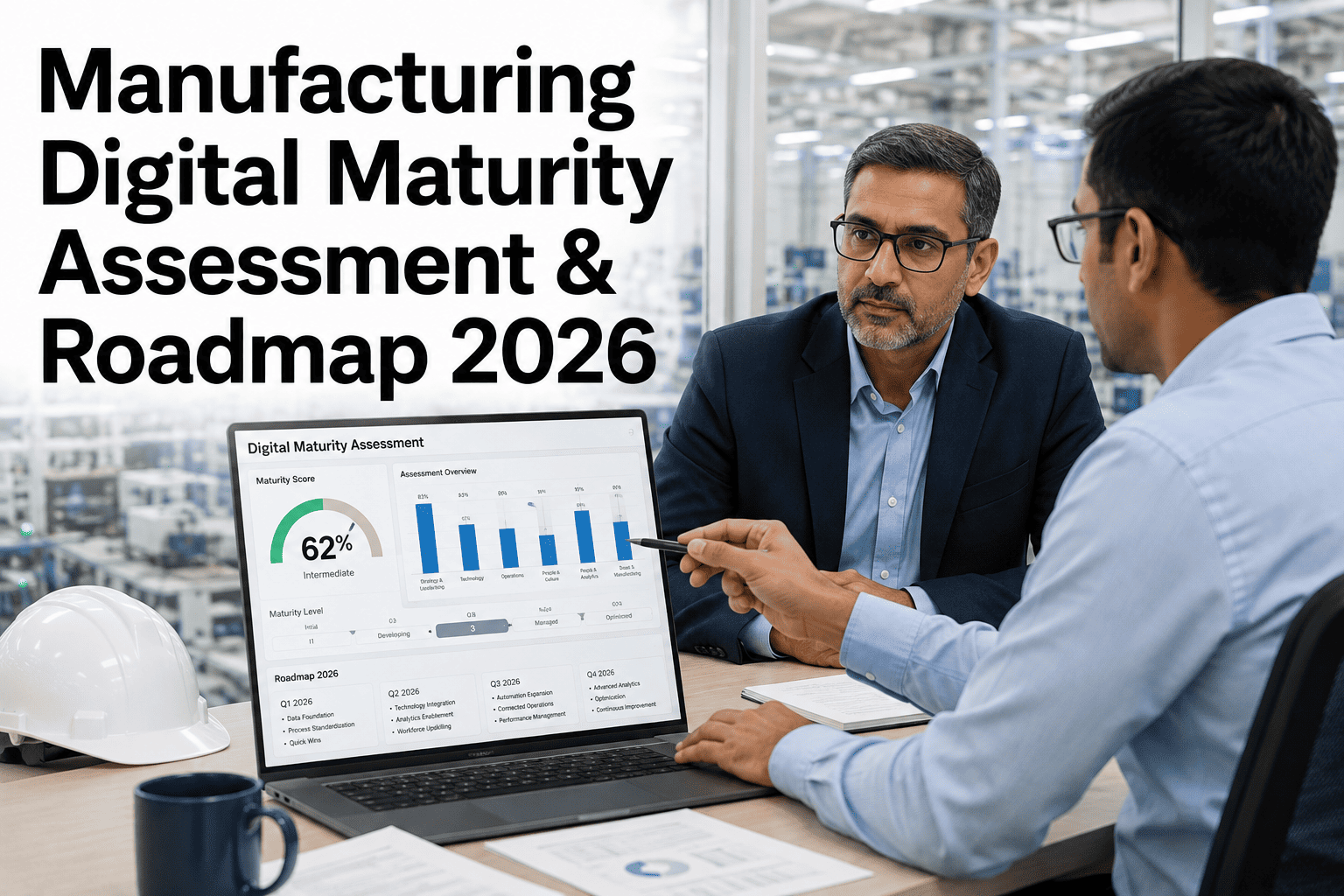
The transformation journey begins with a structured assessment of current operations — production reporting accuracy, maintenance cost per unit, quality defect rates, energy intensity, and technology system inventory. iFactory's deployment team conducts a two-week assessment that maps existing data flows, identifies automation-ready processes, and establishes baseline metrics for every KPI targeted for improvement. The assessment phase delivers a prioritized digital transformation plan with project timelines, resource requirements, and ROI projections for each implementation phase.
Output: Current state assessment · baseline metric report · prioritized technology roadmap · ROI projections and phasing plan
Phase 2
Foundation Deployment — MES, CMMS, and Core Infrastructure
Phase 2 deploys the foundational technology systems that create the digital operations backbone — MES for production tracking and work order execution, CMMS for maintenance management and asset history, and the IoT/PLC integration infrastructure that connects production equipment to the digital platform. This phase establishes real-time production visibility, digital work order management, and automated data collection that replaces manual reporting. Typical deployment duration is 8–12 weeks depending on facility size and system complexity.
Output: Live MES and CMMS · digital work order management · real-time production dashboards · connected equipment data streams
Phase 3
Intelligent Systems — AI Vision, Predictive Analytics, and Digital Twin
Phase 3 layers intelligent systems onto the digital foundation — AI Vision cameras for automated quality inspection and worker safety monitoring, predictive analytics models that analyze sensor data to forecast equipment failures, and Digital Twin simulation that enables virtual factory optimization. These systems use the data infrastructure established in Phase 2 to deliver advanced capabilities without requiring additional integration work. The predictive maintenance module, for example, consumes the same equipment data streams already flowing into the CMMS.
Output: AI Vision inspection station deployment · predictive maintenance models active · Digital Twin simulation environment · integrated analytics dashboards
Phase 4
Optimization and Scale — Robotics AI, Advanced Analytics, and Continuous Improvement
The final phase extends digital transformation across the full facility and into adjacent operations — Robotics AI orchestration for multi-robot fleet management, advanced analytics for cross-system optimization, supplier and vendor management integration, and enterprise system connectivity to ERP and supply chain platforms. This phase focuses on continuous improvement using the data foundation and intelligent systems from prior phases to drive ongoing performance gains. iFactory's platform enables this scaling without proportional increases in integration cost or complexity.
Output: Unified robotics fleet orchestration · cross-system analytics · enterprise system integration · continuous improvement framework with measured KPIs
40%
Average OEE improvement across iFactory-managed digital transformation deployments within six months
8–12
Weeks to deploy foundational MES and CMMS systems with integrated production visibility dashboards
12–18
Months to full digital transformation ROI with phased implementation approach across four phases
500+
Manufacturing facilities deployed with iFactory's integrated digital transformation platform
Start Your Digital Transformation with a Phased, Measurable Roadmap — One Platform for MES, CMMS, AI Vision, Digital Twin, and Robotics AI.
iFactory AI provides the unified platform that enables manufacturers to execute digital transformation in four phases with measurable ROI at each stage — from foundational MES and CMMS deployment to advanced AI Vision, predictive analytics, Digital Twin simulation, and Robotics AI orchestration.
Expert Review: What Manufacturing Leaders Say About Digital Transformation Strategy and Execution
"After leading digital transformation programs at five manufacturing facilities over the past decade, the single most important lesson I have learned is that technology capability far exceeds organizational absorption capacity in most manufacturing organizations. The temptation is to deploy every Industry 4.0 technology simultaneously — AI vision here, predictive maintenance there, a digital twin somewhere else — because each vendor presents their solution as the highest-priority investment. What happens in practice is that the organization gets spread too thin across too many deployment projects, none of which are integrated with each other, and the promised compounding value of connected systems never materializes because the systems were never actually connected. The facilities that achieved genuine digital transformation — where OEE improved by 35 to 50 percent, unplanned downtime dropped by more than half, and quality reject rates fell by 60 percent or more — were the ones that followed a phased, platform-based approach. They deployed a unified MES and CMMS foundation first, stabilized those systems until the data was trusted and used daily by operators and supervisors, and then layered intelligent systems onto that foundation. The integration was inherent because the platform architecture was designed for it — not because a system integrator spent six months building custom APIs between products that were never designed to work together. iFactory's platform embodies this approach. The MES, CMMS, AI Vision, Digital Twin, and Robotics AI modules share a common data model and integration layer, so each phase builds naturally on the previous one without requiring custom integration work. The facilities using iFactory's phased approach are reaching full transformation ROI in 12 to 18 months while facilities attempting to integrate multiple best-of-breed systems independently are still building interfaces at the 24-month mark. In manufacturing digital transformation, integration architecture is strategy."
Senior Vice President of Digital ManufacturingGlobal Industrial Manufacturing Company — 5 Digital Transformation Programs — 25 Years Manufacturing Operations and Technology Leadership — Industry 4.0 Certified Professional
Conclusion: Digital Transformation Is a Journey, Not a Project — Start with the Right Platform Foundation
Manufacturing digital transformation is not a single project with a defined end date — it is an ongoing capability-building journey that progresses through assessment, foundation deployment, intelligent system integration, and continuous optimization. The facilities that achieve the highest returns from digital transformation are those that treat the technology platform decision as the most strategic choice in the journey, selecting a unified platform that can support all phases of transformation without requiring custom integration between systems that were never designed to work together.
iFactory AI provides this unified platform — MES, CMMS, AI Vision, Digital Twin, Robotics AI, predictive analytics, and energy monitoring in a single integrated system with pre-built connections to SAP, PLC, SCADA, and IoT sensor networks. With more than 500 manufacturing facilities deployed and an average OEE improvement of 40 percent within six months, iFactory's platform gives manufacturers the technology foundation to execute a phased digital transformation roadmap with measurable ROI at every stage. Book a Demo to discuss your digital transformation roadmap and see iFactory's platform configured for your production environment.
Frequently Asked Questions
Manufacturing digital transformation is the strategic integration of digital technologies — including MES, CMMS, AI vision, predictive analytics, digital twin simulation, and robotics orchestration — into every aspect of factory operations to fundamentally improve productivity, quality, decision-making speed, and operational agility. It matters because facilities operating with paper-based processes, siloed systems, and reactive maintenance strategies are structurally unable to compete with digitally integrated factories on cost, quality, delivery reliability, or sustainability metrics. Research indicates that manufacturers with mature digital transformation programs achieve 35–50% higher OEE, 45% less unplanned downtime, and 60% fewer quality defects compared to facilities relying on traditional manufacturing approaches.
A complete digital transformation program using a phased, platform-based approach typically spans 12 to 18 months to full ROI. The foundational phase — MES and CMMS deployment with real-time production visibility — can be completed in 8 to 12 weeks. The intelligent systems phase — AI vision, predictive analytics, and digital twin — adds 8 to 16 weeks. The optimization and scale phase — robotics AI, advanced analytics, and enterprise integration — extends the program to approximately 12 to 18 months total. Manufacturers attempting to deploy multiple best-of-breed systems with custom integration report timelines of 24 to 36 months due to integration complexity and organizational disruption from managing multiple parallel deployment projects.
A comprehensive manufacturing digital transformation program typically includes six core technology domains: Manufacturing Execution System (MES) for real-time production tracking and work order management, Computerized Maintenance Management System (CMMS) for asset management and predictive maintenance, AI Vision for automated quality inspection and worker safety monitoring, Digital Twin for production simulation and optimization, Robotics AI for multi-robot fleet orchestration, and Energy Monitoring for sustainability tracking and cost reduction. iFactory's platform provides all six technology domains in a single integrated system with a common data model, eliminating the integration complexity and data fragmentation that occurs when deploying multiple standalone solutions from different vendors.
Digital transformation ROI is measured across five primary value drivers: OEE improvement (targeting 35–50% increase through reduced downtime, faster changeovers, and higher quality rates), maintenance cost reduction (25–35% reduction through predictive maintenance that eliminates unnecessary PM and prevents catastrophic failures), quality cost reduction (60% reduction in defect escapes and warranty claims through AI-powered inspection), energy cost reduction (18–25% reduction through real-time monitoring and AI-driven optimization), and labor productivity improvement (20–30% reduction in manual data entry and reporting overhead through digital work orders and automated data collection). iFactory's analytics platform automatically tracks these metrics and generates ROI reports that quantify the financial impact of each transformation phase.
The first step is conducting a structured current-state assessment that maps existing production workflows, data flows, technology systems, and operational metrics to establish baseline performance and identify highest-impact transformation opportunities. iFactory's deployment team conducts a two-week on-site assessment that produces a prioritized digital transformation roadmap with project timelines, resource requirements, and ROI projections for each implementation phase. The assessment covers production reporting accuracy, maintenance cost per unit, quality defect rates, energy intensity, technology system inventory, and workforce digital capability. The resulting roadmap enables manufacturing leaders to invest with confidence, knowing that each phase builds on the previous one and generates measurable returns that fund subsequent phases.
Build Your Digital Transformation Roadmap — One Platform for the Entire Smart Factory Journey.
iFactory AI provides the unified platform — MES, CMMS, AI Vision, Digital Twin, Robotics AI, and predictive analytics — that enables phased, measurable digital transformation for U.S. manufacturing facilities with proven ROI at every stage.