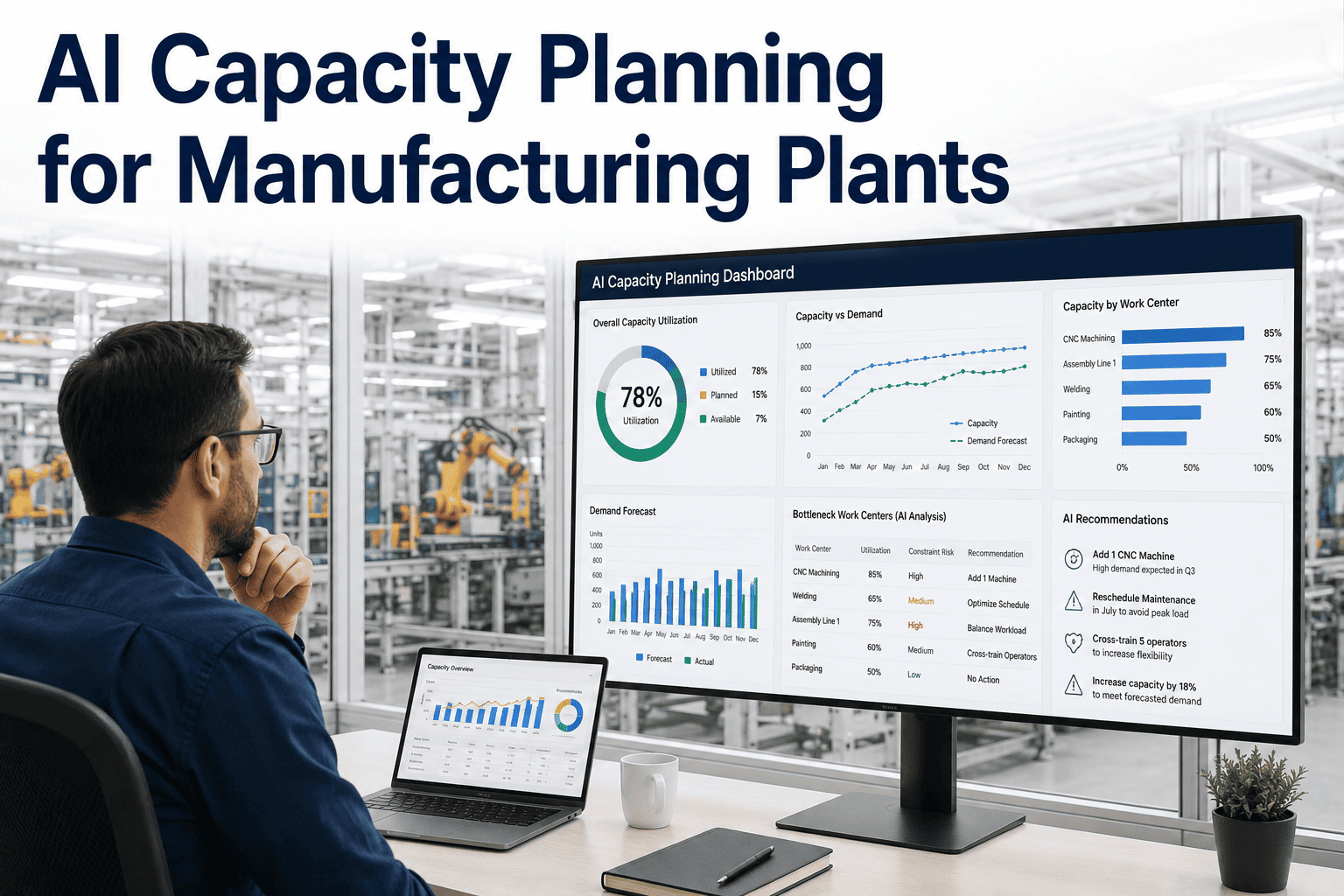
Ask most capacity planners where their numbers live and the honest answer is a spreadsheet, updated by hand, built on assumptions nobody has checked since the formula was first written. Capacity equals machines times hours times shifts times utilization looks clean on a slide, but it quietly ignores machine variability, operator skill constraints, and the shared resources that actually decide what a plant can produce this week. iFactory replaces that static formula with a live model built from real machine and labor data. Book a demo to see your actual capacity number, not the spreadsheet version of it.
AI Capacity Planning + Manufacturing
Your Capacity Spreadsheet Is Lying to You. Politely. Every Week.
iFactory builds a live capacity model from real machine, labor, and maintenance data — so the number you plan against actually matches what the plant can produce.
The Formula Every Plant Knows — And What It Leaves Out
The formula assumes a static utilization rate that rarely reflects what actually happens shift to shift. It does not know that one machine has drifted out of its rated cycle time, that a specific operation requires a certified operator who is only on days, or that a shared finishing station creates a queue no spreadsheet row accounts for. Planners inherit a number that looks precise and behaves like a guess.
Where the Static Formula Breaks First
Machine Variability
Actual cycle times drift from rated speed over time, and a spreadsheet built on nameplate capacity never catches the gap.
Operator Skill Constraints
Capacity on paper assumes any operator can run any job, when in practice only a subset are certified for certain operations.
Shared Resources
A shared finishing station, testing bay, or tooling set limits throughput for an entire product family in ways line-level capacity math misses entirely.
Maintenance Windows
Planned and unplanned maintenance removes capacity that most spreadsheets only reconcile after the fact, if at all.
Changeover Time
A growing product mix means more changeovers eating into available hours, often faster than the utilization assumption gets updated.
Quality Holds
Capacity tied up in a quality investigation is capacity that does not exist for planning purposes, yet static formulas count it as available.
Spreadsheet Planning vs. AI Capacity Planning
Data source
Manual entry, updated periodically
Live machine, labor, and maintenance data
Utilization assumption
Fixed rate applied across the board
Modeled per machine, per shift, per operator
Bottleneck visibility
Discovered after output drops
Flagged before it multiplies downstream
Scenario testing
Rebuilt manually for each what-if
Simulated in minutes against live constraints
Planner time spent
Hours reconciling data across systems
Minutes reviewing a model that is already current
See Your Real Capacity Number, Not the Spreadsheet Version
Bring your current capacity plan to the call and we'll show you where it diverges from what your machines and people are actually delivering.
How AI Builds a Capacity Model That Reflects Reality
Step 1
Ingest Live Constraints
Machine status, labor calendars, tooling availability, and maintenance schedules feed the model continuously instead of a periodic manual update.
Step 2
Model Real Variability
Actual cycle times and changeover durations replace nameplate assumptions, so the utilization number reflects what machines actually do.
Step 3
Surface the True Bottleneck
The model identifies which resource is actually limiting throughput this week, which is often not the constraint planners assumed.
Step 4
Update as Conditions Change
A machine going down or clearing inspection updates available capacity immediately, keeping planning and maintenance aligned automatically.
Scenario Planning Without the Rebuild
Supplier Delay
Model the capacity impact of a three-day material delay before it happens, and see which orders would need to shift.
Rush Order Acceptance
Check whether accepting a new rush order is feasible against current capacity before committing to the customer.
Planned Maintenance Window
See the real throughput impact of scheduling a maintenance window this week versus next, based on current order load.
Demand Spike
Test whether a forecasted demand increase can be absorbed with existing capacity or requires overtime, an extra shift, or outsourcing.
What Capacity Planners Report
15+ hrs
Weekly planner time reclaimed from manual reconciliation
97%
Forecast accuracy achievable with AI-driven modeling
Minutes
To simulate a what-if scenario, not a manual rebuild
Real-Time
Capacity view instead of a stale weekly snapshot
Common Capacity Planning Mistakes AI Catches Early
Treating Nameplate Speed as Real Speed
A machine rated for a certain cycle time rarely runs at that speed indefinitely, and planning against the rating instead of actual performance overstates available capacity.
Ignoring Certification Coverage
Counting every operator as interchangeable hides the fact that a single certified operator on one shift can be the real ceiling on a specific product line.
Averaging Away Seasonal Swings
A flat utilization rate applied year-round smooths over predictable seasonal demand spikes that a live model can plan for in advance instead of absorbing as a surprise.
Updating Capacity After the Fact
Reconciling capacity assumptions once a month means every decision made in between was based on numbers that were already out of date.
How This Fits Into the Broader Planning Cycle
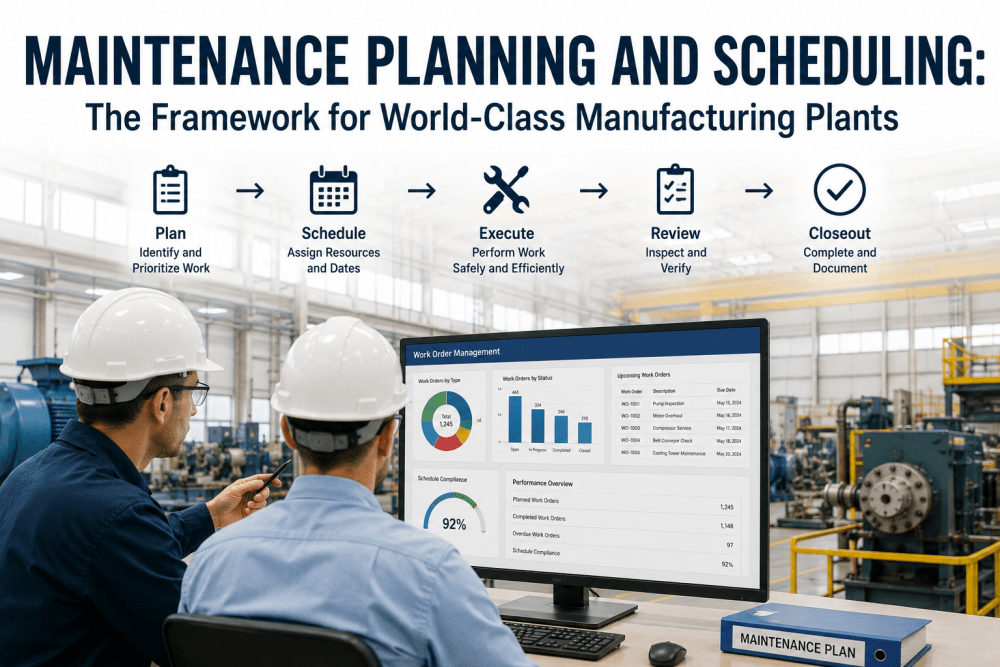
Capacity planning does not happen in isolation. The same live model that tells a capacity planner what the plant can produce this week also feeds directly into production scheduling, sales and operations planning, and maintenance scheduling — all of which depend on the same underlying number. When those functions each maintain their own separate, manually updated version of capacity, small discrepancies compound into missed commitments. A shared, continuously updated capacity model keeps planning, scheduling, and maintenance working from the same reality, which is often the single biggest source of friction reduction plants report after deployment.
FAQ: AI Capacity Planning for Manufacturing Plants
We already have a capacity planning module in our ERP. Why isn't that enough?
Most ERP capacity modules apply finite or infinite capacity rules based on routing times and available hours, which is a reasonable starting point but does not account for real machine variability, operator certification constraints, or shared resource queues. The result is a capacity number that is directionally useful but often diverges from what the floor can actually deliver in a given week. AI capacity planning layers live constraint data on top of that baseline to close the gap.
How much historical data do we need before the model is accurate?
The model can begin working with your current routing, machine, and labor data from day one, and accuracy improves as actual cycle times and changeover durations accumulate over the following weeks. Most plants see the model catching real discrepancies against their spreadsheet numbers within the first month. You do not need months of historical data collected in advance before getting started.
Can this replace our spreadsheets entirely, or does it work alongside them?
Most plants run it alongside existing tools during the transition, using it to validate and eventually replace manual capacity spreadsheets as trust in the live model builds. Planners typically keep using familiar reporting formats while the underlying number comes from the AI model instead of manual entry. Reach out through
support if you want to discuss a phased rollout that fits your current planning cycle.
How does the system identify the real bottleneck if it changes from week to week?
Because the model ingests live machine, labor, and maintenance data continuously, it recalculates which resource is actually constraining throughput as conditions change rather than relying on a fixed assumption about where the bottleneck sits. This matters because the real constraint in a plant often moves — a finishing station one week, a certified operator shortage the next. The model surfaces whichever constraint is binding right now, not the one identified in last quarter's study.
What kind of ROI should a capacity planning team expect?
Planners commonly reclaim more than fifteen hours a week previously spent reconciling capacity data across systems, and forecast accuracy can improve substantially compared to spreadsheet-based averages. Scenario testing that used to take a manual rebuild now takes minutes, which changes how often planners actually test a what-if before committing to it.
Book a demo to model the expected impact against your own plant configuration.
AI Capacity Planning + iFactory
Plan Against Real Capacity, Not a Spreadsheet Assumption.
iFactory builds a live capacity model from your actual machine, labor, and maintenance data — so every plan starts from a number you can trust.