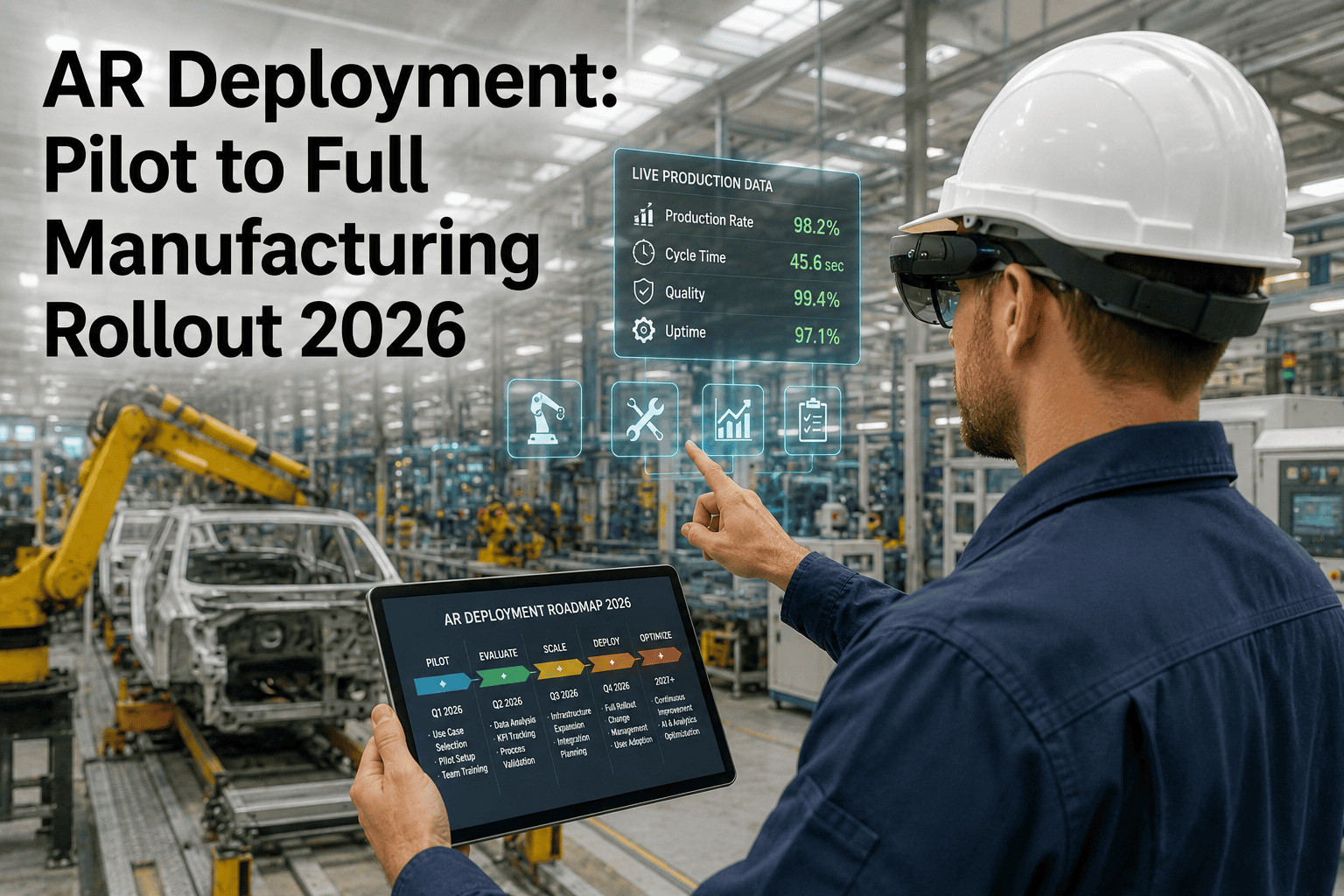
Somewhere in almost every manufacturing plant that bought AR smart glasses in the last two years, there is a box of them sitting in a supply cabinet. The pilot went fine — a handful of technicians used them for a few weeks, the demo to leadership looked great, and then the project quietly stopped because nobody had defined what "success" meant before it started, and nobody owned the plan to go from ten devices to two hundred. Scaling AR past the pilot stage is not a hardware problem. It is a sequencing problem: site selection, baseline metrics, phased expansion, and change management, done in the right order. This guide walks through that sequence. To see how iFactory structures a pilot that actually leads to a funded rollout, book a 30-minute demo with our team.
Most AR Pilots Don't Fail. They Just Never Get a Plan to Scale.
A successful pilot and a fundable rollout are two different projects. This page breaks down the phased path from a ten-device pilot to a plant-wide AR deployment — site selection, baseline metrics, KPI tracking, and the change management that determines whether the technology actually sticks.
Why Promising Pilots Stall Before They Ever Scale
The technology almost never causes the stall. What causes it is a pattern that repeats across manufacturers: a pilot gets approved as a proof-of-concept with no defined success threshold, it runs long enough to generate a positive anecdote, and then it sits without a business case strong enough to justify the next budget cycle. Four specific gaps show up again and again, and each one is preventable with a small amount of planning before the first device ever ships to the floor.
Without measuring task time, error rate, or first-time fix rate before the pilot started, there is no credible "before and after" to present when asking for scale-up budget — only a subjective sense that it helped.
"See how it goes" is not a pilot objective. Without numeric thresholds agreed in advance, a technically successful pilot can still fail to produce a decision, because nobody can agree whether the results were good enough.
Piloting with your most tech-enthusiastic technicians produces glowing feedback that does not predict how the rest of the workforce, including skeptical veterans, will respond once the rollout goes wide.
Device management, network capacity, and security review get treated as pilot afterthoughts, then become the actual blocker when a ten-device pilot needs to become a two-hundred-device deployment across multiple sites.
The Four-Phase Path From Pilot to Plant-Wide Rollout
Manufacturers who scale AR successfully treat it as a staged program with a decision gate at the end of each phase, not a single go-live event. Each phase has a distinct objective, and the exit criteria for one phase becomes the entry requirement for the next.
Baseline & Scope
Capture current task time, error rate, and cost data for the workflow you plan to target before a single device is deployed, and define the numeric thresholds that will decide pass or fail.
Focused Pilot
Deploy 10 to 20 devices with a single crew on one or two well-defined workflows, run for four to eight weeks, and gather structured feedback alongside the performance data.
Validate & Refine
Compare results against baseline, fix the workflow and content issues the pilot surfaced, and build the ROI case with real numbers before requesting scale-up budget.
Phased Scale-Up
Expand in waves — additional shifts, additional lines, additional sites — with device management, network capacity, and content library scaled ahead of each wave rather than reacting to it.
Choosing the Right Pilot Site: A Selection Checklist
Not every line or workflow makes a good pilot candidate. The strongest pilot sites share a specific set of traits that make results easy to measure and easy to defend when the time comes to ask for a bigger budget.
Choose a workflow performed often enough — daily or multiple times per shift — that even a modest per-task improvement compounds into a measurable result within the pilot window.
A workflow with documented rework, first-time-fix issues, or training-related mistakes gives the pilot an obvious, quantifiable problem to solve rather than a vague productivity hope.
A frontline supervisor who is genuinely engaged, not just compliant, becomes the difference between a pilot that gets real feedback and one that generates polite silence.
Pick a pilot area with reliable wireless coverage already in place, so connectivity issues don't get confused with the technology itself failing to deliver value.
Include at least a few skeptical, tenured workers alongside early adopters — their feedback predicts wider rollout resistance far better than an all-enthusiast pilot group.
Pick a workflow senior leadership already cares about, so a strong pilot result lands as evidence for a decision they were already motivated to make.
The Business Metrics That Actually Secure Scale-Up Budget
Technology metrics like device uptime matter operationally, but they rarely justify a capital request on their own. The metrics that move budget conversations are business outcomes measured against a real baseline captured before the pilot began.
Track these against the pre-pilot baseline weekly, not just at the end — a metric trending the wrong way in week three is far cheaper to fix than one discovered at the final review.
Build a Pilot Structure That Turns Into a Funded Rollout
We help scope the baseline metrics, pilot workflow, and success thresholds before day one, so the results you get at the end of the pilot are strong enough to take straight into a budget conversation.
Change Management: The Part of Scaling AR That Isn't About Hardware
Workers who fear a new device is meant to monitor or replace them will not adopt it, no matter how good the software is. The plants that scale successfully treat change management as its own workstream, with named owners across four roles.
Frontline Champions
Early adopters from the pilot group who genuinely like the technology become the most credible trainers for the next wave — their peers trust them more than any corporate rollout memo.
Supervisor Sponsors
Frontline supervisors who reinforce the "why" — safer, easier, faster, not surveillance — in daily huddles carry far more weight than a one-time announcement from leadership.
IT and Security Owner
A named IT stakeholder who owns device management, network capacity planning, and data governance from the pilot stage forward, so scaling doesn't stall on unresolved security review.
Executive Sponsor
A senior leader who owns the budget conversation and translates pilot results into the next funding decision, keeping the program from losing momentum between phases.
What Actually Changes Between a 15-Device Pilot and a 200-Device Rollout
Scaling is not simply buying more of the same devices. Each expansion wave adds infrastructure and process requirements that a small pilot never had to account for.
| Consideration | Pilot (10-20 devices) | Scale (100-200+ devices) |
|---|---|---|
| Device Management | Manual setup and tracking | Centralized MDM with remote wipe and app control |
| Network Capacity | Existing wireless usually sufficient | Dedicated capacity planning and coverage audit required |
| Content Library | One or two workflows scripted manually | Standardized content pipeline across many workflows and lines |
| Support Model | Direct vendor or IT support | Tiered internal support with escalation paths defined |
| Procurement | Standard per-unit pricing | Volume agreements reducing per-device cost 15-25% |
| Training | One-on-one onboarding | Train-the-trainer model using pilot champions |
Where Scale-Up Efforts Most Commonly Break Down
Even well-run pilots can stall during expansion if these specific risks aren't planned for in advance.
Hand-built AR guidance for one workflow does not translate efficiently to dozens of others without a standardized content creation process built in from the start.
Wireless infrastructure that comfortably handled 15 devices can degrade sharply at 150 concurrent users streaming video and data without a capacity upgrade planned ahead of the wave.
Pilot champions who are expected to train the next wave without dedicated time or recognition for that role tend to disengage, taking their credibility with them.
A business case built on early pilot numbers goes stale by the time a second or third budget cycle rolls around — refreshing it with current data keeps momentum with leadership.
How iFactory Supports the Full Pilot-to-Scale Journey
We built our AR deployment process around the same phased structure described on this page, because we have watched too many manufacturers run a technically successful pilot that never turned into a funded rollout.
Frequently Asked Questions
How many devices should a first AR pilot include?
Ten to twenty devices deployed on a single team or workflow is the widely recommended starting point, since it is large enough to generate statistically meaningful results but small enough to manage closely, iterate quickly, and fix content or workflow issues before they multiply across a larger group. Pilots that start too large tend to surface problems at a scale that is harder to diagnose and more expensive to correct, while pilots that stay too small for too long struggle to generate results credible enough to justify a scale-up budget request. If you want help sizing a pilot for your specific plant and workflow, book a demo with our team.
How long should a pilot run before deciding whether to scale?
Four to eight weeks is typically enough time to move past the initial novelty period, gather a meaningful sample of performance data against baseline, and collect structured feedback from both early adopters and more skeptical participants. Running significantly longer without a defined decision point tends to let the pilot drift into an indefinite state where it neither scales nor gets shut down, consuming budget and attention without a clear outcome either way. Setting a fixed evaluation date at the start of the pilot, rather than leaving the end date open-ended, keeps the program moving toward an actual decision.
What is the biggest change management mistake during AR rollout?
The most damaging mistake is failing to address the fear that the technology is meant to monitor or replace workers, rather than make their job safer and easier. Left unaddressed, this fear drives quiet resistance that shows up as low usage rates or workers finding ways to avoid the device, even when leadership believes adoption is going well. Transparent communication about the "why" behind the deployment, combined with real involvement of frontline workers in shaping the pilot rather than just receiving it, is what prevents this pattern from taking hold. For guidance on structuring change communication for your rollout, reach out to our support team.
Does IT and network infrastructure need to be involved from the pilot stage?
Yes, and skipping this step is one of the most common reasons a working pilot cannot scale. AR devices stream video and data continuously, and infrastructure that handles fifteen devices comfortably can degrade significantly once usage grows into the hundreds without a capacity and coverage plan built ahead of each expansion wave. Involving IT early also means device management, security review, and data governance are solved once, during the pilot, rather than becoming an unplanned blocker right when the business case for scaling is strongest.
How much does it cost to scale an AR deployment beyond the pilot?
Per-device pricing typically drops fifteen to twenty-five percent once a deployment crosses roughly twenty-five units under a volume agreement, and many organizations pair this with managed service options that bundle device management, support, and replacement into a predictable monthly cost per device rather than a large upfront capital purchase. The total cost of scaling depends heavily on how much of the content library, device management, and training infrastructure was already built during the pilot phase versus needing to be built from scratch during the scale-up wave. To scope realistic costs for your rollout size, book a call with our team.
Turn Your AR Pilot Into a Funded, Plant-Wide Rollout
Baseline data, phased expansion, and change management built in from day one — not bolted on after the pilot stalls. See how iFactory structures this for manufacturers scaling past the pilot stage.





.png)