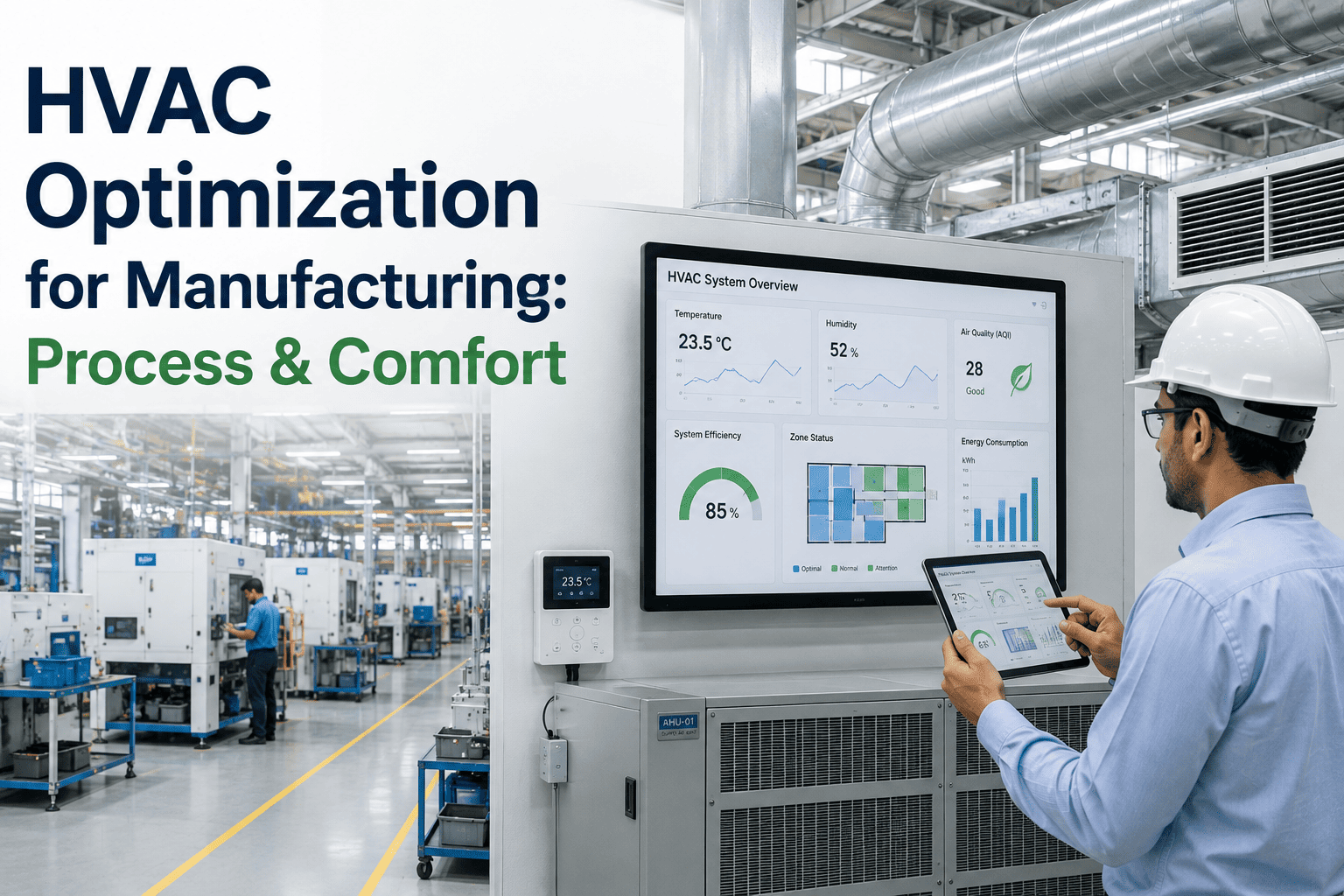
A furnace hall running at 45°C doesn't need the same air handling strategy as a cleanroom held at 21°C ± 1°C, yet plants often run both under one generic HVAC philosophy built for office comfort rather than production reality. The result is usually one of two failure modes: process-critical zones drift outside tolerance and scrap climbs, or comfort zones get over-conditioned and energy bills climb with them. iFactory reads zone-level temperature, humidity, and occupancy data continuously to separate process-driven HVAC needs from comfort-driven ones, and the reasoning behind that split is worth walking through before you Book a Demo.
One HVAC Strategy Can't Serve Both The Process And The People
Process zones need tight, consistent control because product quality depends on it. Comfort zones need a wider, more forgiving band because people, not product, are the constraint. iFactory tunes each zone against its actual requirement instead of running the whole plant on a single setpoint philosophy.
Process Tolerance And Human Comfort Are Not The Same Design Problem
Manufacturing HVAC has to satisfy two very different masters at once. Process zones — cleanrooms, coating lines, electronics assembly, pharmaceutical packaging, cold chain areas — have narrow, often regulatory-driven tolerance bands where a few degrees or a few percentage points of relative humidity can shift yield or trigger a batch deviation. Comfort zones — break rooms, offices, general assembly floors — have a much wider acceptable range where the real driver is worker fatigue, attention, and safety rather than product specification. When both zone types are controlled by the same air handling logic tuned to a single setpoint, one side is almost always compromised, either through unnecessary energy spend keeping comfort zones as tight as process zones, or through process drift when a comfort-oriented setpoint gets applied where it shouldn't.
Process Zones Drift Outside Spec
When HVAC is tuned for average comfort rather than the tighter tolerance a process actually needs, temperature and humidity swings during shift changes, door openings, or equipment load changes can push conditions outside the window that quality depends on.
Comfort Zones Are Over-Conditioned
Running general floor space at process-grade tightness burns energy for no quality benefit, since worker comfort tolerates a materially wider band than most product specifications allow.
Four Steps From Raw Zone Data To A Tuned HVAC Strategy
Rather than applying a plant-wide setpoint, iFactory works zone by zone, using historical and live sensor data to understand what each space actually requires before adjusting anything.
Classify Zones By Tolerance Requirement
Each zone is classified against its documented process tolerance where one exists, or against general comfort guidance where the space is occupancy-driven rather than process-driven, establishing a distinct control band per zone instead of a single plant-wide target.
Track Load Sources Continuously
Occupancy, equipment heat load, door and dock activity, and outside air conditions are tracked per zone so the model understands what is actually driving temperature and humidity swings in that specific space at that specific time.
Adjust Air Handling Per Zone Need
Process zones get tighter, more responsive control tuned to their tolerance window, while comfort zones are allowed to float within a wider band, reducing unnecessary conditioning without risking product quality anywhere it matters.
Flag Drift Before It Becomes A Deviation
Process zones trending toward their tolerance boundary generate an early alert well before a formal deviation would be logged, giving facilities staff time to intervene rather than reacting after a batch or lot has already been affected.
Humidity And Ventilation Rate Matter As Much As Setpoint Temperature
Temperature gets most of the attention in HVAC conversations, but humidity control and ventilation rate often carry more weight for both product quality and worker wellbeing than the thermostat setting alone. A zone can sit exactly on its target temperature and still cause problems if relative humidity drifts, since moisture affects hygroscopic materials, static-sensitive electronics assembly, and coating cure rates in ways that temperature alone doesn't capture. Ventilation rate matters just as much on the comfort side, where recirculated air with too little outside air exchange contributes to the drowsiness and reduced attention that shows up on long shifts, particularly in enclosed production areas without natural airflow.
Humidity-Sensitive Processes
Coating cure times, hygroscopic material handling, and static-sensitive electronics work all depend on relative humidity staying inside a defined band, independent of whether the temperature reading looks acceptable on its own.
Ventilation And Worker Attention
Fresh air exchange rate in enclosed comfort zones affects alertness over a shift, and a zone that is temperature-correct but under-ventilated can still produce the fatigue effects associated with poor air quality.
What Changes When Zones Are Controlled Separately
| Aspect | Single Plant-Wide Setpoint | Zone-Specific Control |
|---|---|---|
| Process tolerance risk | Elevated during load swings | Reduced through tighter zone-specific control |
| Comfort zone energy use | Higher than necessary | Reduced by allowing a wider band |
| Deviation response time | Reactive, after the fact | Early warning before tolerance is breached |
| Setpoint changes across shifts | Manual, inconsistent | Adjusted automatically per occupancy and load |
Stop Running One Setpoint Across A Plant With Two Different Needs
iFactory separates process-critical HVAC zones from comfort zones and controls each against its own tolerance.
Our coating line and our general assembly floor share one air handling loop, and for years that meant keeping the whole loop tight enough for the coating line, which was expensive. Since iFactory started separating the two by zone, we're running the assembly floor on a wider band and only holding tight control where the coating process actually needs it, and our facilities energy spend has come down without a single new quality deviation.
What Plants Report After Zone-Specific HVAC Tuning
Economizer And Free Cooling Windows Are Often Left On The Table
Once zones are correctly classified and controlled to their real tolerance, the next source of savings usually sits in how much mechanical cooling gets used when outside air conditions could do the job for free. Many air handling units already have economizer dampers installed but running on a conservative fixed schedule that doesn't track actual outside air temperature and humidity closely enough to capture every available free-cooling hour, particularly during shoulder seasons when conditions swing through the usable range several times in a single day. A model reading live outside air conditions against each zone's tolerance can open the economizer whenever it's genuinely usable rather than only during a scheduled window, without risking a process zone drifting outside its band.
Condition-Based Economizer Control
Outside air temperature and humidity are compared continuously against each zone's tolerance so free cooling is used whenever it's genuinely viable, not just during a fixed calendar window.
Shoulder Season Capture
Spring and fall conditions often swing in and out of the usable free-cooling range within the same day, and a fixed schedule misses much of that opportunity that condition-based control captures automatically.
Common Obstacles In HVAC Optimization Programs
Undocumented Zone Tolerances
Some process zones were set up years ago without a clearly documented tolerance band, forcing a review of historical quality data before a defensible control range can even be established.
Shared Air Handling Loops
Zones with genuinely different needs sometimes share the same air handling unit, which limits how independently each can be tuned until ductwork or zoning changes are made.
Seasonal Load Swings
A control strategy tuned during one season can underperform in another if outside air conditions and humidity load shift significantly, so the model needs a full seasonal cycle of data to tune reliably.
Frequently Asked Questions
Q: Do we need to re-zone our ductwork before this works?
Not in most cases. Many plants already have enough zone-level sensing and damper control to separate process from comfort logic without physical rework, and iFactory typically starts by working within existing air handling infrastructure. Where zones are so tightly shared that independent control genuinely isn't possible, that gets flagged early during setup rather than discovered later. Reach out through Support Contact to review your current air handling layout.
Q: How does the model decide a zone is process-critical versus comfort?
Classification starts from documented process specifications where they exist, such as cleanroom class requirements or product storage conditions, and from historical temperature and humidity variance where no formal specification is on file. Occupancy patterns and equipment heat signatures are also factored in, since a space with heavy machinery and light foot traffic behaves very differently from an office area with the reverse pattern.
Q: Will loosening comfort zone control affect worker conditions negatively?
The comfort band used is still within recognized occupational comfort guidance, not an arbitrary widening for the sake of energy savings, so the change is meant to eliminate unnecessary over-conditioning rather than to under-serve worker comfort. Most plants find the difference is not perceptible to occupants even though the energy impact is measurable over a full year of operation.
Q: Can this help during a regulatory audit of a controlled environment?
Yes, continuous zone-level logging of temperature and humidity against the documented tolerance band creates a defensible record that a control strategy was actively maintained, which is typically useful supporting evidence during a quality or regulatory audit of a controlled manufacturing environment. Discuss your specific audit requirements during a Book a Demo session.
Q: How long before energy savings become visible?
Comfort zone energy reduction is often visible within the first full billing cycle after tuning, since it reflects a direct reduction in conditioning load, while process zone deviation reduction takes longer to confirm statistically since it depends on accumulating enough production cycles to show a meaningful trend against the prior baseline.
Give Every Zone The HVAC Strategy It Actually Needs
iFactory separates process-critical control from comfort control so neither one compromises the other.