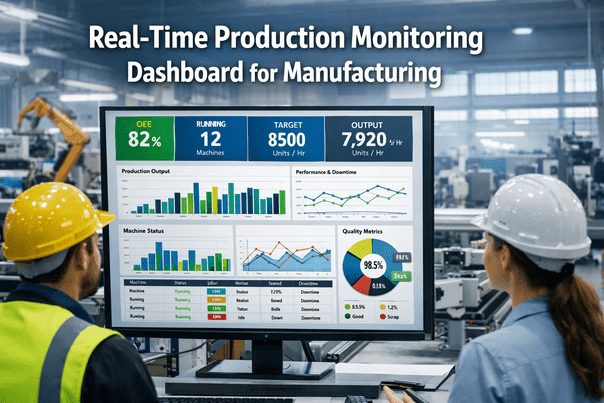
The factory floor is evolving faster than most manufacturers realize. While traditional production lines rely on fixed logic and manual adjustments, AI-driven smart manufacturing systems are learning from every sensor reading, every cycle time, and every quality deviation to optimize processes in real time—without waiting for a shift supervisor to notice something is off. The global AI in manufacturing market is projected to reach $155 billion by 2030, and early adopters are already reporting 20-30% productivity gains through intelligent process control. Wondering how much throughput and efficiency your plant is leaving on the table? Book a free demo to get a personalized AI optimization assessment for your production line.
What Is AI-Driven Smart Manufacturing and Why Does It Matter Now
AI-driven smart manufacturing integrates machine learning, IoT sensor networks, and edge computing into production systems to enable autonomous decision-making at the machine level. Unlike conventional automation that follows pre-programmed rules, AI models continuously analyze thousands of process variables simultaneously—identifying hidden correlations, predicting failures, and adjusting parameters to maintain optimal production conditions. The urgency is clear: according to Deloitte's 2025 Smart Manufacturing Survey, 46% of manufacturing executives rank process automation as their top investment priority, yet only 29% have deployed AI at the facility level. The gap between intent and execution represents a massive competitive opportunity for manufacturers ready to act.
The Five Pillars of Real-Time Process Optimization in Smart Factories
Real-time process optimization does not rely on a single technology. It is built on five interconnected capabilities that work together to create a self-improving production system. Each pillar addresses a specific operational gap that traditional manufacturing methods leave open.
Key AI Applications Transforming the Factory Floor
AI in manufacturing is not a single capability—it is an ecosystem of specialized applications that address distinct operational challenges. The most impactful applications share a common thread: they turn reactive operations into proactive, self-optimizing systems.
How AI Process Optimization Differs from Traditional Automation
Many manufacturers confuse upgrading PLC programs with implementing AI. The distinction matters because the operational results are fundamentally different. Traditional automation executes pre-defined instructions efficiently, while AI optimization discovers the best instructions by learning from data.
Industry-Specific AI Optimization Use Cases
Every manufacturing sector has distinct process variables, equipment types, and regulatory requirements that shape how AI optimization delivers value. The most effective deployments tailor their models to industry-specific operating conditions rather than applying generic algorithms.
| Sector | Critical Equipment | AI Optimization Target | Measurable Outcome |
|---|---|---|---|
| Automotive | Stamping, welding robots, paint booths | Weld quality prediction, paint thickness uniformity, cycle time reduction | 30% fewer quality escapes, 15% faster changeovers |
| Electronics | SMT placement, reflow soldering, AOI | Solder paste volume control, thermal profile optimization, placement accuracy | Near-zero defect rates on high-density boards |
| Pharmaceuticals | Mixing vessels, tablet compression, packaging | Batch consistency monitoring, environmental compliance, serialization | 40% reduction in batch deviations and rework |
| Food and Beverage | Processing lines, ovens, filling machines | Recipe parameter tuning, sanitation cycle optimization, shelf-life modeling | 12% waste reduction, improved product consistency |
| Aerospace | 5-axis CNC, additive manufacturing, NDT | Tool path optimization, material integrity verification, tolerance control | Tighter tolerances with 60% less material waste |
| Chemicals | Reactors, distillation columns, heat exchangers | Reaction yield maximization, energy intensity reduction, emissions control | 8-15% higher yields, regulatory compliance automated |
Quantifiable Results from AI-Powered Manufacturing
The business case for AI process optimization is built on measurable, documented results across multiple performance dimensions. These metrics reflect composite data from industrial deployments and research studies spanning automotive, electronics, aerospace, and process manufacturing sectors.
Step-by-Step Deployment Guide for Manufacturing AI
Successful smart manufacturing transformation follows a phased approach that delivers quick wins early while building toward comprehensive facility-wide optimization. Rushing directly to closed-loop control without proper data foundations is the most common deployment mistake—and the most avoidable.
Integration Architecture for Smart Factory Systems
An AI manufacturing platform does not replace existing systems—it connects and enhances them. Successful integration creates a unified intelligence layer that makes every connected system smarter by sharing context across operational boundaries.
| Connected System | Integration Method | Data Flow |
|---|---|---|
| SCADA / DCS | Real-time bidirectional via OPC-UA | Process variables, setpoints, alarm data, automated optimization commands |
| MES / MOM | Transaction-based API integration | Production orders, batch tracking, quality data, OEE calculations |
| ERP Platforms | Scheduled batch synchronization | Cost allocation, material planning, demand forecasts, order management |
| CMMS / EAM | Event-triggered work order creation | Predictive maintenance alerts, asset health scores, spare parts forecasting |
| Quality Management | Continuous data feed | SPC charts, inspection results, non-conformance reports, corrective actions |
Overcoming Common Smart Manufacturing Adoption Barriers
Every manufacturer faces obstacles when transitioning to AI-driven operations. The difference between organizations that succeed and those that stall lies not in avoiding challenges but in addressing them systematically with proven strategies.
| Barrier | Operational Impact | Resolution Strategy |
|---|---|---|
| Legacy equipment incompatibility | Older machines lack connectivity, limiting data availability | Retrofit IoT sensors and protocol gateways that bridge legacy PLCs to modern platforms without equipment replacement |
| Fragmented data across departments | No unified view of production, quality, and maintenance performance | Implement a unified data lake with standardized ingestion from all operational systems |
| Skilled workforce shortage | 48% of manufacturers report significant challenges filling production roles | Role-specific training programs, intuitive dashboards, and digital champion networks to drive adoption |
| Uncertain return on investment | Difficulty securing budget and executive sponsorship for AI initiatives | Phased pilot approach with clear KPIs at each stage—prove value before scaling investment |
| OT/IT cybersecurity risk | Increased connectivity expands the attack surface for manufacturing systems | Zero-trust architecture, network segmentation, edge-first processing, and SOC 2 compliance |