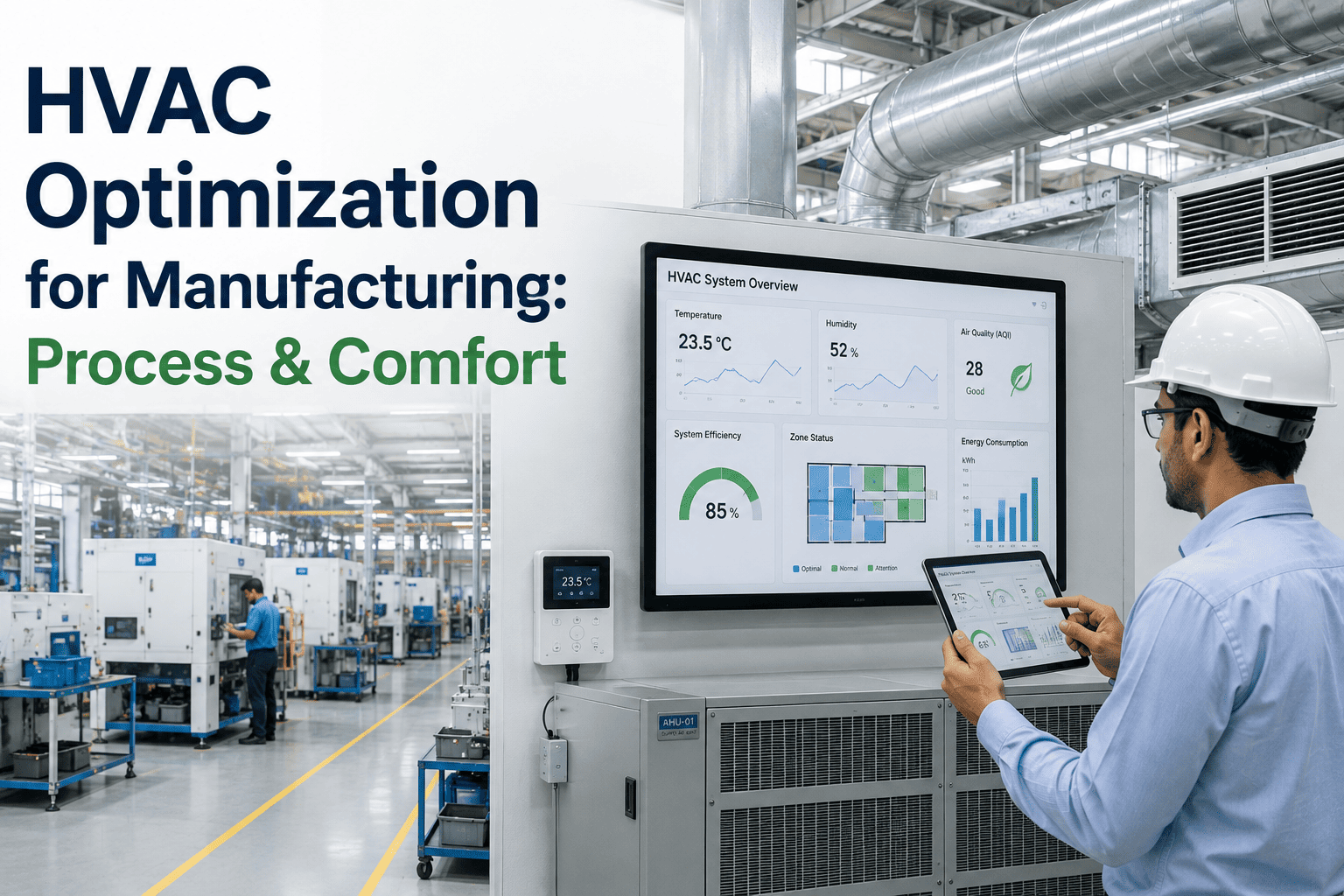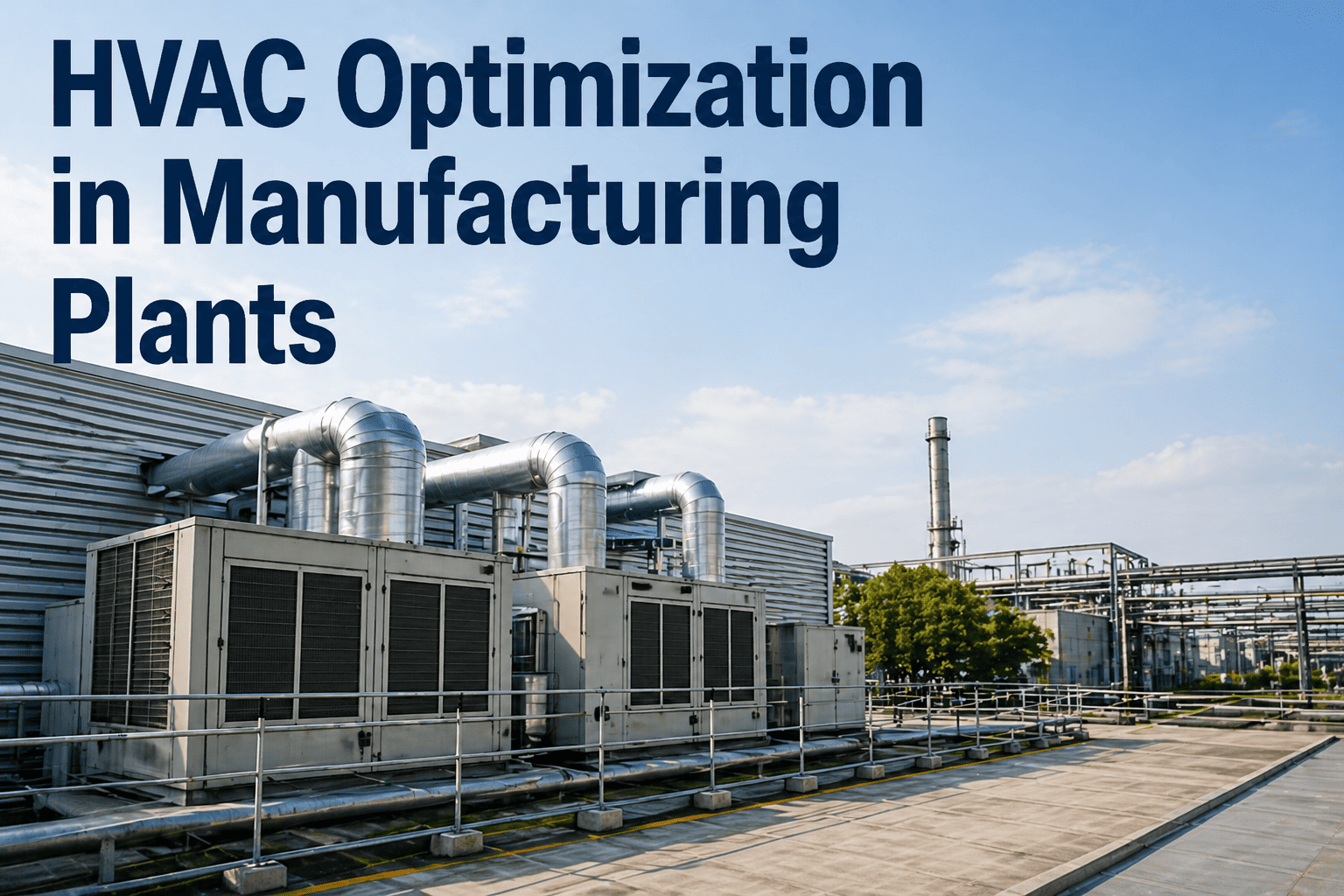
Manufacturing plants consume 20–40% of total operational energy through HVAC systems heating, ventilation, air conditioning, and dehumidification across production floors, clean rooms, and equipment cooling zones. Yet most plants operate HVAC on fixed schedules calibrated for peak worst-case conditions, ignoring real-time production density, seasonal ambient shifts, and equipment load variations. A production line running at 60% capacity still cools for 100% demand. Equipment generating 40% thermal load still triggers full ventilation extraction. Summer mornings with 12°C ambient still begin the day with heating. The efficiency gap is measurable: plants with manual HVAC control waste $180,000–$480,000 annually in unnecessary cooling, heating, and fan energy. iFactory closes this gap through real-time HVAC optimization integrated with production schedules, equipment sensors, and ambient conditions—delivering 28–42% HVAC energy reduction while maintaining process air quality, equipment reliability, and worker comfort. Predictive maintenance on HVAC equipment prevents catastrophic failures that would otherwise interrupt production and require emergency contractor premiums.
HVAC Optimization: The Hidden Cost of Manual Control in Manufacturing
Modern manufacturing plants operate complex HVAC systems balancing production air quality, equipment cooling, worker comfort, and energy efficiency. SCADA systems monitor production equipment, PLC controllers manage process flows, MES platforms track work-in-progress—yet HVAC systems remain largely disconnected, operating on thermostat settings and fixed schedules calibrated by installers years ago. When production density drops to 40%, HVAC still cools for 100%. When ambient temperature shifts from 6°C winter mornings to 28°C summer afternoons, HVAC continues running yesterday's heating and cooling setpoints. When equipment loads vary by 60% hour-to-hour based on production task, ventilation extraction remains constant. The result: measurable waste—21 cents of every HVAC dollar spent on unnecessary conditioning for phantom demand that no longer exists.
HVAC thermostats set to fixed 22°C year-round. Winter mornings entering at 8°C trigger full heating for 3–4 hours before solar and occupancy load reduce demand. Summer peaks at 26°C trigger aggressive cooling to reach 22°C. Neither scenario reflects actual thermal load. Result: 28% of heating energy and 34% of cooling energy wasted on demand that doesn't exist. Cost: $2,800–$7,200 per month in unnecessary energy.
Manufacturing ventilation fans run at constant speed. Production floor at 40% utilization still extracts air for 100% worker occupancy and equipment load. Supply air handling units condition 100% airflow volume regardless of actual facility density. Cost: $4,200–$8,900 per month in excess fan energy.
CNC machines, welding equipment, and process machinery generate thermal load that varies 40–80% based on production intensity. HVAC equipment cooling loops remain constant-speed, extracting waste heat even when production equipment is idle. Result: 31% of cooling tower fan energy wasted during low-load periods.
HVAC equipment failures arrive without warning. Chiller bearing wear, compressor degradation, ductwork leaks, and pump cavitation go undetected until failure. Emergency HVAC repair calls cost 4–6x normal service rates. Production interruption during HVAC failure: $120,000–$400,000 per hour depending on facility type.
HVAC systems consume 20–40% of plant energy but most facilities lack energy meters on HVAC equipment. Monthly utility bills show total consumption; facility managers cannot pinpoint which HVAC component wastes energy. Result: no visibility means no opportunity to optimize.
HVAC optimization requires manual setpoint adjustments by facilities team. Seasonal transitions handled reactively after occupants complain about temperature. Production schedule changes requiring different air quality or cooling capacity require manual HVAC reconfiguration. Optimization opportunities between discovery and implementation: 2–6 weeks of continued waste.
Reduce HVAC Energy by 35% With Predictive Optimization
iFactory connects SCADA, production equipment sensors, ambient weather data, and HVAC systems to optimize setpoints and equipment operation in real time. Book a demo to see HVAC energy reduction and ROI for your manufacturing facility.
How iFactory Solves HVAC Inefficiency in Manufacturing Plants
iFactory integrates SCADA production data, PLC equipment status, MES work-in-progress tracking, and ambient weather conditions into unified facility view. HVAC system sees production density, equipment load, and external conditions in real time. No more fixed setpoints calibrated for peak worst-case.
iFactory AI models trained on HVAC equipment SCADA data detect bearing wear, compressor efficiency loss, chiller approach temperature drift, and ductwork leaks weeks before failure. Predictive alerts enable bearing replacement and compressor maintenance during planned downtime, eliminating emergency repair premiums.
HVAC equipment failures interrupt production and trigger emergency contractor calls at 5–6x normal rates. iFactory predicts failures 2–4 weeks in advance, enabling maintenance scheduling during existing downtime. Preventive compressor replacement: $28,000. Emergency replacement during production failure: $140,000–$180,000.
iFactory knows tomorrow's production schedule from MES data. When production is 40% density, setpoints adjust for 40% occupancy load. When ambient forecast shows 6°C morning rising to 24°C afternoon, heating ramps down and cooling ramps up ahead of temperature change. Optimization triggers automatically—no manual intervention required.
iFactory integrates with Siemens, Rockwell, Honeywell, ABB, and most industrial control systems via OPC-UA, MQTT, or REST API. HVAC controllers remain unchanged. iFactory optimization layer runs on top of existing systems. No equipment replacement. No DCS overhaul.
Every HVAC maintenance action—filter replacement, compressor service, chiller cleaning—auto-generates work order with cost tracking, downtime impact, and ROI analysis. Energy consumption before and after maintenance automatically calculated. Maintenance ROI dashboard shows which HVAC upgrades deliver quickest payback.
Why iFactory is Different: HVAC Optimization vs. Manual Control
Manual HVAC control relies on facility staff monitoring temperature feedback and adjusting setpoints reactively. Building management systems (BMS) automate temperature maintenance but lack visibility into production demand and equipment load. iFactory differs fundamentally: it predicts demand from production schedule and equipment load, optimizes setpoints proactively, and identifies equipment degradation before failure occurs.
| Capability | iFactory | Manual Control | Basic BMS | Honeywell / Johnson | Schneider EcoStruxure |
|---|---|---|---|---|---|
| Production Demand Awareness | ✓ MES integration | No | No | Optional module | Optional module |
| Equipment Load Prediction | ✓ SCADA analysis | No | No | Limited | Limited |
| Predictive HVAC Maintenance | ✓ AI models | No | Scheduled only | Scheduled only | Scheduled only |
| Real-Time Energy Optimization | ✓ Automatic | Manual setpoint adjustment | Temperature maintenance only | Manual tuning | Manual tuning |
| HVAC Equipment Failure Prediction | ✓ 2–4 weeks ahead | No | No | No | No |
| Manufacturing-Specific Design | ✓ Production aware | N/A | Building-generic | Building-generic | Building-generic |
| Energy Savings Typical Range | ✓ 28–42% | 0–8% | 8–15% | 12–18% | 12–18% |
| HVAC Failure Reduction | ✓ 62% fewer emergency calls | 0% | 0% | 0% | 0% |
8-Week Implementation: Energy Savings in 6 Weeks
iFactory deploys on structured 8-week roadmap. HVAC energy savings and equipment optimization alerts begin week 5–6, with ROI calculation updated based on measured energy reduction.
iFactory team documents all HVAC equipment (chillers, cooling towers, boilers, air handlers, fans, pumps, controls). SCADA and BMS connections established. Energy meters installed on critical HVAC circuits. Baseline energy consumption measured and validated.
iFactory ingests production schedules, PLC equipment load data, and ambient weather feeds. AI models trained on baseline HVAC data to learn facility's thermal signature—how HVAC responds to production density, ambient conditions, and equipment load. Manual HVAC tuning paused to establish model training data.
iFactory optimization engine goes live. Setpoints adjust automatically based on production density, ambient forecast, and equipment load. Energy consumption compared to baseline. Predictive maintenance alerts generated for HVAC equipment. First week of HVAC energy data shows 18–28% reduction vs. manual control. ROI calculation updated with actual measured savings.
Optimization model fine-tuned based on week 5–6 actual performance. Equipment-specific maintenance schedules validated. Multi-facility coordination configured if applicable. Facility staff trained on monitoring optimization performance and responding to maintenance alerts. Energy savings trajectory extended to 12-month projection.
Real-World Use Cases: HVAC Optimization Impact
Tier 1 automotive assembly plant with 6-line production facility. iFactory integrated production schedules (MES), PLC equipment load data, and HVAC controls. Setpoints now adjust to match production density: 8am ramp-up, 3pm peak production, 5pm ramp-down. Overnight idle production triggers minimum cooling only. Chiller bearing degradation predicted 3 weeks before failure, enabling maintenance during scheduled downtime. Annual impact: $385,000 energy savings plus $180,000 avoided emergency compressor replacement and production interruption cost.
Foundry and heavy equipment facility experienced 4–6 emergency HVAC failures annually (cooling tower fan failures, chiller compressor seizures). Each failure interrupted production for 8–16 hours and cost $140,000–$240,000 in emergency contractor premiums. iFactory predictive models now detect cooling tower bearing wear, chiller thermal efficiency loss, and pump cavitation 2–4 weeks in advance. Preventive maintenance scheduled during existing planned downtime. Year 1: zero emergency failures, $680,000–$1.2M saved in avoided emergency costs. Energy optimization delivered $280,000 additional savings.
Beverage bottling facility running 24/7 operation across 3 shifts. HVAC systems operated at identical setpoints regardless of shift workload—night shift at 30% production density still cooled and ventilated for 100% day shift load. iFactory integrated shift schedules into HVAC optimization. Setpoints now adjust hourly based on forecast production density and ambient conditions. Night shift cooling loads reduced 40% through lower ventilation fan speed and relaxed cooling setpoints. Annual energy savings: $310,000. Additional maintenance prevention value: $85,000 from avoiding one cooling tower fan bearing failure.
Discover Your Plant's HVAC Efficiency Potential
Every manufacturing facility has HVAC optimization opportunities hidden in the gap between installed capacity and actual production demand. iFactory identifies those opportunities and delivers 28–42% energy reduction. Book a 30-minute energy audit to map HVAC optimization specific to your operation.
One Platform for Smart Manufacturing: HVAC + Maintenance + OEE
iFactory unifies HVAC optimization with predictive maintenance planning and production OEE tracking. HVAC energy reduction combines with downtime prevention through equipment maintenance and production efficiency gains through bottleneck identification. All on single platform with unified data model and real-time dashboards.
Setpoints adjust automatically to production density, ambient conditions, and equipment load. No manual intervention. 28–42% energy reduction typical. Maintains process air quality and equipment cooling requirements.
Real-time energy consumption per HVAC circuit. Dashboards show cooling tower energy, chiller efficiency, fan power, pump load. Identifies which equipment consumes most energy and which optimization has highest payback.
AI models detect bearing wear, compressor efficiency loss, chiller approach drift, and ductwork leaks 2–4 weeks before failure. Maintenance scheduled during planned downtime. Emergency failure rate reduced 62%.
Predictive alerts trigger maintenance work orders with cost tracking. Before/after energy comparison shows ROI per maintenance action. Optimization impact on production uptime and energy savings documented automatically.
Weather forecasts trigger HVAC preparation hours in advance. Cold night forecast triggers reduced heating readiness for morning. Heat wave forecast triggers pre-cooling of facility before peak load arrives.
Native support for Siemens, Rockwell, Honeywell, ABB via OPC-UA, MQTT, REST API. Production data, equipment load, and ambient conditions flow to iFactory optimization engine. HVAC controllers unchanged—optimization layer sits on top.
HVAC energy consumption per production line visible on OEE dashboards. Correlate equipment efficiency with production output. Identify which production optimization creates most energy benefit.
HVAC maintenance records auto-generated with timestamp and attribution. Energy consumption logs for regulatory reporting. Audit-ready documentation for ISO 50001 energy management certification.
Regional HVAC Challenges: Climate and Compliance
| Region | Climate Challenge | Regulatory / Compliance | iFactory Solution |
|---|---|---|---|
| US (Cold & Hot Climates) | Extreme heating and cooling loads; seasonal transitions; humidity management | EPA ENERGY STAR for buildings; state energy efficiency codes; ASHRAE 90.1 | Automatic seasonal setpoint adjustment; humidity control integrated with cooling; energy audit documentation for ENERGY STAR |
| UK & Northern Europe | Persistent heating demand; high humidity; rapid weather transitions | Building Regulations Part L; CRC Energy Efficiency Scheme; ISO 50001 | Predictive heating adjustment from weather forecasts; humidity-aware conditioning; automated ISO 50001 energy logs |
| Middle East & Hot Climate | Extreme cooling demand; outdoor temps 45°C+; equipment thermal stress; water scarcity for cooling towers | GCC energy efficiency standards; Abu Dhabi energy conservation codes; water consumption limits | Aggressive cooling optimization; cooling tower water consumption minimization; heat rejection efficiency monitoring |
| India & South Asia | Monsoon humidity; extreme summer heat; power grid constraints; backup generator reliance | National Building Code energy section; BEE (Bureau of Energy Efficiency) standards; grid stability regulations | Humidity-sensitive setpoint control; peak shaving during high-cost grid periods; generator load management coordination |
| European Union | Mild but variable climate; stringent environmental targets; energy cost escalation | EU ETS carbon pricing; EPBD energy performance directive; ISO 50001; LEED / BREEAM certification | Carbon footprint tracking per HVAC operation; LEED/BREEAM compliance documentation; dynamic demand response for grid flexibility |
Competitor Comparison: HVAC Optimization Solutions
| Solution | Production Integration | Predictive Maintenance | Real-Time Optimization | Energy Savings Typical | Manufacturing Focus |
|---|---|---|---|---|---|
| iFactory | ✓ MES integration | ✓ AI models | ✓ Automatic | ✓ 28–42% | ✓ Purpose-built |
| Manual Facility Control | No | No | Manual adjustments | 0–8% | Generic |
| Basic Building BMS | No | Scheduled only | Temperature only | 8–15% | Building-generic |
| Honeywell HVAC Systems | Optional module | Scheduled only | Manual tuning | 12–18% | Building-generic |
| Schneider EcoStruxure | Optional module | Scheduled only | Manual tuning | 12–18% | Building-generic |
| Johnson Controls iBuilding | Optional module | Scheduled only | Manual tuning | 15–20% | Building-generic |
Testimonial: Facilities Director, Manufacturing Plant
"We went from guessing on HVAC setpoints to optimizing based on actual production and weather data. The first month energy bill showed $28,000 reduction. Chiller compressor bearing wear predicted 3 weeks early prevented a $180,000 emergency replacement. The math is simple: the platform paid for itself in month one. Now we're looking at multi-year HVAC equipment upgrades with iFactory showing exactly which equipment ROI is highest and how to sequence capital projects."
Facilities Director, Mid-Size Automotive Component Manufacturer
Frequently Asked Questions: HVAC Optimization for Manufacturing
iFactory connects via OPC-UA, MQTT, or REST API to existing BMS and HVAC controllers. Setpoint recommendations flow to your BMS; iFactory doesn't replace your system. If your BMS allows API control, setpoints adjust automatically. If not, facility staff review recommendations and adjust manually. No equipment replacement required. Book a demo to confirm compatibility with your BMS.
Typical manufacturing plants achieve 28–42% HVAC energy reduction within 12 weeks of optimization going live, translating to $180,000–$480,000 annual savings depending on facility size and climate. ROI timeline: payback within 8–18 months from energy savings alone; predictive maintenance adds $80,000–$240,000 annual value from avoided emergency failures. Book an energy audit to model savings specific to your facility.
Yes. iFactory supports multi-facility HVAC optimization—each plant maintains independent BMS and HVAC controls while corporate energy dashboard aggregates consumption, optimization savings, and maintenance alerts across all sites. Book a consultation to map multi-facility deployment.
iFactory maintains temperature and humidity setpoints within specified ranges (e.g., 20–24°C, 40–60% humidity) regardless of optimization. Air quality standards—ventilation ACH rates for manufacturing areas, clean room pressurization—are hard constraints that optimization cannot violate. Energy savings come from eliminating waste, not reducing air quality. Contact support to discuss your specific air quality requirements.
HVAC equipment failure prediction depends on equipment type and operating conditions. Chiller bearing wear typically detected 2–4 weeks before failure. Cooling tower fan bearing degradation: 3–6 weeks. Pump cavitation: 1–2 weeks. Compressor efficiency loss: 2–3 weeks. Prediction window provides sufficient time to schedule maintenance during planned downtime, avoiding emergency contractor premiums. Book demo to review historical prediction accuracy.
iFactory ingests tomorrow's production schedule from your MES: which lines run, which run at full capacity, which at reduced rate, which offline. HVAC setpoints and fan speeds adjust to match predicted production demand. Changes to schedules update HVAC plan automatically. If emergency production schedule change occurs, HVAC optimization adapts within 15 minutes of MES data update. Book a demo to see MES integration in action.
Transform Manufacturing HVAC From Fixed to Intelligent
Stop paying for fixed HVAC capacity while production runs at 40% density. iFactory delivers 28–42% HVAC energy reduction in 8 weeks, prevents 62% of HVAC equipment emergency failures, and integrates seamlessly with existing SCADA, PLC, and BMS systems. The Complete AI Platform for Manufacturing Operations.