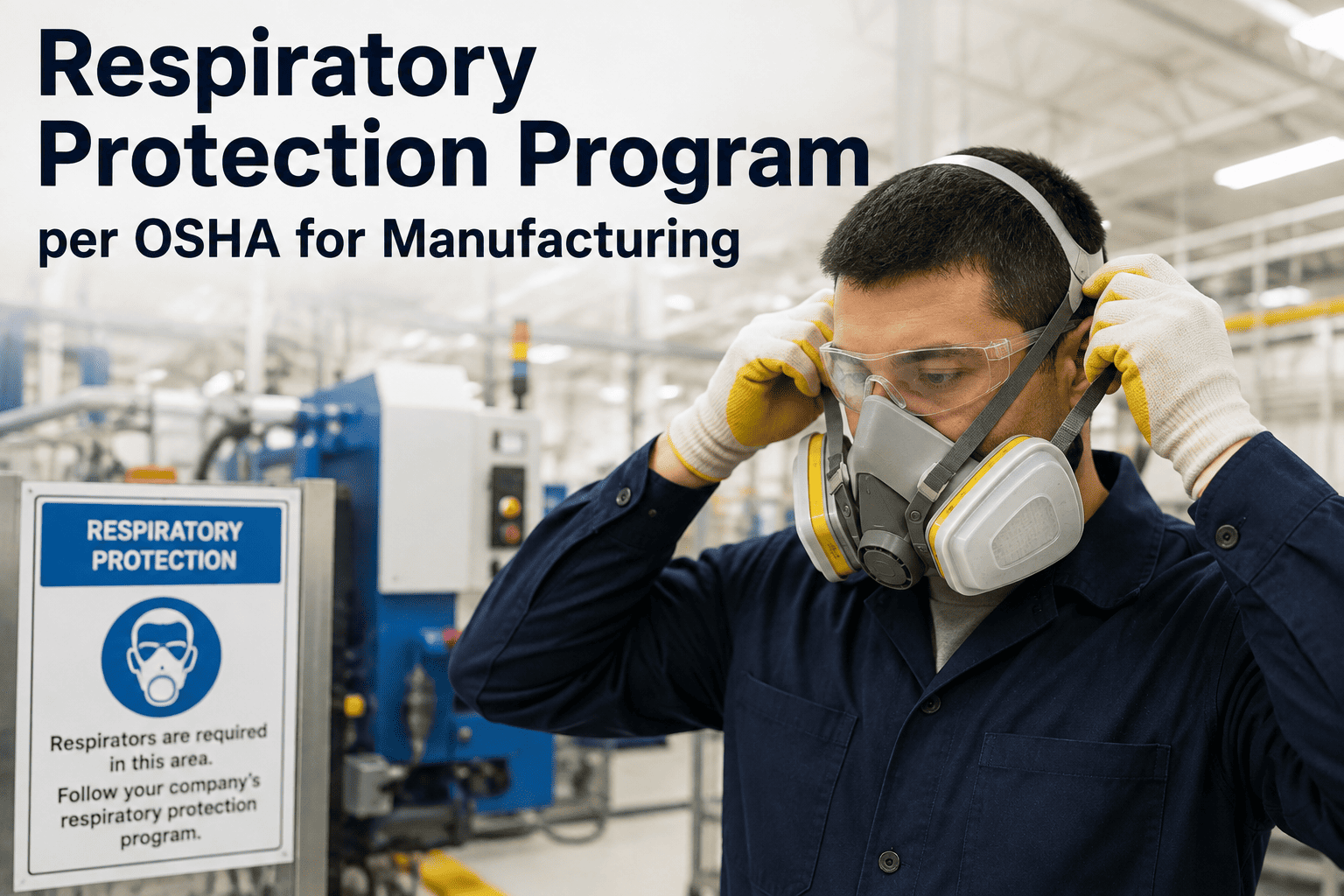
Handing out N95s and calling it a respiratory protection program is one of the fastest ways a manufacturing site ends up in front of an OSHA compliance officer. 29 CFR 1910.134 is one of the most frequently cited general industry standards precisely because employers assume respirators equal compliance, when the regulation actually requires a written, worksite-specific program covering selection, medical evaluation, fit testing, training, and ongoing effectiveness review. Getting each piece right protects workers from a hazard that often can't be seen, smelled, or felt until the exposure has already happened. This guide breaks the standard into the pieces a plant safety team actually has to build and maintain, and teams standing up or auditing a program can walk through their specific hazard set with iFactory's support team.
A Respiratory Protection Program Is Not a Box of Masks — It's a Documented System
Written procedures, medical evaluations, annual fit testing, and a way to prove the program actually works — OSHA's respiratory protection standard has nine required elements, and missing any one of them is a citation waiting to happen.
Does Your Site Even Need a Written Program?
The threshold is broader than most plants expect. A full written program is required whenever a facility requires respirator use for any reason — including cases where exposure sits below the permissible exposure limit but the employer still mandates a respirator. It is also triggered by oxygen-deficient atmospheres, IDLH environments, and any substance-specific OSHA standard — silica, lead, formaldehyde — that separately calls for respiratory protection. Even voluntary use, where an employee chooses to wear a respirator the job doesn't strictly require, carries its own obligations.
Full written program applies: hazard assessment, medical evaluation, fit testing, training, and a documented cartridge and maintenance schedule, all provided at no cost to the employee.
For filtering facepieces, the employer must provide a copy of the standard's Appendix D. For any other voluntary respirator type, medical evaluation is still required and the employer must confirm the respirator itself creates no hazard.
The Nine Elements Every Written Program Must Cover
OSHA does not accept a generic template pulled from another facility. The written program has to describe the actual hazards, respirator models, and procedures at the specific site, addressing each of the following.
Matching Assigned Protection Factor to the Actual Hazard
Every respirator category carries an Assigned Protection Factor — a statistical expectation of how much a properly fitted device reduces exposure. Selecting a respirator without checking its APF against the measured or estimated exposure level is one of the most common program gaps.
| Respirator Type | Typical APF | Fit Testing Required | Common Manufacturing Use |
|---|---|---|---|
| Filtering facepiece (N95-class) | 10 | Yes | Nuisance dust, low-hazard particulate tasks |
| Half-face elastomeric APR | 10 | Yes | Solvent vapors, paint booths, welding fume |
| Full-face elastomeric APR | 50 | Yes | Higher vapor concentration, eye and face hazard combined |
| Loose-fitting PAPR | 25 | No | Beard-wearing employees, extended-wear comfort tasks |
| Tight-fitting full-face PAPR | 1,000 | Yes | High-hazard particulate, some chemical processes |
| Pressure-demand SCBA | 10,000 | Yes | IDLH atmospheres, confined-space rescue standby |
Track Fit-Test Due Dates and Medical Evaluations Before They Lapse
iFactory keeps respirator assignments, fit-test expiry, and medical clearance status in one workflow, so a program element never quietly lapses between audits.
The Fit-Test Cycle, Start to Finish
Fit testing verifies something a medical evaluation and a training session cannot: that a specific device forms an adequate seal on a specific employee's face. It has to be repeated for every make, model, and size a worker is assigned, and re-run whenever facial structure changes enough to affect the seal.
The Medical Evaluation Step Nobody Can Skip
Wearing a respirator places a physiological burden on the body — added breathing resistance, weight on the face and head, and reduced field of vision — that not every employee can safely tolerate. That is why medical evaluation comes before fit testing, not after, and why it applies to voluntary users as well as required users. A physician or other licensed health care professional reviews a standardized questionnaire, and in some cases performs a follow-up exam, before clearing an employee for a specific respirator class.
Before First Assignment
Every employee completes a medical evaluation before being fit tested or required to use a respirator on the job, using OSHA's mandatory questionnaire or an equivalent.
Follow-Up Triggers
A new evaluation is required if an employee reports symptoms during use, if workplace conditions change significantly, or if the evaluating professional recommends periodic reassessment.
What the Report Can Say
The written recommendation is limited to whether the employee is medically able to use the respirator, any use limitations, and whether follow-up evaluation is needed — not unrelated medical detail.
Supplied-Air Systems Add a Layer the Standard Treats Separately
Not every manufacturing respiratory hazard is solved with an air-purifying respirator. Confined-space entries, IDLH atmospheres, and some high-concentration solvent or particulate operations call for supplied-air respirators or self-contained breathing apparatus, and the standard holds these systems to additional requirements air-purifying respirators don't carry.
Breathing air quality
Compressed breathing air supplied through a hose-line system has to meet a defined grade for oxygen content, moisture, and contaminant levels, verified on a documented testing schedule rather than assumed from the compressor's general specification.
Emergency escape provisions
Work in IDLH atmospheres requires a standby employee, communication with the entrant, and rescue equipment ready — a written program has to spell out what happens if the air supply is interrupted, not just how the routine task is performed.
SCBA-specific inspection
Self-contained breathing apparatus needs monthly inspection in addition to before-use checks, with air or oxygen cylinders recharged once pressure drops to a defined threshold of the manufacturer's rated level.
Where Programs Actually Get Cited
No Written, Site-Specific Program
A generic PDF template with the company name swapped in does not satisfy the requirement — the program has to describe the actual hazards and respirators in use at that facility.
Fit Testing Skipped for "Simple" Dust Masks
Filtering facepieces used in a required-use context still need annual fit testing — the assumption that N95s are exempt is one of the most common findings.
Missing Medical Evaluation Before Fit Testing
Fit testing an employee before confirming medical clearance reverses the required order and can mask an underlying condition that makes respirator use unsafe.
No Retest After Facial Hair or Weight Change
A fit test from a year ago does not account for a beard grown last month or a significant weight change — either can break a seal that previously passed.
Cartridge Change-Out Left to Guesswork
Without a documented change-out schedule tied to contaminant type and concentration, cartridges are often changed on a fixed calendar that has no relationship to actual breakthrough time.
No Program Effectiveness Review
Element nine — periodically confirming the program actually works, not just that paperwork exists — is the piece most often skipped once the initial rollout is complete.
A Composite Plant: Passing on Paper, Failing on the Floor
A metal-finishing operation had a written respiratory protection program, annual fit-test records, and a training log going back three years — every document an auditor asks for first was in the file. A closer floor walk found the actual gap: half-face respirators assigned for a solvent-vapor task carried cartridges rated for particulates, not organic vapors, because a supply substitution years earlier had never been checked against the written program's selection criteria.
The correction wasn't complicated once found — replacing the cartridge type and adding a supply-chain check tied to the respirator selection procedure closed the gap within a week. The harder lesson was procedural: a program can pass every documentation check and still leave workers under-protected if nobody periodically verifies that the equipment on the floor still matches the equipment described on paper.
Every respirator model in use matches the written program
A substitution at the supply level — a different cartridge, a different facepiece — has to be checked against the selection criteria before it reaches the floor, not discovered during an audit.
Fit-test records show the actual expiration date, not just the last test date
A dashboard that only shows when someone was last tested makes it easy to miss who is overdue; tracking the expiration date directly is what actually prevents a lapse.
Cartridge change-out is scheduled, not improvised
A documented change-out schedule based on contaminant type, concentration, and use duration removes the guesswork that leads to cartridges running past their effective service life.
Recordkeeping That Survives an Audit
A respiratory protection program lives or dies on its paperwork trail when an OSHA compliance officer walks in unannounced. Fit-test records need to be kept until the next fit test is performed, medical evaluation results need to be retained per the applicable retention rules, and training records should show not just that a session happened but which respirator model and hazard it covered. Programs that store these records across separate spreadsheets, binders, and a training vendor's portal tend to discover gaps only when an auditor asks for a specific employee's complete file on the spot, which is exactly the wrong moment to find out a fit test lapsed eight months ago.
Frequently Asked Questions
When does OSHA require a written respiratory protection program?
A full written program is required whenever a facility requires respirator use for any reason, including situations where exposure is below the permissible exposure limit but the employer still mandates the respirator, as well as oxygen-deficient atmospheres, IDLH environments, and any substance-specific standard that independently requires respiratory protection. The program must be site-specific rather than a generic template, describing the actual hazards, respirator models, and procedures used at that facility. Sites unsure whether their current use case crosses this threshold can review it with iFactory's support team.
How often does fit testing have to be repeated?
Tight-fitting respirators require fit testing at least annually, and the test must be repeated immediately whenever an employee changes facepiece make, model, or size, reports a change in fit, or undergoes a facial change — new facial hair, scarring, dental work, or a significant weight change — that could affect the seal. The annual fit test is separate from and does not replace the daily user seal check every wearer must perform each time the respirator is donned.
Does voluntary respirator use still require a program?
Yes, though the obligations are lighter than for required use. For voluntary use of filtering facepieces, the employer must provide the employee a copy of the standard's Appendix D describing safe use. For voluntary use of any other respirator type, the employer must still provide a medical evaluation and confirm the respirator itself does not introduce a hazard, even though full program elements like fit testing are not mandated in that scenario.
What is an Assigned Protection Factor and why does it matter for selection?
An Assigned Protection Factor is the workplace-level protection a properly fitted respirator category is expected to provide, ranging from an APF of 10 for filtering facepieces and half-face respirators up to 10,000 for a pressure-demand SCBA. Selecting a respirator means checking the measured or estimated exposure level against the APF for that respirator class, so the assigned device actually brings exposure below the relevant limit rather than assuming any respirator is sufficient for any hazard.
Can respiratory protection compliance be tracked digitally instead of on paper logs?
Yes, and doing so closes a common gap where fit-test expirations, medical evaluation renewals, and cartridge change-out schedules are tracked across separate paper logs that rarely get cross-checked. A connected system can flag an employee whose fit test is about to lapse or a respirator model that no longer matches its selection criteria before an auditor finds it first. Manufacturing safety teams can book a demo to see how iFactory tracks respiratory program status alongside other EHS compliance data.
Make Your Respiratory Protection Program Audit-Ready Every Day, Not Just Before an Inspection
iFactory connects fit-test records, medical clearances, and cartridge schedules into one compliance view for your manufacturing site. Book a walkthrough to see how it fits your program.