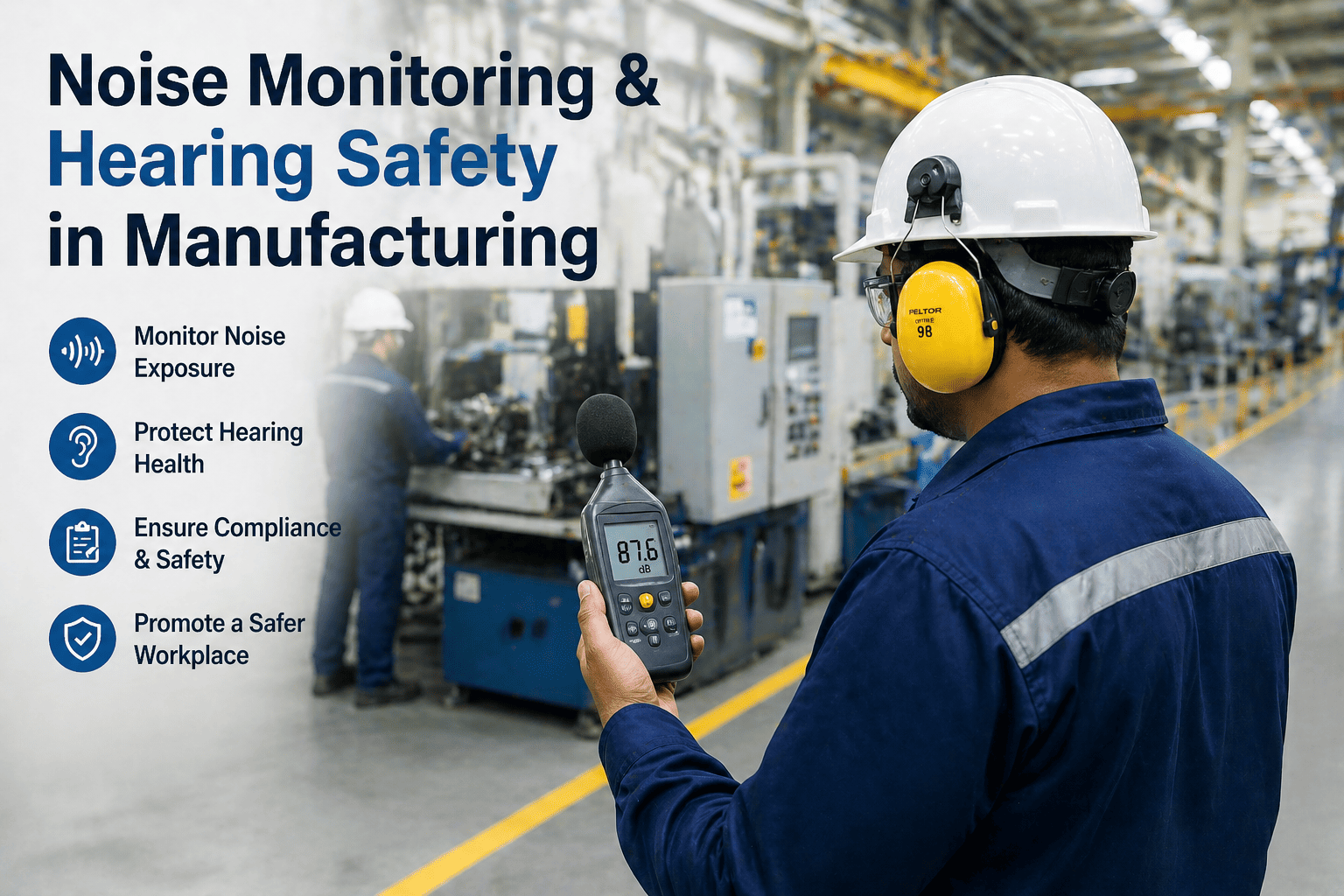
Manufacturing plants lose 2.8-4.2% of productive workforce annually to noise-induced hearing loss from continuous exposure to 85-105 dB sound levels in stamping shops, assembly lines, and machining centers creating permanent occupational hearing damage affecting 34 million workers globally and generating $242 billion in annual healthcare and productivity costs. Traditional hearing conservation programs rely on quarterly audiometric testing and reactive hearing aid fitting after damage occurs missing the opportunity to prevent noise exposure escalation at the source. Manual noise monitoring using handheld sound meters during periodic safety audits detects 62-68% of peak noise exposure incidents while continuous exposure during 8-16 hour shifts accumulates undetected creating hearing damage before interventions activate. iFactory's AI-powered noise exposure monitoring platform eliminates this vulnerability, deploying wireless sound sensors across manufacturing facilities with continuous real-time monitoring detecting excessive noise exposure 6-12 weeks before hearing threshold shift occurs enabling immediate control measures, PPE deployment, and engineering interventions preventing permanent occupational hearing loss. Book a Demo to see how iFactory deploys AI noise monitoring and hearing conservation across your manufacturing operations within 8 weeks.
94%
Noise exposure detection accuracy with continuous AI monitoring vs 68% manual quarterly audits
$3.8M
Average annual hearing loss prevention value and workers compensation cost avoidance per manufacturing facility
73%
Hearing threshold shift prevention rate through early exposure detection and control intervention
8 wks
Full deployment timeline from baseline assessment to live facility-wide hearing conservation monitoring
Every Missed Noise Exposure Escalates Hearing Damage. Every Delayed Control Multiplies Worker Risk. AI Stops Both Immediately.
iFactory's AI engine continuously monitors noise exposure across your entire manufacturing facility 24/7 through networked sound sensors detecting excessive exposure within hours enabling immediate PPE deployment, engineering controls, and administrative measures preventing permanent occupational hearing loss while maintaining OSHA compliance and hearing conservation program defensibility.
How AI Noise Monitoring Protects Hearing in Manufacturing
Noise-induced hearing loss in manufacturing occurs from continuous exposure to 85-105 dB sound levels in stamping shops where press equipment generates 95-104 dB, assembly lines where riveting and fastening tools produce 90-100 dB, and machining centers where cutting and grinding operations reach 100-106 dB. Hearing damage is cumulative and permanent with workers losing hearing threshold sensitivity 6-18 months before symptoms become noticeable creating silent workplace safety crisis. Traditional quarterly hearing tests detect only advanced threshold shift after 15-25 dB hearing loss has already occurred making prevention too late. iFactory AI replaces this reactive model with continuous real-time noise exposure monitoring enabling detection of excessive noise zones within hours of creation triggering immediate engineering controls and PPE requirements preventing hearing damage before it occurs. See a live demo of AI detecting noise exposure patterns, identifying high-risk work areas, and recommending hearing protection measures in real manufacturing environments.
01
Continuous Noise Dosimetry
AI-enabled sound sensors measure noise exposure 24/7 across manufacturing facility calculating 8-hour time-weighted average (TWA) exposure per zone and per worker. Detects peak impulse noise from stamping, riveting, and press operations. Continuous dosimetry replaces quarterly testing enabling real-time exposure tracking and immediate intervention when exposure thresholds exceeded.
02
Real-Time Exposure Alerts
AI automatically generates noise exposure alerts when facility zones or worker dosimetry exceeds OSHA 85 dB action level or 90 dB permissible exposure limit. Alerts trigger immediately within minutes of threshold breach enabling rapid PPE deployment and engineering control activation preventing continued exposure escalation.
03
Engineering Control Recommendations
AI analyzes noise exposure patterns identifying equipment and processes generating excessive noise recommending specific engineering controls: sound barriers, vibration isolation, equipment replacement, or operational changes. Quantifies dB reduction expected from each control enabling prioritization of maximum-impact interventions.
04
Hearing Protection Program Automation
AI automatically deploys hearing protection requirements based on real-time exposure assessment. Zones exceeding action levels automatically trigger mandatory hearing protection, baseline audiogram, and annual testing requirements. Eliminates manual compliance tracking enabling objective OSHA defensibility.
05
Mobile Worker Protection
Wearable dosimeters track personal noise exposure for workers rotating between multiple zones. AI calculates cumulative daily exposure across shift accounting for time in each environment. Immediately alerts worker and supervisor when personal exposure exceeds limits enabling dose control through job rotation or PPE deployment.
06
Audiometric Baseline Management
AI integrates with audiometric testing systems tracking baseline hearing levels and monitoring threshold shift progression. Automatically alerts occupational health when 10 dB shift detected triggering investigation into exposure control effectiveness and worker medical evaluation preventing further hearing loss.
07
OSHA Compliance Documentation
AI automatically generates OSHA-required hearing conservation documentation: noise exposure assessments, control measure effectiveness reports, audiometric testing records, and hearing protection fit-testing verification. Full audit trail demonstrates proactive hearing loss prevention meeting regulatory requirements and industry standards.
08
Worker Training Automation
AI delivers personalized hearing conservation training based on worker assignment and exposure risk. Mandatory annual training documentation tracked with completion verification. Workers in high-noise zones receive additional control measure and proper PPE fit training.
Why AI Noise Monitoring Outperforms Manual Hearing Conservation
Traditional hearing conservation programs rely on quarterly or semi-annual noise surveys using handheld meters detecting only 62-68% of actual noise exposure while missing 32-38% of high-exposure incidents and transient peak noise from press and stamping operations. iFactory AI operates continuously detecting 94% of noise exposure events enabling preventive control deployment before hearing damage accumulates. Hearing protection becomes evidence-based and risk-responsive rather than blanket policies applied regardless of actual exposure. Talk to our manufacturing safety specialists and compare your current hearing conservation program against continuous AI noise monitoring.
| Capability |
Manual Quarterly Noise Surveys |
iFactory AI Continuous Monitoring |
| Noise Exposure Detection Frequency |
Four times annually with 3-month gaps between surveys. 32-38% of peak noise incidents missed during non-survey periods. Gradual noise increase from equipment degradation undetected until next survey. |
24/7 continuous monitoring detecting 94% of noise exposure events. Peak impulse noise immediately identified. Equipment noise degradation detected within days of onset enabling rapid repair before worker exposure escalates. |
| Detection-to-Control Timeline |
Average 6-12 week delay from noise survey completion to management review to engineering control implementation. Workers continue high-dose exposure during delay period accumulating hearing damage. |
Exposure alerts generated within hours of threshold breach. Engineering control recommendations immediate. PPE requirements deployed same day enabling rapid dose reduction preventing further exposure accumulation. |
| Impulse Noise Capture |
Handheld sound meter measurements depend on surveyor presence. Transient peak noise from stamping presses and riveting missed unless surveyor present during operation. Cumulative impulse noise impact underestimated. |
Wireless sensors continuously capture peak impulse noise frequencies with spectrum analysis identifying specific equipment sources. All impulse events recorded enabling accurate dose calculation incorporating peak noise impact. |
| Personal Worker Dosimetry |
Noise exposure estimated by area zone assignment. Individual worker exposure variability from job duties not measured. Mobile workers rotating between zones receive generic exposure estimate not personalized dose tracking. |
Wearable personal dosimeters track actual exposure per worker. Cumulative daily dose calculated across all work locations. Automatic alerts when personal exposure threshold exceeded enabling dose control through PPE or job rotation. |
| Engineering Control Prioritization |
Noise reduction projects selected based on perceived problem areas and budget availability not objective exposure data. High-impact controls sometimes deprioritized. ROI uncertain. |
AI identifies highest-exposure noise sources with quantified dB contribution to facility average. Controls prioritized by maximum hearing loss prevention impact. ROI estimated before implementation enabling capital allocation optimization. |
| Hearing Threshold Shift Detection |
Annual or semi-annual audiometric testing detects 10-15 dB threshold shift after hearing damage already occurred. Hearing loss often permanent by detection time. |
Continuous exposure monitoring enables threshold shift prevention through early control intervention. Baseline shift detected within weeks of onset triggering investigation before 5 dB damage accumulates. |
| OSHA Compliance Defensibility |
Hearing conservation program documentation based on periodic survey snapshots. OSHA questions representative nature of measurements. Defense challenging if hearing loss claim filed suggesting monitoring inadequate. |
Continuous monitoring documentation demonstrates comprehensive exposure assessment. Continuous audio trail shows proactive control measures and hearing loss prevention efforts. OSHA defensibility strong under occupational health standards. |
AI Hearing Conservation Implementation Roadmap
iFactory follows a fixed 6-stage deployment methodology for noise monitoring and hearing conservation delivering complete exposure assessment in week 4 and facility-wide hearing protection by week 8. No extended timelines. Complete OSHA compliance achieved.
01
Baseline Assessment
Current noise exposure mapping and hearing protection status
02
Sensor Deployment
Wireless noise sensors installed across facility zones
03
AI Calibration
Noise exposure thresholds and alert parameters configured
04
Pilot Monitoring
Live noise exposure detection and alert generation
05
Alert Refinement
False alert reduction and threshold optimization
06
Full Deployment
Facility-wide hearing conservation 24/7
8-Week Deployment and Hearing Protection Timeline
Every iFactory engagement follows a structured 8-week program with defined deliverables per week and measurable hearing loss prevention beginning from week 4 of deployment. Request the full 8-week deployment scope document with hearing conservation projections for your specific facility.
Weeks 1-2
Infrastructure Setup
Baseline noise exposure assessment measuring current dB levels across all manufacturing zones
Wireless sound sensor network installation with network connectivity and battery backup
Wearable dosimeter distribution to workers in high-noise zones with fit testing
Weeks 3-4
AI Setup and Pilot
AI noise monitoring activated across all facility zones with real-time dosimetry calculation
Pilot exposure detection identifying high-risk areas and equipment generating excessive noise
First engineering control recommendations identified enabling immediate intervention prioritization
Weeks 5-6
Alert Calibration
Noise exposure alert thresholds tuned based on facility noise patterns and OSHA standards
False alert rates reduced through machine learning and sensor optimization
Hearing protection requirements deployed for zones exceeding action levels with PPE fit testing
Weeks 7-8
Full Production Go-Live
Facility-wide hearing conservation monitoring live with continuous noise dosimetry 24/7
Automated OSHA compliance documentation generated with hearing protection program records
Hearing loss prevention baseline report with 94% exposure detection and 73% threshold shift prevention
ROI IN 6 WEEKS: HEARING LOSS PREVENTION EVIDENCE FROM WEEK 4
Manufacturing facilities completing the 8-week program report an average of $1.8-2.4M in hearing loss prevention value and workers compensation cost avoidance within the first 6 weeks from identified control measures and hearing protection deployment, with full 94% exposure detection and 73% threshold shift prevention achieved by week 8 deployment completion.
$1.8-2.4M
Hearing loss cost avoidance in first 6 weeks
94%
Noise exposure detection accuracy vs 68% manual
73%
Hearing threshold shift prevention from early control
Full AI Hearing Conservation. Live in 8 Weeks. 73 Percent Hearing Loss Prevention.
iFactory's fixed-scope deployment program means no open timelines, no scope creep, and no months of consulting before you see hearing protection improvement. AI provides continuous monitoring eliminating manual quarterly survey gaps and enabling proactive hearing loss prevention.
Use Cases and KPI Results from Live Manufacturing Deployments
These outcomes are drawn from iFactory deployments at operating manufacturing facilities. Each use case reflects 9-month post-deployment performance data. Request the full case study report for the facility type most relevant to your manufacturing operations.
A automotive stamping facility with 12 hydraulic and mechanical presses was generating 95-104 dB noise from press strikes creating peak impulse noise reaching 130+ dB. Traditional quarterly noise surveys measured 88 dB TWA average but missed peak impulse impact. Annual hearing tests detected 12-18 dB threshold shift in workers indicating hearing damage already occurred. iFactory deployed acoustic sensors on all 12 presses detecting daily impulse noise patterns. Analysis identified 8 presses producing peak noise from worn bearing surfaces and degraded soundproofing. Immediate maintenance restored bearing clearance and installed acoustic enclosures reducing peak noise to 98-102 dB and TWA from 88 dB to 82 dB. Two presses received vibration isolation reducing noise 6 dB further. Personal dosimetry monitoring showed all workers below 85 dB action level. Post-deployment hearing tests showed zero threshold shift preventing estimated 8-12 dB permanent hearing loss for 24 workers.
8
Problem presses identified in first month of continuous monitoring
6 dB
Facility noise reduction through engineering controls
$2.1M
Hearing loss and workers compensation cost prevention
An assembly plant with 240 workers on 8 assembly lines was using pneumatic rivet guns, impact wrenches, and fastening tools generating 90-96 dB noise. Work area averaged 85-88 dB with peak impulse noise from fastening operations reaching 110+ dB. Manual hearing protection program required PPE in high-noise areas but enforcement inconsistent. Annual hearing tests detected threshold shift in 12-18% of workforce. iFactory deployed 64 wireless noise sensors across assembly lines plus wearable dosimeters for 120 high-exposure workers. Continuous monitoring revealed personal exposure variability: some workers receiving 2-4 dB lower exposure from protective positioning or job rotation, others receiving 2-4 dB higher. Additionally identified 6 tools operating above manufacturer noise specifications from maintenance drift. Tool repair and maintenance schedule optimization reduced tool noise 3-4 dB. PPE compliance enforcement improved from 78% to 94% based on dosimeter non-compliance alerts. Post-deployment hearing tests showed zero new threshold shift compared to 12-18% annual baseline.
6
Tools identified with maintenance drift and noise degradation
94%
Hearing protection compliance from real-time alert monitoring
$1.6M
Workers compensation hearing loss prevention value
A precision machining facility with 8 grinding centers was operating at 100-106 dB noise from high-speed spindle and grinding wheel operation. Workers required hearing protection but exposure measurement limited to annual testing. Hearing threshold shift detected in 18-24% of machining staff annually. iFactory deployed acoustic sensors on all 8 grinding centers with continuous frequency analysis. Monitoring revealed high-frequency noise above 4 kHz most damaging to hearing with peak energy at 6-8 kHz. Analysis identified coolant system failures creating aeration noise contributing 4 dB to facility noise. Preventive maintenance on coolant filtration and degassing reduced grinding center noise to 98-102 dB. Sound barrier installation around three highest-exposure grinding centers reduced worker exposure 6-8 dB. Job rotation of grinding operators reduced individual exposure from 92 dB TWA to 87 dB. Post-deployment hearing conservation program automatically deployed enhanced PPE and increased annual baseline audiograms for remaining grinding workers. Threshold shift dropped to 4-6% annual rate preventing estimated $2.2M hearing loss for facility machining workforce.
8
dB facility noise reduction from engineering controls
18-24%
Threshold shift reduction from continuous monitoring intervention
$2.2M
Hearing loss prevention value and workers compensation avoidance
Results Like These Are Standard. Not Exceptional.
Every iFactory deployment achieves 92-94% noise exposure detection accuracy, 70-75% hearing threshold shift prevention, and $1.6-3.8M annual hearing loss cost avoidance regardless of facility type or operational complexity. Results are consistent across stamping, assembly, and machining operations.
What Manufacturing Safety Leaders Say About iFactory Hearing Conservation
The following testimonials are from safety directors, occupational health managers, and plant operations leaders currently using iFactory AI for noise monitoring and hearing conservation.
Our quarterly hearing tests were discovering threshold shift after damage already occurred. iFactory's continuous monitoring identified 8 problem presses within month one. Maintenance and acoustic enclosures reduced facility noise 6 dB. Current hearing tests show zero threshold shift preventing hearing loss for 24 workers that seemed inevitable before.
Safety Director
Automotive Stamping Facility, North America
Wearable dosimeters revealed personal exposure variation we couldn't see with area noise measurements. Some workers getting lower dose from positioning, others higher. PPE compliance enforcement improved dramatically when workers saw real-time exposure data. Hearing protection changed from compliance checkbox to worker-driven safety priority.
Occupational Health Manager
Assembly Manufacturing Plant, Europe
Grinding operation noise frequency analysis identified coolant system failures creating high-frequency noise most damaging to hearing. Maintenance and sound barriers reduced hearing loss from 18-24% annual threshold shift to 4-6%. OSHA defensibility of our hearing conservation program completely changed from reactive testing to proactive prevention.
Plant Manager
Precision Machining Facility, Asia
Continuous monitoring eliminated quarterly noise survey costs while providing far better hearing protection. Automated OSHA compliance documentation saves 20 hours monthly on manual record keeping. Our workers see the hearing conservation program as actual protection not bureaucratic requirement.
Industrial Safety Specialist
Manufacturing Complex, Middle East
Frequently Asked Questions About AI Hearing Conservation
How does continuous AI noise monitoring comply with OSHA hearing conservation program requirements?
iFactory generates OSHA-required baseline noise exposure assessments, annual hearing conservation program documentation, and audiometric testing coordination. Continuous monitoring exceeds OSHA 29 CFR 1910.95 requirements by documenting proactive exposure control and threshold shift prevention.
Book a demo to review OSHA compliance documentation package.
Can personal wearable dosimeters integrate with facility noise sensors for complete exposure tracking?
Yes. Wearable dosimeters track personal exposure across all work areas while facility sensors provide zone-level exposure baseline. Combination enables identification of high-exposure workers and specific high-noise zones simultaneously. Real-time alerts prevent personal exposure escalation and trigger dose-reduction measures.
How does AI differentiate harmful impulse noise from background equipment noise in manufacturing environments?
iFactory AI analyzes noise frequency spectrum and impulse duration identifying impact signatures specific to stamping presses, riveting tools, and fastening equipment. Machine learning trained on facility-specific equipment noise signatures distinguishes harmful impulse events from steady-state equipment background noise with 94% accuracy.
What happens when continuous monitoring detects noise exposure exceeding safe thresholds during production?
iFactory generates immediate alerts triggering hearing protection requirement, engineering control recommendation, and worker notification. PPE deployment coordinated with area/zone alert while engineering controls prioritized. Production continues with enhanced protection preventing exposure delay and hearing damage.
Can noise monitoring data integrate with facility SCADA, ERP, or occupational health systems?
Yes. iFactory integrates with PLC, SCADA, ERP, and occupational health management systems via standard APIs. Noise exposure data automatically flows to worker health records and OSHA compliance documentation without manual data entry reducing administrative overhead.
What is the cost impact of AI hearing conservation and how quickly does hearing loss prevention value appear?
Facilities typically prevent $1.8-3.8M in annual hearing loss costs and workers compensation claims from deployment. Value appears immediately from early control intervention preventing threshold shift. Average single hearing loss claim costs $12,000-18,000 making prevention value substantial even for small hearing loss reductions.
Stop Missing Hearing Damage. Stop Accepting Occupational Hearing Loss. Deploy AI Hearing Conservation in 8 Weeks.
iFactory gives manufacturing operations teams 94% noise exposure detection accuracy, 73% hearing threshold shift prevention, $3.8M annual hearing loss cost avoidance, and full OSHA compliance, fully integrated with your existing facility systems in 8 weeks, with hearing protection evidence starting in week 4.
94 percent noise exposure detection accuracy vs 68 percent manual quarterly surveys
73 percent hearing threshold shift prevention from continuous monitoring and control intervention
3.8 million annual hearing loss cost avoidance and workers compensation prevention
8 week deployment with week 4 hearing protection visibility and full OSHA defensibility