The plant director had a decision to make. The facility had invested $2.4M in sensors, dashboards, and analytics infrastructure over the previous 18 months, but the tools were barely being used. The lean operations team — already stretched across three production shifts — did not have the statistical expertise to build control charts, configure out-of-trend detection rules, or interpret capability indices. The director had two options: hire an in-house analytics team, or engage an outsourced analytics provider. The choice between outsourcing and in-house analytics determines not only the cost structure of the analytics function but also the speed of insight generation, the depth of domain expertise applied to production data, and the organization's long-term ability to build internal data capability.
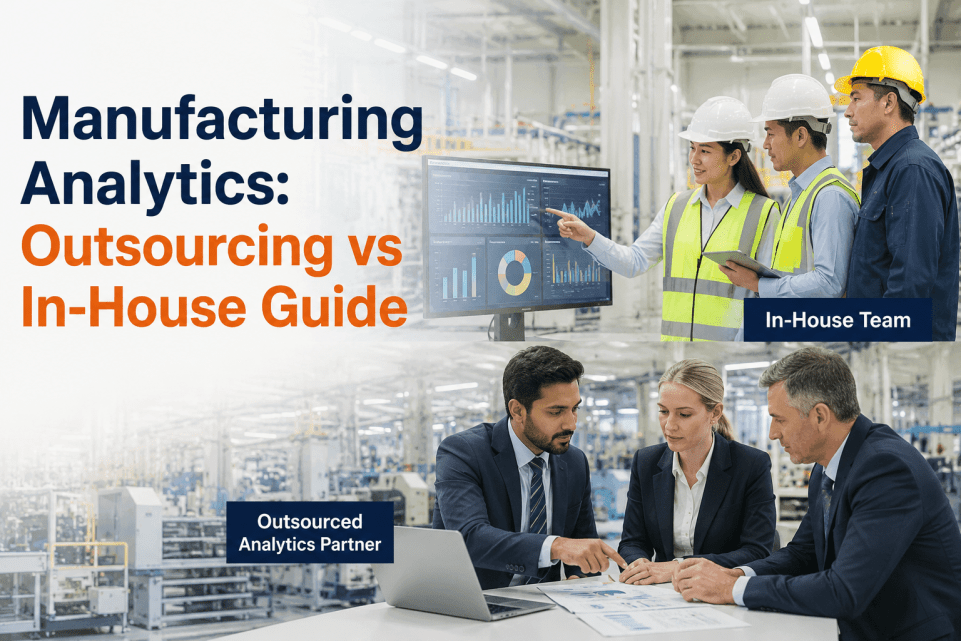
Manufacturing Analytics: Outsourcing vs In-House — A Complete Guide for Plant Leaders
Deciding between an outsourced analytics provider and an in-house team is a capital allocation decision with long-term consequences. This guide compares cost, expertise, response time, scalability, and IP protection across both models — and shows how a hybrid approach often delivers the best results for mid-size manufacturing facilities.
The Core Trade-Offs Between Outsourced and In-House Manufacturing Analytics
The decision between outsourcing and building in-house is not a binary choice — it is a trade-off across seven dimensions that affect the speed, quality, and cost of analytics delivery. Understanding how each model performs on these dimensions is the foundation of an informed staffing strategy.
| Dimension | Outsourced Analytics Provider | In-House Analytics Team |
|---|---|---|
| Cost Structure | Predictable monthly subscription or project-based fee; no overhead for benefits, training, or turnover | Fixed salary cost plus benefits, training budget, software licensing, and management overhead |
| Domain Expertise | Access to specialized statisticians and data scientists with cross-industry experience; broader perspective on best practices | Deep plant-specific process knowledge; team understands the equipment, products, and operators personally |
| Response Time | Standard SLA of 4–24 hours for routine requests; 24/7 support available at premium | Immediate availability during business hours; depends on staffing levels for after-hours coverage |
| Scalability | Easily scaled up or down by adjusting contract scope; no hiring or termination costs | Scaling requires recruiting, onboarding, and training — typically 8–16 weeks to add capability |
| IP Protection | Data security and confidentiality agreements required; provider serves multiple clients including competitors | Data remains entirely within the organization; no exposure to competitor analytics contexts |
| Tool Integration | Provider brings pre-built connectors and templates; integration depth depends on provider's platform compatibility | Direct integration with existing MES, CMMS, and DCS systems; full control over tool stack decisions |
| Knowledge Retention | Analytics methods and insights stay with the provider; turnover risk is the provider's problem | Institutional knowledge builds over time; departure of key personnel creates capability gaps |
Most mid-size manufacturing facilities find that a purely outsourced or purely in-house model leaves value on the table. The optimal approach is typically a hybrid model that combines the specialized expertise and scalability of an outsourced provider with the plant-specific knowledge and immediate availability of an in-house capability. Book a Demo to discuss which analytics staffing model fits your facility.
What Each Model Actually Delivers — Capability Comparison by Analytics Function
The suitability of outsourcing vs in-house depends on the specific analytics function being performed. Some analytics tasks require deep plant-specific knowledge that only an in-house team can provide. Others benefit from the specialized statistical expertise and cross-industry perspective that outsourced providers deliver.
Dashboard and Report Building
Dashboard development is a defined-scope task requiring technical skills that can be specified in a contract. Outsourced providers bring pre-built templates and accelerators that reduce build time. In-house teams maintain dashboards once built.
Statistical Quality Control
SQC requires specialized statistical expertise that most plant operations teams do not possess. Outsourced providers bring certified quality engineers who configure control charts, OOT detection rules, and capability analysis. In-house teams oversee the process.
Root Cause Investigation
Root cause analysis requires intimate knowledge of the specific process equipment, materials, and operating conditions. In-house teams with process engineering backgrounds conduct investigations faster and more accurately than external providers.
Predictive Model Development
Building predictive maintenance and quality prediction models requires data science expertise that is expensive to hire and retain in-house. Outsourced providers bring pre-trained model libraries and experienced ML engineers.
Daily Operational Analytics
Shift-level OEE monitoring, production reporting, and daily performance reviews require immediate availability and deep process knowledge. These tasks belong to an in-house operations team supported by automated dashboards.
Strategic Analytics Projects
Capital investment analysis and strategic improvement initiatives benefit from the combination of outsourced analytical expertise and in-house operational knowledge. Hybrid project teams deliver the best outcomes.
When Outsourcing Makes Sense — and When In-House Wins
The decision framework below distills the staffing decision into two clear scenarios based on the nature of the analytics work, the existing team capability, and the strategic importance of data capability to the organization's long-term plan.
Statistical modeling, data science, or advanced SQC that the existing team does not have
Analytics needs spike during qualification campaigns, product launches, or improvement initiatives
Organization needs analytics results within weeks, not the months required to hire and train in-house
Root cause investigations and daily decisions need people who know the equipment and products intimately
Proprietary formulations or quality data that the organization cannot expose to external providers
Data-driven operations are central to competitive advantage, warranting investment in internal expertise
Industry Perspective on Manufacturing Analytics Staffing Strategy
"I have led analytics capability building at five manufacturing organizations over three decades, and I have never seen a purely outsourced or purely in-house model work well for long. The outsourced model delivers specialized expertise quickly, but it does not build institutional capability — when the contract ends, the knowledge leaves. The in-house model builds lasting capability, but it takes too long and costs too much for organizations that need results this quarter, not next year. The organizations that are winning at analytics are the ones that have figured out the hybrid model: outsourced partners for specialized projects and model development, a small in-house team for daily operational analytics and process knowledge, and an analytics platform that both groups can use effectively. The platform is the critical enabler — without it, the handoffs between external and internal teams create friction that kills the value of both models."
Not Sure Which Model Fits Your Facility? Let iFactory Help You Decide
iFactory AI's platform supports both deployment models — connect an outsourced analytics team through our API and pre-built connectors, or deploy role-based dashboards and guided workflows for your in-house team. We will evaluate your specific analytics staffing needs and recommend a model that aligns with your budget, timeline, and strategic goals.
Building the Right Analytics Staffing Strategy for Your Manufacturing Facility
The decision between outsourcing and in-house analytics is not a one-time choice — it is an evolving staffing strategy that should be revisited as the organization's analytics maturity grows. Early-stage analytics programs benefit from outsourced providers who can deliver rapid results and build the initial analytics infrastructure. As the organization matures, in-house capability should be developed for daily operational analytics and process-specific work, while outsourced partners continue to provide specialized expertise for advanced modeling, strategic projects, and peak workload periods.
The iFactory AI platform is designed to support both deployment models equally well. For outsourced analytics teams, the platform provides API access, pre-built connectors, and integration templates that enable rapid setup and consistent reporting. For in-house teams, role-based dashboards, guided analytics workflows, and automated reporting reduce the statistical expertise required to generate actionable insights. Many facilities use both models simultaneously — an outsourced partner builds the initial dashboards while the in-house team monitors daily performance — using the same platform interface. Book a Demo to discuss which analytics staffing model fits your facility's current maturity level and long-term capability goals.
Frequently Asked Questions About Manufacturing Analytics Outsourcing vs In-House
Get a Personalized Recommendation — Outsourced, In-House, or Hybrid
iFactory AI's analytics platform supports every staffing model. We will evaluate your facility's current analytics maturity, team capability, and strategic goals to recommend the optimal staffing approach — and show you how the platform enables seamless collaboration between internal and external analytics teams.