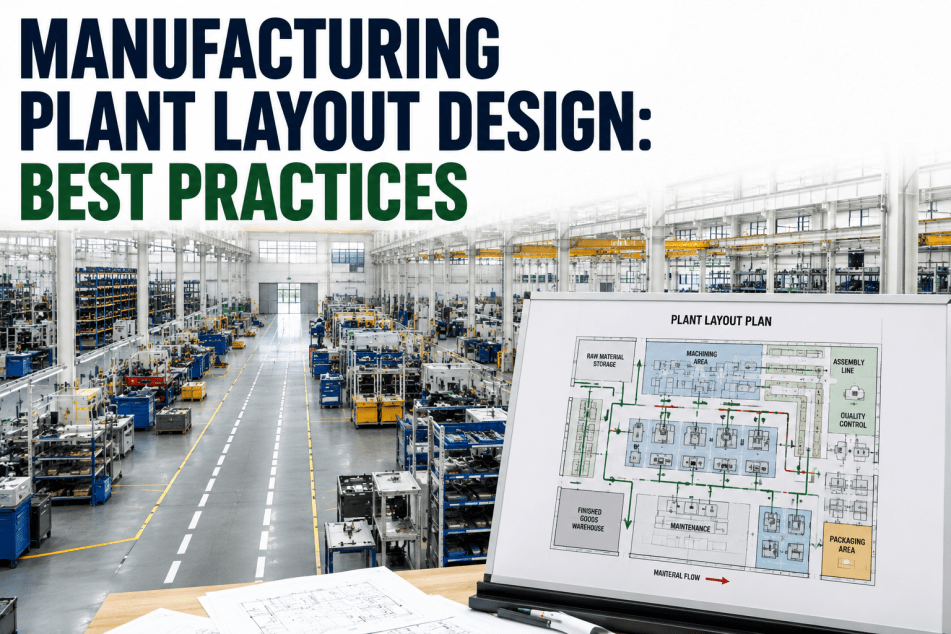
A well-designed manufacturing plant layout is the physical foundation upon which production efficiency, material flow, worker safety, and operational scalability are built. In U.S. manufacturing facilities, the difference between a plant that consistently hits OEE targets and one that struggles with bottlenecks, excessive WIP and recurring safety incidents is most often traced back to layout decisions made during the initial design or subsequent reconfiguration phase. Plant layout optimization directly impacts material handling costs — which typically account for 20 to 50 percent of total manufacturing operating expenses — and determines whether the facility can adapt to product mix changes, new equipment introductions, and capacity expansions without major production interruption. iFactory AI's industrial intelligence platform — incorporating AI Vision, Digital Twin simulation, Robotics AI, CMMS, and MES capabilities — provides manufacturing operations leaders with the digital tools to design, validate, and continuously optimize plant layouts using real production data rather than static engineering assumptions.
Why Manufacturing Plant Layout Design Directly Impacts Production Performance
Manufacturing plant layout design is the strategic arrangement of workstations, equipment, material storage, and support functions within a facility to optimize the flow of materials, information, and personnel. Unlike operational improvements that target individual processes, layout decisions create the physical constraints within which every production activity occurs — a poorly arranged layout imposes recurring inefficiencies that no amount of process optimization can fully overcome. The most common layout types in U.S. manufacturing facilities include product-oriented (flow line) layouts for high-volume production, process-oriented (functional) layouts for job shop environments, cellular manufacturing layouts for mid-volume mixed-model production, and fixed-position layouts for large-scale assembly operations. Each layout type presents distinct material flow patterns, space utilization characteristics, and operational trade-offs that must be aligned with production volume, product variety, and process requirements.
The financial impact of suboptimal plant layout extends well beyond material handling labor costs. Excessive travel distances increase WIP inventory carrying costs, extended flow paths lengthen production lead times, congested aisles create safety hazards that drive incident rates, and inflexible layouts force costly reconfiguration when production requirements change. iFactory AI's platform addresses these challenges by providing Digital Twin simulation capabilities that model material flow, workstation interaction, and equipment utilization before physical changes are made — enabling manufacturing engineers to validate layout alternatives using actual production data, cycle times, and material handling parameters rather than engineering estimates. Book a Demo to see how iFactory AI's Digital Twin and layout optimization tools apply to your facility.
Material Flow Analysis: The Cornerstone of Factory Layout Design
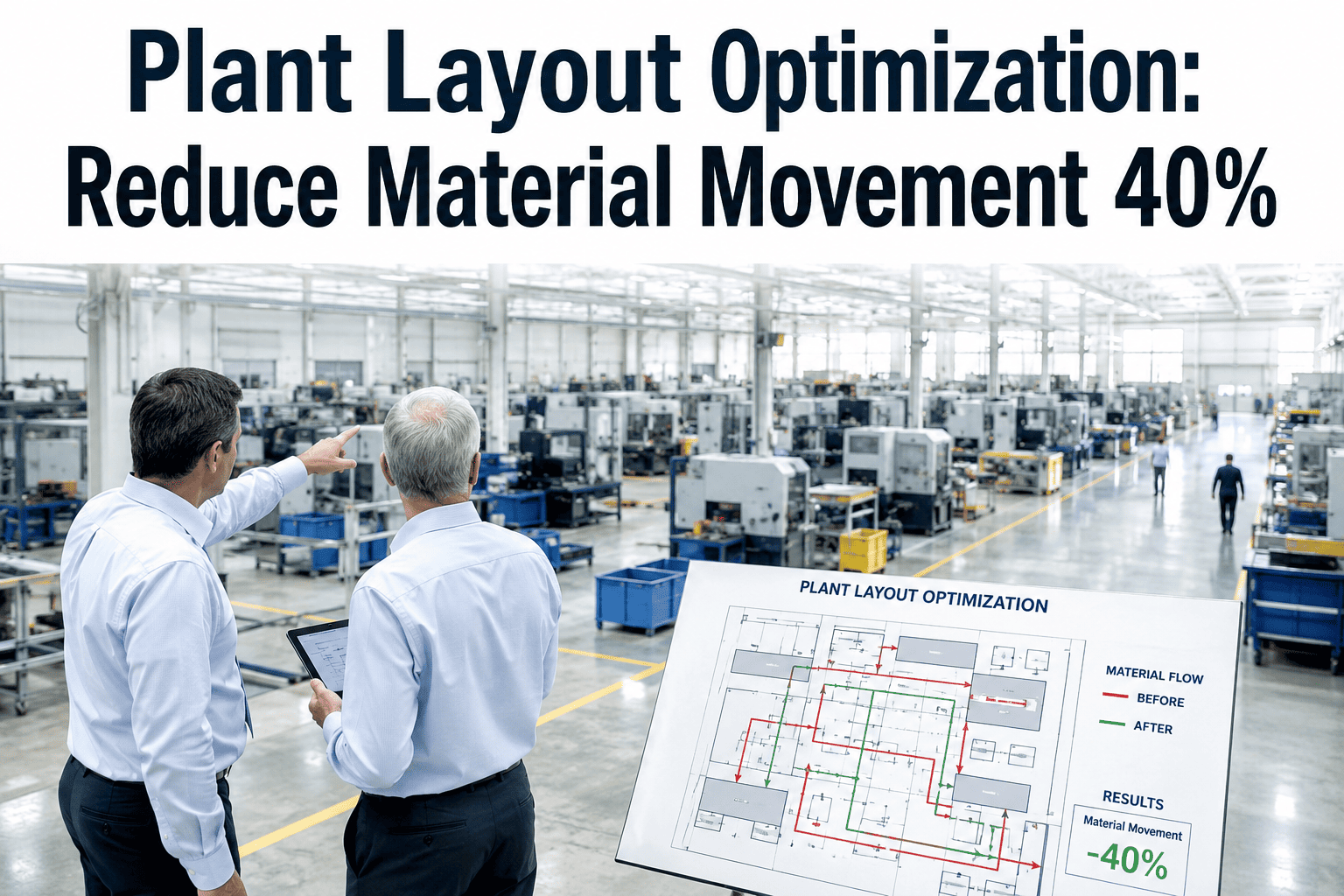
Material flow analysis is the systematic study of how raw materials, WIP, finished goods, and supporting supplies move through a manufacturing facility. In factory layout design, the objective of material flow analysis is to minimize total travel distance, eliminate cross-traffic and backtracking, reduce material handling costs, and ensure that flow paths support production volume requirements without creating congestion points. The fundamental principle governing plant layout material flow is simple in concept but challenging in execution: arrange production resources so that the most frequent and highest-volume material movements occur over the shortest possible distances.
Effective material flow analysis for plant design requires understanding not only the current state of material movement but also the variability in flow patterns introduced by product mix changes, seasonal demand fluctuations, and new product introductions. Static flow analysis based on average production volumes systematically underestimates congestion risk during peak periods and fails to identify flow path conflicts that emerge only under specific product mix scenarios. iFactory AI's platform addresses this limitation through Digital Twin simulation that models material flow dynamics across the full range of production conditions — applying actual historical demand patterns, cycle time distributions, and changeover sequences to validate that the planned layout performs across the operating envelope rather than only at the design point. Book a Demo to learn how iFactory AI's material flow simulation validates plant layout designs against your actual production data.
| Plant Layout Type | Material Flow Pattern | Best Suited For | Material Handling Cost Impact | iFactory AI Optimization Capability |
|---|---|---|---|---|
| Product-Oriented (Flow Line) | Linear or serpentine movement along production sequence; minimal branching | High-volume, low-variety production — automotive assembly, food processing, consumer packaged goods | 10–15% of total manufacturing cost; lowest among layout types when fully utilized | Digital Twin simulation of line balancing, station cycle times, and conveyor/automated handling integration |
| Process-Oriented (Functional) | Variable movement between departmental areas; significant cross-traffic potential | Low-volume, high-variety production — job shops, aerospace components, custom fabrication | 30–50% of total manufacturing cost; highest due to variable flow paths and batch movement | AI Vision-based flow path analysis identifying congestion zones; automated layout reconfiguration recommendations |
| Cellular Manufacturing | U-shaped or circular movement within cells; minimal inter-cell movement when designed correctly | Mid-volume, mixed-model production — medical devices, electronics assembly, precision machining | 15–25% of total manufacturing cost; significantly lower than process-oriented with improved flexibility | Robotics AI and workstation design optimization for cell layout; material handling robot integration planning |
| Fixed-Position Layout | Equipment and personnel movement to the product; complex logistics coordination | Large-scale assembly — aircraft manufacturing, shipbuilding, heavy equipment, turbines | 20–35% of total manufacturing cost; dominated by logistics coordination complexity | CMMS-based equipment and tool positioning optimization; work order sequencing for logistics coordination |
| Hybrid / Mixed-Model Layout | Combination of flow line and cellular patterns with shared material handling infrastructure | Facilities with multiple product families at varying volumes — general manufacturing, industrial equipment | Variable; 15–30% depending on product mix stability and layout maturity | MES-based production scheduling integrated with layout configuration; dynamic material flow routing |
Define Production Requirements and Volume Data
Begin by collecting and validating production volume data by product family, process routing sequences, cycle times, changeover frequencies, and material handling requirements across all product variants. Import this data directly from your MES or ERP into iFactory AI's Digital Twin platform to establish the production demand baseline that drives all subsequent layout decisions.
Map Current and Target Material Flow Paths
Document existing material flow patterns using AI Vision analysis of actual movement paths captured from facility cameras, or create target flow maps based on production routing data. Identify cross-traffic points, backtracking occurrences, and congestion zones. The Digital Twin model automatically computes travel distances, material handling equipment utilization, and flow path density metrics.
Develop and Simulate Layout Alternatives
Generate multiple layout alternatives within the Digital Twin environment, applying different arrangement strategies — product-oriented, process-oriented, cellular, hybrid — and simulate material flow dynamics for each. The platform evaluates each alternative against KPIs including total travel distance, WIP accumulation, throughput capacity, congestion frequency, and changeover impact under varying production mix scenarios.
Validate, Implement, and Continuously Optimize
Select the optimal layout alternative based on simulation results and implement the physical reconfiguration. Post-implementation, deploy iFactory AI Vision monitoring to validate that actual material flow patterns match design assumptions. Use ongoing CMMS data — work order locations, equipment downtime patterns, maintenance access frequency — to continuously refine the layout as production requirements evolve.
Workstation Design and Equipment Placement for Optimal Manufacturing Floor Layout
Workstation design and equipment placement within a manufacturing facility layout directly determine operator efficiency, product quality, and production flexibility. The physical arrangement of each workstation — including work surface height, tool positioning, material presentation, and operator access — must be designed concurrently with the overall facility layout to ensure that individual station performance is not compromised by the surrounding material flow and equipment placement decisions. Industry best practices for workstation design in plant layout include applying ergonomic principles to minimize operator motion waste, designing material presentation within the operator's strike zone to eliminate reaching and bending, and ensuring that workstation footprint accounts for both production operations and maintenance access requirements.
Equipment placement decisions in factory floor planning extend beyond simple location assignment. Critical factors include equipment footprint and service clearance requirements, foundation and vibration isolation needs, utility connection points (electrical, compressed air, coolant, exhaust), material input and output orientation relative to flow paths, and maintenance access for both routine PM and major repairs. iFactory AI's platform integrates equipment placement data — captured from the CMMS equipment database and Digital Twin facility model — to ensure that layout design accounts for all equipment-specific constraints before physical installation occurs. The platform's AI Vision module can additionally analyze existing facility layouts to identify suboptimal equipment positions based on observed material flow patterns, operator movement paths, and maintenance intervention frequency. Book a Demo to see how iFactory AI's Digital Twin and AI Vision capabilities support evidence-based equipment placement and workstation design decisions.
Lean Manufacturing Layout Principles and Factory Floor Plan Optimization
Lean manufacturing principles provide the philosophical framework for plant layout design that prioritizes waste elimination, continuous flow, and value-added activity optimization. The lean factory layout is fundamentally organized around the value stream rather than departmental functions — equipment and workstations are arranged in the sequence of production steps, with material presented at the point of use and movement paths designed to minimize transportation and waiting waste. Key lean layout principles include arranging workstations in U-shaped cells that enable multi-machine operation and flexible staffing, implementing point-of-use storage to eliminate centralized stockrooms, designing Kanban material flow paths that signal replenishment based on actual consumption, and creating visual factory environments where layout organization makes abnormalities immediately apparent.
The transition from departmental to value-stream-oriented layout is one of the highest-impact changes a manufacturing facility can make, yet it requires careful analysis of product families, volume variability, and process capability to execute successfully. iFactory AI's platform supports lean layout implementation through Digital Twin simulation that validates value stream flow before physical moves occur, MES-based production data that identifies true product family groupings for cellular layout design, and AI Vision monitoring that confirms lean flow principles are maintained after implementation. The platform's CMMS integration ensures that preventive maintenance routes, spare parts locations, and equipment history are updated to reflect the new layout configuration — preventing the common post-reconfiguration problem where support systems remain organized around the old departmental structure. Book a Demo to explore how iFactory AI's integrated platform supports lean layout design and continuous improvement programs in your facility.
Product-Oriented Flow Line Layout
In a product-oriented layout, equipment and workstations are arranged in the exact sequence of production operations for a specific product or product family. Material moves in a continuous or near-continuous flow from raw material input to finished goods output with minimal queuing or backtracking. This layout type achieves the lowest material handling cost and shortest production lead time among all layout alternatives but requires stable, high-volume demand to justify dedicated equipment allocation. iFactory AI's Digital Twin platform enables product-oriented layout design by modeling line balance, workstation cycle time synchronization, and automated material handling system integration — ensuring that the flow line is designed for both peak efficiency and operational flexibility to accommodate product variants within the same line.
Process-Oriented Functional Layout
Process-oriented layouts group equipment by function — all milling machines in one department, all assembly stations in another — with material routed between departments according to each product's unique process sequence. This layout provides maximum flexibility for high-variety production but generates the highest material handling costs and longest lead times due to variable flow paths and batch movement between departments. iFactory AI addresses the inherent inefficiency of process layouts through AI Vision-based flow path analysis that identifies the most frequent inter-departmental movement patterns, congestion points, and backtracking occurrences — providing data-driven recommendations for functional grouping optimization and identifying candidates for cellular manufacturing conversion.
Cellular Manufacturing Layout
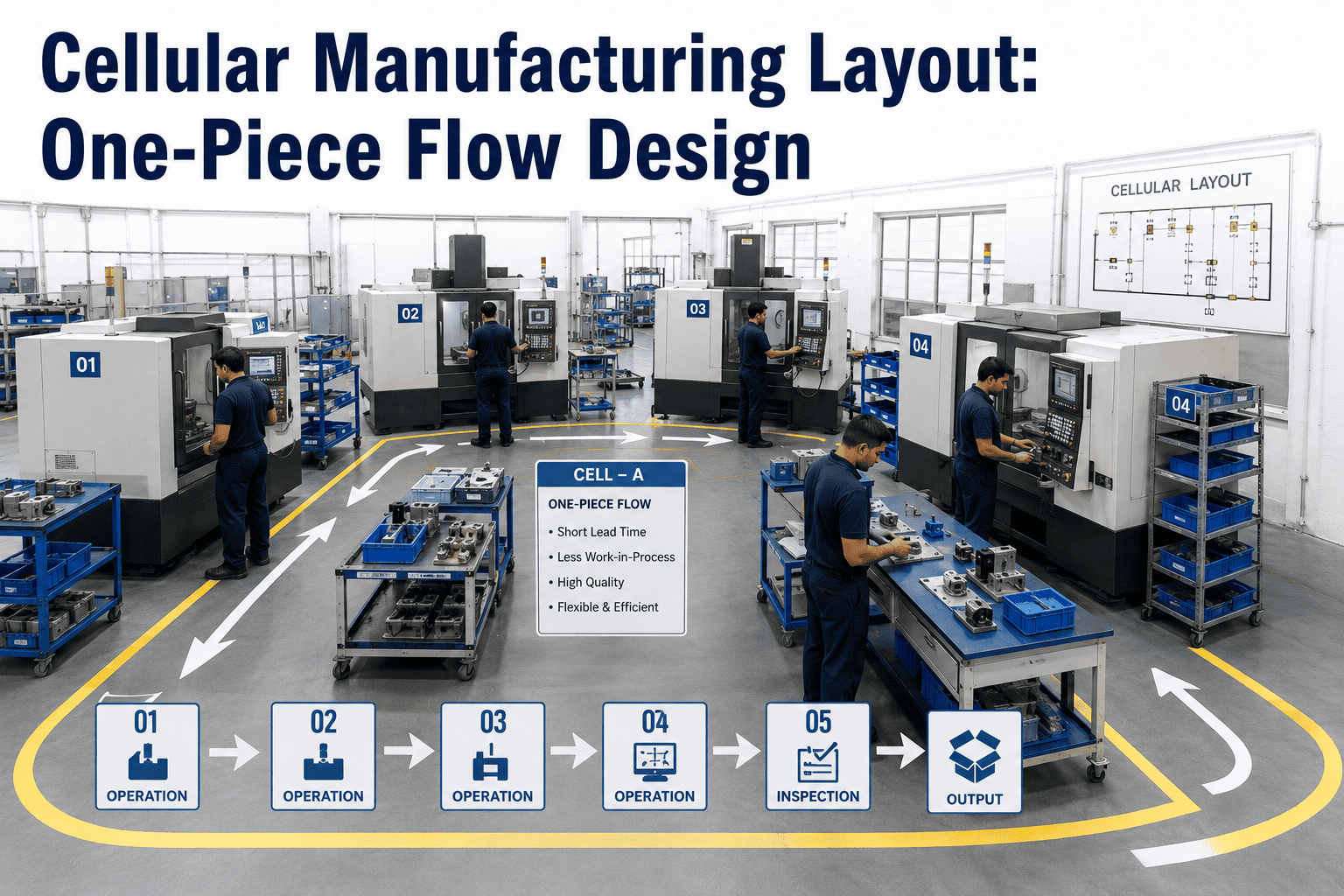
Cellular manufacturing layout arranges dissimilar equipment into production cells dedicated to a product family or group of similar parts, creating the flow efficiency of a product layout within the flexibility framework of a process layout. Cells are typically U-shaped to facilitate multi-machine operation, flexible staffing, and reduced walking distance between operations. iFactory AI's platform supports cellular layout design through production data analysis that identifies natural product family groupings, Digital Twin simulation that validates cell arrangement and operator allocation, and Robotics AI integration that identifies opportunities for robotic material handling within and between cells to further reduce non-value-added movement.
Digital Tools for Plant Layout Optimization: Digital Twin, AI Vision, and Integrated Intelligence
Modern manufacturing plant layout design has been transformed by digital tools that replace static CAD drawings and manual analysis with dynamic, data-driven simulation and continuous monitoring. The most impactful digital capabilities for plant layout optimization include Digital Twin simulation for dynamic layout validation, AI Vision systems for real-time material flow analysis, integrated CMMS data for maintenance-aware layout planning, and MES integration for production-schedule-responsive layout configuration. iFactory AI's platform delivers these capabilities in an integrated architecture that connects layout design directly to production operations — enabling manufacturing engineers to design layouts based on actual production data, validate them through simulation, monitor their performance through AI Vision, and adjust them continuously as production requirements evolve.
The Digital Twin capability is particularly transformative for plant layout design because it enables dynamic simulation of material flow, workstation interaction, and material handling system loading under realistic production conditions — including demand variability, product mix changes, equipment downtime events, and shift schedule differences. Rather than evaluating layout alternatives against static assumptions, manufacturing engineers can test each layout candidate against weeks or months of actual production data, observing how congestion patterns emerge, WIP accumulates, and throughput is affected under the full range of operating conditions the facility will encounter. This simulation-based validation significantly reduces the risk of post-implementation surprises — congested aisles that were not apparent in static drawings, workstation interactions that create unexpected bottlenecks, material handling systems that are undersized for peak demand periods. Book a Demo to see iFactory AI's Digital Twin, AI Vision, and CMMS-MES integration applied to manufacturing plant layout design and optimization.
Expert Review: Plant Layout Design Best Practices in Modern Manufacturing
Over my 28 years in manufacturing operations — spanning plant engineering, operations management, and facility design leadership across automotive, aerospace, and industrial equipment production — I have participated in more than 30 major plant layout projects, including three greenfield facility designs and over a dozen major brownfield reconfigurations. The single most consistent pattern I have observed across these projects is that organizations that rely exclusively on static CAD drawings and engineering judgment for layout decisions inevitably discover flow conflicts, congestion points, and capacity constraints within the first three months of operation that were not identified during the design phase. The root cause is not engineering competence — it is that the human mind cannot reliably predict the dynamic interactions between material flow variability, machine downtime patterns, operator movement, and material handling system loading that emerge when a layout is subjected to real production conditions. Digital Twin simulation changes this fundamentally. On a recent greenfield facility project where we deployed iFactory AI's Digital Twin platform for layout validation, we evaluated 14 layout alternatives against six months of production data from our existing facility — including actual order patterns, machine downtime events, and changeover sequences. The simulation identified a congestion point at a main aisle intersection that would have created a 12 percent throughput loss during peak periods, a condition that none of the four senior engineers on the design team had identified from the CAD drawings. The layout adjustment required to eliminate the congestion was minor — moving a single workstation cluster six feet and reorienting two material presentation racks — but the cost of discovering that congestion post-installation would have exceeded $80,000 in reconfiguration labor and lost production. For manufacturing operations leaders planning facility layout projects: invest in Digital Twin simulation capability before you move the first piece of equipment. The cost of a simulation platform is a fraction of a single post-implementation reconfiguration, and the confidence it provides in layout decisions transforms the facility design process from hope-based to data-based.
— Vice President of Manufacturing Engineering, Tier 1 Automotive and Industrial Equipment Manufacturer — 28 Years Industry Experience — iFactory AI Reference Customer 2026Conclusion
Manufacturing plant layout design remains one of the highest-leverage decisions available to operations leaders seeking to improve production efficiency, reduce operating costs, and build operational flexibility into their facilities. The best practices outlined in this guide — systematic material flow analysis, intentional workstation design and equipment placement, application of lean layout principles, and deployment of digital tools for layout validation — provide a structured approach to factory layout design that reduces risk, accelerates implementation, and delivers measurable operational improvement.
iFactory AI's platform provides the digital infrastructure that transforms plant layout design from a periodic engineering exercise into a continuous optimization capability. Digital Twin simulation enables data-driven layout validation before physical changes are made. AI Vision systems monitor actual material flow patterns and identify optimization opportunities in real time. CMMS and MES integration ensures that layout decisions account for equipment maintenance requirements, production scheduling constraints, and operational data that static design approaches miss. Whether designing a greenfield facility or reconfiguring an existing plant, iFactory AI's integrated platform provides the intelligence layer that connects layout design to production performance. Book a Demo to see how iFactory AI can support your next plant layout design or reconfiguration project.
Frequently Asked Questions
Product-oriented layout arranges equipment and workstations in the sequence of production operations for a specific product, creating a continuous flow line that minimizes material handling and lead time. This layout is best suited for high-volume, low-variety production such as automotive assembly or food processing. Process-oriented layout groups equipment by function — all milling machines together, all assembly stations together — with material routed between departments according to each product's unique process sequence. This layout provides maximum flexibility for high-variety, low-volume production but generates higher material handling costs and longer lead times. iFactory AI's Digital Twin platform enables objective comparison of layout alternatives based on your specific production volume, product mix, and material flow requirements. Book a Demo to see comparative layout analysis for your facility.
Digital Twin simulation extends beyond static CAD drawings by enabling dynamic modeling of material flow, workstation interactions, and material handling system loading under realistic production conditions. Unlike CAD, which shows the physical arrangement of equipment, a Digital Twin simulates how materials actually move through the layout, where congestion occurs under varying production mix scenarios, how equipment downtime events propagate through the flow path, and whether material handling systems are adequately sized for peak demand periods. iFactory AI's Digital Twin platform uses actual production data — cycle times, changeover sequences, demand patterns, equipment reliability history — rather than engineering estimates, providing layout validation that reflects real operating conditions. This simulation-based approach identifies flow conflicts and capacity constraints that are invisible in static drawings and typically discovered only after physical installation is complete.
The key principles of lean manufacturing plant layout include organizing around the value stream rather than departmental functions, arranging workstations in U-shaped cells for flexible staffing and multi-machine operation, implementing point-of-use storage to eliminate centralized stockrooms and reduce transportation waste, designing Kanban material flow paths that signal replenishment based on actual consumption, creating visual factory environments where layout organization makes abnormalities immediately apparent, minimizing inventory buffers between operations to expose flow problems, and designing material presentation within the operator's strike zone to eliminate motion waste. iFactory AI's integrated platform supports lean layout implementation through Digital Twin simulation that validates value stream flow before physical moves occur, MES production data that identifies product family groupings for cellular design, and AI Vision monitoring that confirms lean flow principles are maintained post-implementation.
Equipment placement in manufacturing facility layout design must account for equipment footprint and service clearance requirements, foundation and vibration isolation needs, utility connection points including electrical, compressed air, coolant, and exhaust systems, material input and output orientation relative to planned material flow paths, maintenance access for both routine preventive maintenance and major repairs, operator access and egress in compliance with safety regulations, material presentation area for incoming supplies and outgoing finished work, and future expansion or replacement access. iFactory AI's platform integrates equipment placement data from the CMMS equipment database into the Digital Twin facility model, ensuring that all equipment-specific constraints are accounted for before physical installation. The platform's AI Vision module can additionally analyze existing facility layouts to identify suboptimal equipment positions based on observed material flow patterns and maintenance intervention frequency.
Manufacturing facilities implementing layout optimization using iFactory AI's Digital Twin simulation typically document positive ROI within 3–6 months of physical implementation. The primary drivers include 20–30 percent reduction in material handling labor costs, 15–25 percent improvement in production lead time through optimized flow paths, 10–20 percent reduction in WIP inventory carrying costs due to reduced queue time and travel distance, and elimination of post-implementation reconfiguration costs — which frequently exceed $50,000–$100,000 for a single layout error discovered after installation. Facilities reconfiguring existing layouts without Digital Twin simulation typically experience 6–12 months of suboptimal operation while flow problems are identified and corrected through trial and error. iFactory AI's platform deploys in 8–12 weeks and integrates with existing CMMS, MES, and facility planning systems without requiring replacement of installed technology infrastructure. Book a Demo to discuss the projected ROI for your specific manufacturing facility layout project.